surreal poetry
Surrealist poetry embodies the essence of poetry itself, drawing upon shocking imagery and lyrical incongruities to comment on the inner-workings of the mind.
September
9/2/25 9:55pm I’m cross-legged on the sidewalk and there’s a cloud that looks like my elementary school, they upgraded the busses on the north side so it matches your funeral-inspired eggplant drapes and I can’t tell anyone about it because it doesn’t make sense to someone with living relatives, my legs are getting stiff on the concrete and elementary cloud turned into something like a salsa rendition with goats as butlers, the drapes look a lot worse than you thought they would but it was that or the electric bill so we’re eating dinner in the dark until you find the courage to pack it up and bring it to Whole Foods, we’re doing everything in the dark until someone digs their hands into the couch and finds the lyrics to that tune we wrote last year, you said it had notes of autumn’s song and I laughed at you then but now it makes sense because my family is getting smaller and the leaves don’t sound as crunchy anymore, my legs don’t feel as strong as anymore, my ceiling-fan lights don’t seem as necessary as before, and my windows don’t do anything but mock the solitude in our house that does nothing but pay homage to every grave next door.
By Olivia Dodge12 months ago in Poets
Parallel Realities, Soft Paw Entry
As a child my friend was a baby bear. I saw him even if no one else saw him or her. Dreams have always been my nights of play and movies of creativity of different realities. I see spirits and see the future at times through my dreams. I thought I was a normal 2 and 3 D human. I am not and this causes some folks to walk away and say, "You are strange, boo!" I am happy creating art, writing, music, & rainbows. Expression is a part of my personality. Dreams are a part of my art. I admit some folks hate that I use AI to help create my animations and photos that I write prompts to obtain the final art to represent my writing. LIFE IS FULL OF TWISTS AND TURNS AROUND DIFFERENT REALITIES EVERYDAY IF ONE OPENS THEIR HEART AND EYES. I am an empath, psychic dreamer. My creations come from my soul. So, if you hate AI, just try putting that thought away for 10 minutes to read, watch, and listen to my creations that come from my heart and soul.
By Vicki Lawana Trusselli 12 months ago in Poets
Marrying Life and Death
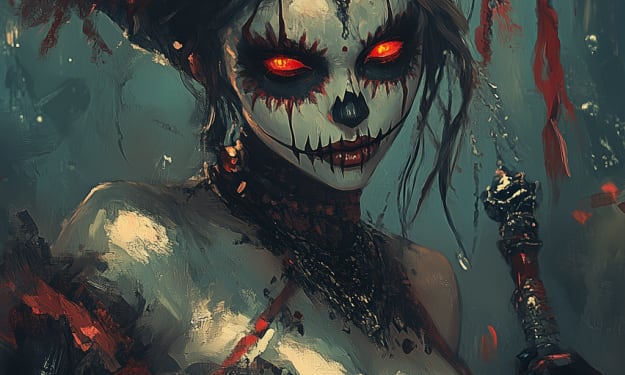
Foul mouthed grave bride, Peppered rum giftee spitting Yes, "I do", Voodoo ..... Author's Note: This haiku is based on Maman Brigitte, one of the most important loas, known for her association with death and cemeteries. Brigitte is the only loa depicted as white and is believed to have come from Ireland not Africa.
By Marilyn Glover12 months ago in Poets
The Power of Long Poetry: A Journey Through Words and Wonder
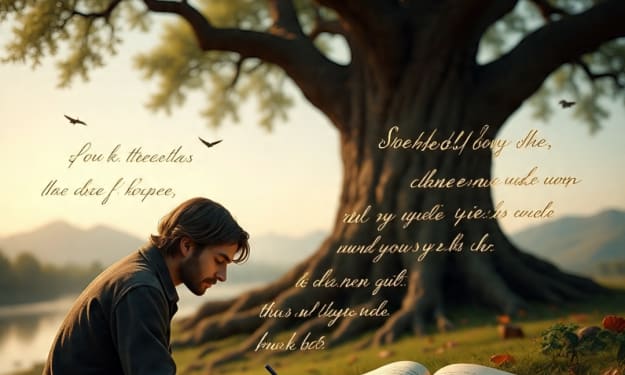
In a quiet corner of a sun-drenched park, Maya unfolded a soft leather notebook that had accompanied her for years. The pages were worn at the edges, filled with looping ink and carefully measured lines. She had been writing poetry since childhood, but today, something different stirred in her spirit — a desire to write not just a poem, but a journey. Long poetry was often misunderstood. In a world that valued speed, skimming, and soundbites, the idea of a poem stretching across pages seemed, to some, like an indulgence or an outdated relic. But Maya knew better. She had felt the way a long poem unfolded like a slow sunrise — not hurried, not forced — but full of promise. She remembered the first time she read a long poem that truly moved her. It was T.S. Eliot’s The Waste Land. Though complex and at times mysterious, it invited her into a layered world of emotion, history, and thought. Each stanza revealed something new. Each shift in voice or tone was a doorway. The length didn’t make it harder to love — it made the love deeper. And that was the quiet power of long poetry. It asked for time, and in return, it gave transformation. Maya began to write, her pen gliding across the paper: > This is not a tale to fit in a breath, Nor a thought meant to end at the first sigh. It stretches like a road beneath the moon, Waiting for feet brave enough to try. As the verses grew, so did her world. The poem explored a young girl’s journey through grief, healing, and hope — themes too complex for a single stanza or neat four-line rhyme. She wove metaphors like rivers, let memories echo through repeated lines, and allowed space for silence between sections. There was room to breathe, to reflect, to feel. Long poetry, Maya realized, is an invitation — not just for the writer, but for the reader. It invites you to slow down, to dwell in meaning, to walk beside the poet through valleys and up hills. Unlike shorter forms, which sometimes offer a sharp punch or a quick moment of beauty, longer poems hold space for evolution. They can begin in sorrow and end in joy. They can shift perspectives, grow characters, or carry a conversation across continents of thought. Throughout literary history, long poems have shaped cultures and echoed across generations. Homer’s Odyssey, Dante’s Divine Comedy, Milton’s Paradise Lost — each a towering work that speaks to the power of sustained poetic thought. In more recent times, long poems have become a form of protest, reflection, and healing. Poets like Derek Walcott, Anne Carson, and Adrienne Rich have used the form to unpack identity, memory, and the truths often too tangled for brief verse. But even outside of academia and literary fame, long poetry lives in everyday writers like Maya. For her, it was a personal practice — one that helped her process life’s complexity. It didn’t need to be published or perfect. It simply needed to be written. As she reached the end of her poem, Maya smiled. > And now I close this book, but not the road, For every word I’ve sown will bloom again. A poem may end, but the truth it holds Will echo long beyond its final line. She closed her notebook with care, feeling a quiet satisfaction. Not just from finishing a piece of work, but from honoring the depth of her thoughts, the fullness of her heart. In a world rushing toward the next notification, the next distraction, the next task — long poetry is a rebellion. A beautiful, gentle rebellion that says: “Wait. Linger. Feel this fully.” It’s not about being long for the sake of length, but about allowing the soul of a poem the room it needs to speak. Sometimes, the most important truths take time to unfold. As Maya walked away from the bench, the sun casting golden shadows behind her, she felt lighter. Her story — not just the one on the page, but the one in her heart — had found its voice. And in that moment, she knew: long poetry wasn’t just something she loved. It was something the world still needed.
By Muhammad Saad 12 months ago in Poets