Sonnet
The Room I Locked Away from Time
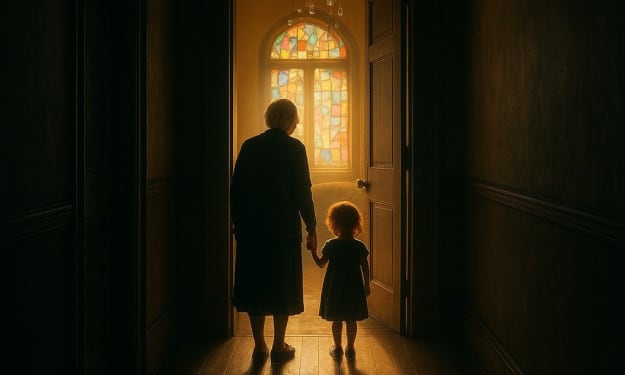
At the very end of the upstairs corridor, where the light gives up and the floorboards grow quiet, there is a door no one notices anymore. It’s plain, swallowed by dust and shadow, its edges blurred into the wallpaper as if the house itself has tried to forget it exists. I rarely walk that far. Still, sometimes—while turning into one of the rooms I still use—I feel my gaze tugged toward it, the way a half-remembered dream tugs at waking thought. The moment never lasts. My eyes tire easily these days, and memory has learned to stay silent. The house and I have aged together, fading in tandem. Colors that once announced themselves proudly—the buttery yellow walls, the sharp blue of my eyes, the copper brightness of my hair—have dulled into the same tired gray. Cracks spread across plaster and skin alike, fine and branching. The stairs complain under my weight, my knees answering them with their own brittle music. There is a heaviness here, a stale stillness that smells faintly of endings. We wait together, the house and I. Not for anything specific—just for what always comes eventually. My days follow a well-worn path. I wake in the bedroom nearest the stairs and cross the hall to the bathroom, where the pipes groan like old men stretching stiff joints. I shuffle down to the kitchen for toast and tea, settling in front of a small black-and-white television where familiar voices tell stories that never surprise me. It passes the time. The climb back upstairs feels steeper every day. I spend the late morning in what used to be my workroom, maneuvering between stacks of yellowed pages and unopened boxes to reach the oak desk where my typewriter still waits. There was a time when inspiration arrived easily—when sunlight spilled through tall windows and the street below offered endless characters. I used to watch the world and then race to the keys, eager to capture it. Now the curtains stay closed, and when I type, the words arrive tangled and thin. Still, the sound of the keys comforts me. It reminds me who I was. At five o’clock sharp, the doorbell rings. The days are marked by who stands on the other side. Groceries twice a week. A nurse with polite concern and practiced cheer. Bags of pills delivered with solemn efficiency—some meant to keep me here, others meant to make it easier when I’m not. On Saturdays, neighborhood boys linger awkwardly on my step, pretending to want chores. Their mothers hover nearby, ready to insist. I grumble, but I let the boys rake leaves or pull weeds. It’s easier than arguing. Sundays are the worst. That’s when the church women come—smiling too brightly, armed with casseroles and good intentions. They clean, they cook, they fold my laundry with a familiarity I never invited. One sits with me while I eat, telling me how loved I am. I nod and imagine being forgotten entirely, the way some people are found long after the world has moved on without them. When they finally leave, I close the door with relief and count the days until I must endure it again. Each night ends the same way: a slow bath, a careful climb, and a whispered plea to a God I’m told cares deeply for me—to please, finally, let this all be over. Until one Sunday, something changes. One of the women arrives late, breathless, apologizing for bringing her daughter along. The child perches at the table, barely tall enough to see her plate, staring at me with fearless curiosity. Her hair is a vivid red. Her eyes are bright and searching. I scowl. She laughs. I bare my teeth. She mirrors me, tongue out, delighted. Her mother scolds her just as the girl bolts from the room, laughter echoing up the stairs. I stop the woman before she can follow. “I’ll get her.” The climb feels longer than usual, but I follow the sound of giggles down the dark hallway. The child stands before the forgotten door, her small hand hovering near the knob. She looks at it the way one looks at something familiar but unnamed. Then she turns to me, and the breath leaves my chest. I have stood here before. Not as I am now—but as a child, tugging at my mother’s hand, begging to be let inside. I remember sealing that room shut after grief hollowed me out, after love was lost faster than I could understand. I had told myself it was easier to lock happiness away than risk losing it again. The door resists, stiff with disuse, but I turn the knob anyway. Light explodes into the hallway. Sunset pours through stained glass, scattering rainbows across pristine walls. Crystal mobiles sway gently from the ceiling, chiming softly as we step inside. The room is untouched by time—bright, warm, alive. My childhood couch waits in rosy velvet. The air hums with memory. The girl slips her hand into mine. I lift her without effort, laughter bubbling up from somewhere deep and forgotten as she brushes the crystals and sends them singing. The sound that joins them startles me. It’s my own laugh. The women find us there later—me on the couch, reading aloud, the child curled happily at my side. They hesitate in the doorway, unsure. “I forgot this room existed,” I tell them. “It was where I was happiest.” I never closed the door again. Light returns to the hallway. The boys come inside instead of staying in the yard. The women help me sort my stories, the good ones, the ones worth sharing. I open the curtains. I write again—not out of habit, but joy. And now, when sleep comes, my prayer has changed. It is no longer a plea to be released—but gratitude, whispered softly, for the stubborn kindness that led me back to myself.
By LUNA EDITH10 months ago in Poets
Gaps to the Sky
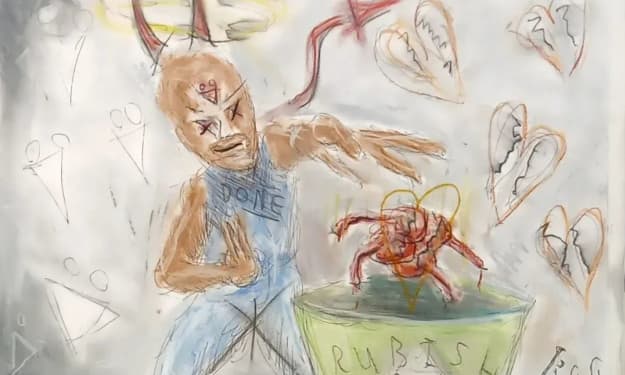
On nights like tonight, the world feels simultaneously immense and intimate. Constellations emerge, careful and deliberate, threading the black canvas above. Branches sway in the winter wind, skeletal and stark, creating gaps through which starlight flickers and dances. The spaces between the limbs, stripped of leaves, are openings to something larger, something beyond my reach — yet perfectly within sight. When I first became pregnant, fear threatened to swallow me whole. Its maw was chasmic, deep and unyielding, and I felt it pressing against my chest. I had spent my life anticipating danger, planning for every contingency, playing chess with the universe, moving five steps ahead at all times. Yet here was a force I could not anticipate, one that rendered my careful strategies meaningless. I was forced to relinquish control. My body betrayed me with hormones that tangled with my mind, and my mind betrayed me with spirals of fear. I remember one night, pressed to the cold bathroom tile, lifeless and trembling, realizing something crucial: in this life, you can act from love, or you can act from fear. You must act regardless, but which path you choose matters. I chose love. That choice became the foundation of everything. Love was the branch I nurtured, the branch I leaned upon when terror threatened to topple me. And yet, even with this conscious decision, my mind sometimes drifts. There are evenings when I berate myself for losing focus, for forgetting the horizon’s prize while I wrestle with minor anxieties. Yet clarity comes, always, in quiet moments. In the warmth of a bath, with water pressing against my skin and the world reduced to soft murmurs, I remember who I am, and what I have chosen to protect. Now, I scan my son constantly, not because he needs me to, but because my instinct cannot help itself. I look for knots, weaknesses, rot — dangers that might threaten him in ways I cannot yet see. I anticipate, I strategize, I plan. But then I pause. I see his hands clutching a sword, his eyes tracing lines of story, his mind inventing worlds. I see the boy I once was, hard steps taken through a forest thick with danger, moving past hopelessness toward wonder. He is secure, deeply rooted in love, nurtured along a stem I have carefully tended. He does not yet know, and need not know, the weight of choices I made for him. He blossoms freely, his growth unhindered, sprouting into curiosity, resilience, and joy. In him, the terror that once threatened me loses its power. The gaps through which stars shine are not voids; they are opportunities, spaces to breathe, spaces where life reaches upward toward possibility. Motherhood has reshaped my understanding of fear. It taught me that control is an illusion and that love is an active, deliberate force. You cannot protect a child from all harm, nor can you dictate every step. But you can guide, nurture, and provide the roots from which courage grows. The gaps in the branches, the spaces I once feared, are where the sun enters, where air circulates, where the future takes shape. Watching him, I understand that my previous life of calculation and foresight was preparation for this. All the years spent strategizing, anticipating, and planning were not merely exercises in control; they were lessons in letting go, in learning to trust growth. The child I am raising is proof that when you choose love over fear, the seeds you plant can thrive even in the most uncertain soil. And yet, even now, I sometimes forget where my heart is nested. I find myself lost in worry, imagining threats that may never come. In those moments, I return to the simple truth: love is the branch I nourish, the branch that supports me and him. It is in this quiet, steady choice that clarity lives. Tonight, the stars peek through the gaps again. I watch my son, immersed in his books, strategies, and imagination. I feel a deep, unspoken gratitude. The branches sway, the constellations remain, and the gaps — the sacred spaces where growth occurs — remind me that life is not about filling every void but about creating room for possibility. I see the boy I have raised, the reflection of the child I once was, and the promise of the person he will become. I understand now that gaps are not emptiness; they are openings for life to breathe, for growth to unfold, for wonder to thrive. In those spaces, he will learn, he will stumble, he will rise. And I will be there, nurturing the branch that guides him, allowing him to reach for the sky. In this, I find peace. In this, I find love. In this, I see that the gaps are not failures but invitations — openings for life to surprise, to grow, to thrive. And I know that, at last, I am doing the right thing.
By LUNA EDITH10 months ago in Poets
Sundial Sonnets
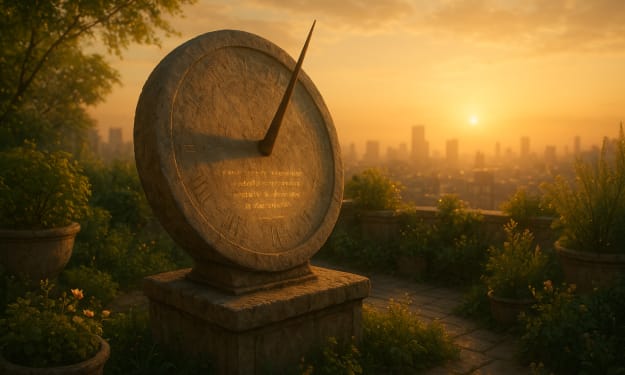
They say every city keeps one secret rooftop, a place where the noise grows shy and the wind remembers your name. The rooftop garden above Building Forty-Three was such a place. Most people assumed the rusted elevator simply didn’t go that high anymore, but the truth was simpler: the garden didn’t want to be found by anyone who wasn’t ready to slow down. At its center stood a massive stone sundial—older than the building, older perhaps than memory itself. No plaque explained it. No architect claimed it. Yet anyone who stepped into its quiet orbit felt the same hush, as though they had wandered into an hour that didn’t belong to the rest of the day. The sundial didn’t just mark time. It wrote it. Each hour, when the sun shifted at just the right angle, the long bronze gnomon cast a shadow across the stone, and where the shadow touched, faint words brightened—just for a breath, just long enough to be read. Lines of a sonnet, etched not by hand but by light itself. Nobody knew who carved them, or if anyone ever had. Some believed the stone was blank and the sun was merely remembering. Every noon, a boy named Emil climbed the final set of metal stairs to the rooftop, lunchbox under his arm. He worked in the mailroom downstairs, a job that required more patience than joy, but he liked the quiet rhythm of it. His coworkers spent their breaks doom-scrolling, yet Emil always came here, to the only place where the world didn’t seem eager to outrun him. He discovered the sundial by accident—one day when the elevator stalled and curiosity outran caution. Now he visited daily, as though checking in with a mentor who spoke only in metaphors. On this afternoon, clouds had thinned to silk. The shadow moved slowly, stretching its fingertip across the stone as the hour turned. Emil leaned closer, watching the new line of the poem brighten: “What light forgets, the heart will memorize.” The words trembled across the stone like a living thing. Emil swallowed. He wasn’t the poetic sort, but the sundial had a way of coaxing truths out of him—truths he didn’t know he carried. He sat on the small bench near the rosemary bush, the scent rising like warm breath. From here he could see the city’s glass towers glitter in the distance. He thought of his mother, who had once traced sunbeam patterns on their kitchen floor and told him that time wasn’t an enemy; it was a storyteller. He had not thought of her in years. The shadow shifted again. A second line glimmered into view: “Each hour writes a footstep in our days.” Emil felt the words settle into him like soft weight. Footsteps. He’d taken many recently—rushed ones, anxious ones, ones that didn’t feel like choosing but merely surviving. But here, in this little skyward garden, the hour felt like something he could walk beside, not outrun. As the shadow continued its sweeping arc, the rest of the sonnet slowly revealed itself—line by luminous line—until the final couplet unfurled like a secret: “When daylight fades, remember this, my friend: Time’s tender poems wait for you again.” The letters glowed, then softened, then vanished entirely, as though embarrassed by their own honesty. Emil sat a long while after the words dissolved. The city below resumed its frantic counting of minutes, but he was no longer rushing to join it. When he finally stood, brushing dust from his jeans, he felt something tug quietly inside him—hope, perhaps, or simply a promise that tomorrow, at this same hour, the sun would write to him again. And maybe that was enough.
By LUNA EDITH10 months ago in Poets