nature poetry
An ode to Mother Nature; poems that take their inspiration from the great outdoors.
When the Moon Loved a Girl
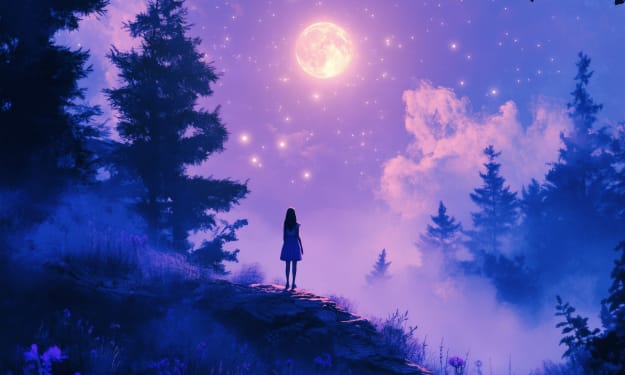
She strolled unshod through midnight, not since the world had harmed her, but since it had overlooked her. Her heart was delicate thunder wrapped in quiet, reverberating in places no one challenged to listen. Each evening, she climbed the slope behind her little town, where the wind whispered privileged insights through pine trees and the sky extended wide sufficient to hold her pity. The moon observed her. Not like a man observes a lady, but like a soul recognizes another soul still learning how to sparkle through the breaks. The stars flickered over, flashing in deference, but it was the moon that remained. Each night. Immovable. Calm. Steadfast. He never inquired her to grin. Never requested delight from her distress. Instep, he reflected the delicate silver of her despondency, making it see like enchantment. She would whisper her considerations into the sky. "Will I ever be more than nearly?" "Will somebody remain, indeed when I am unloveable?" The moon never replied in words, but his light continuously extended a small closer, brushing her cheek like a guarantee, like: "You as of now are." And so, a young lady who felt like sunset started to gleam in pieces. A few evenings, she would chuckle once more. And in spite of the fact that her giggling was broken like porcelain, the moon held each shard as sacrosanct. There came a time she didn't cry as much. She begun planting blooms at the best of the slope. To begin with violets, at that point lavender, at that point sunflowers— like trust sprouting beneath the night sky. And the moon? He gleamed brighter. Since adoring her didn't cruel sparing her. It implied seeing her gotten to be her claim protect. One night, she remained a small longer on the slope, eyes closed, palms open to the stars. And after that she whispered, “I think I'm affirm now.” The moon did not dim. He did not turn absent in pity. Instep, he shone with calm delight, knowing that he had never been her light— as it were the reflect to assist her discover her claim. And as she strolled back down the slope, the night still wrapped around her, but so did the warmth of something else— a self rebuilt, a heart re-bloomed, a young lady now not holding up to be chosen since she had chosen herself. Still, when the moon looks down, he grins delicately. For in his noiseless, ethereal way, he had cherished a young lady. And she had at last learned to adore herself.
By Maharuf Islamabout a year ago in Poets
What the trees know?
“Sometimes I Dream of the Trees” A meditation on time, memory, and the quiet life of the forest. --- Sometimes I dream of the trees. Not the ones planted in neat rows outside buildings, nor the weary ones that line suburban streets, their roots suffocating under concrete and convenience. No, I dream of the old trees— the ones untouched, untamed, towering monuments to time itself, who stand in ancient groves where the air breathes different. Where silence is not absence, but presence. These trees do not speak in words. They murmur in creaks and rustles, in the hush of wind that shifts the leaves like turning pages— a language older than any tongue we’ve ever known. You don’t need to understand it. You just need to listen. There’s a stillness there that startles, like the world forgot to keep spinning. Light filters through in soft shafts, breaking like holy beams across the forest floor. Dust dances in it—tiny, weightless galaxies— and in that hush, time bends and blurs. You lose track of it. Hours pass like minutes, minutes like dreams. And maybe that’s the point. Maybe time doesn’t pass here. Maybe it just waits. Moss wraps around the trunks like scarves in winter, soft and cool, welcoming to the touch. Lichen paints the bark in muted greens and blues, nature’s quiet graffiti, claiming what man cannot. Every fallen tree becomes a bridge, or a bed, or a banquet table for beetles and birds. In the forest, nothing is wasted. Decay is not an end, but a doorway. Even rot is rich. Even death gives back. And isn't that what we fear the most? That our endings will be empty? That we will return to the earth with nothing to offer? But here, death feeds life. One thing falls, another rises. And so it goes. And so we go. Everything is transformed. We, the intruders, walk with heavy steps— boots on soil, unaware of the songs beneath our soles. The trees have seen generations rise and fall, have known stillness longer than we’ve known speed. And yet they remain, rooted and resilient, watching us rush past in pursuit of things that do not matter. Sometimes I wonder if they pity us. If, in their quiet wisdom, they know something we’ve forgotten: how to stay. How to wait. How to grow slow and wide and kind. When I am old—truly old— and my skin folds like bark, and my spine curves like a branch under snow, perhaps I will remember the forest more clearly than anything else. I will dream of the hush. Of the light breaking through green. Of the soft press of moss beneath my feet. Of the way the air felt sacred, like I’d stepped not into a place, but a prayer. And when the time comes— when breath leaves me like fog rising in the morning— maybe I will become a tree, or return to one. Let my bones be buried in roots. Let my stories live on in leaves. Let time forget me, so the forest can remember.
By Swathika Swathiabout a year ago in Poets