nature poetry
An ode to Mother Nature; poems that take their inspiration from the great outdoors.
The Gentle Society of Ink
In the heart of a quiet village, beside a dusty road that curved like a forgotten sentence, stood an old banyan tree. Its branches stretched wide like arms welcoming tired souls. Under that shade, every evening, men gathered not to gossip, not to argue, but to write poetry. They called themselves The Gentle Society of Ink. They were not famous. They did not care for applause or medals. They wrote because words were their breath, their calm, their unseen courage. The world outside might chase money, noise, and speed. But under this tree, time slowed like a humble student of literature. The youngest poet, Haaris, was new to writing. His notebook had more torn pages than words. He often scribbled half-sentences and scratched them out impatiently. He believed poetry had to sound grand. His voice trembled each time he read. There was Kabeer, a quiet man who worked as a carpenter. His poems were shaped like the furniture he built—simple, strong, useful. He wrote of struggles without fear, of hope without shouting, of life without pretending. He never tried to impress, and yet his lines always impressed everyone. Beside him sat Yawar, a school librarian with thick glasses. He collected poems like fireflies—each captured moment glowing softly. His verses were smooth, like rivers unbothered by stones. He had read more books than he had spoken words. Every evening, they sat with pens dipped in patience and hearts wide open. One day, a traveler named Arham arrived with dusty clothes and a bag full of books. He had wandered from town to town searching for poets who wrote with sincerity instead of fame. When he saw the men beneath the old tree, writing without competition, without vanity, only with peace, he sat down silently and listened. Haaris hesitated that day. “I cannot read. My poems are unfinished,” he murmured. Kabeer smiled and said, “A poem is never finished. It only stops when it has said enough.” Yawar nodded. “Read. Even broken lines can build strong feelings.” Trembling, Haaris read his short poem about rain that came too late for a farmer. His voice cracked. His words were simple. Yet the silence afterwards was heavy with meaning. Arham wiped a small tear. “Young poet,” he said, “water does not need perfume to be precious. Your words are water.” Haaris’ heart widened. He realized poetry was not decoration—it was truth. The Gentle Society of Ink began to grow stronger, not in numbers, but in spirit. They shared tea without price, stories without fear, and ideas without ego. When one wrote, the others listened like roots listening to rain. Some wrote about sorrow like it was a guest. Some wrote about love like it was daylight. Some wrote about hardship like it was a teacher. And every poem, no matter how small, was welcomed under that ancient tree. Weeks passed. Arham decided to leave and continue his journey. Before going, he said: “You men have something the world has forgotten. You write with humility. You read with respect. Protect this society—not with walls, but with honesty.” They bowed their heads, not in sadness, but in gratitude. The banyan tree rustled as if blessing them. And so, the Gentle Society of Ink continued, beneath leaves that listened, under skies that nodded, writing not for the world, but for the soul.
By EchoVerse Poet10 months ago in Poets
The Hall of Echoed Voices
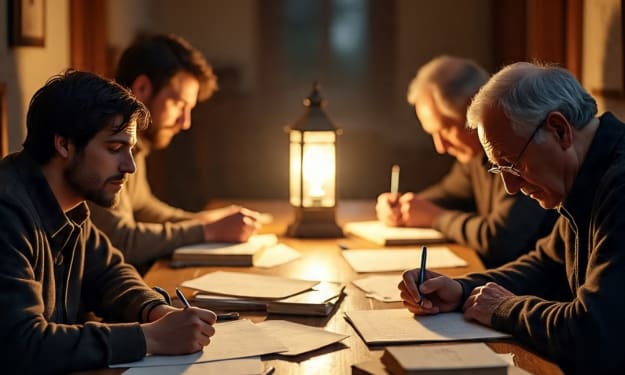
In a quiet corner of the town, beyond the marketplace of noise and beyond the restless rush of streets, stood a hall as modest as a whisper and as wise as a century. The people called it The Hall of Echoed Voices, but poets called it home. Every night, when the lantern was lit and shadows began to speak on the walls, the poets arrived carrying paper, stories, silence, and dreams still unformed. It did not matter who they were outside—some were tailors, some were teachers, one even sold tea in a wooden cart—but once they stepped into the hall, they became keepers of words. The youngest among them was Azeem, a boy of seventeen with questions more than answers and verses more than rules. He wrote with excitement, messy and sincere, like a river discovering its own path. The oldest was Baqir, his beard white as a forgotten winter, his voice soft like an old book. He wrote slowly, carefully, as though every word had to be respected before it was allowed to exist. There was Rafi, who spoke less and listened more. He believed silence had rhythm and believed deeply that poems were simply silent songs given names. He wrote poetry on the backs of receipts, sometimes on walls, sometimes on his own palms, because inspiration never waited for paper. Lastly, there was Sultan, a man of strong build and quiet observation. While others wrote, he would sit, watch, and sketch lines of poetry with the calm of a craftsman shaping wood. He said poems were carved, not written. Each night, they gathered around the lantern, and the hall became a living heartbeat of ink. They read aloud their verses—some trembling, some bold, some broken, some whole. No one mocked, no one competed. They listened with reverence, because here, poetry was not a show; it was truth being uncovered. Azeem once asked, “Master Baqir, how does a poet know if his poem is good?” Baqir smiled the slow smile of someone who had watched many words grow wings. “A poem is not good because others clap,” he replied. “It is good when it refuses to leave your heart after you write it.” The hall echoed with understanding, with nods, with shared silence. Some nights, they wrote about the moon that kept them company. Some nights about unseen pain. Some nights about hope that stubbornly refused to die. They wrote for the farmer who could not sleep, for the laborer who hummed songs of hunger, for the children chasing kites of forgotten dreams, and for themselves—broken, healing, learning. The Hall of Echoed Voices became more than a place; it became a bridge of souls, built by lines of poetry. The community that gathered there did not write to become famous; they wrote because they felt alive only when words breathed through them. And one night, after years of meeting, Baqir said, “One day, my friends, this building may fall, but our echoes will not. Poets do not live in halls. They live in hearts that feel.” The lantern flickered as if agreeing. So the poets continued, night after night, carrying not just ink and paper, but the power to turn silence into gold, and ordinary life into endless poetry.
By Muhammad Saad 10 months ago in Poets
The Brotherhood of Ink
The Brotherhood of Ink Along the quiet edge of an evening street, Where footsteps of day and moonlight meet, A circle of poets, shoulder to shoulder, Brothers of ink, hearts growing bolder. With notebooks opened like windows wide, And pens like rivers at rising tide, They gathered not to boast or compete, But to lift each voice, to make words complete. No stage, no fame, no noisy applause, Only verses formed from unwritten laws, That poems are bridges, not walls to divide, And true art lives when ego steps aside. One wrote about dreams turning into gold, Another of stars the sky could barely hold, A third wrote hope for the tired and weak, A fourth wrote courage no silence could break. They shared their lines like shared bread and tea, No envy, no rush, no jealousy— For poetry was bigger than any single name, And a poet grows stronger when others do the same. They offered advice like lanterns in night, Not to dim a voice, but to help it shine bright, They tuned each verse, like strings of a lute, Not to change its soul, but to help it speak truth. “Write what heals,” one whispered with grace, “Write what makes the world a kinder place.” “Write the struggle,” another replied, “But end every battle with hope on your side.” No poet there wrote for money alone, Though success is sweet, like fruit when grown— They wrote to serve hearts who needed light, For every poem is a small torch against night. And when they parted, beneath the evening air, They left not just words, but wisdom to share. For each poet carried a piece of the rest, Like a verse that fits perfectly inside a chest. And so grew the circle, from ten to a hundred, Their impact rose as their unity thundered, Because poetry is power when given, not stored, Like rain that gives life, not treasure to hoard. O reader, if your pen feels heavy someday, Find poets who lift, not those who betray. For the Brotherhood of Ink still waits for you, With space in the circle, a chair, and a view. Bring your struggles, your hope, your voice that’s unique, Write bold, write true, let your purpose speak. Join the poets who build, who uplift, who begin— Welcome, dear writer… to the Brotherhood of Ink.
By Muhammad Saad 10 months ago in Poets
Poems That Build the Sky
“Poems That Build the Sky” In a small town brushed with morning gold, Where silence speaks stories waiting to be told, Poets gather before the sun climbs high, To write the verses that help build the sky. They come from places both near and far, Some quiet as dew, others bold as stars. Their notebooks hold dreams like fragile glass, Ready to shine when the shadows pass. No spotlights glare on a stage so grand, No bright microphones, no cheering band. Just honest words, pure as the breeze, Carried by hearts that long to please. One poet brings a poem shaped like rain, Healing those who drown in pain. His lines drip warm like summer showers, Teaching patience like growing flowers. Another writes of roads unknown, Of footsteps taken when one stands alone. His poem paints strength in shades of gray, A map for souls who have lost their way. A quiet poet whispers of trees, How they stand firm in strongest breeze. Her verses root deep in the soil of mind, Teaching resilience to all humankind. A boy with laughter tucked in his pen, Writes lives that start again and again. His poem floats like balloons in June, Bright as sunlight, soft as the moon. A man who has crossed many troubled seas, Recites a poem as gentle as ease. His words are sails catching healing winds, Teaching broken spirits how life rescinds. Poets here do not chase applause, They write with honesty as their cause. For poetry is not a performance loud— It is truth whispered beyond the crowd. They know poems do not need crowns to shine, Nor sparkling jewels or royal design. All they need is a heart awake, Listening to feelings most people fake. The sky slowly builds with shades of blue, As if colored by the words they drew. Each poem rises like a floating star, Lighting the world, near and far. They read by rivers, on benches, by trees, Letting their thoughts wander with ease. Words spill freely with rhythm and grace, Filling empty air with an embrace. Every verse becomes a brick so light, Stacked together to shape morning bright. Every rhyme forms a beam of gold, Holding up horizons for stories untold. And though the world may never see How poems carry humanity, The sky knows well the magic they give, Helping every heart choose to live. For poetry builds something no storm can break, It lifts the heavy hearts that ache. It plants courage where fear had grown, It gives wings to minds that once felt alone. The sun climbs higher, the sky stands tall, Held by poet bricks, strong for all. Their words like colors spread far and wide, Painting hope on the morning tide. Slowly, one by one, the poets go, Walking peacefully, quiet and slow. Their notebooks close, but their gift remains— Stories like rivers carving gentle plains. And long after the poets step out of sight, Their poems stay glowing, bright as light. They linger in memories, in laughter, in cry, Forever shaping the limitless sky. For poems are not written for paper alone— They are homes built where lost hearts roam. Their lines are windows where new dreams lie, And their rhymes become bridges that reach the sky.
By EchoVerse Poet10 months ago in Poets
Things I could only hope to keep forever
Solaciacious, sprawling, radiant golden nuggets, Curcubits, verdant snacks, popping colors that could fill the hearts of families everywhere. While I could only hope to keep up. Hand dirty, beating sun, endless tomatoes. The cost, the time, the people, the haul of zucchini The gargantuan hard-earned harvest. I need a mission statement here: We don't work for each other, ourselves, or even the expectations put in front of us. I’ve come to realize that the vegetable gardens which need us more than we know, (we work for them) hold something that is often overlooked. No matter the nutrition, the arduous back bending, the survivalism That flies in the face of Modern sprawling idealism - It's a chance to come together. Now keep this for me - The lessons learned, the harvest earned Imparts a way to the heart. Perhaps our naivete can be sullied But I hope to keep our renegade harvests anyway. (You can’t out-compete big box stores, yet). The candles burned, and both ends discerned Although I'm glad the time, this summer Has run away on me. I’ll look forward to it next year.
By Joe argast10 months ago in Poets
The Lanterns of Quiet Poets
“The Lanterns of Quiet Poets” In a quiet town where the evenings glow, Where lamp posts whisper and rivers flow, Poets gather beneath the silent skies, Carrying notebooks full of unspoken replies. They come like seekers with hearts aflame, Not chasing glory, fortune, or fame, But simply to listen as truth unfolds, In words like silver, in lines like gold. No crowd applauds, no loud cheers rise, Yet every poet feels rich and wise, For poems are lanterns lighting the night, Turning shadows into gentle light. One poet draws rivers that dream in blue, Another writes storms fierce, wild, and true, A third pens laughter dancing like sun, While a fourth paints sorrow, soft and undone. Each line they breathe becomes a flame, Different in shape, but equal in aim: To show the heart the roads unseen, To wash the soul, to keep thoughts clean. The moon sits high like a patient guide, Watching their verses side by side. Stars gather close as if leaning in, To listen how every poem begins. Some poets scribble in nervous haste, Others take time, letting words ferment and taste. Some lines spill like rain, sudden and loud, Others rest quietly beneath a cloud. A poet of few words lifts his pen, He writes of mountains, oceans, and when Hope arrives slow like the morning breeze, Bringing comfort with effortless ease. Another poet, shy but brave, Spills truth about memories time could not save. His poem bends like a grieving tree, Yet it stands with strength and dignity. A boy with dreams taller than skies, Writes of futures no fear can disguise. He promises worlds where kindness grows, Where friendship rises like a perfect rose. An old man writes in ink worn thin, His thoughts fragile, yet strong within. His poem carries the wisdom of years, A language carved through laughter and tears. They do not compete, they do not compare, For poetry is freedom—limitless air. Each poet offers the world a voice, Not forced or shouting, but peaceful by choice. They know every poem is a lantern small, And though it may not brighten all, It might change one heart, save one soul, Guide someone lost toward their goal. The night deepens, the lanterns glow, The poets pack their dreams to go, Yet every step leaves a shining trace, Like fireflies dancing from place to place. The moon bows slow, the stars fade light, But poetry stays long after the night. It rests in notebooks, in hearts, in minds, In the quiet spaces a listener finds. And so the poets leave without noise, Carrying whispers instead of toys. They walk like lanterns, glowing inside, With words as wings, and hope as their guide. For poems are not merely written to rhyme, They are bridges crossing the tides of time, They heal the broken, strengthen the weak, They let the silent truths finally speak. And long after the poets step out of sight, The town wakes up to gentle light. For every line they crafted with care, Has left a lantern burning somewhere.
By Muhammad Saad 10 months ago in Poets