childrens poetry
Nostalgia-inducing poetry inspired by our earliest favorites; from Dr. Seuss to Mother Goose, children’s poetry is all grown up.
The Tragic Love Story of Qays and Layla
The Tragic Love Story of Qays and Layla True story Long ago, in the deserts of Arabia, in the tribe of Banu ‘Amir, two children were born: Qays ibn al-Mulawwah** and his cousin Layla al-‘Amiriyyah**. From the moment they could walk, they played together among the tents of their tribe, chasing each other across the sands, sharing laughter, and forming a bond that grew stronger with every passing year.
By America today about a year ago in Poets
The Knock That Shouldn’t Have Come
The Knock That Shouldn’t Have Come Blurb When a knock echoes through the house at midnight, the narrator thinks it’s nothing more than a prank. But the silence that follows, the footprints on the floor, and the stranger waiting in the bedroom tell a different story. Some doors should never be opened.
By Wings of Time about a year ago in Poets
When Two Lovers Are Torn by Fate
. They met beneath a quiet sky of gold, . Two hearts aflame, two stories yet untold. . Their laughter bloomed like roses in the spring, . A fragile joy that love alone can bring. . They walked through fields where silence seemed to sing, . Believing life was kind in everything. . With every glance, a universe was made, . With every touch, their sorrow seemed to fade. . But fate, that silent master of the stars, . Drew heavy lines, and built unseen bars. . It whispered cold across the gentle air, . And tore apart a bond beyond compare. . One morning came with letters edged in gray, . The world demanded they must walk away. . No war of theirs, no fault they could explain, . Just cruel design that left them both in pain. . She wept beneath the willow by the stream, . He held her hand as if within a dream. . They vowed their love would never turn to dust, . Though distance came, they swore, “In you I trust.” . The train departed with a mournful cry, . She watched its smoke dissolve into the sky. . Her heart was broken, yet it still beat fast, . For love had carved a fire that would last. . Through endless nights he whispered to the moon, . “I’ll find you, love, if not today, then soon.” . Her prayers ascended like a candle’s flame, . She called upon the stars to speak his name. . They lived apart as seasons turned to years, . Their letters inked with longing, stained with tears. . Though oceans roared and mountains lay between, . Their souls were tethered by what might have been. . She kept his scarf, still fragrant with the rain, . And held it close to ease her quiet pain. . He kept her locket near his beating chest, . To guard the memory of what he loved best. . In crowded streets they searched each passing face, . Hoping by chance their eyes would interlace. . But fate was stern, and shadows drew them wide, . No tender arms to hold them side by side. . Yet every night their spirits seemed to meet, . In dreams where time and distance were defeat. . They danced again beneath the starlit skies, . With joy eternal burning in their eyes. . But dawn would come, and cruelly break the spell, . Returning each to lonely, silent hell. . They woke with tears, yet cherished every dream, . For love still lived within that fleeting gleam. . She aged with grace, her beauty never gone, . Her heart still sang the same devoted song. . He too grew older, yet within his soul, . Her memory burned, unbroken, strong, and whole. . They missed the touch they once had held so dear, They missed the voice they longed each day to hear. . Yet even so, they never let love die, . It lingered on, eternal as the sky. . And when the storms of sorrow swept their days, . They found in thought of each a healing blaze. . For though apart, together still they were, . Two flames that fate could scatter, not deter. . The world may think their love was torn away, . But deeper truths no cruel hand can sway. . For in their hearts, they never truly parted, . They lived as one, though oceans had them charted. . And sometimes when the night was calm and still, . She felt his presence near against her will. . A whisper soft, a breath upon her ear, . “My darling, know that I am always near.” . He too would pause beneath the evening glow, . And swear he saw her shadow come and go. . A fleeting scent, a memory so near, . Enough to prove their bond would persevere. . For love like theirs no distance could erase, . No time, no fate, no cold, unfeeling space. . It lived beyond the reach of mortal years, . A shining flame untouched by grief or fears. . And when at last their weary lives grew slow, . And all around the autumn leaves would blow, . They closed their eyes and let the silence take, . The souls that pain could bend but never break. . In heaven’s realm their spirits found embrace, . Two lovers met beyond the bounds of place. . The chains of fate dissolved, the pain was done, . Eternal love at last had just begun. . The stars above bore witness to their song, . A melody that will forever belong. . For though on earth they walked divided ways, . Their love endured across eternal days. . And now when hearts of mortals ache with sorrow, . Their tale inspires hope for each tomorrow. . For true love lost is never truly gone, . It rises still, like dawn after the dawn. . So if you part from one you hold so dear, . Remember love still lingers, always near. . Though fate may wound, and time may intercede, . Love blooms again, eternal as the seed. . And in the silence, when the world is still, . Their whispered vow drifts gently through the hill: . “No force of fate shall tear our souls apart, . For love is endless, written in the heart.” . They met beneath a quiet sky of gold, . Two hearts aflame, two stories yet untold. . Their laughter bloomed like roses in the spring, . A fragile joy that love alone can bring. . They walked through fields where silence seemed to sing, . Believing life was kind in everything. . With every glance, a universe was made, . With every touch, their sorrow seemed to fade. . But fate, that silent master of the stars, . Drew heavy lines, and built unseen bars. . It whispered cold across the gentle air, . And tore apart a bond beyond compare. . One morning came with letters edged in gray, . The world demanded they must walk away. . No war of theirs, no fault they could explain, . Just cruel design that left them both in pain. . She wept beneath the willow by the stream, . He held her hand as if within a dream. . They vowed their love would never turn to dust, . Though distance came, they swore, “In you I trust.” . The train departed with a mournful cry, . She watched its smoke dissolve into the sky. . Her heart was broken, yet it still beat fast, . For love had carved a fire that would last. . Through endless nights he whispered to the moon, . “I’ll find you, love, if not today, then soon.” . Her prayers ascended like a candle’s flame, . She called upon the stars to speak his name. . They lived apart as seasons turned to years, . Their letters inked with longing, stained with tears. . Though oceans roared and mountains lay between, . Their souls were tethered by what might have been. . She kept his scarf, still fragrant with the rain, . And held it close to ease her quiet pain. . He kept her locket near his beating chest, . To guard the memory of what he loved best. . In crowded streets they searched each passing face, . Hoping by chance their eyes would interlace. . But fate was stern, and shadows drew them wide, . No tender arms to hold them side by side. . Yet every night their spirits seemed to meet, . In dreams where time and distance were defeat. . They danced again beneath the starlit skies, . With joy eternal burning in their eyes. . But dawn would come, and cruelly break the spell, . Returning each to lonely, silent hell. . They woke with tears, yet cherished every dream, . For love still lived within that fleeting gleam. . She aged with grace, her beauty never gone, . Her heart still sang the same devoted song. . He too grew older, yet within his soul, . Her memory burned, unbroken, strong, and whole. . They missed the touch they once had held so dear, They missed the voice they longed each day to hear. . Yet even so, they never let love die, . It lingered on, eternal as the sky. . And when the storms of sorrow swept their days, . They found in thought of each a healing blaze. . For though apart, together still they were, . Two flames that fate could scatter, not deter. . The world may think their love was torn away, . But deeper truths no cruel hand can sway. . For in their hearts, they never truly parted, . They lived as one, though oceans had them charted. . And sometimes when the night was calm and still, . She felt his presence near against her will. . A whisper soft, a breath upon her ear, . “My darling, know that I am always near.” . He too would pause beneath the evening glow, . And swear he saw her shadow come and go. . A fleeting scent, a memory so near, . Enough to prove their bond would persevere. . For love like theirs no distance could erase, . No time, no fate, no cold, unfeeling space. . It lived beyond the reach of mortal years, . A shining flame untouched by grief or fears. . And when at last their weary lives grew slow, . And all around the autumn leaves would blow, . They closed their eyes and let the silence take, . The souls that pain could bend but never break. . In heaven’s realm their spirits found embrace, . Two lovers met beyond the bounds of place. . The chains of fate dissolved, the pain was done, . Eternal love at last had just begun. . The stars above bore witness to their song, . A melody that will forever belong. . For though on earth they walked divided ways, . Their love endured across eternal days. . And now when hearts of mortals ache with sorrow, . Their tale inspires hope for each tomorrow. . For true love lost is never truly gone, . It rises still, like dawn after the dawn. . So if you part from one you hold so dear, . Remember love still lingers, always near. . Though fate may wound, and time may intercede, . Love blooms again, eternal as the seed. . And in the silence, when the world is still, . Their whispered vow drifts gently through the hill: . “No force of fate shall tear our souls apart, . For love is endless, written in the heart.”
By America today about a year ago in Poets
Whispers Above the Clouds
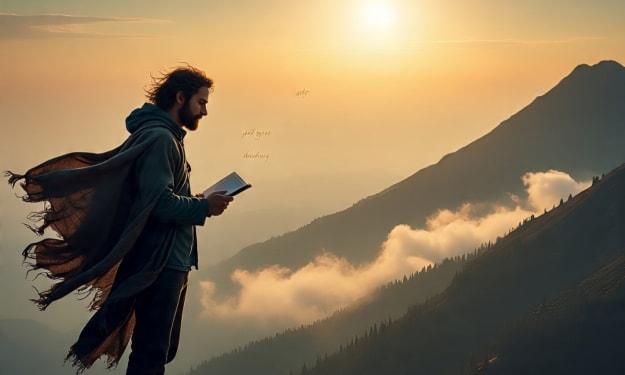
Whispers Above the Clouds A Poet’s Journey to the Summit of Inspiration The path was steep, but his heart was light. Arin had been walking for hours, the mountain trail winding endlessly beneath his boots. The world below had grown smaller, fading into the distance like a forgotten echo. Yet he didn’t feel tired. Not in the way he used to. For months—no, years—Arin had been stuck. A once-celebrated poet, he had fallen silent. The words that once danced freely from his soul now hid in shadows, unreachable. Fame had come, then faded. Applause had dimmed. His pen, once an extension of his heart, lay untouched in a drawer. One morning, after yet another sleepless night, he packed a small bag and walked out the door. No destination, no fanfare. Just a whisper within: Go where the sky touches the soul. And now, here he was—nearing the summit of Mount Viraya, a place known more to monks than tourists. A place said to be "where silence speaks." The final steps were the hardest. The air was thin, the wind sharp. But when Arin reached the top, everything changed. The sun was just rising, spilling gold across the sky. Below him, a vast sea of clouds shimmered like waves frozen in time. He stood on an island in the sky. He closed his eyes. For the first time in years, he didn’t think about being a poet. He didn’t think about success or expectations. He simply listened. And then—he heard it. Not a voice, not a sound, but a feeling. A whisper from within. A truth he had buried beneath doubt and fear. “You were never meant to write for applause,” it said. “You write because your soul sings.” Tears welled in Arin’s eyes—not from sadness, but from recognition. The mountain hadn’t given him new words; it had helped him remember the old ones. The true ones. He pulled out his notebook, long forgotten at the bottom of his pack. His fingers trembled as he opened it. Not from cold—but from something else. A spark. The pen moved. Not forced, not rushed—just flowing. He wrote about the wind. About the sky. About climbing, falling, rising again. About forgetting who you are, and then finally remembering. The words came like rain after drought. For hours he wrote. And when he paused, it wasn’t because the words had stopped—but because his heart was full. As the sun climbed higher, Arin stood and breathed deeply. He didn’t feel like the old Arin, or even a “new” Arin. He just felt real. He didn’t need validation. He didn’t crave likes or followers. But he knew one thing: he would share this moment. Not to impress—but to inspire. When he descended the mountain, he posted a simple poem online: --- Whispers above the clouds, Where the sky holds your name, I climbed to lose myself— And found my soul again. --- To his surprise, the post resonated. Not because it was perfect—but because it was honest. Thousands shared it. Not for its rhyme or rhythm—but for its truth. Messages flooded in. People wrote: “This reminded me why I paint.” “I’ve been stuck for so long. This gave me hope.” “Thank you. I needed this.” And Arin replied to every one. Because this was what poetry was always meant to be—not a performance, but a connection. --- A year later, Arin returned to Mount Viraya. Not to seek inspiration—but to say thank you. He sat at the same spot, watching the clouds roll beneath him. In his hands was a small, hand-bound book: a collection of poems written since that first climb. But this time, the pages weren’t filled with the need to be noticed. They were filled with love. With truth. He left a copy at the summit, tucked gently between two stones, for the next traveler who might need it. Not signed. No name. Just a note on the inside cover: “May you remember who you are above the clouds.” --- 💬 What this story reminds us: We all have mountains to climb—creative, emotional, or spiritual. Sometimes, the world tells us we need to do more, be more, prove more. But often, the real inspiration comes when we pause, listen, and remember why we began at all. You don’t have to be perfect. You just have to be true. --- If this story moved you, feel free to share it. It might be the whisper someone else is waiting to hear. 🌤️✍️
By Muhammad Saad about a year ago in Poets
The Power of Poetry: A Journey Through 100 Uplifting Lines
The Power of Poetry: A Journey Through 100 Uplifting Lines Discover the Beauty, Strength, and Truth in Verse That Inspires and Heals In a quiet village nestled between golden fields and rolling hills, lived a young girl named Mira. She was known for her bright eyes and quiet spirit, always seen with a notebook in hand. While others chased noise and news, Mira sought the quiet music of words. Her mother had been a poet—gentle, wise, and full of light. She had passed away when Mira was only ten, leaving behind a single letter and a worn leather journal filled with her verses. One rainy afternoon, Mira sat by her window, the journal resting on her knees. She whispered, “If poems could speak, would they bring her voice back?” That question became the beginning of her journey. She decided she would write a single poem—a long one, 100 lines strong—to carry forward her mother’s spirit and share the healing poetry had brought her. She titled it: “A Light Within: 100 Lines of Hope” A Light Within: 100 Lines of Hope (Poem begins — 100 lines) 1. In every dawn, a promise lies, 2. Beneath the gold of waking skies. 3. A whispered breeze, a bird in flight, 4. The world begins again in light. 5. Though nights are long and shadows deep, 6. The earth still turns while angels sleep. 7. And stars, like poems, softly shine— 8. A gentle hand, a sacred sign. 9. When hearts are cracked by loss or fear, 10. Let every tear bring something near. 11. For in our pain, a seed is sown, 12. And from it, love and strength have grown. 13. The smallest word, the kindest touch, 14. Can steady hands that shake too much. 15. A line of verse, a melody, 16. Can set a weary spirit free. 17. I write not just for those who weep, 18. But those who dare to dream in sleep. 19. I write for joy, for peace, for flame— 20. For all the things we cannot name. 21. Each poem a lantern in the night, 22. A thread that pulls us toward the light. 23. Each stanza, like a heartbeat strong, 24. Each rhyme a place where souls belong. 25. Remember this when days are grey: 26. The storm will pass, the clouds give way. 27. The sun will rise, as sunflowers do— 28. And shine again inside of you. 29. Be kind, be brave, be fully you, 30. In all you feel, in all you do. 31. No step is small, no voice too low— 32. The softest seeds still choose to grow. 33. If you have stumbled, rise again. 34. The ground is not the end, but when 35. You lift yourself and breathe once more, 36. You’ll find your wings begin to soar. 37. Don’t chase the stars—be one instead. 38. Let kindness be the path you tread. 39. And when the world forgets your name, 40. Let love remain your lasting flame. 41. There’s beauty in the broken parts, 42. In scarred-up hands and healing hearts. 43. Perfection isn’t where you’ll find 44. The deepest truths of humankind. 45. So share your story, write your song, 46. And know that you have always belonged. 47. In laughter, tears, in dreams you’ve spun— 48. There lives the light of everyone. 49. Forgive the past, release its weight. 50. The future waits beyond the gate. 51. And as you step through morning’s hue, 52. Know this: the world makes room for you. 53. Walk barefoot in the morning dew, 54. Let skies of silver wash you new. 55. Let every breath remind your soul 56. That healing too can make you whole. 57. The quiet holds a secret sound— 58. A music humming underground. 59. It sings of roots and rise and rain, 60. Of all that’s lost and all we gain. 61. You are a poem, not yet done— 62. A rhythm dancing in the sun. 63. A verse that winds through time and space, 64. A sacred, irreplaceable grace. 65. Speak softly when the world is loud. 66. Be humble even when you’re proud. 67. And in your silence, may you find 68. The gentle language of the kind. 69. No storm will ever stay too long— 70. The soul was made to carry song. 71. And when you tremble, when you fall, 72. May courage answer every call. 73. The road is long, the map unclear, 74. But faith will always draw you near. 75. Not to a place, but to a way— 76. A journey shaped by each new day. 77. So light a candle in the dark, 78. And dare to be your truest spark. 79. Let kindness be the fire you feed— 80. It’s always been the thing we need. 81. Love deeply, even when it’s hard. 82. Forgiveness is a soft reward. 83. And gratitude, a steady tide— 84. It keeps the heart alive inside. 85. Find joy in things both big and small— 86. A morning breeze, a sparrow’s call. 87. A word well said, a silent nod— 88. The quiet, quiet grace of God. 89. And when your time to rest arrives, 90. May love be all you leave behind. 91. A single line, a glowing thread— 92. A light to guide when you have fled. 93. For poems last when we are gone, 94. They echo soft, they carry on. 95. And in their lines, we meet again— 96. As mother, daughter, now as friends. 97. So here I write these hundred lines, 98. To share her soul, to echo mine. 99. And if you read them, may you see— 100. The light within is also me. --- As Mira finished the final line, the clouds parted. Light spilled across her desk, just like it had in her mother’s old study. She closed the journal, smiled softly, and knew something sacred had passed between pages. Not just a poem—but healing. A connection. A legacy. Poetry hadn’t just helped her remember. It helped her begin again.
By Muhammad Saad about a year ago in Poets
Healing in Verse: The Power of Psychological Poetry
Healing in Verse: The Power of Psychological Poetry For as long as she could remember, Mara had lived with a storm inside her. It wasn’t always loud or violent—sometimes it was a quiet gray that followed her into every room, like a shadow she couldn't shake. Friends called her "the deep thinker," teachers praised her essays, and her voice carried calm in conversation. But inside, she was always swimming in thoughts too big to name. At seventeen, after a long season of silence, Mara’s therapist gave her a simple suggestion: “Try writing what you feel. Don’t worry about sense—just sound.” So that night, Mara opened a notebook and wrote: > “My mind is a house where windows blink, Walls whisper, and silence sings.” It didn’t make perfect sense, but it felt true. That was the night poetry found her. Over the weeks that followed, Mara poured her quiet chaos into verse. She wrote about feeling invisible, about dreams that spoke in symbols, about the strange comfort of being alone. Her words didn't rhyme, and her lines didn’t follow rules—but something inside her began to shift. With every poem, she wasn’t just venting emotion—she was decoding it. The act of writing made the unnamed parts of her pain visible, and once visible, they became livable. --- The Psychology Behind the Pen What Mara didn’t know yet was that she had stumbled into an age-old practice now being explored by modern psychologists: poetry therapy. Psychological poetry—sometimes called therapeutic or expressive poetry—is the use of poetic language and structure to explore, understand, and even heal the mind. Research has shown that writing poetry can reduce anxiety, increase emotional resilience, and improve self-awareness. According to Dr. James Pennebaker, a leading psychologist in expressive writing, the process of putting feelings into words changes how the brain processes trauma. It's as if the act of writing allows the mind to reorganize painful memories, giving the author both distance and control. Unlike clinical talk therapy, poetry doesn’t demand clarity or explanation. Instead, it welcomes metaphor, ambiguity, and emotion. For many, that makes it safer—more intuitive. In Mara’s case, poetry became the bridge between her inner world and outer reality. It gave her a voice when she didn’t know how to speak plainly. --- A Blooming Mind One morning in early spring, Mara stood in front of her English class and read one of her poems aloud. It wasn’t about depression or trauma—it was about a tree that forgot how to bloom, and the wind that sang it back to life. > “And so the branches shook with song, Until one petal dared to wake.” When she finished, the room was silent. Not the awkward kind—the holy kind. One classmate had tears in their eyes. Another came up after class and whispered, "That poem felt like me." It was then Mara understood: poetry doesn’t just heal the writer—it heals the reader, too. --- Why Psychological Poetry Matters In a world full of fast communication and emotional noise, poetry invites depth, slowness, and reflection. It lets people: Name the unnamable (grief, fear, longing) Find meaning in pain Transform wounds into art Connect with others in silent understanding And it’s not just for “poets.” Anyone—with or without experience—can benefit from writing or reading psychologically rooted poetry. Whether it’s a journal scribbled in at midnight, a spoken word shared on stage, or a single verse taped to a mirror, poetry reminds us: You are not alone in how you feel. --- The Final Line Years later, Mara became a counselor. On the shelf behind her desk sat a stack of empty notebooks, free for any client who needed them. When one young boy asked, “What if I don’t know what to write?” She smiled and said, “Start with how it sounds inside your head.” And so the healing continued—line by line, soul by soul.
By Muhammad Saad about a year ago in Poets
The Mind's Melody: Exploring the Psychological Game of Poetry
In a quiet town nestled between hills and sky, lived a teacher named Liana. She was known not just for her love of words, but for the way she made them come alive. Her classroom was filled with sunlight, old books, and laughter—a space where poetry wasn’t just studied, but felt. One autumn morning, she gave her students an unusual assignment: “Write a poem that shows how you feel without saying exactly what you feel.” The students looked puzzled. “Isn’t that what poetry is supposed to do?” asked a boy named Amir. “Exactly,” Liana smiled. “That’s the game. The psychological game of poetry.” The idea of poetry as a “game” intrigued the class. They were used to rhyme schemes and metaphors, but this was different. This was about decoding the self, one word at a time. Over the next few weeks, something incredible happened. One quiet student, Elena, who often sat alone, wrote about a “bird trapped under glass.” It wasn’t until she read it aloud that the class understood: the bird was her anxiety. Her words didn’t name the feeling—but everyone felt it. Amir wrote a poem using only colors—describing a storm as “deep maroon” and laughter as “sunbeam yellow.” Liana pointed out how his mind connected emotions with sensory detail, and how powerful that was. They weren’t just writing poetry—they were unlocking themselves. Liana explained that poetry is one of the oldest forms of human expression. Long before psychology was a science, poetry was already mapping the mind. In haiku, in odes, in ballads—humans poured their fears, hopes, and questions into verse. But more than that, poetry let people process their emotions without always having to explain them directly. “It’s like playing chess with your own thoughts,” she said. “A strategy to understand yourself without overwhelming yourself.” Studies have shown that writing poetry activates areas in the brain related to memory, emotion regulation, and language. It helps people reframe negative thoughts, and in doing so, heal. Poetry is a mirror, a translator, and sometimes—a silent therapist. What makes poetry especially unique, Liana told them, is how it builds bridges between people. A poet in Nigeria can write about longing, and someone in Norway can read it and feel less alone. It’s a universal code—wrapped in rhythm and metaphor—that binds humanity. One day, the class wrote a collaborative poem. Each student added one line, continuing where the last left off. The poem danced between joy, grief, hope, and dreams. In just 18 lines, they had told a collective story—without planning or overthinking. It was honest. Raw. Beautiful. By the end of the semester, even the shyest students were writing poems with confidence. Their grammar improved, yes—but more importantly, they felt heard. Seen. Validated. That winter, the class held a poetry night called The Mind’s Melody. Parents came. Grandparents came. Strangers came. One by one, the students stood at the microphone and read their poems. Some spoke of heartbreak. Others of laughter. One student read a poem about her late grandmother, and half the room cried. But it wasn’t sadness that filled the room—it was connection. Healing. Humanity. Afterward, a parent approached Liana with tears in her eyes. “My son never talks much. But tonight, I feel like I met him for the first time.” Liana smiled. “That’s poetry. It helps us speak in silence.” --- In our fast-paced, digital world, poetry remains a quiet force—simple yet profound. It teaches us to observe, to reflect, and to connect beyond surface-level words. The psychological game of poetry isn’t about winning or losing. It’s about listening—to ourselves, and to others. It’s about decoding the heart’s language when regular speech falls short. So the next time you feel overwhelmed, uncertain, or inspired—pick up a pen. Let the melody of your mind flow. You may just find a poem waiting to be written—and a piece of yourself waiting to be found.
By Muhammad Saad about a year ago in Poets
The Heart of Humanity: How Poetry Connects Us All
On a quiet Sunday morning in a city that never quite stopped moving, something unusual was happening in Central Park. Beneath the wide branches of an old oak tree, a small crowd had gathered—not for a concert, a protest, or a marathon, but for poetry. There was no stage, no microphone, no tickets. Just a circle of people—young and old, from different parts of the city and beyond—reading poems aloud, listening, and sharing. Some brought classics from Rumi, Tagore, and Maya Angelou. Others read their own verses, voices shaking slightly, hearts laid bare. At the center of the circle sat Elena, a retired schoolteacher who had started this informal gathering during the lockdowns. “I wanted to keep people connected when we were all feeling so apart,” she said. “I thought maybe a few friends would come. Now, three years later, we’re here every week—and there’s always someone new.” Poetry, often considered a quiet and solitary art, was doing something remarkable. It was reaching people. Not just in quiet parks, but online, in schools, in cafes, on social media—everywhere. Hashtags like #PoetryHeals and #VersesForChange had millions of views. Teenagers were sharing haikus on TikTok. Elders were reciting old poems on YouTube. Refugees were writing verses in camps. Prison inmates were expressing dreams through stanzas. And readers—millions of them—were listening. Why poetry? Why now? According to Dr. Amina Bell, a literature professor and social psychologist, the answer lies in poetry’s simplicity—and its depth. “In just a few lines, poetry can capture what entire books cannot,” she explains. “It gives people a way to process their emotions, to feel seen, and to connect with others. Especially in times of uncertainty, poetry feels like a lifeline.” Indeed, the world in recent years has faced profound challenges—pandemics, wars, climate change, isolation. In these moments, people turn inward. They search for meaning. They look for words that don’t just explain, but feel. And poetry is feeling, distilled. Consider the story of Rafiq, a young man who fled conflict in Syria and resettled in Sweden. At a refugee center, he began writing poems in Arabic about his journey, grief, and hope. Volunteers helped translate his work, and soon his poems were published in a small anthology. One of his verses reads: "I carried my home in my chest / like a bird keeps a sky / folded inside its wings." That one line touched thousands, reminding readers not just of Rafiq’s story, but of their own longing—for safety, belonging, and beauty. Then there’s Ava, a teenager in Brazil who struggled with anxiety during the lockdowns. She started writing short poems on her phone and posting them online. To her surprise, people responded with kindness and resonance. “It was like I wasn’t alone anymore,” she said. “And neither were they.” Poetry today isn’t just found in dusty books or academic journals. It’s on subway walls, in Instagram captions, printed on coffee cups, and spoken at open mics. It’s becoming a language of the people—accessible, personal, and healing. Governments and educators are taking note. Schools in Finland, India, and Canada have introduced daily “poetry minutes” where students read or write a short verse to begin the day. Hospitals in several countries now employ "poet therapists" who use poetry to help patients process trauma. Even corporations are exploring poetry as a tool for empathy and communication. But perhaps the most powerful impact of poetry is the human one—the simple, sacred act of sharing words. Back under the oak tree in Central Park, Elena listens as a boy of about ten reads a poem he wrote about his dog. His voice is soft, but steady. When he finishes, the group claps warmly. “That was beautiful,” Elena tells him. “Thank you for sharing your heart.” Later, she reflects: “We live in a noisy world. Poetry helps us listen—to each other, to ourselves, to the silence between the words.” As the sun dips behind the buildings, casting long shadows on the grass, the group slowly disperses. Some stay to talk. Others head home, carrying poems in their pockets or tucked into their memory. Poetry may not solve every problem. But it reminds us who we are. It brings light to the dark, gives voice to the voiceless, and reminds us that even in silence, we are not alone. And perhaps that is why more and more people are reading, writing, and living poetry—not just as art, but as a way of being.
By Muhammad Saad about a year ago in Poets