
Negative Space
Some things do not disappear. They simply stop being visible, leaving us to live around the shape they once occupied.

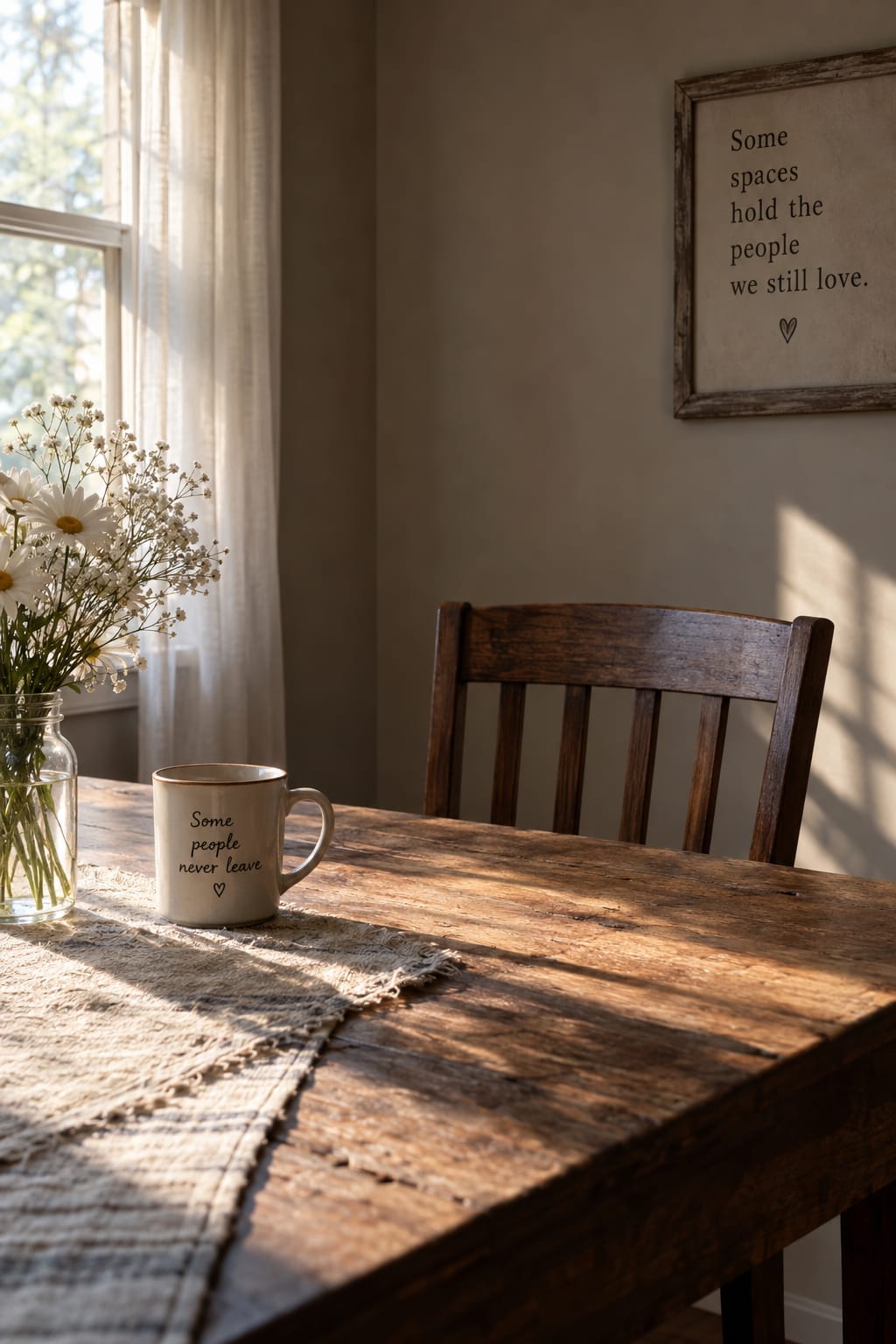
There is a place at the table
where no one sits anymore.
Not because the chair is broken.
Not because the room is too small.
Not because we needed the space.
We leave it there.
Perhaps out of habit.
Perhaps because moving it
would mean admitting
that whoever belonged there
is not coming back.
So the chair remains,
slightly pulled away from the table,
waiting for hands
that will never reach for it.
And somehow
the emptiness above that seat
has become another member
of the family.
We rarely talk about absence
as though it were a thing.
We talk about what remains.
The photographs.
The letters.
The sweater forgotten
in the back of a closet.
The coffee cup with the chipped rim
that nobody wants to throw away.
The number still saved
inside a telephone.
The birthday that arrives every year
without asking permission.
These are the objects
we know how to name.
But what do we call
the space beside them?
What do we call
the silence after a voice
has stopped answering?
What do we call
the half of a bed
that stays cold?
What do we call
the sentence we still rehearse
for someone
who will never hear it?
There should be a word
for the architecture of missing.
A word for the way absence
builds rooms inside us.
A word for how something
can be gone
and still
take up
so much
space.
When I was younger,
I thought losing something
meant it disappeared.
I imagined loss
as subtraction.
One person.
Minus one person.
One love.
Minus one love.
One dream.
Minus one dream.
Simple arithmetic.
Clean.
Final.
But nobody tells you
that absence has weight.
Nobody tells you
that subtraction
can leave something behind.
There are mornings
when I still reach
toward places
that no longer contain
what I remember.
My hand moves first.
Memory follows.
Reality arrives last.
And for one impossible second,
everything is still there.
Then the world corrects itself.
No.
Not anymore.
I have learned
that grief sometimes happens
in the smallest measurements.
Not years.
Not months.
Not anniversaries.
Inches.
The distance between
one pillow and another.
Seconds.
The time it takes
to remember
you cannot call.
Decibels.
The difference between
a house with someone's laughter
and the same house
afterward.
People imagine emptiness
as nothing.
A blank page.
An abandoned room.
A darkened window.
But emptiness is rarely empty.
Walk into a bedroom
after someone has left it forever
and tell me there is nothing there.
Stand in the doorway.
Listen.
The room will introduce you
to everything that is missing.
Here,
a depression in the mattress
slowly forgetting
the body that made it.
Here,
a hook on the wall
holding nothing.
Here,
dust gathering
around the outline
where a photograph once hung.
Here,
a drawer that still smells faintly
of soap,
paper,
winter,
someone.
Here—
—the unbearable evidence
of nothing.
Maybe that is why
we keep certain things.
Not because we believe
objects can replace people.
They cannot.
But objects give absence
an edge.
A boundary.
Something we can touch.
Without them,
missing becomes enormous.
It spills beneath doors.
It climbs walls.
It follows us
from room to room.
I once believed healing
meant filling every empty place.
New people.
New routines.
New furniture.
New cities.
New conversations.
Anything
to cover the blank spaces.
Anything
to keep the eye
from noticing
what wasn't there.
But some spaces
refuse replacement.
Put another chair
at the table.
It is still not that chair.
Hear another voice
say your name.
It is still not that voice.
Hold another hand.
Love another person.
Build another life.
Still—
there are rooms
inside the human heart
with only one key.
Perhaps healing
is not filling them.
Perhaps healing
is learning
that an empty room
can remain part of the house.
You stop locking the door.
You stop pretending
the room does not exist.
Sometimes
you even walk inside.
You open the curtains.
You let the afternoon
touch the floor.
You sit quietly
with everything
that isn't there.
And you survive it.
That is the strange thing.
You survive.
Not all at once.
Not heroically.
Not in the beautiful way
people describe survival
after enough time has passed
to turn pain into a story.
You survive badly.
You survive Tuesday.
You survive
washing a plate.
You survive
hearing a song
in a grocery store.
You survive
finding handwriting
on the back of an envelope.
You survive
someone casually saying a name
they do not know
has become sacred.
You survive
the first holiday.
Then another.
Then another.
Until one day
you realize
you have been carrying
an absence
for years.
And it has changed shape.
At first,
it was a crater.
Everything fell toward it.
Every thought.
Every memory.
Every ordinary moment.
You could stand miles away
and still feel yourself
being pulled toward
what was gone.
Later,
it became a doorway.
You could walk past it
without entering.
Most days.
Later still,
a window.
You could look through it
and remember
without always breaking.
But it never became nothing.
Maybe that is the mistake
we make when we tell people
to move on.
As though love
were luggage.
As though memory
were a house
we could sell.
As though there were
some respectable amount of time
after which absence
should surrender its address.
But the heart
does not obey eviction notices.
It keeps what mattered.
Quietly.
Stubbornly.
Sometimes beautifully.
There are people
I no longer speak to
who still live inside
certain versions of me.
They do not know it.
Perhaps they never will.
They are present
in expressions I learned from them.
In songs
I cannot hear innocently.
In jokes
whose origins I have forgotten.
In the way I pronounce
certain words.
In places
I avoid.
In places
I return to.
Some people leave
without dying.
There are no funerals
for those disappearances.
No casseroles.
No flowers.
No gathering
where everyone agrees
that something has ended.
Sometimes a person
simply becomes
someone you used to know.
And the world
keeps moving
with astonishing indifference.
Your phone still works.
The mail arrives.
Traffic lights change.
People complain
about the weather.
Somewhere,
someone is laughing
so hard they cannot breathe.
And you are standing
in the middle of an ordinary day
trying to understand
how something enormous
could vanish
without disturbing
the sky.
There are other absences, too.
Not people.
Lives.
The life you thought
you would have.
The version of yourself
you expected to become.
The door you were certain
would open.
The apology
that never came.
The child
you once were.
The future
you rehearsed
until it felt like memory.
How do you mourn
something
that never happened?
Where do you place flowers
for an unlived life?
What photograph
do you frame?
What date
do you circle?
What grave
do you visit?
There is only
space.
And imagination.
Sometimes imagination
is the crueler of the two.
Because it can build
the missing life perfectly.
It can show you
the kitchen.
The windows.
The morning light.
The person beside you.
The work you loved.
The phone call
that went differently.
The decision
you did not make.
The road
you did not take.
Imagination can furnish
an entire house
you will never enter.
Then leave you
standing outside.
I think we are all
made partly
from these invisible rooms.
The conversations
we never had.
The questions
we never asked.
The words
we swallowed.
The goodbyes
we postponed
because we believed
there would be another afternoon.
There wasn't.
And now the unsaid things
have become their own language.
I love you.
I'm sorry.
Please stay.
I forgive you.
I don't forgive you.
I needed you.
You hurt me.
Come back.
Goodbye.
Nothing.
Maybe silence
is not the absence of language.
Maybe silence
is language
with nowhere left to go.
There are nights
when the missing
becomes louder.
The world grows still enough
for absence to speak.
It does not shout.
It does not have to.
It sits beside you.
Familiar.
Patient.
Almost gentle now.
And you understand
that you are no longer
trying to defeat it.
You have learned
to make room.
There is a tenderness
in that.
A strange mercy.
To stop demanding
that every wound disappear.
To stop measuring healing
by how little you remember.
To understand
that remembering
is not failure.
Missing someone
is not failure.
Missing a place,
a dream,
a former self,
is not proof
that you have refused
to live.
Sometimes it is simply proof
that something mattered.
And things that matter
leave outlines.
Take a picture
off a wall
after twenty years.
The paint beneath it
will be different.
Protected from sunlight.
Untouched by dust.
A pale rectangle
inside a darker room.
That is what love does.
That is what loss does.
Someone stays long enough
to change the color
of the place they occupied.
Then they leave,
and suddenly
you can see
exactly
where they were.
Negative space.
Artists understand it.
They know
the empty part of an image
is not useless.
The blankness
defines the shape.
The untouched paper
tells the eye
where to look.
What is absent
gives form
to what remains.
Perhaps people
are not so different.
Perhaps we are shaped
not only by what we have,
but by what we have lost.
By doors that closed.
By hands we released.
By names we stopped saying.
By rooms we left.
By dreams
that never learned
how to become real.
Look closely at a life
and you will see
its missing pieces.
Not as failures.
As outlines.
There.
Around the person
they loved.
There.
Around the childhood
they survived.
There.
Around the future
they once imagined.
There.
Around every goodbye
they thought
they were prepared for.
And maybe
that is why some absences
eventually become beautiful.
Not because losing
was beautiful.
It wasn't.
Not because pain
was necessary.
Not because everything
happens for a reason.
Some things happen
and leave us
without explanations.
But years later,
we may look at the shape
left behind
and recognize ourselves
around it.
We grew there.
Around the missing.
Like a tree
growing around
an old wound.
The scar does not vanish.
The trunk widens.
Season after season.
Ring after ring.
Life does not erase
what happened.
It grows around it.
So perhaps
I will stop trying
to fill every empty place.
Perhaps I will leave
some spaces untouched.
A chair.
A photograph.
A name.
A memory.
A dream.
Perhaps absence
deserves its own corner
of the page.
Perhaps not every silence
needs a sentence.
Perhaps not every ending
needs an explanation.
Perhaps there are things
we honor best
by refusing
to replace them.
And perhaps someday
when someone looks
at the shape of my life,
they will notice
the blank places too.
They will wonder
what belonged there.
Who belonged there.
What I wanted.
What I lost.
What I almost became.
They may never know.
That is all right.
Because some stories
are told
by what remains.
And some
by what doesn't.
About the Creator
Brenda Fluharty
Brenda Marie Fluharty is an author and spiritual healer with 30+ years of experience. Creator of the God Spark spiritual healing program, she writes about dreams, intuition, healing, spiritual awakening, and personal transformation.
Enjoyed the story? Support the Creator.
Subscribe for free to receive all their stories in your feed. You could also become a paid subscriber, letting them know you appreciate their work.
Comments
There are no comments for this story
Be the first to respond and start the conversation.