Latest Stories
Most recently published stories in Photography.
How Image Masking Improves Ecommerce Product Photography. AI-Generated.
Product photography has become one of the most important parts of online selling. Before a customer reads product details, compares prices, or checks reviews, they usually look at the image first.
By Clipping Photo Experts3 months ago in Photography
The Last Light in the Window. AI-Generated.
It’s not a smart bulb. Not one of those color-changing things. Just a cheap desk lamp from a thrift store, with a yellow bulb that hums a little when it warms up. The shade is dented on one side. The cord is wrapped with tape where a cat chewed it twenty years ago. From the street, it looks ordinary. One lit window among twenty dark ones. But on this block, everyone knows what that light means. I grew up three buildings down. For as long as I can remember, that lamp was on when I came home from late shifts, from parties I wasn’t supposed to be at, from nights when I didn’t know where else to go. My mom used to say, “Look, there’s Mrs. Alvarez’s light. That means you’re close.” Mrs. Alvarez never told anyone why she kept it on. People asked, once, years ago. She just smiled and said, “Old habit.” Then she changed the subject and offered you tea. The truth came out in pieces, the way truth does in neighborhoods. Her brother, Daniel, worked the night shift at the bus depot. He hated the dark. Not the dark itself — the kind of dark where you’re not sure if you’re going the right way. When he was nineteen, he told her, “If I see your light from the corner, I’ll know I’m home. I won’t get lost.” He didn’t come home one night in 1998. Bus accident. The kind you read about in the paper and think, “That could’ve been anyone.” She turned the lamp on that night anyway. She said she forgot to turn it off. Then she forgot again the next night. And the next. After a year, people started noticing. Nurse Patel from St. Mary’s told me she saw it the night her car broke down at 1 a.m. She was new to the city, no money for a cab, walking with her scrubs in a plastic bag. “I saw that yellow window and I started crying,” she said. “Not because I was scared. Because something was awake. Something was waiting.” Marcus, who did eight months for a mistake he still doesn’t talk about, said the first night he was out, he walked the whole city. Didn’t want to go home yet. Didn’t know how to be home yet. At 2 a.m. he found himself on Maple Street. “That light was the only thing that didn’t look like it was judging me,” he told me later. “So I sat on the curb across the street until the sun came up.” A girl named Lena, sixteen, missed the last train after a fight with her parents. She slept on the bench under that window. Mrs. Alvarez never came down. Never opened the door. She just left the light on. Lena said it was enough. “I knew if things got worse, someone was up.” Mrs. Alvarez doesn’t know any of them. She doesn’t keep a list. She doesn’t open her door at 3 a.m. She’s not running a shelter. She’s just keeping a promise to a brother who isn’t here anymore, and in doing that, she’s keeping a promise to everyone else. Ten years ago the power went out during a storm. The whole block went dark. At 11:05 p.m. someone knocked on her door. It was Mr. Chen from the corner store. He’d brought her a camping lantern. “For the window,” he said. He didn’t ask why. He just knew. Since then, the block takes care of the light. When the bulb burns out, someone leaves a new one by her door. When the tape on the cord finally gave up, Mr. Chen rewired it for free. When she got sick two winters ago and couldn’t get out of bed, her neighbor Rosa plugged the lamp in and set a timer. Nobody talks about it much. That’s not how this works. You don’t thank someone for keeping a light on. You just walk a little straighter when you see it. Last month I came back to Maple Street after five years away. Different city, different job, different life. My train was delayed. I got in at midnight. The street was empty and colder than I remembered. Then I saw it. Third floor. Yellow. On. I stood there for a minute, just looking. And I understood what Daniel must have felt. That relief that hits your chest when you realize you’re not as lost as you thought. I never met Mrs. Alvarez. She died last spring, peacefully, in her sleep. The lamp went off for three nights after. The whole block felt it. Like the street had lost its heartbeat. On the fourth night, Rosa plugged it back in. Then Marcus did the timer when Rosa went to visit her sister. Now we take turns. Nobody owns the light. Everyone does. It’s still a cheap lamp. Still hums. Still has tape on the cord. But if you’re walking home late, and you’re not sure you have a place, look for the third floor on Maple. There’s a light on. It won’t fix everything. It won’t make the night less dark. But it will tell you one thing, clear and simple: You’re close. You’re not forgotten. Keep going. And sometimes, that’s enough.
By Khalil Ullah3 months ago in Photography
Beyond the Binary:
**Abstract** This paper proposes a metaphysical and symbolic critique of the standard 24-hour temporal cycle. By employing the lens of numerological analysis, particularly the esoteric significance of the numbers 3, 6, and 9, we argue that the 24-hour day functions as a structural mechanism for enforcing dualistic consciousness. Through a detailed examination of its divisibility patterns, digital root, and lived 12/12 partition, we suggest that the 24-hour cycle scripts reality into moralized binaries of right/wrong and useful/useless. We posit that this system conceals a fundamental "trinitarian" potential represented by the number 27. Re-integrating the "hidden 3" hours required to reach 27 from 24, and reimagining the day as three complete 9-hour cycles, serves as a symbolic key, or "unlock," from binary opposition into a state of holistic synthesis. This exploration bridges chronobiology, philosophical dualism, and sacred numerology to offer a model for understanding how time itself may be encoded to shape human perception.
By Anyone Ananymos3 months ago in Photography
Where to Install Feature Wall Wallpaper in Open-Plan Australian Living Areas
The Role of the Feature Wall in Australian Homes The evolution of Australian architecture towards open-plan living has provided homeowners with light-filled, airy spaces that are perfect for modern lifestyles. However, the lack of internal walls can sometimes leave a home feeling disconnected or devoid of character. Without clear boundaries, large multipurpose zones can feel overwhelming, making it difficult to define where the lounge ends and the dining area begins. This is where the strategic use of feature wall wallpaper becomes an essential design tool.
By Giffywalls AUS3 months ago in Photography
WATERFALL PHOTOS. 5 TIPS!
Learn tips for mesmerizing waterfall photos with perfect time a..... Waterfalls are stunning natural phenomena, and many of them have become popular tourist destinations. They are formed through the process of river erosion, where continuous narrowing of the river channel increases the speed of the water and the height of the cliffs the water flows over. The result is the creation of a waterfall. Many people are eager to learn how to photograph waterfalls, as these natural landscapes offer unique and captivating beauty. Understanding how to capture waterfalls is essential, especially for photographers involved in landscape photography. Photographing waterfalls can be tricky—sometimes the fast-moving water can cause blurry or misty images. The challenges faced when photographing waterfalls make it a particularly interesting subject to capture. To help you capture stunning waterfall photographs, here are some helpful tips on how to photograph waterfalls! 1. Adjusting Shutter Speed Waterfalls vary greatly in speed, and accordingly, shutter speed settings will differ depending on the waterfall you're photographing. To capture the movement of the water, use a fast shutter speed, such as 0.3 seconds. It’s also beneficial to use the continuous shot mode, so multiple frames are captured with a single press of the shutter. This allows you to choose the best shot from several frames. If 0.3 seconds doesn't produce the desired effect, you can experiment with longer shutter speeds, such as 1 second or more, to get the right look. 2. Use a Tripod Using a tripod is essential for minimizing blur or mist in your photos. Why is a tripod important? Holding the camera by hand often results in slight movements, either vertical or horizontal, making the image unstable. This instability can lead to blurry or misty effects in the photo. While some people avoid using a tripod because of its size and the hassle of carrying it around, it is an important tool for ensuring sharp and steady shots. If you don't have a tripod or prefer not to carry one, look for a stable surface, such as stacked rocks, to rest your camera on. 3. Use Filters In addition to a tripod, using filters can greatly improve your waterfall photography. If you have them, a neutral density (ND) filter can help adjust the color effects of the waterfall, making your images more visually appealing. Another useful filter is a Circular Polarizer, which reduces light reflection, thus enhancing the quality of the shot. This filter helps reduce reflections off wet rocks, water surfaces, and foliage. It also boosts color saturation, making the image clearer and more vibrant. 4. Set the ISO When photographing waterfalls during the daytime, it's essential to set the ISO as low as possible, typically around ISO 100 or lower if your camera allows it. A low ISO reduces the camera's sensitivity, which allows for slower shutter speeds. Avoid using high ISO settings, as this can introduce noise, which can degrade the quality of your waterfall photos. 5. Adjust the Aperture Setting the aperture correctly is crucial for capturing high-quality waterfall images. For the best results, use a small aperture setting, which will lengthen the exposure time and create a greater depth of field. A narrow aperture allows for more of the scene to be in focus, from the closest water droplets to the distant landscape, ensuring a detailed and sharp photograph. Ideal Timing for Waterfall Photography The best times to photograph waterfalls are either early in the morning, just after sunrise, or during the late afternoon or evening, as the lighting during these times is softer and more flattering. You should also take time to find interesting compositions and experiment with different angles and perspectives. Creativity plays a significant role in achieving beautiful and unique waterfall photographs. Lykkers, to capture stunning waterfall photographs, it's important to understand how to adjust settings such as shutter speed, aperture, and ISO, while also considering the use of a tripod and filters. Moreover, choosing the right time and location to photograph, and experimenting with composition and angles, will help you create visually striking images. Always plan your photography session in advance for the best possible results!
By Muhammad Talha3 months ago in Photography
UNIQUE PHOTOGRAPHY VI.....
Here is the complete transcription of the text from the provided images, stitched together in order: Photography isn't just about capturing what we see—it's about capturing how we see the world. Every photographer has a unique perspective, influenced by their experiences, emotions, and environment.
By Muhammad Talha4 months ago in Photography
The map drawn on a melting glacier. AI-Generated.
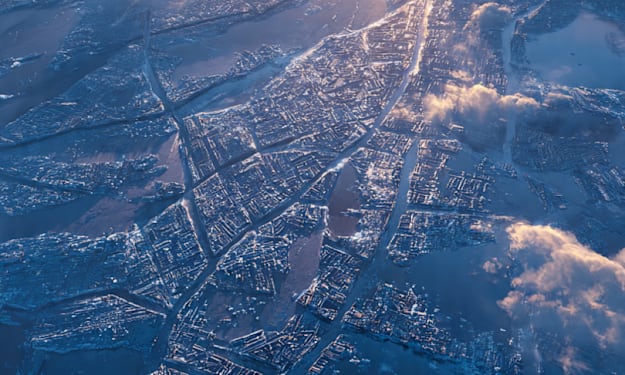
The helicopter pilot refused to fly lower. From the sky, the glacier looked alive. White cracks moved across its frozen surface like veins under skin, glowing faintly beneath the morning sun. Every few minutes, a piece of ice the size of a building collapsed into the dark water below. The sound arrived late — deep, thunderous, final. Dr. Elias Vey pressed his forehead against the cold helicopter window and stared at the impossible lines carved into the glacier. Roads. Perfect roads. Not random cracks. Not natural fractures. Streets. Intersections. Districts. A city map. “Tell me you see that,” he whispered. The pilot remained silent. The radio on Elias’s chest crackled with static. Then a voice emerged from the research station far behind them. “Temperature rising faster than predicted. You have less than two hours before the shelf breaks.” Elias ignored the warning. Below him, hidden inside centuries of ice, was something no satellite had ever recorded clearly. A shape too organized to be natural. An enormous pattern stretching for miles beneath the translucent glacier. And it was melting. Fast. The world had spent decades watching glaciers disappear, but this one had become famous for another reason. Every summer, as more ice vanished, strange geometric patterns appeared underneath the surface. Scientists first believed they were mineral formations. Then someone connected the lines together. The result resembled a complete city blueprint. News channels called it The Frozen Atlas. Conspiracy theories exploded across the internet. Some claimed it was Atlantis. Others believed it was evidence of a lost civilization older than history itself. Elias hated those theories. He believed in facts. But facts were becoming difficult to explain. The helicopter landed roughly on a stable patch of ice. Elias jumped out with his equipment and immediately felt the glacier vibrating beneath his boots. Not shaking. Breathing. He forced the thought away. The air smelled strangely metallic. Meltwater flowed through narrow channels around him, reflecting silver light into the clouds above. Ahead, beneath a layer of crystal-clear ice, massive structures emerged in faint outlines. Towers. Bridges. Entire blocks. A city trapped inside frozen light. Elias activated his scanner and slowly walked forward. The map beneath the glacier was too precise. Every line matched the mathematical ratios of modern urban planning. But carbon dating from nearby ice samples suggested the structures were older than recorded civilization itself. That should have been impossible. Yet the evidence remained frozen under his feet. He stopped near a circular formation buried deep below the surface. Unlike the rest of the city, this section glowed faintly blue. His scanner malfunctioned instantly. Static burst across the display. Then words appeared. NOT EMPTY. Elias froze. The message disappeared. He stared at the dead screen, his heartbeat echoing louder than the wind. “Probably interference,” he muttered. But his voice sounded uncertain. A loud crack split the glacier nearby. Chunks of ice slid into darkness below as freezing water surged upward through new fractures. Elias stumbled backward, nearly dropping the scanner. Then he saw movement beneath the ice. At first he thought it was water distortion. But no. Something moved through the streets below. Slowly. Deliberately. A shadow crossing intersections buried beneath thousands of years of ice. Elias backed away in horror. His rational mind searched desperately for explanations. Light reflection. Pressure waves. Hallucination caused by exhaustion. But the shadow stopped directly under him. Waiting. The ice beneath his boots glowed brighter. Then the glacier began to melt faster. Not naturally. Not gradually. Entire layers turned transparent within seconds, revealing the city below in impossible detail. Towers stretched downward farther than light could reach. Vehicles — or something resembling vehicles — remained frozen along massive roads. And everywhere, lights awakened beneath the ice. One by one. Street after street. Like a city returning to life. Elias heard screaming through his radio. “GET OUT NOW!” the station operator shouted. “The glacier is collapsing!” Too late. The ice beneath Elias shattered. He fell. The world exploded into freezing water and blinding blue light. He expected death instantly, but instead he crashed onto solid ground. Stone. Warm stone. Elias coughed violently and looked upward. Above him stretched transparent ice like a glass sky, with the ocean floating beyond it. Sunlight poured through cracks overhead, illuminating the impossible city around him. It was intact. Not ruined. Waiting. Massive structures towered above silent streets lined with glowing symbols. Rivers of light flowed through channels in the walls like liquid electricity. The air carried a low humming sound that vibrated inside his chest. The city was alive. A sudden voice echoed behind him. “You arrived earlier than expected.” Elias turned sharply. A figure stood in the distance. Human-shaped, though something about its movements felt unnatural — too smooth, too precise. Its skin reflected pale blue light, almost transparent beneath the glowing streets. Elias stepped backward. “Who are you?” The figure tilted its head. “That question has changed many times across history.” Its voice sounded calm. Ancient. Tired. Elias struggled to breathe. “This city… what is this place?” The figure looked upward toward the melting glacier ceiling. “A memory.” More cracks spread through the ice sky above them. Water streamed downward in silver curtains. “The ice protected us longer than predicted,” the figure continued. “But your world became warmer faster than your species understood.” Elias stared at the glowing streets around him. “You’re not human.” The figure smiled sadly. “Neither are you. Not entirely.” Before Elias could respond, the ground trembled violently. Above them, the glacier finally began to collapse. Entire sections shattered like falling glass, sending oceans crashing into the hidden city. Alarms echoed through the streets in a language Elias somehow almost understood. The figure stepped closer. “We left this map for your civilization to find when the ice disappeared.” “Why?” “Because your world is approaching the same ending as ours.” The lights around the city dimmed. Buildings disappeared beneath rising black water. “And because memory survives longer than empires.” The ceiling broke apart completely. Sunlight flooded the ancient city for the first time in thousands of years. Then the ocean swallowed everything. Days later, rescue teams found no trace of Elias Vey. No city. No ruins. Only fragments of melted ice drifting across dark Arctic water. But satellite images captured something strange before the glacier vanished forever. A perfect map. Briefly visible beneath the liquid light. And in the center of it, new lines had appeared. Lines no one could explain. Lines shaped exactly like modern cities across the world.
By Khalil Ullah4 months ago in Photography
Why Do Your Hands Shake While Taking Photos?
You line up the perfect shot, press the shutter button, and expect a sharp image. But when you check the photo, it looks blurry. If this happens often, shaky hands may be the reason. Hand movement is one of the most common causes of blurry photos, affecting beginners and experienced photographers alike.
By Stories Today4 months ago in Photography
The Waiting Room: How Film Taught Us to Hold Our Breath. AI-Generated.
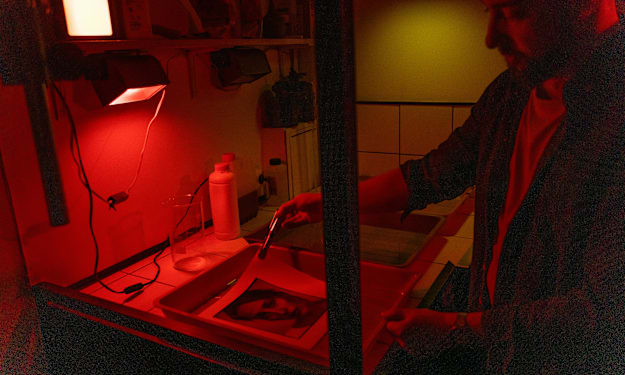
The Silence of the Darkroom There's a particular kind of silence that belongs only to darkrooms. Not the empty quiet of an unused space, but a living hush, thick with chemistry and possibility. I remember standing in my father's makeshift darkroom as a child, watching him work under the amber glow of the safelight, his hands moving through trays of solution with the practiced grace of someone performing a ritual. The air smelled sharp and sweet at once, metallic and alive, like breathing in secrets. He never spoke much during those hours. There was nothing to say. We were both waiting for the same small miracle.
By The Icon4 months ago in Photography
The Prudhoe Badger And Things You Miss On Trains And Buses
Introduction I suppose this is just a piece on photographs that we take when things are moving at speed. Sometimes it is because you are on a bus or train, or because you see something and you have seconds to capture that picture.
By Mike Singleton 💜 Mikeydred 4 months ago in Photography
Evan Roderick’s Most Dynamic Roles and the Talent Behind Them
Evan Roderick has continued to impress audiences with his ability to take on a wide variety of characters across television and film. His performances consistently feel authentic, emotionally grounded, and engaging because he brings sincerity to every role he plays. As his career has evolved, fans have watched him move comfortably between emotional dramas, romantic storylines, and lighter character-driven projects.
By Evan Roderick4 months ago in Photography