
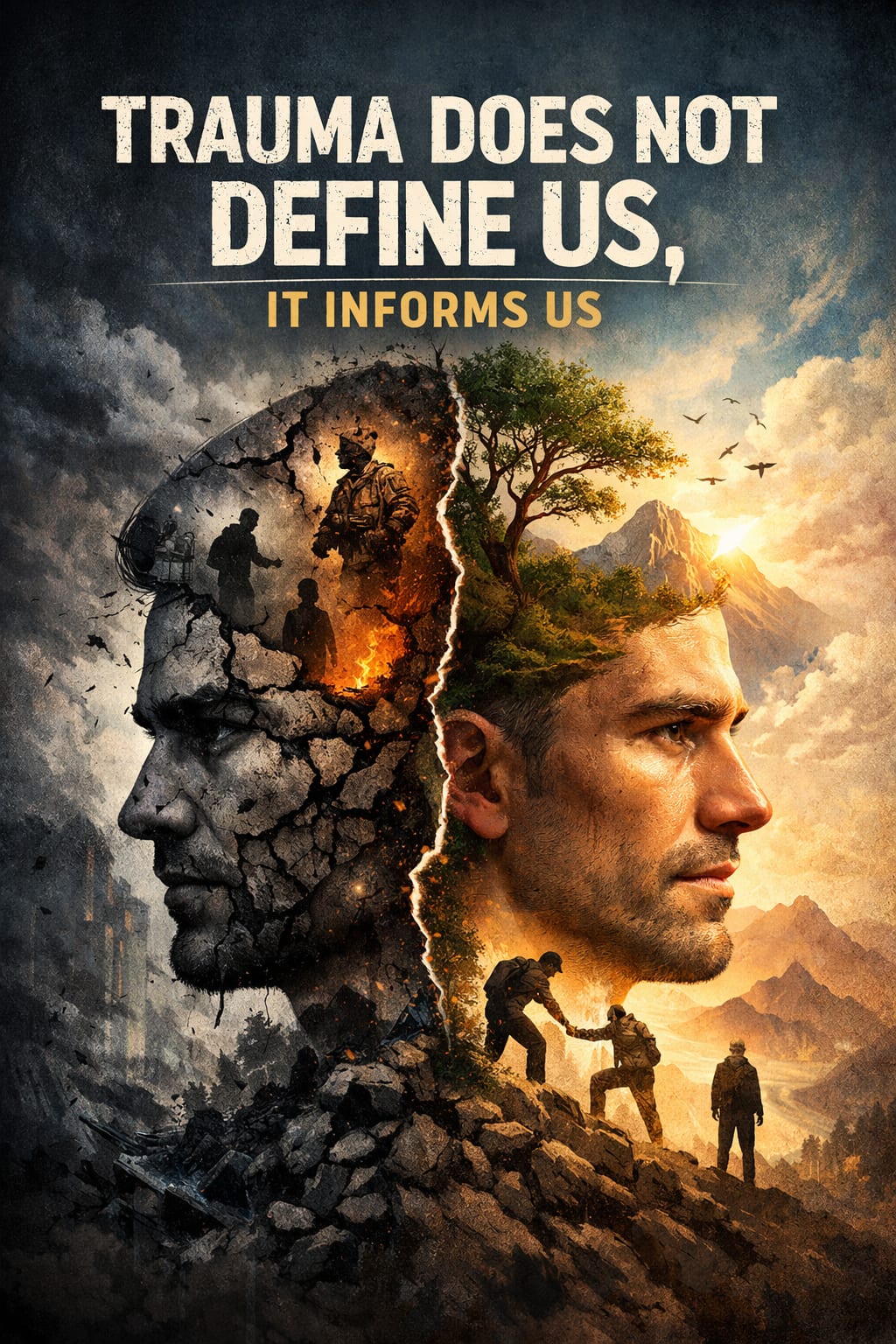
Trauma is not the story of what happened to us; it is the story of what our nervous system had to become in order to survive what happened. Most trauma occurs in childhood, long before we have the emotional intelligence or cognitive capacity to understand what we are experiencing. A child cannot interpret emotional neglect, inconsistency, chaos, or conditional love with adult clarity. A child does not think, “My parent is overwhelmed,” or “My environment is unstable.” A child thinks, “Something must be wrong with me,” “I must be too much,” “I must not be enough,” “Love is unpredictable,” “Closeness is dangerous,” or “I have to earn affection.” These beliefs do not form through logic; they form through survival. This is where responsible parenting becomes essential. A child depends on caregivers not only for food and shelter but for emotional processing. When something frightening, confusing, or overwhelming happens, a child needs an adult to help them understand the event, regulate their emotions, and move through the experience. When this does not happen, the child is left alone with feelings they cannot make sense of. They will do one of two things: they will improperly process the event, or they will not process it at all. Both outcomes lead to the same consequences later in life. Improperly processed emotions become distorted beliefs about the self. Unprocessed emotions become frozen, stored in the body, waiting for adulthood to trigger them again. In both cases, the child adapts in the only ways they know how: through fight, flight, freeze, or fawn. Fight becomes defensiveness, anger, and control. Flight becomes avoidance, emotional distance, and disappearing. Freeze becomes shutdown, numbness, and dissociation. Fawn becomes people‑pleasing, over‑accommodating, and self‑abandonment. These adaptations are intelligent in childhood, but when carried into adulthood, they become patterns that shape identity, relationships, attraction, and self‑worth. They become the architecture of the wound.
This is why therapy is so important. When we go to therapy, we are asked to talk about what is bothering us or what we think is bothering us. At first, we often describe symptoms—stress, anxiety, relationship issues, emotional triggers. But a skilled therapist listens for the deeper thread. Eventually, they guide us to the source. Once we reach the origin of the wound, the therapist helps us walk through the event carefully, safely, and slowly. In doing so, we either properly process an event that was improperly processed in childhood or finally process emotions that were never processed at all. Because trauma, at its core, is either improperly processed emotion or unprocessed emotion. Therapy helps the nervous system complete what it could not complete when we were young. It gives us the emotional intelligence we did not have at the time of the wound. It allows us to rewrite the meaning of the event, and in doing so, rewrite the patterns that grew from it.
As we grow, these early adaptations evolve into adult behaviors that often confuse us. Adults rarely say “I fear intimacy,” “I fear abandonment,” “I don’t know how to regulate my emotions,” or “I’m terrified of being seen.” Instead, they say “I’m not ready for anything serious,” “I’m bad at texting,” “I need space,” “I shut down,” “I get overwhelmed,” or “I don’t know what I want.” The wound hides behind the behavior. Modern dating amplifies these wounds because it offers endless options, low accountability, and emotional distance. People can act out their patterns without consequence. Avoidants can disappear. Anxious attachers can chase. Narcissistic defenses can thrive. People with low self‑worth can accept crumbs and call it connection. Unstable people can latch onto stable ones. The patterns we see today—ghosting, breadcrumbing, emotional unavailability, the chase dynamic, testing behavior, love bombing, hyper‑independence—are not modern inventions. They are ancient wounds wearing modern clothes. They are the adult expression of childhood survival strategies. Avoidance becomes ghosting. Anxiety becomes over‑pursuit. Shame becomes perfectionism. Fear becomes hyper‑independence. Control becomes the chase dynamic. Emotional neglect becomes emotional unavailability. Inconsistent love becomes attraction to inconsistency. Trauma creates familiarity, not compatibility. The nervous system is drawn to what it recognizes, not what is healthy. This is why people often say “I know they’re bad for me, but I can’t stop thinking about them,” or “I know they’re good for me, but I feel nothing.” The body is not confused; it is patterned. And until the pattern is understood, it repeats.
To identify trauma patterns in ourselves, we must look inward with honesty rather than judgment. We must ask whether we shut down when things get real, whether we chase people who don’t choose us, whether we avoid people who show genuine interest, whether we confuse anxiety with chemistry, whether we feel unsafe when someone gets close, whether we feel responsible for other people’s emotions, whether we tolerate inconsistency, whether we sabotage healthy relationships, whether we over‑explain ourselves, whether we fear being a burden, or whether we fear being truly seen. If the answer is yes, we are not broken—we are patterned. Patterns are learned, and patterns can be unlearned. To identify the wound, we must look for our triggers, our reactions, our fears, our avoidance, our over‑investment, our shutdowns, our emotional intensity, and our emotional numbness. These are the fingerprints of the wound.
To identify trauma patterns in others, we must observe without diagnosing. We look for inconsistency, avoidance, emotional volatility, push‑pull behavior, ghosting, testing, love bombing, lack of accountability, fear of vulnerability, hyper‑independence, boundary confusion, validation seeking, fantasy bonding, and emotional unavailability. These are not signs of bad character; they are signs of unhealed wounds. When we understand the wound, we stop taking behavior personally. We stop asking “What’s wrong with me?” and start asking “What happened to them?” This shift does not excuse harmful behavior, but it explains it. And understanding is the first step toward clarity.
Overcoming trauma patterns in ourselves requires five pillars. The first is awareness. We must name the pattern, because naming creates distance and distance creates choice. The second is regulation. We must learn to calm our nervous system, because safety is the foundation of healing. The third is opposite action. We must do the opposite of our trauma instinct, because this rewires the brain. The fourth is boundaries. We must set limits that protect our peace, because boundaries rebuild self‑worth. The fifth is identity work. We must rewrite the story we inherited, because we are not our wound. Healing is not becoming someone new; it is returning to who we were before the world taught us to shrink.
Helping others see their patterns is delicate work. We cannot force awareness. We cannot drag someone into healing. We cannot love someone into emotional maturity. But we can create conditions where awareness becomes possible. We can use calm communication, reflective statements, boundaries, consistency, and compassion without enabling. We can say “I notice you pull away when things get close,” or “It seems like this situation overwhelms you,” or “I care about you, but I can’t participate in this pattern.” We are not fixing them; we are holding up a mirror. Helping others heal is not about rescuing them. It is about offering stability, clarity, accountability, emotional safety, encouragement to seek help, and boundaries that protect both people. Healing is a personal journey, but support makes the journey possible.
In the end, healing is not loud. It is steady. It is choosing clarity over chaos, boundaries over burnout, self‑respect over chasing, consistency over intensity, truth over fantasy, and peace over patterns. Healing is the return to self. The wound is not your identity. The pattern is not your destiny. The past is not your blueprint. You can rewrite the architecture. And you will.
About the Creator
Enjoyed the story? Support the Creator.
Subscribe for free to receive all their stories in your feed.
Comments
There are no comments for this story
Be the first to respond and start the conversation.