
The Unpredictable Dance of Fate
This story is a reimagining of a classic Chinese parable about perspective and fate
In a quiet village nestled between rolling hills, there lived a farmer named Lin. His farm was small, and he owned only one horse—a strong, chestnut mare that helped him plow his fields. The villagers often pitied him for having so little, but Lin never complained. He worked hard and trusted in the rhythm of life.
One morning, as Lin opened the stable, he found the gate broken and his horse gone. The villagers gathered, shaking their heads. "Such terrible luck," they murmured. "Now you have nothing." Lin listened quietly, then simply said, "Maybe."
Two days later, Lin woke to the sound of hooves thundering across the fields. His mare had returned—but she wasn’t alone. Behind her galloped ten wild horses, their manes flowing like rivers in the wind. The villagers gasped. "Incredible luck!" they cried. "Now you’re a rich man!" Lin watched the horses with calm eyes and again replied, "Maybe."
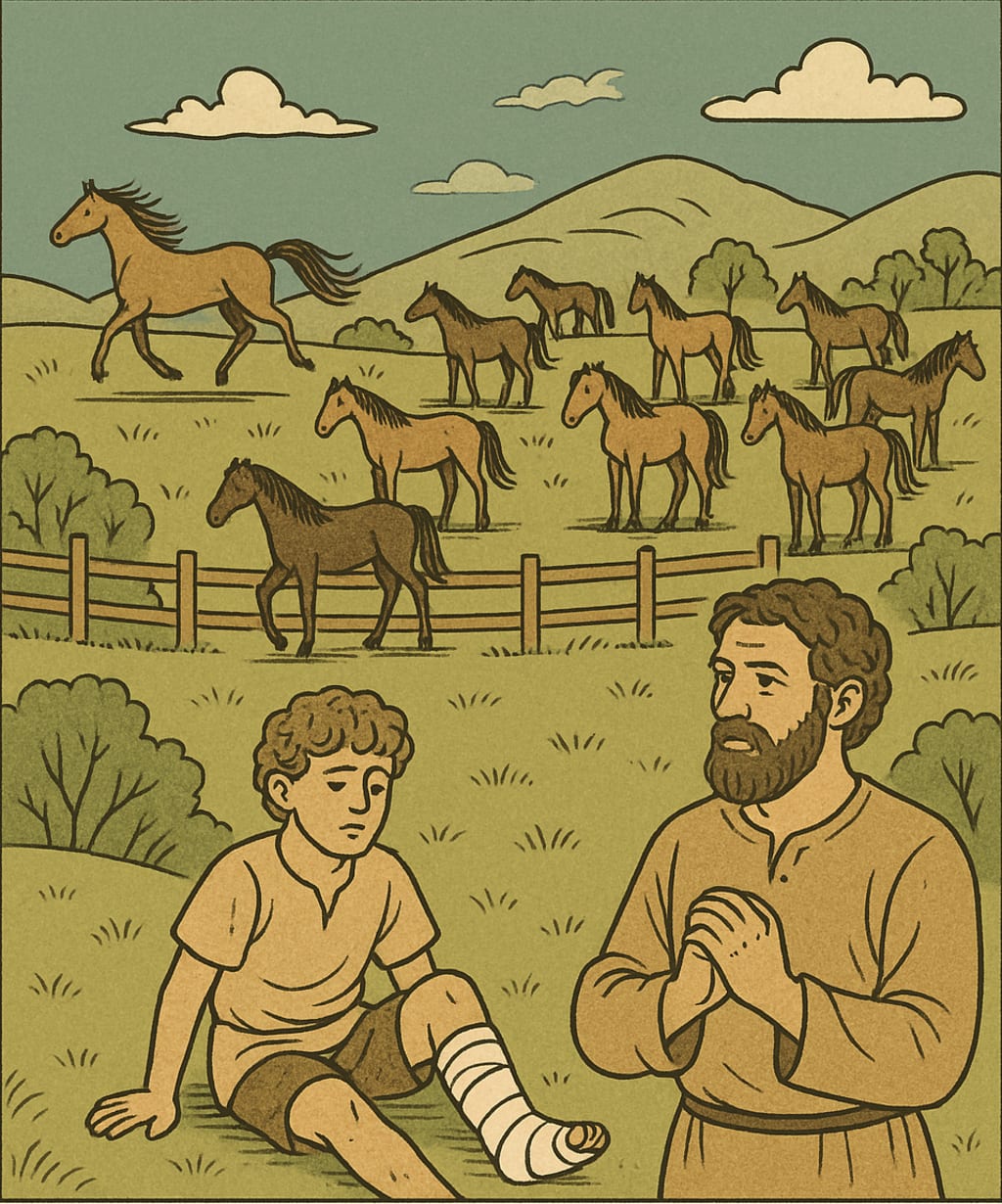
With more horses, Lin’s son, Wei, took to taming them. He was young and eager, but one afternoon, as he mounted a spirited stallion, the horse reared and threw him to the ground. Wei cried out in pain—his leg was badly broken. The villagers rushed over, their faces grim. "A curse!" they whispered. "Your only son, injured! What misfortune!" Lin helped his son inside, bandaged his leg, and once more said, "Maybe."
Weeks passed, and Wei’s leg slowly healed. Then, one evening, the village elder arrived with urgent news. The neighboring kingdom had declared war, and soldiers were coming to conscript every able-bodied young man. Families wept as their sons were taken away. But when the soldiers saw Wei’s limp, they left him behind. The villagers, now wide-eyed, turned to Lin. "Your son is spared! What a blessing!" Lin only smiled and repeated, "Maybe."
As the seasons turned, news trickled back from the battlefield. Many young men had perished, and grief hung heavy over the village. Yet Wei, though still limping, worked alongside his father, tending to the farm and the horses. The villagers, humbled, no longer rushed to judge Lin’s fortunes. They began to see what he had always known—that life was not simply good or bad, but a river of moments, each flowing into the next.
One evening, as Lin and Wei sat beneath the old oak tree, watching the horses graze, Wei finally asked, "Father, why do you always say 'maybe'?" Lin stroked his beard and gazed at the horizon. "Because life is like the wind—it changes direction without warning. What seems like loss may bring gain, and what seems like joy may carry sorrow. We cannot know, so we must learn to wait, to watch, and to trust."
Wei nodded slowly, understanding dawning in his eyes. From that day on, he, too, stopped labeling every event as fortune or misfortune. Instead, he embraced his father’s wisdom—the quiet acceptance that life’s truest meaning often reveals itself in time.
Life doesn’t come labeled as "good" or "bad." The same event that seems like misfortune today may become a blessing tomorrow—and what appears to be luck may carry hidden trials.
The farmer understood this. He knew that rushing to judge any moment robbed him of the chance to see how it might unfold. A lost horse could return with a herd. A broken leg could save a life. A curse could become a gift—or not. The truth is, we never really know.
So perhaps the wisest response to life’s twists isn’t celebration or despair, but a quiet, open-hearted "Maybe."
Because only time reveals the full story. And until then? We wait, we watch, and we learn to trust the unfolding.
About the Creator
Enjoyed the story? Support the Creator.
Subscribe for free to receive all their stories in your feed.
Comments
There are no comments for this story
Be the first to respond and start the conversation.