
The Multi-Sensory Robot: Why Sight Isn’t Enough Anymore
Physical & Multimodal AI

For decades, the robotics industry operated under a simple assumption: if a machine can see an object, it can interact with it. Driven by rapid breakthroughs in computer vision and deep learning, we built incredibly smart "brains" that could recognize items in a fraction of a second. Yet, when these same advanced AI models are placed into physical mechanical bodies, they frequently fail at basic everyday tasks. A multi-million dollar humanoid robot might perfectly identify a paper cup, only to crush it instantly upon picking it up. A state-of-the-art robotic arm might seamlessly map out a cluttered room using cameras, yet get stuck trying to open a slightly stiff door handle.
The lesson is clear: sight alone is no longer enough. As artificial intelligence transitions from digital screens into physical spaces—a field known as Embodied AI or Physical AI—machines must move beyond simple vision. To operate safely and efficiently alongside humans, the next generation of robots must learn how to feel, hear, and interpret the physical world through multiple senses simultaneously (Ko, 2026).
The Blind Spot of Camera-Only Vision

To understand why pure computer vision fails, consider how humans interact with their surroundings. If you close your eyes and reach into your pocket, you can instantly distinguish a house key from a coin based entirely on texture, temperature, and edge stiffness. A robot relying purely on cameras possesses zero innate concept of these physical realities. It sees the world as a two-dimensional grid of pixels or a three-dimensional cloud of geometric points. It can guess the weight or fragility of an object based on its appearance, but guesses are highly dangerous when interacting with the real world. Classic rigid-body robotic systems without tactile feedback exhibit operational failure or cause damage rates as high as 8% to 15% when handling delicate or irregular items like fresh produce or soft materials (Wu, 2026). If a camera gets blocked by a shadow, blinded by a reflection, or cut off by the robot’s own arm, the machine is left completely blind to its surroundings.
Enter Multimodal Sensor Fusion: Giving Robots "Common Sense"

To bridge this gap, engineers are utilizing multimodal sensor fusion. This framework combines external visual tracking data with physical feedback metrics directly inside the robot’s operating loops (Zhu, 2026). Instead of routing all instructions through a single visual processing model, modern physical AI systems integrate an array of complementary sensors:
● Tactile Skin Arrays: Using piezoresistive materials, capacitive sheets, or optical sensors (such as GelSight technology), modern robotic hands can feel microscopic shifts in surface texture and grip slip (Zhou, 2026). When a robot touches a surface, the continuous change in contact forces allows it to instantly map out material stiffness and damping characteristics (Zhou, 2026).
● Multi-Axis Force & Torque Sensors: Mounted directly in robotic wrists and joints, these devices act like human muscles. They measure the resistance an arm experiences when pulling, pushing, or twisting an object (Li, 2025). This feedback allows the robot to sense if a door is locked or if a heavy box is slipping from its grasp.
● Auditory & Acoustic Monitors: Microphones are being used to detect the exact moment a tool makes physical contact with a metal surface, or to listen to the subtle hum of a mechanical motor under heavy strain.
Sensory Processing Comparison
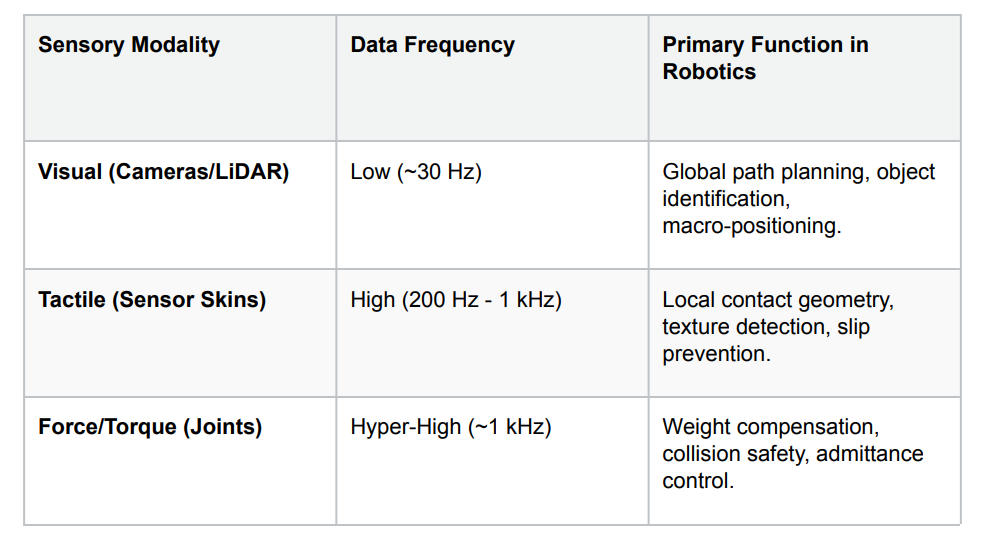
Fusing the Senses: How VLA Models Work
The true magic happens when these diverse sensory streams are unified into a single AI model. This approach is powered by Vision-Language-Action (VLA) models (Ko, 2026). In a VLA setup, visual pixels, spoken human instructions, and real-time pressure streams are converted into unified digital markers called tokens (Zhu, 2026). The AI processes these tokens together in an asynchronous pool, allowing the machine to alter its muscle movements on the fly based on what it senses (Zhu, 2026).
For example, when a mobile service robot navigates through an unstructured office space and encounters an ambiguous obstacle like a low-hanging curtain or artificial foliage, a camera-only system would classify it as a solid wall and completely change its route (Zhou, 2026).
However, by using a multimodal approach, the robot can deploy a probing arm to lightly touch the object. The tactile array analyzes the surface flex, recognizes the object as a soft, passable fabric, and safely drives straight through it. This multi-sensory approach reduces total travel distance by over 22% and mission times by more than 18% compared to traditional vision-only detours (Zhou, 2026).
Real-World Applications: From Warehouses to Surgery Rooms
The transition to multi-sensory AI is rapidly transforming several critical high-stakes industries:
● Robotic Surgery: In minimally invasive operations, surgeons cannot physically touch patient tissues. Integrating tactile arrays and multi-modal sensor fusion into Robotic-Assisted Surgery (RAS) platforms creates high-fidelity palpation feedback (Friebe, 2026). This allows the robotic system to feel tissue density variations, helping surgeons pinpoint deep tumors while preventing accidental punctures or tissue damage (Friebe, 2026).
● Agricultural Automation: Picking delicate fruits like strawberries requires constant, real-time adjustments. Synchronous visuo-tactile perception allows robotic grippers to apply the exact amount of pressure needed to pluck a piece of fruit without bruising it (Wu, 2026).
● Human-Robot Collaboration: In manufacturing and physical therapy environments, robots must work directly alongside humans. If a human unexpectedly bumps into a robot, high-frequency force sensors running at 1 kHz can instantly trigger a safety halt long before the slow visual tracking cameras even register the collision (Zhu, 2026).
The Next Frontier: Overcoming the Edge Latency Challenge
Building a truly multi-sensory robot requires solving a major computing bottleneck: latency. While a camera updates roughly 30 times per second, a robotic force sensor updates 1,000 times per second (Zhu, 2026). Sending this massive mountain of high-frequency data up to a cloud server to process and wait for a response is far too slow. A robot assistant cannot afford a processing delay when it is trying to balance a falling glass vase or catching a human patient during a physical therapy slip (Dembovski et al., 2022).
To solve this issue, the robotics industry is moving away from cloud-dependent processing and shifting toward Edge AI. By running highly compressed, efficient machine models directly on physical onboard hardware chips, robots can parse visual data and tactile responses locally. This architecture guarantees the sub-millisecond reflexes required for safe, autonomous physical contact. Ultimately, the future of embodied AI does not rely on building larger virtual models or sharper camera lenses. True physical intelligence requires building machines that can actively feel and safely interact with our complex, messy world.
___________________________________________________
References
1. Dembovski, A., Amitai, Y., & Levy-Tzedek, S. (2022). A Socially Assistive Robot for Stroke Patients: Acceptance, Needs, and Concerns of Patients and Informal Caregivers. Frontiers in Rehabilitation Sciences, 2, Article 793233.
2. Friebe, M. H. (2026). Haptic and Palpation Sensing for Robotic Surgery: Engineering Perspectives on Design and Integration. MDPI Sensors, 26(4), 1126.
3. Ko, B. C. (2026). Sensing the Action: Rethinking Sensor Modalities and Multi-Modal Fusion in Vision–Language–Action Models for Robotic Manipulation. MDPI Sensors, 26(11), 3541.
4. Li, S. (2025). Multiaxis force/torque sensor technologies: design principles. Intelligence & Robotics, 5(3), 607-630.
5. Wu, W. (2026). A Comprehensive Review of Research and Applications of Intelligent Manipulators in Agriculture. MDPI Agronomy, 16(11), 1041.
6. Zhou, Z. T. (2026). Multimodal Autonomous Navigation by Fusing Visual and Tactile Perception for Deformable Obstacle Traversal. Academic Journal of Emerging Technologies, 5(2), 84-89.
7. Zhu, D. (2026). Semantic–Physical Sensor Fusion for Safe Physical Human–Robot Interaction in Dual-Arm Rehabilitation. PMC journal of Robot Safety, 12(3), e12986929.
About the Creator
Nasir Amin
Creative content writer passionate about crafting engaging, SEO-friendly stories that connect ideas with audiences. I turn complex topics into clear, impactful, and reader-focused content.
Enjoyed the story? Support the Creator.
Subscribe for free to receive all their stories in your feed.
Comments
There are no comments for this story
Be the first to respond and start the conversation.