
The Light of Perseverance
"How Thomas Edison Turned Failure into a World-Changing Invention"
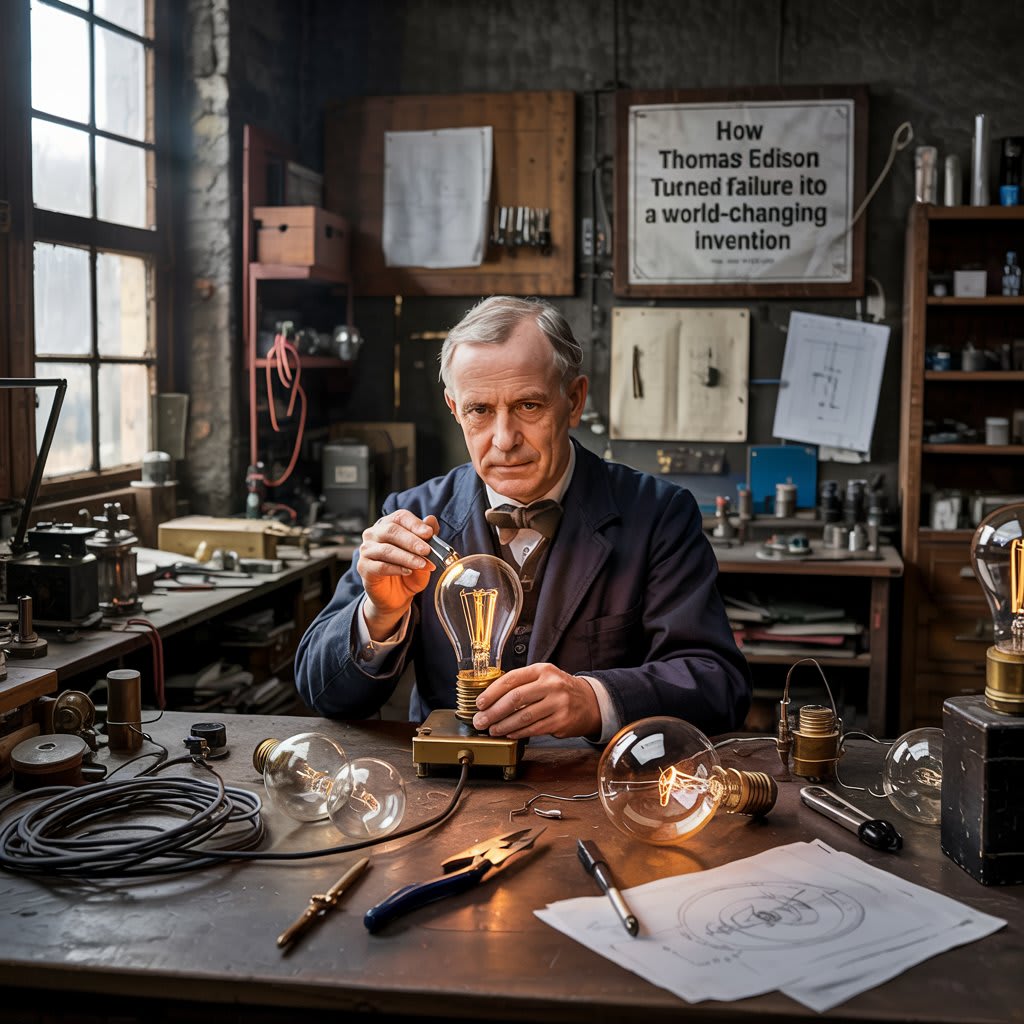
Thomas Alva Edison, one of the most prolific inventors in human history, is often celebrated for bringing light to the world — quite literally. But behind the warm glow of the incandescent bulb lies a story not just of science, but of spirit. Edison's journey is one of relentless perseverance, of refusing to be defined by failure, and of holding firm to a vision even when the world called him a dreamer. Born in 1847 in Milan, Ohio, Edison was the youngest of seven children. His early years were marked by curiosity and struggle. A bout of scarlet fever left him with severe hearing loss, and his teachers labeled him "difficult" due to his constant questioning and restlessness. He was pulled out of school after only three months of formal education. But this was no end — his mother, a former schoolteacher, took on the task of homeschooling him. This nurturing of his natural curiosity planted the seeds for his future greatness. Edison's early life was defined by an insatiable appetite for knowledge. He set up his own chemistry lab in the basement and was often found reading scientific journals, experimenting with chemicals, and taking apart mechanical devices. At 12, he began working as a newsboy on the Grand Trunk Railroad. He sold newspapers, candy, and other goods, but more importantly, he gained access to the telegraph system and eventually taught himself telegraphy. This skill would serve as a stepping stone into the world of electrical invention. By his early twenties, Edison had already secured his first patent — an electric vote recorder. Although it failed commercially, it didn't deter him. His breakthrough came in 1877 with the invention of the phonograph, a device that could record and reproduce sound. The world was stunned. Newspapers called him "The Wizard of Menlo Park," and suddenly, Edison's reputation soared. But Edison's greatest and most defining challenge was yet to come: inventing the practical incandescent light bulb. The idea of electric lighting was not new in the 1870s. Scientists and inventors had been trying to create a reliable, long-lasting light source for years. The problem was not creating light — it was sustaining it. Bulbs would either burn out quickly, require too much current, or be too expensive to manufacture. Edison saw the problem as one of materials and engineering. He believed that by experimenting with different filament materials and improving the vacuum inside the bulb, he could solve the issue. What followed was a period of unimaginable trial and error. It is estimated that Edison and his team tested over 6,000 different plant materials to find the right filament. He experimented with metals like platinum and carbonized materials such as bamboo, cotton thread, and even beard hair. His laboratory became a hive of innovation and chaos. Assistants labored around the clock, and Edison often slept on a workbench. Failure became a daily companion. Journalists ridiculed him, and competitors mocked his relentless trials. But Edison was undeterred. When asked about his failures, he famously replied, "I have not failed. I've just found 10,000 ways that won't work." This attitude is what truly sets Edison apart. In a world that often gives up at the first obstacle, he embodied the mindset that failure is not the opposite of success — it's a part of it. Finally, in 1879, after years of research and relentless persistence, Edison and his team found success with a carbonized bamboo filament that lasted more than 1,200 hours. This was the breakthrough the world had been waiting for. The light bulb was not just an invention; it was a revolution. Edison went on to create the Edison Electric Light Company and established the first investor-owned electric utility in 1882. This company laid the groundwork for the modern electric grid, fundamentally changing how people lived and worked. Streets, homes, and factories were now illuminated, extending productive hours and transforming urban life. But the story of Edison's light bulb is more than just a tale of invention. It's a testament to human perseverance. In a time without digital simulations, databases, or even modern labs, Edison relied on curiosity, persistence, and a refusal to accept defeat. He believed that solutions existed — it was just a matter of uncovering them. His journey teaches us that greatness often hides behind long corridors of trial and failure. It shows that true innovation is not the result of a single moment of brilliance but the outcome of countless hours of effort, sacrifice, and belief. Today, we flick a switch and flood our homes with light, often without a second thought. But behind that simple gesture is a legacy of unwavering determination. Edison didn’t just light up a room; he illuminated a path for dreamers, doers, and believers everywhere. The light of perseverance burns brighter than any filament, and Thomas Edison proved that it could change the world.
About the Creator
Enjoyed the story? Support the Creator.
Subscribe for free to receive all their stories in your feed.
Comments
There are no comments for this story
Be the first to respond and start the conversation.