
The Death of the Blast: How to Implement AI Email Hyper-Personalization for Scalable Growth
How AI Dynamic Content Replaces Email Blasts to Drive Business Revenue

Every day, your customers' inboxes receive millions of digital messages. Data from the Radicati Group shows that global daily email volume will exceed 392 billion messages. In this sea of noise, sending a single, generic email blast to your entire list is no longer just ineffective—it is actively damaging to your brand.
When you send an unsegmented "batch-and-blast" email, you risk losing your audience completely. Research from HubSpot reveals that over half of modern consumers will instantly unsubscribe if a brand sends irrelevant, high-frequency messages.
To survive and grow, businesses must transition to AI-driven hyper-personalization. This means moving past simple tricks like inserting a recipient’s first name into a subject line. Instead, it involves using artificial intelligence to build real-time, dynamic email experiences that adapt to individual user behavior.
1. The Core Shift: Static Blasts vs. Hyper-Personalization

Traditional email marketing relies on broad segmentation. You might group users by general attributes like location, age, or gender. This is static profiling, and it assumes that every person in that bucket wants the same content at the exact same time.
Hyper-personalization turns this model upside down. It blends advanced automation with real-time data science to change the internal structure of an email for each specific recipient.
In his foundational textbook Data-Driven Marketing, Kellogg School of Management professor Mark Jeffery emphasizes that true marketing optimization relies on managing infrastructure to track granular user interactions. AI brings this principle to your inbox by analyzing three distinct layers of data:
- Behavioral Signals: What pages did the user view? Did they abandon a specific item in their cart? How long did they spend looking at a case study?
- Contextual Data: What device are they using? What is the local weather or time zone at the exact moment they open the file?
- Predictive Data: Based on past actions, what product category are they most likely to buy next? When are they most likely to check their inbox?
2. How AI Dynamic Content Blocks Work
The core engine of hyper-personalization is the dynamic content block. Instead of coding ten different emails for ten different customer types, you build a single email template with modular sections.
When a user opens the email, your automated email system queries your central database. Within milliseconds, the AI fills those modular sections with content tailored specifically to that subscriber.
- Capture First-Party Data: Your customer relationship management (CRM) platform tracks actions across your website, apps, and previous emails. This builds a clean profile of user preferences without relying on third-party tracking cookies.
- Evaluate Behavioral Triggers: The AI algorithm flags high-intent actions. For example, a subscriber visits a B2B software pricing page twice in 48 hours but does not book a consultation.
- Assemble the Dynamic Template: The email system activates a pre-built layout. It reserves specific content frames for personalized items, such as customized case studies or unique product rows.
- Contextual Matching: The AI automatically inserts the correct case study related to the user's industry and pairs it with a call-to-action button matching their exact lifecycle stage.
3. The Real-World Growth Impact
Shifting to an AI-driven model directly transforms your business performance metrics. According to data from the Salesforce State of Marketing report, companies using predictive AI personalization experience an average 41% increase in revenue per email.
Furthermore, the operational speed gains are stark. Industry benchmarks show that while manual production of complex, multi-version email campaigns used to take marketing teams up to two weeks, automated workflows allow 94% of modern teams to deploy high-performing campaigns in just a few hours.
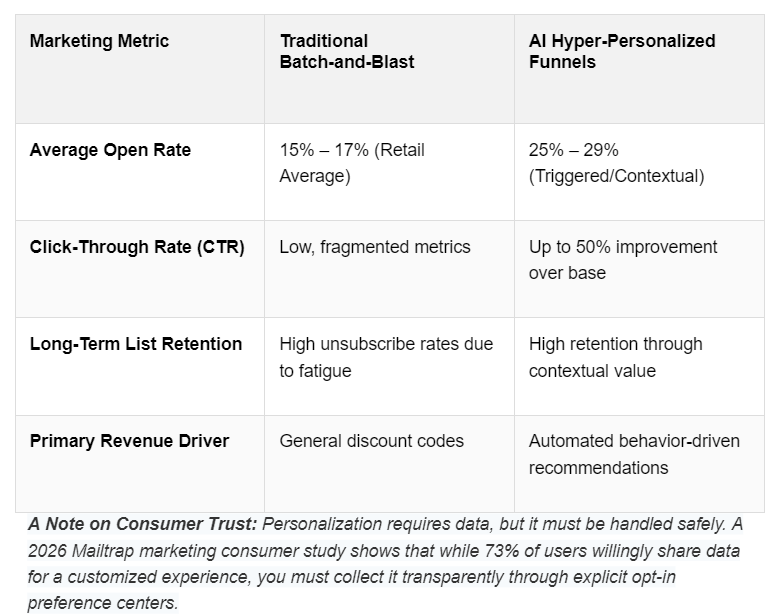
4. Steps to Implement Hyper-Personalization in Your Business

Transitioning to an AI-powered system does not have to happen overnight. You can scale your growth sustainably by focusing on a crawl, walk, run methodology.
- Clean Your Data Architecture: AI is only as good as the information it consumes. Ensure your email tool is directly connected to your primary customer database or CRM. Eliminate duplicate records and track clear behavioral events like product page visits, resource downloads, and physical checkout steps.
- Deploy One High-Intent Flow First: Do not try to personalize your entire newsletter directory on day one. Start with a single high-intent trigger, such as a Browse Abandonment flow. Configure your AI copywriter to generate three distinct variations of the subject line and body text, keeping a human-in-the-loop editor to review the final emotional tone.
- Turn on Algorithmic Send-Time Optimization (STO): Stop guessing whether your emails should go out at 9:00 AM on a Tuesday. Activate your platform's built-in STO engine. The AI will look at historical opening habits for every individual subscriber and deliver the message exactly when that specific person is most active in their inbox.
____________________________________________________
Heading References & Bibliography
- The Radicati Group. Email Market, 2022-2026. Executive summary on global daily electronic messaging thresholds and volume scaling.
- HubSpot Research. The State of Inbound Marketing and Consumer Trends Report. Analytical data on user unsubscribe behaviors linked to broadcast distribution frequency.
- Jeffery, Mark. Data-Driven Marketing: The 15 Metrics Everyone in Marketing Should Know. Kellogg School of Management, John Wiley & Sons. Infrastructure models for tracking customer behavior attributes.
- Salesforce Research. State of Marketing Report (8th Edition). Statistical analysis of conversion metrics, automated campaign velocity, and predictive AI revenue attribution.
- Mailtrap Insights. Consumer Privacy and Personalization Study (2026). Survey data evaluating user trust parameters versus dynamic content acceptance thresholds.
About the Creator
Nasir Amin
Creative content writer passionate about crafting engaging, SEO-friendly stories that connect ideas with audiences. I turn complex topics into clear, impactful, and reader-focused content.
Enjoyed the story? Support the Creator.
Subscribe for free to receive all their stories in your feed.
Comments
There are no comments for this story
Be the first to respond and start the conversation.