
The Boy Who Sold Tea on the Street Now Owns the Building Behind It
A true-to-life story of hunger, humiliation, and the kind of patience that quietly rewrites a destiny.
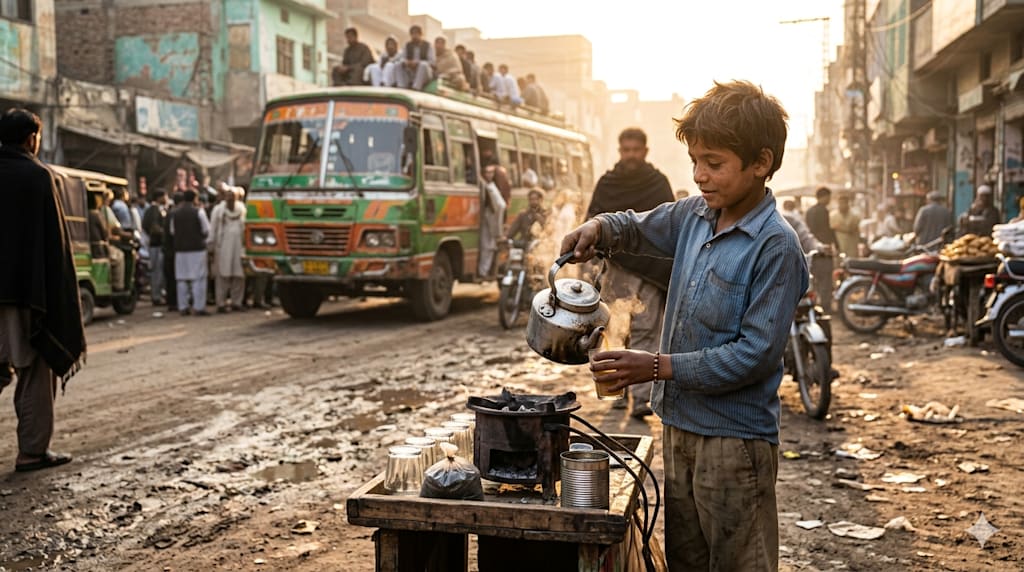
When Imran was eleven years old, he carried a kettle heavier than his own arms could comfortably hold. Every morning, before the sun fully woke up, he walked the same dusty street near the old bus stand, calling out "Chai garam!" to truck drivers, shopkeepers, and tired travelers who barely looked at his face before throwing coins into his hand. His father had passed away when Imran was just seven. His mother stitched clothes late into the night by the light of a single bulb, and there were many evenings when dinner was just water and a piece of stale bread shared between three children. Imran was the eldest. He understood early that childhood was a luxury his family could not afford. People mocked him. Some called him "chai wala" with a smirk, as if that name was the only identity he would ever deserve. Boys his age went to school with clean uniforms and shiny shoes; Imran went to the same corner every day with burnt fingertips and a kettle that never seemed to get lighter. But there was one thing Imran refused to lose — his hope. At night, after selling the last cup of tea, he would sit under a street light and read torn pages of an old English book a customer had once left behind. He didn't understand most of the words, but he memorized them anyway, repeating them under his breath like a prayer. He believed, with a strange unshakeable certainty, that one day his life would not look like this. Years passed. Imran saved every extra rupee he earned — not in a bank, because he didn't trust one yet, but in a rusted tin box hidden under his mother's sewing machine. By the time he was nineteen, he had saved enough to buy a small cart and a gas stove. No more borrowed kettle. No more standing at someone else's stall. This one was his. He worked eighteen hours a day. While other young men his age were sleeping, Imran was wiping down his cart, preparing for the morning rush, calculating profits in his head because he couldn't yet afford a calculator. Slowly, the small cart became a small shop. The small shop became a proper tea stall with seating. And the tea stall, after twelve more years of relentless work, became a chain of cafés spread across three cities.

Today, Imran owns the very building that stands where his old tea stall once was. The same bus stand where men once mocked him now has his company's name printed in bold letters above the entrance. Young boys who once called him "chai wala" with disrespect now ask him for jobs. But Imran never forgot where he came from. Every month, he personally visits the same street corner and serves tea, free of charge, to anyone who cannot afford a meal that day. Not for publicity. Not for cameras. He does it because he remembers what it feels like when nobody believes a poor boy with a kettle could ever become something more. When asked what kept him going through years of humiliation and hunger, Imran smiles and says one line that has now become his life's motto: "They laughed at my kettle. I let them laugh. I just kept boiling my hope a little longer than their patience could last." This is not just Imran's story. It is the story of every person who has ever been underestimated, every dreamer who was told to "stay realistic," and every soul who refused to let poverty define their worth. Success rarely announces itself loudly. Sometimes, it simply boils — quietly, patiently — until the whole world is finally forced to taste it.

About the Creator
Enjoyed the story? Support the Creator.
Subscribe for free to receive all their stories in your feed.
Comments
There are no comments for this story
Be the first to respond and start the conversation.