
The Algebra of Blooming
How Roots Rewrite Equations in the Cracks of the World
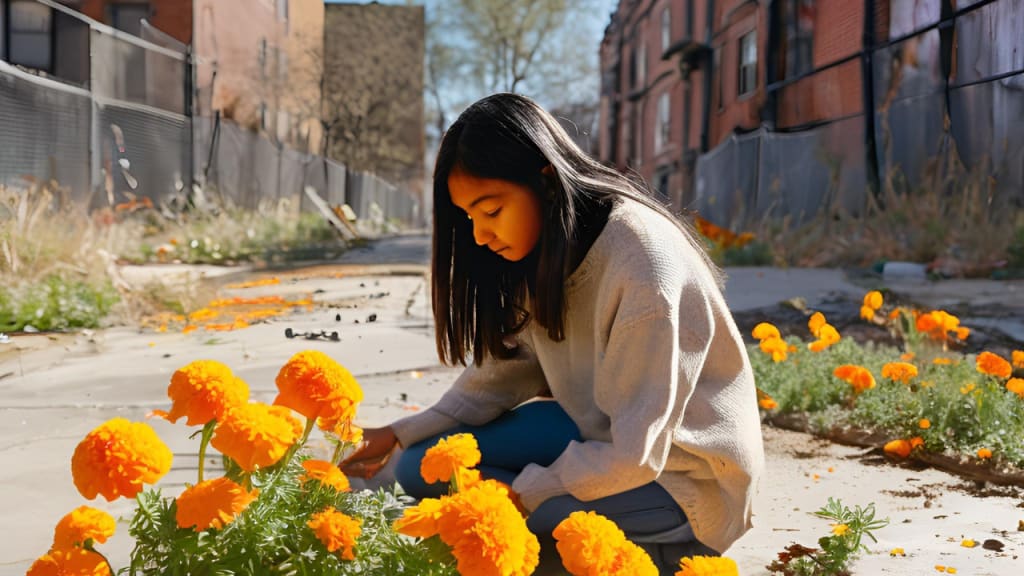
The first time I stole, it was a packet of tomato seeds. Not the dollar-store kind, but the heirloom variety Old Mrs. Kapoor sold at her nursery—seeds that had crossed oceans in the hems of saris, survived partition, outlived husbands. At twelve, I didn’t know guilt could taste like soil and stolen potential. I only knew our balcony’s concrete wept cracks where Ammi once grew tulsi, before the eviction notice, before Abbubhai’s taxi became our home.
“Roots don’t need land,” Ammi lied, her voice frayed as the prayer mat we kept under the passenger seat. She’d pour chai into a thermos lid, my schoolbooks balanced on the dashboard. “Fatima, even weeds flower through pavement. Be the weed.”
Abbubhai died the summer I turned fourteen—heart attack at a red light, still gripping the wheel. The bank took his taxi. We moved into Auntie Naseem’s garage, where cockroaches danced over Ammi’s engineering degree framed in cracked glass. “University of Punjab, 1993,” the plaque read, its gold letters mocking us as we slept on stained mattresses.
“Why keep it?” I asked once, watching Ammi polish the frame with her dupatta.
Her laughter tasted bitter, like neem leaves. “So you never forget what women carry—degrees, debts, the dumb hope that merit matters more than dowries.”
Auntie’s house smelled of bleach and regret. Her husband’s eyes followed me to the outdoor bathroom, where I learned to shower in three minutes flat. When I told Ammi, she sold her wedding necklace to buy a rusty RV parked behind the 7-Eleven. Our new home rattled with each passing truck, but the door locked from the inside.
The trailer park manager caught me digging through the community garden dumpster. “Looking for these?” Mr. Thompson dangled a jar of marigold seeds, his smile all crooked teeth and pity. I froze, potato peels clinging to my sweater.
“They’re expired,” he said, tossing the jar. It shattered against my chest. “But desperate times, eh?”
That night, Ammi rubbed aloe on my cut palms. “Shame is a rich man’s game,” she whispered, crushing aspirin into our last yogurt. “We play survival.”
I began cataloging survival tactics:
5:45 a.m. – Shower at the truck stop before men arrive
Lunch – Free cafeteria pizza by “forgetting” my wallet thrice weekly
Algebra class – Solve equations on used napkins to save notebook paper
11 p.m. – Study under streetlights while Ammi braids hair for $5 a head
Mr. Thompson’s “expired” seeds sprouted in coffee cans behind our RV. When marigolds bloomed the color of stolen sunrise, Ammi wove them into garlands sold to Hindu aunties for puja. “All gods love defiance,” she’d say, pocketing wrinkled dollars.
The college fair poster haunted our Walmart bulletin board: “Full STEM Scholarships – Apply Now!” Ammi stared at it like it was the Quran and she’d forgotten how to pray. That night, she didn’t come home. I found her at the 24-hour Laundromat, scrubbing blood from a stranger’s sheets.
“Three years’ tuition,” she said, hands raw from bleach. “The nurse pays cash.”
I ripped the gloves off her. “We’re not servants!”
Her slap left a crescent moon of detergent burns on my cheek. “You think beggars choose their bowls? I’ve licked cleaner floors than these to feed you. Now study.”
Senior year, I became a equation:
4.0 GPA + 3 jobs = 1 college application fee
(Tears x Silence)^2 = Valedictorian speech
Racist counselor’s “community college” advice – (Ammi’s slipper thrown at his head) = Smith College acceptance letter
The night scholarships were announced, Ammi burned her engineering degree in our campfire. “Light needs no frame,” she said, feeding the flames. I watched her dreams turn to smoke, breathing in their ghost.
Move-in day smelled of new textbooks and old shame. Ammi wore her last good shalwar, washed in the gas station sink. When my roommate’s mother eyed our plastic trash bag of belongings, Ammi declared, “Fatima’s allergic to closets. Traps ambition.”
They gave us six months to “adjust.” By Thanksgiving, I’d memorized the custodial schedule to shower after hours. Ammi’s letters came weekly, written on Burger King receipts:
“Sold RV. Don’t worry—sleeping at Fatima’s Hair Salon (they have AC!). Enclosed $20. Buy apples. P.S. Tell those rich boys you’re allergic to diamonds. Only trust men who bring soil.”
Junior year, the robotics lab became my lover. While classmates partied, I taught circuits to sing Urdu lullabies. My solar-powered irrigation model won MIT’s innovation prize—$50,000, awarded the same week Ammi’s cough turned into a symphony of broken bagpipes.
Stage IV. The oncologist avoided my eyes. “Complications from… prolonged chemical exposure.”
In the trailer-turned-hospital-room, machines sang the song of dying. Ammi’s hands, once swift with henna needles, now trembled tracing my face. “Don’t let them bury me,” she rasped. “Plant me where the pavement cracks.”
I learned final equations:
1 mother’s lifetime = 27 vials of morphine
Grief ÷ Time = ∞
1 fistful of ashes + concrete = rebellion
Today, a solar panel farm hums where our RV once parked. My engineers call it “urban renewal.” I call it Ammi’s Garden. Beneath each photovoltaic bloom, marigolds push through reinforced concrete—hybrid flowers fed by ashes and algorithms.
At the inauguration, a girl in Walmart sneakers lingers by the display. “They’re weeds,” her mother sneers, tugging her away.
I press a seed packet into the girl’s palm. “The best kind,” I whisper.
Somewhere, Ammi laughs in the language of broken English and unbroken dreams. Somewhere, a flower cracks a sidewalk. Somewhere, a weed becomes a wonder.
The world tried to bury us. It didn’t know we carried the algebra of blooming—the exponential power of roots taught to hunger for light.
About the Creator
SANA ULLAH
Turning life’s whispers into tales that linger. Romance, mystery, fantasy, or raw reality—my words paint worlds you’ll crave to inhabit. Dive into stories where you become the character, and every chapter feels like a heartbeat
Enjoyed the story? Support the Creator.
Subscribe for free to receive all their stories in your feed.
Comments
There are no comments for this story
Be the first to respond and start the conversation.