
Preface
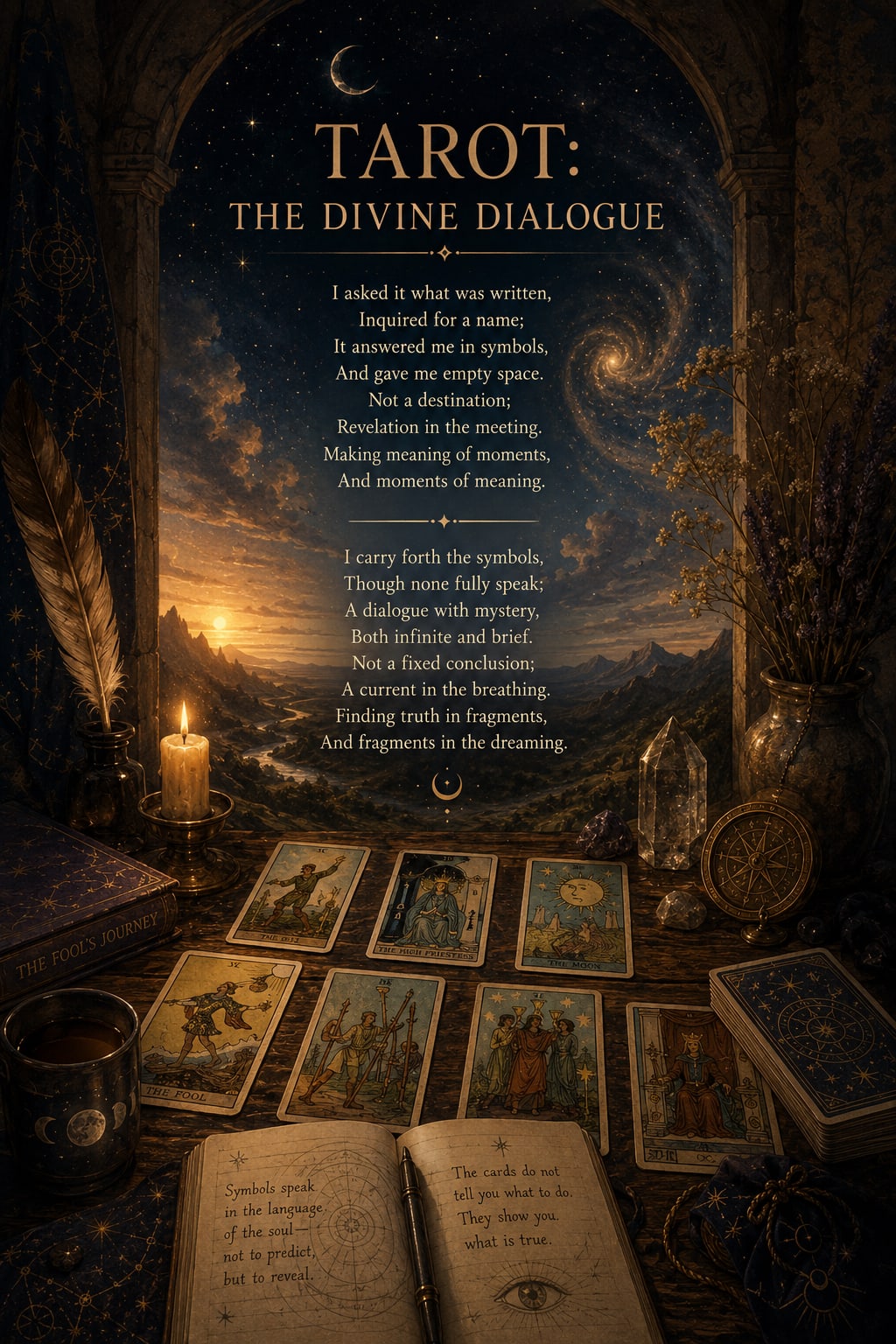
“I asked it what was written,
Inquired for a name;
It answered me in symbols,
And gave me empty space.
Not a destination;
Revelation in the meeting.
Making meaning of moments,
And moments of meaning.”
This is not a book about Tarot cards.
It is a book about the conversation that becomes possible when you pick them up.
There is a story most people have been told about Tarot - about fortune tellers and fixed fates, about darkness and superstition, about a mysterious stranger who knows something you don't. That story is not without atmosphere. But it is, in almost every way that matters, wrong.
What follows is an attempt to tell a truer one.
Not a manual. Not a mystical authority speaking from above. These are essays - explorations, really - written in the belief that Tarot is a living language, and that like all languages, it rewards those who come to it not with demands, but with questions.
You do not need to believe anything in particular to read this. You need only be willing to sit with a symbol and let it speak. You need only be open to the possibility that the answers you're looking for might arrive not as declarations, but as dialogue.
The cards will not tell you what is written.
But they may help you learn to read.
The Wrong Story
There is a silhouette most people conjure when they hear the word Tarot. She sits across a small table draped in velvet. Candlelight. Rings on every finger. She turns a card and her expression shifts - knowing, grave - and she tells you something is coming. Something you cannot stop.
This image is so pervasive it has become almost architectural. It holds the whole practice inside it like a room with no windows, and most people have never thought to look for a door.
The silhouette is not entirely invented. There have always been those who use mystery as theater, who dress uncertainty in costume and sell it as certainty. But the myth that grew around them - that Tarot is a system for receiving bad news from the universe, that the cards carry power unto themselves, that some among us are gifted with access to a force the rest cannot touch - this is not Tarot. This is a story about Tarot. And it has done considerable damage.
Consider the card known as The Devil.
In the Rider-Waite tradition, he looms - horned, winged, enthroned above two figures in chains. To the uninitiated, it reads as threat. An omen. Evidence that the deck dabbles in something dangerous.
But look more closely. The chains around the figures' necks are loose. They could remove them. The Devil does not hold them - they stand there, bound by their own stillness, their own belief in the binding. The card is not a warning that evil is coming for you. It is a mirror, reflecting the places where you have surrendered your agency to something you've decided is larger than yourself. A habit. A fear. A story you keep telling about who you are and what you're capable of.
There is no Devil in Tarot. There is only the question: what have you chained yourself to, and do you know you could let go?
This is what the myths cost us. Not just a misreading of one card, but an entire misunderstanding of what the practice is for.
The words themselves have been similarly distorted.
Magic. Spiritual. Divine. Each one arrives trailing centuries of misuse - co-opted by institutions, weaponized by charlatans, dismissed by skeptics, romanticized beyond recognition. To call something magical, in common usage, is either to trivialize it or to place it outside the bounds of the real. To call yourself spiritual is to risk being heard as vague, as escapist, as someone who has opted out of rigorous thinking.
But consider what these words actually point toward.
Energy is real. It moves through everything - through matter, through relationship, through thought and intention and the charged silence between two people who understand each other without speaking. The cosmos is not a static backdrop. It is a living system of constant exchange, cycling and flowing in patterns older than language. This is not mysticism. This is physics, and philosophy, and the direct experience of anyone who has ever stood in a forest, or fallen in love, or felt the particular weight of a room where something significant has just happened.
Magic is not a force that exists apart from reality. It is reality, perceived with full attention.
We are not separate from it. We are made of it, moving through it, generating it with every thought, every choice, every act of genuine attention. The tools we use - cards, stones, symbols of any kind - do not create this energy. They conduct it. A deck of Tarot cards is paper and ink until human hands bring intention to it. It may hold impressions of the energy that has moved through it, the way a beloved object carries the warmth of everyone who has held it. But the source was never the object. The source is always the person.
This matters because it changes everything about what a reading is.
If the cards are the magic, then you are a passive recipient - waiting to be told, hoping the news is good, vulnerable to whoever holds the deck. If you are the magic, then a reading is something else entirely. It is a conversation you are having with your own deep knowledge, with the patterns alive in your present moment, with the current of reality as it moves through you right now.
The fortune teller's Tarot is something done to you.
This Tarot is something you do with yourself.
That is the wrong story, and this is where we leave it.
What follows is an attempt at a truer one - not a replacement myth, but a living language. Not a system of answers, but a practice of better questions.
The cards are waiting.
So is the conversation.
We Are the Magic
Begin with what you know.
You have felt it - the atmosphere of a room that changes when someone enters it. The particular silence after a difficult conversation. The way certain places hold grief, or joy, or the residue of something that happened long before you arrived. You have felt the pull of a decision before you understood it intellectually. You have known things without knowing how you knew them.
You did not imagine this. You were not being irrational or romantic or imprecise. You were perceiving something real - the energetic texture of the world, which is always present, always moving, available to anyone willing to pay attention.
This is where Tarot begins. Not in the cards. In you.
There is a current running through everything.
Not metaphorically. Not as a comforting idea to hold in difficult times. The universe is not a collection of separate objects moving through empty space - it is a living system of relationship and exchange, in which everything participates, in which nothing is truly still. Energy moves through matter and through meaning. It flows between people, through places, across time. It responds to intention the way water responds to stone - not always visibly, not always immediately, but always.
We are not observers of this system. We are expressions of it.
Every thought you think is an energetic event. Every choice you make shifts the current, however slightly, in ways that ripple outward in patterns too complex to fully trace. When you act with intention - when you bring genuine awareness to what you are doing and why - you are not simply going through motions. You are participating in something ancient and precise. You are practicing a kind of fluency in the language the universe has always been speaking.
This is what magic is.
Not the impossible made real. Not powers reserved for the gifted few. Magic is the capacity - available to all of us - to perceive the current, harmonize with it, and act within it with awareness. It is what happens when intention meets attention, and both are fully engaged.
The misunderstanding runs deep, and it runs in two directions.
On one side: those who dismiss the unseen entirely, who reduce experience to what can be measured and repeated in controlled conditions, who mistake the limits of current instruments for the limits of reality itself. They are not wrong to demand rigor. They are wrong to assume the map is the territory.
On the other: those who place magic outside the material world entirely - who make it supernatural, which is to say, above or beyond nature, operating by different rules. Who treat it as rare, as dangerous, as the province of special people with special access. This version of magic requires intermediaries. It creates hierarchy. It tells you that the power is somewhere other than where you're standing.
Both are wrong in the same way. Both locate magic somewhere other than here.
Here is what is true: there is no supernatural. There is only the natural, most of which we do not yet fully understand. Magic is not the exception to reality. It is reality, operating at a frequency we are still learning to hear.
And Tarot is one instrument for learning to hear it.
The cards are paper. Ink and pigment pressed onto stock, cut into rectangles, shuffled by hands. There is nothing inherently magical about them, any more than there is something inherently musical about wood and wire before someone makes a violin of them.
But bring intention to them. Bring your full presence, your genuine question, the weight of what you are actually carrying - and something happens. Your energy moves through them. The symbols surface that are already alive in you. The pattern that emerges in a spread is not random in the way a coin flip is random. It is responsive - to you, to this moment, to the current running through your life right now.
Objects can hold impressions of the energy that has passed through them. A deck used with care and consistency develops a kind of resonance - not power unto itself, but familiarity, like a path worn smooth by use. This is why practitioners cleanse their tools, why some are protective of who handles their cards. Not because the deck is sacred in isolation. Because what has moved through it is.
The magic was always yours.
This changes the nature of the practice in ways that are difficult to overstate.
If the cards are oracles and you are a supplicant, then your role is to receive - passively, hopefully, gratefully or fearfully depending on what arrives. You are subject to the reading. The power is elsewhere.
But if you are the source - if the energy that animates the reading flows from you, through the symbols, and back to you as reflection - then you are never a passive recipient. You are a participant. An author, of sorts, reading your own deep text.
This does not make the reading less meaningful. It makes it more. Because what surfaces is not some external authority's judgment of your life. It is your own knowing, made visible. Your own patterns, held up to the light. Your own current, translated into a language you can sit with and respond to.
The universe is not delivering a verdict.
It is continuing a conversation.
And you have always been the one it most wanted to speak with.
A Living Language
Every language begins as metaphor.
Before there were words for grief, someone gestured at their chest. Before there were words for time, someone pointed at the sun and traced its arc across the sky. The first human languages were not abstractions - they were bodies in relationship with the world, reaching for symbols that could carry what direct speech could not.
Tarot is older than its cards. It is as old as the human impulse to make meaning from pattern - to look at the shape of clouds, the flight of birds, the arrangement of stars, and feel that something is being communicated. Not because the clouds intend to speak, but because we are meaning-making creatures, and meaning flows wherever attention is genuinely directed.
The cards formalized this impulse. Gave it structure, gave it symbols, gave it a grammar. But the language was already in us.
A symbol is not a sign.
A sign points to one fixed thing. An arrow on a road means turn here. A symbol opens. It contains multitudes simultaneously, and different multitudes depending on who is looking, and from where, and what they are carrying when they arrive.
The Moon, in Tarot, is not a fact. It is a field. It holds the unconscious and the cyclical and the deceptive and the intuitive and the liminal all at once - and which of these rises to the surface in a reading depends entirely on the question, the context, the reader, the moment. This is not vagueness. This is precision of a different order. The symbol is precise because it is alive, because it responds.
This is why Tarot cannot be reduced to a dictionary of meanings. Those books exist - card one means this, card two means that - and they have their uses, particularly for beginners finding their footing. But they are training wheels, not the destination. A fluent reader does not look up words. They listen for the way the symbols are speaking to each other, to the question, to the person sitting across from them. They read the living sentence, not the isolated terms.
And here is where imagination enters - and where it is most commonly misunderstood.
There is a persistent anxiety among those new to Tarot, and even among some practitioners, that imagination contaminates the reading. That if the meaning you find in a card is something you brought with you - something your own mind generated - then it isn't real. It isn't the true message. You have gotten in the way.
This is exactly backwards.
Imagination is not interference. It is the interface.
The symbols in Tarot do not transmit meaning the way a radio transmits a signal - a fixed message sent from a fixed source, received correctly or incorrectly. They function more like a catalyst. They create the conditions for meaning to emerge from the contact between the symbol and the consciousness encountering it. Your imagination is not adding noise to the signal. Your imagination is the signal, activated.
Think of it this way. A mirror does not generate your face. But without the mirror, you cannot see it. The cards do not generate your knowing. But without the cards - without the structured invitation of the symbols, the ritual of the spread, the deliberate act of asking - that knowing might remain submerged, unexamined, unavailable.
Imagination is how the deeper self speaks. When a card surfaces an image, a feeling, a memory you didn't expect - when you look at the Eight of Swords and suddenly understand something about your own life you had not consciously articulated - that is not fantasy. That is recognition.
Like remembering something you didn't know you knew.
The reading, then, is a translation.
Not a transmission from an external authority, but a rendering into language of something that was already present - in you, in the moment, in the living texture of your current reality. The cards provide the vocabulary. You provide the grammar, the context, the act of interpretation that turns symbol into sentence, sentence into meaning, meaning into something you can carry forward and act on.
This is why two people can draw the same card in the same position and receive entirely different - and entirely valid - readings. The symbol is constant. The consciousness encountering it is not. The meaning lives in the meeting.
It is also why the reading changes you. Not because the cards have power over you, but because the act of genuine interpretation is itself transformative. To sit with a symbol and ask what it means - really ask, without demanding a comfortable answer - is to practice a kind of radical honesty with yourself. The cards become a space where you are allowed to know what you know.
There is a word for what happens in that space.
Not fortune-telling. Not prophecy. Not even divination, exactly, though that word is closer - divinare, to foresee, but also, in its older roots, to be inspired, to be in contact with something larger than the individual self.
Dialogue.
A living language requires two participants. The symbols speak. You respond. They reflect your response back. You interpret the reflection. And in that exchange - that back-and-forth between the pattern laid out before you and the consciousness you bring to it - something emerges that neither could have produced alone.
Not a message delivered.
A meaning made.
And making meaning, it turns out, is one of the most profoundly human things we can do - and one of the most magical.
The Branching Moment
Time is not a corridor.
We speak of it that way - the past behind us, the future ahead, the present a single point of contact between the two. It is a useful metaphor for scheduling and memory. It is a poor metaphor for reality.
The present moment is not a point. It is a field of possibility, alive in all directions simultaneously. What we call the future is not a fixed destination waiting at the end of a straight line. It is a set of probabilities, branching and rebranching with every choice, every action, every shift in attention or intention. Some branches are more likely than others. Some paths have so much momentum behind them that they feel, from the inside, like inevitability.
They are not inevitable. They are simply well-established.
This is where Tarot enters - not as a window onto a fixed future, but as an instrument for reading the present momentum clearly enough to understand where it is likely to lead.
A reading is a snapshot.
Not of what will happen, but of what is happening - the currents alive in you right now, the patterns you are living inside of, the direction your accumulated choices are carrying you. If you continue on this path, making these choices, operating from these assumptions, the reading reflects the most probable destination. Not because the future is written, but because trajectories are real, and a skilled reader can feel them.
This is what genuine predictive reading actually is. Not prophecy. Probability made visible.
And here is the extraordinary thing about probability made visible: the moment you see it, it changes.
Consider what happens when a reading lands.
You ask a question. The cards surface a pattern. Something in it resonates - perhaps uncomfortably, perhaps with a recognition that bypasses your defenses and lands somewhere deeper. You receive this information. And whether you consciously remember it in the days that follow, whether you act on it deliberately or file it away or resist it entirely - it has entered you. It has become part of the field from which your future choices will emerge.
You cannot unsee what you have seen.
And because your choices will be subtly different - because the information has shifted something, however slightly, in the way you perceive your situation - the future that was being reflected back to you is already no longer quite the same future.
The prediction, in the act of being perceived, begins to dissolve.
This is not a flaw in the practice. It is the practice working exactly as it should.
Tarot that aims to predict a fixed outcome has already misunderstood its own nature. The reading is not a forecast to be awaited passively, a verdict to accept or dread. It is an intervention. A moment of clarity inserted into the stream of an unfolding life, which by its very presence alters the stream.
This is why the question matters so much - more than almost anything else in a reading. If you come asking what will happen, you are positioning yourself as a passenger. The future is something arriving at you, and the cards will tell you what to expect. But this framing contains a fundamental error: it assumes the future is being generated somewhere other than here, by forces other than you.
If instead you come asking what is alive in me right now - what patterns am I living inside of, what momentum am I carrying, what branch am I on and do I want to stay on it - then you are not a passenger. You are the driver. The reading becomes navigational rather than oracular. It serves your agency rather than replacing it.
Destiny, then, is not something that happens to you.
It is something you are continuously making, in every moment of choice - including the moments so small and automatic that they barely feel like choices at all. The accumulated weight of your attention, your habits, your beliefs about what is possible - these are the real architects of your future. They establish the trajectory. They determine which branches are even visible to you.
What Tarot can do is make the trajectory conscious. Hold it up where you can see it. Give you the chance to ask: is this the branch I'm meant to be on? Is this momentum mine, or did I inherit it? If I could choose clearly, right now, would I choose this direction?
These are not small questions.
They are, in fact, the only questions that have ever mattered.
Multiple timelines are not science fiction. They are the lived experience of anyone who has ever stood at a crossroads and felt the weight of both directions simultaneously - who has understood, in their body, that both futures are real until the moment of choosing, and that the choice itself is the act of creation.
Every reading is conducted at a crossroads.
Not to tell you which path is destined. But to illuminate where each one leads, what you are carrying, and what it would mean to choose with your eyes open.
The future is not written.
It is being written.
By you.
Now.
The Right Question
A question is not a neutral thing.
Every question contains assumptions. It frames what kind of answer is possible, what territory is being entered, who holds the power in the exchange. Will he come back? assumes the outcome is already determined and you are waiting to be told. What do I actually want from this relationship? assumes you are a person with interior knowledge worth consulting. The first positions you as subject. The second positions you as source.
Most people come to Tarot asking the wrong questions. Not wrong because they are stupid or unworthy, but wrong because they have been taught - by the myth, by the silhouette, by the whole apparatus of fortune-telling - that Tarot is a system for receiving answers from somewhere outside themselves. And so they ask accordingly. They ask for verdicts. They ask for reassurance. They ask, in essence, to be relieved of the uncertainty of being alive.
Tarot cannot do this. Nothing can.
But Tarot can do something far more valuable, if you come to it with the right question.
There is an art to asking.
It requires, first, a willingness to be honest about what you actually want to know - which is often not the same as what you think you want to know. The surface question and the real question are frequently different creatures. Will I get the job? might really be Am I good enough? or Do I actually want this, or am I pursuing it because I think I should? or What am I afraid will happen if I don't get it?
The surface question asks for a prediction. The real question asks for a mirror.
Part of the practice of Tarot - part of what makes it genuinely useful over time - is learning to feel the difference. To sit with your initial question and ask: what is underneath this? What am I actually trying to understand? Often, by the time you have found the real question, you have already begun to find the answer. The cards become confirmation, deepening, elaboration - rather than the source of knowledge you were waiting for someone else to hand you.
This is not always comfortable. Real questions have weight. They require you to admit what you are uncertain about, what you are afraid of, what you have been avoiding looking at directly. A good question for a Tarot reading is often one that makes you slightly nervous to ask - because it is close enough to something true that the answer might actually change something.
There are also questions Tarot should not answer.
Not cannot - should not. The distinction matters.
Tarot can surface patterns, tendencies, energies, and probabilities around almost any subject. In the hands of an unskilled or unethical reader, it can be made to seem like it is answering questions it has no business answering - delivering verdicts on other people's intentions, pronouncing fixed outcomes, confirming fears in ways that create rather than clarify them.
The question is my partner being faithful? is not a Tarot question. Not because the cards cannot produce an evocative response, but because the question asks for surveillance of another person's interior life - which is not available to the cards, and not the reader's to access. What is available is your experience, your intuition, your pattern of feeling in this relationship. What do I need to understand about what I am feeling right now? is a question the cards can genuinely meet.
The question when will I die? is not a Tarot question. Neither is any question that asks the cards to remove the fundamental uncertainty of being human - because that uncertainty is not a problem to be solved. It is the condition that makes choice meaningful.
A reading that attempts to eliminate uncertainty does not liberate you. It replaces your agency with someone else's authority.
The questions that Tarot answers best are the ones that return you to yourself.
What am I not seeing clearly?
What am I carrying that no longer serves me?
What does this situation require of me that I have been reluctant to give?
What is the next right thing?
These questions are not passive. They assume you are capable of knowing, of changing, of acting. They treat you as the protagonist of your own life rather than a supporting character in a story being written elsewhere. They are, in their way, acts of courage - because they open rather than close, and an open question can lead anywhere.
There is a particular quality of attention that the right question creates.
Not anxious scanning for confirmation of what you fear. Not desperate searching for permission to do what you already know you want to do. Something quieter than both - a genuine willingness to receive what is actually there, rather than what you hoped or dreaded would be.
This quality of attention is, in itself, a kind of magic. It is the same attention a great listener brings to a conversation, the same attention a scientist brings to an unexpected result, the same attention a poet brings to the moment just before language arrives. It is the attention of someone who has decided, at least for now, to be more interested in truth than in comfort.
Tarot rewards this attention. It has very little to offer the person who has already decided what they want to hear.
But to the person who arrives genuinely open - who has found the real question underneath the surface question, who is willing to sit with a symbol and let it speak without rushing to close the meaning down - the cards become something extraordinary.
Not an oracle pronouncing judgment.
Not a mirror flattering you with your own reflection.
Something more like a conversation with a very wise, very patient presence that has no investment in your comfort and every investment in your clarity.
It will not tell you what is written.
But it will help you learn what questions are worth asking.
And that, it turns out, is most of the work.
The Ethics of the Unseen
Power requires accountability.
This is not a complicated idea. It is, in fact, one of the oldest ideas we have - present in every tradition that has ever taken seriously the question of how human beings ought to treat one another. And yet it is an idea that the world of intuitive and energetic practice has not always honored. There are readers who have used the authority of the unseen to control, to frighten, to create dependency, to profit from vulnerability. There are practitioners who have mistaken their own projections for divine transmission, and delivered those projections with a certainty that left no room for the person on the receiving end to disagree.
This is not a small problem. It is the reason many people arrive at Tarot wounded before they begin - burned by a reader who told them something they couldn't unhear, shaped by an experience that replaced their own knowing with someone else's authority.
Ethics in this practice is not bureaucratic. It is not a list of rules designed to limit what you can do. It is the recognition that when you sit across from someone who is genuinely open, genuinely vulnerable, genuinely hoping for clarity - you are holding something precious. And precious things require care.
The first principle is consent.
Not as formality - not the casual assumption that because someone has booked a reading they have consented to anything that might emerge from it. Genuine consent is specific, informed, and ongoing. It means the person knows what kind of reading they are receiving, what the reader's approach is, what will and will not be addressed. It means checking in when the reading moves into sensitive territory. It means understanding that consent can be withdrawn at any moment, that a person can say I don't want to go further with this, and that the right response is always to stop.
Curiosity is not consent. Concern is not consent. The fact that you, as a reader, sense something that feels important does not give you permission to pursue it uninvited. Intuition is not permission.
This principle extends beyond the reading room. It extends to the practice of reading people energetically in casual contexts - at a party, in conversation, because you noticed something and wanted to explore it. The capacity to perceive is not the right to intrude. What you can sense about a person belongs to them, not to you. Enter only where you are invited.
The second principle is humility.
Every perception is filtered through the consciousness of the perceiver. This is not a weakness to be overcome - it is a fact to be honored. When you read for someone, you are not receiving pure transmission from an objective source. You are interpreting symbols through the lens of your own experience, your own associations, your own unresolved material. The reading is a collaboration between what is genuinely present in the other person and what your particular consciousness is capable of perceiving and articulating on any given day.
This means naming your limits. Saying I'm not certain about this when you're not certain. Saying this may be my own projection when something feels more personal than universal. Saying I don't know when you don't know, rather than filling the silence with performance.
There is a particular temptation in this work toward drama - toward the charged pause, the grave pronouncement, the suggestion that you are receiving something extraordinary. This temptation is understandable. Mystery is compelling. Certainty is reassuring. People often want to be told something remarkable.
But clarity is more valuable than theater. And a reader who prioritizes the appearance of power over the genuine service of the person in front of them has already lost the thread of what this practice is for.
The third principle is sovereignty.
Every person who sits across from you is the ultimate authority on their own life. Not you. Not the cards. Not the reading, however resonant it feels, however precisely it seems to name what they are living through.
Your role is to witness and reflect - not to direct, not to rescue, not to override. You offer insight. You do not offer control. You invite awareness. You do not create dependency.
This distinction is not always easy to hold. There are moments in a reading when you can see something clearly - a pattern, a tendency, a place where someone is causing themselves harm - and the impulse to intervene, to fix, to steer is strong. It feels like care. Sometimes it is care. But care that overrides another person's autonomy is not, finally, care. It is a subtler form of the same problem it is trying to solve.
The work is to offer what you see as clearly and honestly as you can, and then to let the person do what they will with it. Their process, their timing, their lessons - even when they differ from what you would choose for them - are theirs. Trust that. Respect it even when it is difficult.
The fourth principle is what might be called integration over dependence.
The goal of a reading is not to make someone need another reading.
This sounds obvious. It is, in practice, one of the most important boundaries in the work - because dependency can develop gradually, imperceptibly, in ways that feel to both parties like deepening relationship or ongoing support. A person returns again and again, not because they are growing in clarity but because the readings have become a substitute for their own discernment. The reader has become an authority they consult rather than a mirror they use.
A reading done well should ultimately return a person to themselves. It should increase their trust in their own perception, their own knowing, their own capacity to navigate. If a reading leaves someone more dependent on external guidance than they were before, something has gone wrong - regardless of how accurate or resonant the content was.
This means, sometimes, saying directly: you already know this. You don't need me to tell you. It means resisting the pull toward being needed. It means measuring the success of the work not by how much someone values your reading, but by how much more they value their own knowing afterward.
There are questions this work will not answer.
Not because the cards are incapable of producing a response, but because some questions should not be asked of anyone other than the person themselves - and some answers, even if available, cause more harm than the uncertainty they replace.
The interior life of another person is not available to you without their consent. Fixed pronouncements about health, death, or irreversible outcomes have no place in ethical reading - not because the future is unknowable, but because declaring it known removes the one thing that makes the future worth engaging with: the possibility of choice.
What a reader can always legitimately offer is this: here is what is present in this moment. Here are the patterns I perceive. Here is what the symbols seem to be saying. What you do with this is entirely yours.
That framing is not a limitation. It is the whole point.
To practice Tarot ethically is to practice a particular vision of what human beings are and what they deserve.
They deserve to be met with honesty, not performance. With reflection, not control. With the full weight of your attention and the full acknowledgment of your limits. They deserve to leave a reading more themselves - more grounded, more trusting of their own perception, more capable of navigating their own life - than when they arrived.
This is what the ethics of the unseen actually protects.
Not the reader's reputation. Not the practice's credibility. Not even the person on the other side of the table, exactly - though it protects them too.
It protects the conversation itself.
The dialogue that is possible when two people meet in genuine openness, with genuine respect for what neither of them fully knows.
That dialogue is sacred.
Not because it is rare.
Because it is real.
Coda
You have reached the end of this particular conversation.
But that is all it was - one conversation, among the infinite that are possible. A set of symbols laid out, interpreted, offered. What you do with it is yours entirely.
If anything here has resonated, it is because it was already true for you before you read it. That is how recognition works. The words did not create the knowing. They simply created the conditions for it to surface - the way a card laid on a table does not generate meaning, but invites it. The way a question, asked with genuine openness, makes room for an answer that was always present, waiting for somewhere to land.
This is what Tarot has always been, beneath the myths and the theater and the centuries of misunderstanding. Not a system for bypassing the uncertainty of being human. Not a hotline to a fixed future. Not power held by special people in velvet rooms.
A conversation. A living language. A practice of sitting with what is real and asking, with as much honesty as you can manage: what is actually here? What do I actually know? What is the next true thing?
The cards will answer in symbols. They will give you empty space where you hoped for certainty. They will reflect back what you brought, transformed by the meeting into something you could not have arrived at alone.
This is not a limitation.
This is the gift.
Take the questions that found you here. Carry them lightly. Let them change shape as you do. Return to them when the path is unclear, or when it is clear and you want to understand why.
The dialogue does not end when the cards are gathered back into the deck. It continues in the choices you make, the attention you bring, the way you move through your days with a little more awareness of the current running through everything - through matter and meaning, through you, through all of it simultaneously.
You are made of magic.
You are making magic.
You are experiencing magic.
You always were.
“I carry forth the symbols,
Though none fully speak;
A dialogue with mystery,
Both infinite and brief.
Not a fixed conclusion;
A current in the breathing.
Finding truth in fragments,
And fragments in the dreaming.”
About the Creator
Enjoyed the story? Support the Creator.
Subscribe for free to receive all their stories in your feed.
Comments
There are no comments for this story
Be the first to respond and start the conversation.