Vocal
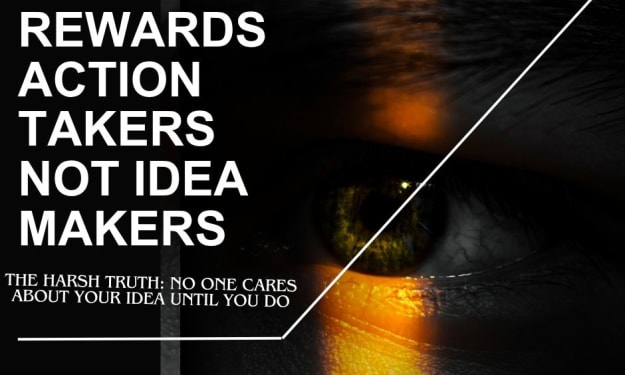
Life Only Rewards Action Takers, Not Idea Makers
In today’s fast-paced and competitive world, ideas alone are not enough. People have amazing aspirations, creative ideas, and clever solutions to problems everywhere you look. Yet, despite all these brilliant ideas, only a handful of people manage to turn them into reality. Why? Because life doesn’t reward those who merely think or talk about doing something—it rewards those who take action. This truth, though sometimes uncomfortable, is a powerful reminder that success lies in execution, not imagination. Everyone has had a great idea at some point. Perhaps you thought of a new app, a unique product, or a business model that could revolutionize an industry. Maybe you dreamed of writing a book, starting a YouTube channel, or getting fit and healthy. But how many of those ideas did you actually act on? How many of them turned into something real? Chances are, very few. That’s because the journey from idea to result is long and often difficult—and only those willing to walk that path reap the rewards. Ideas are cheap. In fact, they’re everywhere. Everybody is always talking about what they "could" do. “I had that idea years ago,” someone says when a new company succeeds. But here’s the thing—having an idea doesn’t make you successful. Taking action does. The person who turned the idea into a business, built the team, faced the challenges, and stayed consistent is the one who deserves the reward. Fear is a major reason why people don't act on their ideas. Even the most gifted minds can be paralyzed by fears of failure, rejection, and judgment. They convince us to wait, to overthink, to keep planning without ever starting. But what most people don’t realize is that failure is not the enemy—inaction is. You can learn from failure, adapt, and improve. But if you do nothing, there’s nothing to grow from. Action is what teaches you. It’s how you gain experience and get better. Another common barrier is perfectionism. Many people want everything to be just right before they begin. They wait for the perfect time, the perfect plan, or the perfect conditions. But perfection is an illusion. There is no perfect moment. What matters is starting—imperfectly, awkwardly, even messily—and improving along the way. The most successful people in the world didn’t wait to be perfect. They just began, and they figured it out as they moved forward. Confidence, or the lack of it, also holds many people back. They think, “Who am I to do this?” or “I’m not qualified enough.” But here’s the secret: confidence grows through action. The more you do, the more you learn. The more you learn, the more capable you feel. And the more capable you feel, the more confident you become. It’s a cycle—but it starts with action. The world is full of people with potential. But potential doesn’t pay the bills. Potential doesn’t build companies or write books or change lives. Only action does. If you want results, you have to move. Even small steps matter. Writing one page a day, recording one video a week, saving a little money each month—these things add up over time. Progress doesn’t have to be dramatic; it just has to be consistent. Let’s look at some real-life examples. Thomas Edison didn’t just imagine the lightbulb—he tested thousands of materials until he found the right one. Elon Musk didn’t just dream of electric cars—he invested his own money and worked 100-hour weeks to build Tesla and SpaceX. J.K. Rowling didn’t just come up with the idea of Harry Potter—she wrote the books while facing poverty and rejection. What made them successful wasn’t their ideas alone—it was their willingness to act, to persist, and to overcome obstacles. When you take action, amazing things happen. First, you gain clarity. You start to notice what doesn't work and what does. Theory becomes practice. Second, you increase your speed. One step leads to another, and soon you’re further than you thought possible. Third, you earn respect—from others and from yourself. People admire doers. Most importantly, you begin to see results, albeit modest at first but undeniable. So, how can you learn to take action? Start by breaking your big idea into small, manageable tasks. Don’t aim to finish everything in one day—just begin. Set deadlines for yourself. Make a schedule. Take one step every single day, no matter how small. Embrace mistakes—they are proof that you’re trying. Surround yourself with people who take action too; their energy will inspire you. And most importantly, believe in yourself enough to begin. Also, keep in mind that the world doesn’t care about what you’re planning to do. It cares about what you’ve done. People don’t invest in ideas—they invest in action. Employers hire people who deliver. Readers read what’s published, not what’s imagined. Customers buy finished products, not concepts. Until you take action, your idea has no real value in the world. One of the hardest truths you’ll ever accept is this: No one is coming to push you. It’s your job to act. Your job to show up every day and put in the effort. Motivation is not the issue; commitment is. And when you commit to action, life rewards you in ways you never expected. New opportunities appear. Unexpected support shows up. Confidence grows. And step by step, your idea becomes reality. In conclusion, having a great idea is only the beginning. What truly matters is what you do with it. Life is a field of action, not a fantasy. You can think, plan, dream, and hope all you want, but without action, none of it will matter. So take that first step. Start messy. Be bold. Make the effort. Because at the end of the day, life only rewards action takers—not idea makers.
By Putulabout a year ago in Motivation
Read, think, and develop
In a quiet town nestled between low-rolling hills and the winding bends of a river, there lived a young man named Rayyan. He was like many others in his neighborhood—woke up to the same morning alarms, followed the same narrow road to work, and ended his days with the hum of the same television shows. But unlike many, Rayyan had one habit that quietly set him apart: he read.
By Taslim Ullahabout a year ago in Motivation
What If You Didn’t Need to Feel Better to Live Better?
Nobody needs to be taught that life is hard — we quickly learn that ourselves. But what many people have been taught — sometimes subtly, sometimes explicitly — is that life only starts after the hard parts go away. That if you’re feeling anxious, you need to fix it before you can speak up. That if you’re grieving, you have to wait until the sadness is gone before you can begin again. The implicit mental rule is this: you have to avoid feeling bad to feel good, and you need to feel good before you can do good.
By Md kamrul Islamabout a year ago in Motivation
Why Is Real-Time Bidding a Game Changer for Equipment Sellers?
In the world of equipment sales, time and price are often the most significant factors influencing both buyers and sellers. Whether you're liquidating assets, upgrading machinery, or selling off surplus equipment, finding a fast and efficient way to reach potential buyers is essential. One of the most transformative developments in the equipment sales industry is the rise of online real-time bidding auctions. Real-time bidding, a feature that allows participants to bid on items live during an auction section, has proven to be a game-changer for equipment sellers. In this article, we will explore why real-time bidding is such a powerful tool for sellers, delving into the key benefits that make it an indispensable element of modern equipment sales.
By davidabout a year ago in Motivation
You Won’t Believe What Happened When I Tried This for 7 Days!
We scroll past these "7-day challenges" all the time, right? Drink water for 7 days. Wake up at 5 a.m. for 7 days. Quit sugar, meditate, journal, walk 10,000 steps—for just 7 days. They all sound easy, even kind of gimmicky. So one lazy Sunday afternoon, I thought: Why not?
By Basit imran about a year ago in Motivation
"The Doctor I Became"
There’s something no one tells you when you first wear that white coat — that healing others will sometimes break you. That behind every diagnosis is a story. Behind every patient is a mirror. And somewhere in the long corridors of hospitals and endless charts, you will find parts of yourself you never knew were missing. My journey to becoming a doctor was not a straight road. It was twisted, uphill, and full of silent battles. There were days I studied on an empty stomach. Nights I went to sleep without knowing if I would be able to pay for my books the next semester. But I had a dream that was louder than the doubt — to save lives. To matter. I still remember the day I first stepped into a government hospital as a medical student. The ceilings were old, the walls stained with time, and the smell — a mix of antiseptic and something deeper — reality. I wasn’t ready for it. None of us were. We had read about diseases in textbooks, memorized symptoms, and recited protocols. But no book had prepared me for the first patient who looked me in the eye and said, “Doctor, will I live?” I wasn’t even a doctor yet. But in that moment, she didn’t care. She just wanted someone to listen.
By Doctor marwan Dorani about a year ago in Motivation
How to Build Unbreakable Belief in Yourself
You ever wake up, look in the mirror, and think, “Dang… when did I start doubting myself so much?” Yeah. Been there. Here’s the thing nobody tells you — believing in yourself isn’t this one-time, magical switch that flips and boom, you’re overflowing with confidence. Nope. It’s slow. Messy. Sometimes it hurts. And honestly, a lot of it happens in silence — in little moments no one else even notices.
By Md Motiur Rahmanabout a year ago in Motivation
E.M. pushes back
E.M. appeared on the courtroom screen, her image flickering slightly as she joined the session remotely. Judge Maria Carroccia sat to the left, presiding over the case with a stern but focused expression, her gavel resting firmly on the polished wooden bench. The air in the courtroom was thick with tension, every word carrying the weight of a deeply contested truth. "Miss E.M.," began the defense attorney, Greenspan, his voice sharp and calculated, each syllable a carefully placed piece in his argument. "You say that these men were having a 'good time' at your expense. But isn’t it possible that they were simply enjoying themselves, that the laughter you describe had nothing to do with you? Isn’t it true that you sought their attention?" E.M. straightened, her expression hardening as she met the camera's unblinking eye. Her voice, though crackling slightly through the video feed, carried a steady conviction. "No," she replied, her tone cutting through the air. "They were in that room because they were told that a 'drunk naked girl' was there. That’s why they came. That’s what they were there for." Greenspan leaned forward, a practiced smile tugging at the corners of his mouth. "Yet you stayed in that room, didn’t you? You didn’t leave. You didn’t tell them to go. In fact, by your own admission, you were part of the gathering. Isn’t it true that you only objected when they started to focus their attention elsewhere? When they weren’t giving you the attention you wanted?" E.M. felt a surge of heat rise in her chest. She took a steadying breath, her jaw tightening. "That’s not true," she said firmly. "I never wanted their attention. This was attention I never asked for. They were objectifying me. They were literally laughing at me. They didn’t need to be in that room." Greenspan carried on as usual. "So, you claim that you were being objectified, yet you stayed. You participated. You had a good time until you decided you didn’t. Isn’t that what happened?" E.M.’s eyes narrowed, her hands clenching just out of frame. "I stayed because I felt trapped. Because the moment more people entered, I felt like I had no choice. I felt surrounded. Any one of those men could have stood up and said, ‘This is not OK.’ However, they didn't. They just kept going. They didn’t want to think about the fact that I wasn’t consenting." There was a pause. A hush fell over the courtroom, the silence amplifying the weight of her words. Judge Carroccia’s gaze flicked from the screen to Greenspan, her pen tapping lightly against her notebook. She, like everyone else in the room, seemed to be measuring the tone, the emotion, the credibility of E.M.’s every syllable. Greenspan straightened his jacket, adjusting the cuffs as he glanced down at his notes. "And yet," he said, his voice now softer, more calculated, "you never said the word ‘no.’ You never explicitly told them to stop. Isn’t that correct?" E.M.’s heart pounded in her chest. She felt the familiar ache of disbelief, the frustration of her words being twisted, her experience minimized. She leaned closer to the screen, her voice growing more intense. "I didn’t have to say the word ‘no’ for them to know I wasn’t OK. My silence wasn’t consent. It was clear that I was hurting. They just chose to ignore it." The room remained silent for a moment longer, the air heavy with the unspoken complexities of consent, power, and blame. Judge Carroccia’s eyes flicked back to E.M. on the screen, a hint of something like empathy passing over her otherwise stoic expression. The court stenographer’s fingers flew over the keys, capturing every word, every pause, every beat of the unfolding tension. As Greenspan prepared his next question, E.M. took another steadying breath, her resolve hardening. She was not just a witness today. She was a voice demanding to be heard, a reminder that silence, however forced or fearful, should never be mistaken for consent.
By Md Israfilabout a year ago in Motivation
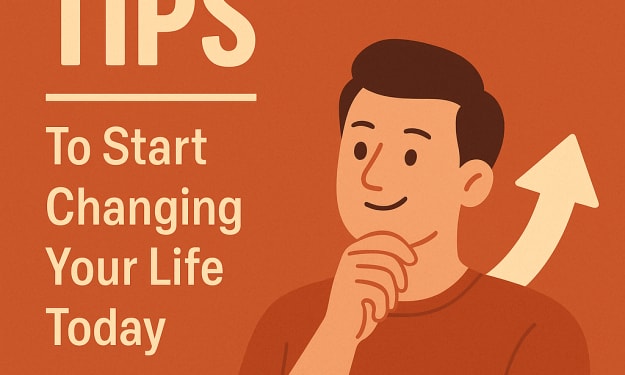
7 Simple Self-Improvement Tips to Start Changing Your Life Today (Even If You're a Total Beginner)
Let’s be real—self-improvement can feel like a lot sometimes. You scroll through social media, and everyone’s waking up at 5 AM, meditating for an hour, running marathons, and somehow still managing to drink eight gallons of water a day.
By Md Zillur Rahaman Chowdhuryabout a year ago in Motivation