success
The road to success is always under construction; share your equations for success — and learn some new ones.
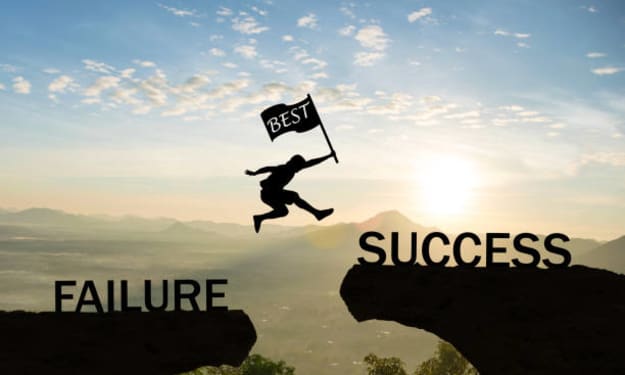
Why Failure Is Not the End — It’s the Beginning
If there’s one thing we’re taught to avoid in life, it’s failure. From school exams to job interviews, we’re made to believe that failing is something shameful — a sign that we’re not good enough, smart enough, or talented enough. But what if I told you that failure isn’t just a part of life, it’s one of the most valuable teachers you’ll ever have? The truth is, failure is often misunderstood. It’s not a dead end; it’s a detour. It’s not the opposite of success — it’s a crucial part of it. Every person who’s ever achieved something meaningful has failed along the way. The difference between those who succeed and those who don’t isn’t how many times they fall, but how many times they get back up. The Lessons Failure Teaches You Failure hurts. There’s no denying it. Whether it’s a rejected job application, a lost business deal, or a personal relationship that didn’t work out, failure stings. But hidden inside that pain are lessons you can’t learn any other way. 1. It Builds Resilience: Every time you fail and choose to keep going, you become mentally tougher. Life will always have ups and downs, and resilience is what helps you navigate both. 2. It Shows You What Doesn’t Work: Failure acts like a filter. It eliminates paths that aren’t meant for you or approaches that need adjustment. Each setback brings you one step closer to a strategy that does work. 3. It Teaches Humility: Success can make people overconfident, but failure reminds you that you’re human. It keeps you grounded and helps you grow as a person. 4. It Forces You to Innovate: When something doesn’t go as planned, you’re forced to think differently. Many of history’s greatest inventions and ideas came from failed attempts. Famous Failures Who Made It Big If you need proof of how powerful failure can be, just look at some of the world’s most successful people. Walt Disney was fired from a newspaper job because his editor said he “lacked imagination.” Today, his name is one of the most recognized in entertainment history. Michael Jordan, often considered the greatest basketball player of all time, was once cut from his high school team. He later said, “I’ve failed over and over and over again in my life. And that is why I succeed.” Oprah Winfrey faced numerous rejections early in her career and was told she was “unfit for television.” Now she’s one of the most influential media personalities in the world. These stories aren’t about luck. They’re about persistence. About refusing to let failure define you. Changing How We View Failure One of the biggest reasons people fear failure is because of how society labels it. But what if we started seeing failure as feedback instead of defeat? Each failure contains information about what went wrong, what could be done differently, and what lessons can be carried forward. Imagine a world where students weren’t afraid of getting wrong answers because every mistake was seen as a learning opportunity. Or entrepreneurs felt encouraged to take bold risks because even if they failed, they’d gain wisdom for their next venture. That mindset shift alone could change lives. How to Handle Failure the Right Way Here’s how you can start using failure as a tool for growth: 1. Acknowledge it. Don’t pretend it didn’t happen. Accept it with honesty. 2. Learn from it. Ask yourself what went wrong and what you can improve. 3. Adjust your plan. Use the lessons learned to tweak your strategy. 4. Don’t dwell. Reflect, then move on. Don’t let failure freeze you in place. 5. Stay optimistic. Remember that failure is temporary — quitting is permanent. Final Thoughts At the end of the day, failure is inevitable. Nobody has a perfect record. The people who rise above it are those who understand its value and use it as a stepping stone. So the next time you stumble, don’t be too hard on yourself. Embrace the setback, learn from it, and get back in the game. Because often, your biggest failure is just the start of your greatest story.
By SHADOW-WRITESabout a year ago in Motivation
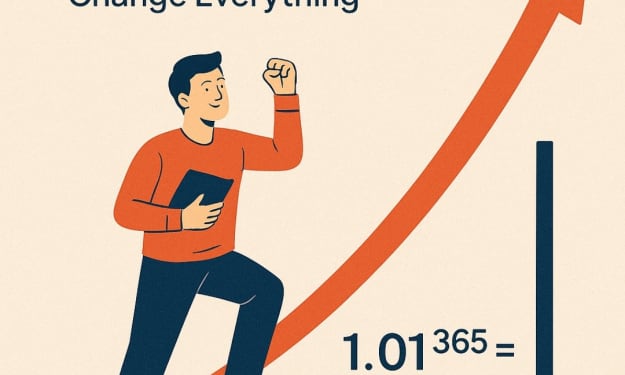
The Power of Small Habits: How 1% Improvements Change Everything
In a world that constantly celebrates big wins, overnight success, and massive breakthroughs, it’s easy to overlook the quiet power of small, consistent actions. We scroll through social media and see people achieving incredible things—transforming their bodies, launching million-dollar businesses, mastering new skills—and we wonder, “How did they do it?”
By Rajonabout a year ago in Motivation
Time Management Strategies for Remote Employees
Picture this: you’re working from home, sipping coffee in your favorite sweats, no commute in sight. Sounds perfect, right? But then the dishes start calling, your inbox overflows, and suddenly it’s 5 PM and you’ve barely checked off your to-do list. I’ve been there. Remote work is awesome, but without a grip on your time, it can feel like you’re juggling chaos. That’s why I’m sharing my go-to time management strategies for remote employees—practical tips to help you stay focused, get stuff done, and still have time to binge that new show guilt-free.
By Padm Rabout a year ago in Motivation
The Light of Perseverance
Thomas Alva Edison, one of the most prolific inventors in human history, is often celebrated for bringing light to the world — quite literally. But behind the warm glow of the incandescent bulb lies a story not just of science, but of spirit. Edison's journey is one of relentless perseverance, of refusing to be defined by failure, and of holding firm to a vision even when the world called him a dreamer. Born in 1847 in Milan, Ohio, Edison was the youngest of seven children. His early years were marked by curiosity and struggle. A bout of scarlet fever left him with severe hearing loss, and his teachers labeled him "difficult" due to his constant questioning and restlessness. He was pulled out of school after only three months of formal education. But this was no end — his mother, a former schoolteacher, took on the task of homeschooling him. This nurturing of his natural curiosity planted the seeds for his future greatness. Edison's early life was defined by an insatiable appetite for knowledge. He set up his own chemistry lab in the basement and was often found reading scientific journals, experimenting with chemicals, and taking apart mechanical devices. At 12, he began working as a newsboy on the Grand Trunk Railroad. He sold newspapers, candy, and other goods, but more importantly, he gained access to the telegraph system and eventually taught himself telegraphy. This skill would serve as a stepping stone into the world of electrical invention. By his early twenties, Edison had already secured his first patent — an electric vote recorder. Although it failed commercially, it didn't deter him. His breakthrough came in 1877 with the invention of the phonograph, a device that could record and reproduce sound. The world was stunned. Newspapers called him "The Wizard of Menlo Park," and suddenly, Edison's reputation soared. But Edison's greatest and most defining challenge was yet to come: inventing the practical incandescent light bulb. The idea of electric lighting was not new in the 1870s. Scientists and inventors had been trying to create a reliable, long-lasting light source for years. The problem was not creating light — it was sustaining it. Bulbs would either burn out quickly, require too much current, or be too expensive to manufacture. Edison saw the problem as one of materials and engineering. He believed that by experimenting with different filament materials and improving the vacuum inside the bulb, he could solve the issue. What followed was a period of unimaginable trial and error. It is estimated that Edison and his team tested over 6,000 different plant materials to find the right filament. He experimented with metals like platinum and carbonized materials such as bamboo, cotton thread, and even beard hair. His laboratory became a hive of innovation and chaos. Assistants labored around the clock, and Edison often slept on a workbench. Failure became a daily companion. Journalists ridiculed him, and competitors mocked his relentless trials. But Edison was undeterred. When asked about his failures, he famously replied, "I have not failed. I've just found 10,000 ways that won't work." This attitude is what truly sets Edison apart. In a world that often gives up at the first obstacle, he embodied the mindset that failure is not the opposite of success — it's a part of it. Finally, in 1879, after years of research and relentless persistence, Edison and his team found success with a carbonized bamboo filament that lasted more than 1,200 hours. This was the breakthrough the world had been waiting for. The light bulb was not just an invention; it was a revolution. Edison went on to create the Edison Electric Light Company and established the first investor-owned electric utility in 1882. This company laid the groundwork for the modern electric grid, fundamentally changing how people lived and worked. Streets, homes, and factories were now illuminated, extending productive hours and transforming urban life. But the story of Edison's light bulb is more than just a tale of invention. It's a testament to human perseverance. In a time without digital simulations, databases, or even modern labs, Edison relied on curiosity, persistence, and a refusal to accept defeat. He believed that solutions existed — it was just a matter of uncovering them. His journey teaches us that greatness often hides behind long corridors of trial and failure. It shows that true innovation is not the result of a single moment of brilliance but the outcome of countless hours of effort, sacrifice, and belief. Today, we flick a switch and flood our homes with light, often without a second thought. But behind that simple gesture is a legacy of unwavering determination. Edison didn’t just light up a room; he illuminated a path for dreamers, doers, and believers everywhere. The light of perseverance burns brighter than any filament, and Thomas Edison proved that it could change the world.
By Zain Ullahabout a year ago in Motivation
💔 How Failing Saved Me. AI-Generated.
I used to be terrified of failure. Like… sick-to-my-stomach, can’t-sleep, avoid-it-at-all-costs terrified. Because in my head, failing meant I wasn’t good enough. That I’d wasted my time. That everyone who doubted me was right. 😞
By THE MOTIVATIONabout a year ago in Motivation
Nobody Believed In Me… Until I Did. AI-Generated.
I wasn’t the “obvious” choice. Not the smartest in the room. Not the loudest. Not the most talented. If you lined up everyone I knew and asked, “Who’s going to make something of themselves?”—I wouldn’t have been their pick.
By THE MOTIVATIONabout a year ago in Motivation
You can now make money from artificial intelligence without leaving your job.
Most people are overworked and underpaid. They spend 40+ hours a week in a job that barely covers their bills, stuck in a cycle of waiting for the weekend, dreading Mondays, and dreaming about quitting but never actually doing it.
By Georgios Adelabout a year ago in Motivation
Rising from the Ashes: Afrin's Journey from Failure to Success
There are stories that echo far beyond the pages they’re written on — stories that remind us of the power of the human spirit. This is one such story. Not a fantasy, not a tale of luck, but the real journey of a young woman named Afrin, who rose from the depths of failure to a place of strength, confidence, and self-made success. The Fall — When Dreams Seem Distant Afrin was never short of dreams. She had always imagined a future where she would do something meaningful — something that would make her parents proud and give her life a purpose. But reality is often harsher than our dreams. During her teenage years, Afrin faced academic pressure, societal expectations, and most painfully, her own self-doubt. She failed one of her most important board exams — an event that felt like the end of the world. While her friends celebrated their results, Afrin sat in silence, broken, embarrassed, and scared. The words of relatives, whispers of neighbors, and the quiet disappointment in her parents’ eyes pierced deeper than any wound. For months, she isolated herself. Her books collected dust, her phone remained untouched, and the mirror no longer reflected hope — only shame and regret. The Breaking Point — And a Whisper of Change One rainy evening, Afrin stood by her window, watching children play in the streets, laughing without worry. A thought crossed her mind — “What if I never try again? What if I remain stuck here forever?” That question echoed in her soul. That night, she did something different. She opened her diary — a gift from her late grandmother — and wrote just one line: “I may be broken, but I am not done.” It wasn’t a declaration of war. It was a whisper. A small flicker of belief. But that whisper was enough to begin her transformation. Step by Step — Rebuilding Herself Afrin didn't transform overnight. It started with waking up early, drinking water, and sitting at her study table — even if for just 15 minutes. Slowly, the 15 became 30. Then an hour. Then four. She avoided social media, reduced time with people who doubted her, and surrounded herself with positivity — be it motivational videos, books, or simply the voice in her head saying, “Try one more time.” Her biggest challenge wasn’t the syllabus or the exams. It was rebuilding her confidence. She reminded herself daily: “I am not my past. I am my potential.” Months turned into a year. The same exam she had once failed — she passed with distinction. But more than that, she smiled again. A real, proud, glowing smile. From Failure to Firsts Afrin didn’t stop at passing an exam. She enrolled in college, got involved in extracurriculars, joined workshops, and started a blog where she wrote about student life, failure, pressure, and resilience. Her words touched many, because they came from a place of truth. Eventually, Afrin became a mentor to younger students — especially those who were on the verge of giving up. She shared her story openly, not to boast, but to show others that falling down doesn’t mean staying down. She received offers from NGOs to speak at youth events. She was even invited to a TEDx session to share her story. Her past — once her greatest shame — had become her greatest weapon. Lessons Afrin Learned 1. Failure is not the opposite of success — it is a part of it. 2. What others say about you matters less than what you believe about yourself. 3. You don’t need to take a giant leap. Sometimes, a small step is enough to change your life. 4. Healing is not always visible. But it’s always happening, if you let it. 5. Helping others heal is one of the most powerful ways to heal yourself. A Message from Afrin In one of her blog entries, Afrin wrote: “To anyone reading this who feels like giving up — I was you. And now I’m telling you, this moment is not your ending. It's your beginning. Don’t be afraid of the dark. That’s where the stars shine brightest.” Conclusion: You Are Not Alone Afrin's journey is not just hers — it is a reflection of so many young souls who feel broken by failure, judged by society, and abandoned by their own dreams. But her story reminds us that resilience is louder than regret. That even in the face of shame, loss, and fear — we can rise, rebuild, and reclaim our worth. So to anyone reading this: If Afrin can rise, so can you. You are more than your marks. More than your mistakes. You are a masterpiece — still in progress.
By TA TAZIM about a year ago in Motivation
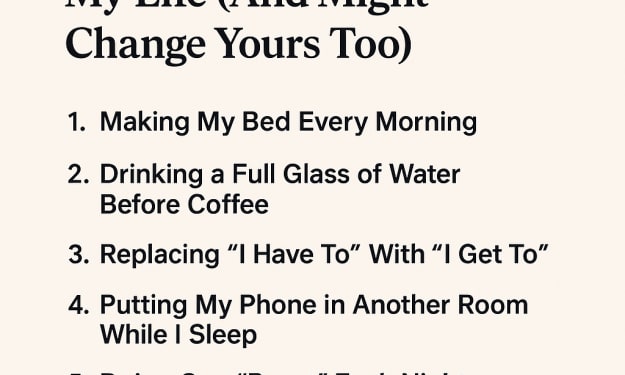
7 Small Habits That Quietly Changed My Life (And Might Change Yours Too)
1. Making My Bed Every Morning I used to laugh at this idea. How could fluffing pillows and tugging sheets make any real impact? But once I committed to it, I understood the hype.
By muhammadabdul hayeeabout a year ago in Motivation