success
The road to success is always under construction; share your equations for success — and learn some new ones.
Naushad Parpia Shares Eco-Friendly Practices That Cut Business Costs
Whether you run a small business or a large corporation, making sustainable choices can lead to big savings. Business owners like Naushad Parpia understand that making eco-friendly changes doesn’t have to be expensive. In fact, many green practices are cost-effective and offer long-term benefits for your business’s bottom line. In this article, we will explore how adopting eco-friendly practices can save your business money and improve its overall sustainability.
By Naushad Parpiaabout a year ago in Motivation
Why Sleep is Your Superpower—and How the Right Gear Can Transform Your Nights
Sleep isn’t just a time to shut down—it’s one of the most powerful things your body can do. While we tend to think of sleep as simply "rest," what actually happens during this time is far more complex. Your brain is actively organizing memories, your muscles are repairing themselves, your immune system is recharging, and even your emotions are getting a reset. In fact, sleep affects nearly every system in your body, from cognitive performance to cardiovascular health.
By Paul Claybrook MS MBAabout a year ago in Motivation
5 Ways to Turn your Life Around
The quest for self-improvement has emerged as a crucial component of human development in a world that is always expecting more of us. Small adjustments can result in big changes, whether your goal is to improve relationships, increase productivity, or improve mental health. These five tips for self-improvement can help you reach your full potential and live a more satisfying life.
By Shahjalal Shakikabout a year ago in Motivation
How to Become Successful in Life: A Practical and Motivational Guide
Success for all is not the same. To one, it's wealth and fame; to another, it's health, happiness, or good relationships. It could be anything you measure success by. The journey to achieve that, however, is largely the same. Success in life doesn't happen overnight. It's the result of hard work, smart decisions, personal development, and pure motivation. In this article, we will discover the habits, attitude, and actionable steps you must take to achieve success in life. 1. Define What Success Is to You Before you pursue success, you need to know what success is to you. Many people copy the other person's definition of success—wealth, big house, fancy job—without even taking the time to see if such things actually make them happy. Ask yourself: What makes me whole? What am I talented at and most passionate about? What kind of life do I want to lead? When you speak of success in your own terms, your goals become clearer and more motivating. --- 2. Establish Clear and Achievable Goals Success starts with a goal. Without them, you are like a ship without a chart. Whether you want to be an entrepreneur, a high-performing student, or a healthier person, clear goals give you direction. Utilize the SMART objective method: Specific: Be specific about what you want. Measurable: Monitor your progress. Achievable: Make it realistic. Relevant: Align it with your values. Time-bound: Have a deadline. Set large goals into smaller steps and rejoice over your progress in the process. Small wins lead to big confidence. --- 3. Cultivate a Success-Oriented Mindset Your attitude plays a great part in your achievement or non-achievement of goals. Fixed mindset believes that talent is innate, but a growth mindset believes that talent can be made through practice and study. To build a success attitude: Embrace challenges and not avoid them. Learn from failure rather than being defeated by it. Replace negative thoughts with positive affirmations. Surround yourself with people who support and motivate you. Having a belief in yourself, even when others do not, is one of the first steps to permanent success. --- 4. Work Hard—But Work Smart Too Hard work is essential, but smart work is also essential. You will need discipline, commitment, and perseverance. Simply being "busy" does not always lead to success—being effective does. Working smart tips: Apply the 80/20 rule (80% results from 20% efforts) to prioritize work. Don't let yourself get sidetracked by things such as excessive social media and TV. Use tools like to-do lists, calendars, or productivity apps. Take tips and learn from successful people who work in your field. Seize every hour. Your most valuable resource is time. --- 5. Keep Learning and Improving Success requires constant improvement. The world is rapidly changing, and you must keep learning to remain ahead. This is how you can keep growing: Read self-help books, career, or business books. Listen to learning podcasts and videos. Turn your failures into lessons and learn from them. Take online courses or certifications as needed. Even spending as little as 15–30 minutes a day on self-improvement can make giant differences in the long run. --- 6. Build Good Habits and Remain Disciplined Success is built on daily habits. Tiny behaviors done on a daily basis can make an enormous difference. Some good habits are: Waking up early and planning out your day. Regular exercise to build energy and concentration. Journaling to track progress and manage stress. Keeping hope and gratitude alive. Discipline is doing what needs to be done even if you don't feel like doing it. Successful people don't rely on motivation—they rely on discipline and habit. --- 7. Meet Challenges with Courage Success brings challenges. Life will challenge you—financial troubles, setbacks, criticism, stress—but how you handle those challenges sets your destiny. What you can do: Stay calm during tough times. Analyze the problem and find a solution. Seek help or guidance from mentors, friends, or family. Never give up. Remember, every setback is a setup for a comeback. Resilience—the ability to bounce back from failure—is a common trait among successful people. --- 8. Build a Positive Environment Your environment greatly influences your mindset and motivation. If you’re surrounded by negative, lazy, or discouraging people, success becomes harder. Instead: Surround yourself with individuals who believe in your aspirations. Learn from people who have already accomplished what you wish to achieve. Stay away from gossip, drama, and negativity. Listen to motivational YouTube videos, books, or podcasts. A positive environment can enhance your mood, work productivity, and stay motivated towards goals. --- 9. Stay Humble and Give Back True success is not just about doing what you desire—but also about giving back. Stay humble, no matter how successful you become. Treat everyone with respect. Share your knowledge to inspire others. Assist others and make a positive impact. Always be grateful for what you have. When you lift others up, success tastes better. --- 10. Be Patient and Trust the Process Success does not happen overnight. It will not happen in a week or a month. There will be moments you want to quit, but keep in mind: every great individual ever felt the same way. Keep hope alive, keep pushing, and never lose faith. Don't compare your journey with others. Focus on your progress, however minute. Trust that your efforts will be rewarded. Big things take time—so don't hurry, just keep going forward. --- Final Thoughts Success in life isn't necessarily about talent or luck. It's about determination, consistency, the right mindset, and making something happen each day. No matter where you come from or where you are now, you have the ability to improve your future. Dream big, stay focused, and keep working. Success is not a destination—it's a journey. And that journey starts with you, today. You've got this!
By Sourove Kumarabout a year ago in Motivation
Is Your 3 PM Energy Crash Inevitable? Research Says Otherwise!
Ever looked at your timetable and felt it could be working against you? You start your morning feeling sluggish, and before you can regain your composure, the day becomes a haze of notifications, appointments, and an endless to-do list. If you feel overwhelmed by numerous tasks and striving for balance, you’re not the only one. Indeed, recent data from the CDC reveal that almost one in three adults in the United States face difficulties with sleep, while the American Psychological Association indicates that chronic stress impacts 68% of adults. It's clear to understand why numerous individuals sense that they're just managing to survive.
By Ivan Hugabout a year ago in Motivation
AI Cruelty in Business and Employment: A Growing Concern
A Developing Concern As counterfeit insights become more integrated into the workplace, questions are rising about how it is affecting workers, job seekers, and even entire industries. While AI promises productivity, speed, and cost savings, it also presents a darker side, one that involves job displacement, loss of dignity, and ethical concerns. The rise of AI isn’t just a technological shift, it's a transformation that's reshaping human lives in significant and sometimes harsh ways.
By Nafees Salmanabout a year ago in Motivation
Living with Anxiety in a Loud World
Part 1: The Noise Was Everywhere I don’t remember the first time I felt anxious. Not in the “normal” nervous-before-a-presentation way, but in that stomach-in-knots, mind-on-fire, I-want-to-run-but-don’t-know-where kind of way.
By Amr Alyabout a year ago in Motivation
11-Year-Old Girl Discovers Ichthyotitan severnensis, the Largest-Ever Marine Reptile. Content Warning.
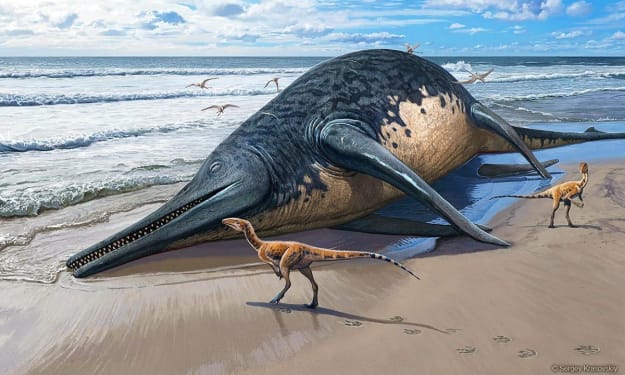
In a discovery that has captivated paleontologists and science enthusiasts alike, an 11-year-old girl from Somerset, England, has helped uncover a fossil belonging to the largest marine reptile ever found—*Ichthyotitan severnensis*. This remarkable find not only adds a new chapter to our understanding of prehistoric marine life but also proves that curiosity and exploration know no age limits. A Discovery That Began with Curiosity In May 2020, Ruby Reynolds and her father, Justin Reynolds, set out for a fossil-hunting expedition on the rocky shores of Blue Anchor in Somerset, England. What began as a casual outing quickly turned into a historic scientific breakthrough. Justin found a curious bone fragment on the muddy flats, and shortly afterward, Ruby discovered a much larger piece nearby. Realizing the significance of the bones, the Reynolds family contacted Dr. Dean Lomax, a paleontologist affiliated with the University of Bristol and the University of Manchester. Dr. Lomax is a leading authority on ichthyosaurs—marine reptiles that roamed the oceans over 200 million years ago—and his expertise would soon confirm that Ruby's discovery was far from ordinary. A Familiar Fossil from the Past Upon examining the bones, Dr. Lomax noticed a striking resemblance to another fossil found in 2016 by fossil collector Paul de la Salle. That specimen had also been recovered from the same region near the Bristol Channel. At the time, the jawbone fragment measured over 6.5 feet (2 meters) long but was considered an isolated find. With the Reynolds family’s discovery, scientists had the missing puzzle piece they needed. Over the next few years, a team of experts—including Dr. Lomax and Dr. Mark Evans from the British Antarctic Survey—conducted multiple field trips and further analysis. Their conclusion was groundbreaking: the fossils belonged to a new species, now named *Ichthyotitan severnensis*, which translates to “giant fish lizard from the Severn.” The Largest Marine Reptile to Ever Live So how big was *Ichthyotitan severnensis*? According to the scientific study published in *PLOS ONE*, the creature’s lower jawbone alone spans more than 2 meters. Based on comparisons with known ichthyosaurs like *Shonisaurus*, scientists estimate that *Ichthyotitan* may have reached lengths of up to 82 feet (25 meters). That makes it longer than a modern blue whale and the largest marine reptile ever discovered. Ichthyosaurs were fast-swimming predators that dominated prehistoric oceans during the Mesozoic Era, especially in the Late Triassic and Early Jurassic periods. Despite their fish-like appearance, ichthyosaurs were reptiles, more closely related to modern-day lizards than to fish or whales. Their streamlined bodies, large eyes, and powerful tails made them perfectly adapted for life in the deep sea. A Glimpse Into Prehistoric Oceans *Ichthyotitan severnensis* lived around 202 million years ago, just before a mass extinction event that wiped out over 75% of life on Earth at the end of the Triassic period. This extinction paved the way for the rise of the dinosaurs on land and may have contributed to the eventual decline of ichthyosaurs in the oceans. What makes this discovery even more significant is the evolutionary parallel it presents. After ichthyosaurs went extinct approximately 94 million years ago, the role of top marine predator remained unfilled until whales evolved to occupy that niche around 50 million years ago. This phenomenon, known as convergent evolution, shows how unrelated species can develop similar traits and ecological roles due to comparable environmental pressures. A Family Legacy in Paleontology Dr. Lomax praised the Reynolds family for their incredible contribution to science, calling it one of the most exciting fossil discoveries in recent memory. He also pointed out that Ruby’s name will forever be linked with the discovery of this ancient giant, an achievement few can claim regardless of age. “To think that Ruby Reynolds, an 11-year-old girl, helped uncover this magnificent piece of natural history is just awe-inspiring,” Lomax said. “It demonstrates the importance of amateur fossil hunters and the potential impact they can have on scientific research.” Ruby’s discovery has already inspired a new generation of young fossil hunters and has been widely reported across international news outlets. It serves as a shining example of how scientific curiosity, when nurtured, can lead to incredible achievements—no matter your age or background. Conservation and Continued Exploration The fossil-rich coastline of Somerset, especially the areas surrounding the Bristol Channel, has proven once again to be a treasure trove for paleontologists. These coastal mudflats and cliffs are subject to constant erosion, often revealing fossils hidden for hundreds of millions of years. Scientists believe more jawbone fragments from *Ichthyotitan* could be found in the future, which may help them reconstruct a more complete skeleton. In light of this discovery, conservation efforts to protect fossil-rich coastal zones have gained renewed importance. Paleontologists are urging for more awareness and responsible fossil hunting practices to preserve these vital areas for scientific study. Final Thoughts The story of *Ichthyotitan severnensis* is a perfect blend of science, history, and human curiosity. Thanks to the keen eyes of a young girl and her father, the world now knows about the largest marine reptile to ever swim Earth’s oceans. The discovery highlights the ongoing importance of fossil exploration and serves as a powerful reminder that groundbreaking scientific discoveries can come from anyone—young or old. Whether you're a seasoned paleontologist or a child with a fossil-hunting kit, one thing is certain: the next big discovery might just be waiting beneath your feet.
By Tech Horizonsabout a year ago in Motivation
Digital Detox: Why Unplugging Can Make You Happier, Smarter, and More Focused
Let’s be honest for a second: how often do you catch yourself unlocking your phone without even realizing it? Maybe you're waiting in line, watching TV, or even talking to someone—and your thumb just knows what to do. No real reason. Just habit.
By Mantha Panthaabout a year ago in Motivation