success
The road to success is always under construction; share your equations for success — and learn some new ones.
Mastering Social Intelligence: The Hidden Skill That Changes Everything
We spend years learning facts, building careers, chasing credentials. But there’s one life-changing skill that quietly shapes your relationships, your confidence, and even your success - and most people never learn it. It’s called social intelligence: the art of reading people and responding with awareness, tact, and heart. Unlike raw intellect, this isn’t about how much you know, but how well you understand. And in a world that’s more connected than ever - but often feels more disconnected than ever - this skill is more essential than we realize.
By Olena about a year ago in Motivation
“Lonely but Not Alone?” – Understanding Emotional Disconnection
There’s a quiet kind of loneliness that’s harder to name - the kind you feel in a room full of people. Maybe you’re at a family gathering, a party, or even in a relationship… but something feels missing. You smile, talk, go through the motions - but inside, you feel hollow, disconnected, unseen. This kind of emotional loneliness isn’t about physical isolation. It’s about the ache for real connection - where your inner world is felt, held, and truly known.
By Olena about a year ago in Motivation
“Feeling Behind in Life?” – Trusting Your Own Timing
It’s easy to feel behind - behind in your career, your healing, your relationships, your “timeline.” Especially when everyone else seems to be checking boxes: marriage, kids, promotions, success. You scroll through highlight reels and wonder, Did I miss something? Am I falling behind? But the truth is, life isn’t a race. There is no universal clock. And comparing your timing to someone else’s will only steal the joy of becoming who you are meant to be.
By Olena about a year ago in Motivation
“Why Can’t I Let Go?” – Healing from Emotional Attachments
Sometimes the hardest part isn’t what happened - it’s letting go of what could have been. Letting go sounds simple - until you try to do it. You might know, logically, that something or someone isn’t good for you anymore… but the emotional grip remains. You replay moments, imagine different endings, or wait for closure that may never come. Emotional attachment runs deep - not because you’re weak, but because you care deeply. This post explores why letting go can feel so impossible and how to begin releasing what’s keeping your heart stuck in the past.
By Olena about a year ago in Motivation
“Am I Too Sensitive?” – Turning Sensitivity into Strength
If you’ve ever been told you’re “too sensitive,” you’re not alone. Maybe you’ve felt overwhelmed in loud spaces, affected deeply by others’ moods, or hurt by things people say that others easily brush off. Sensitivity can feel like both a gift and a curse. But what if your depth, awareness, and empathy weren’t flaws to fix - but qualities to protect, nurture, and celebrate? This post is a reminder that emotional sensitivity isn’t something to hide - it’s something to understand and reclaim as powerful.
By Olena about a year ago in Motivation
What a narcissist goes through after break up with you
Breaking up with a narcissist can leave you questioning everything - especially when they act like it never meant anything. Their cold detachment, quick rebound, or even silence might make you wonder: did they ever care? But beneath their surface-level composure lies a different reality - one filled with ego injury, panic, and emotional scrambling. While they may seem fine, the truth is, narcissists experience post-breakup collapse in a way that’s chaotic, self-centered, and often hidden. Here’s what a narcissist really goes through after losing someone like you.
By Olena about a year ago in Motivation
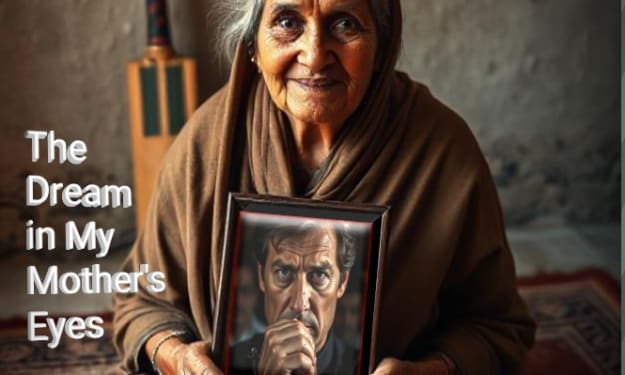
My Mother Was Imran Khan’s Biggest Fan
I don’t know when my mother first saw him. Perhaps it was in the 80s when she would tune into the neighbour’s black-and-white television to watch cricket. Back then, televisions weren’t common in our narrow street of inner Lahore, and my father never bought one, calling it a “waste of money and morals.” But my mother loved cricket. More precisely, she loved watching him. Imran Khan.
By GooD BoYabout a year ago in Motivation
You Can Do It
*You Can Do It* In the small town of Khairpur, lived a 17-year-old boy named *Imran*. He wasn’t the smartest student in school. In fact, he failed in mathematics three times, could barely speak English, and was often laughed at by classmates. Teachers didn’t expect much from him either. But Imran had something that no one could see — a stubborn heart that whispered every morning, *"You can do it."* Life was not easy. His father ran a small tea stall, and his mother worked in a garment shop. Money was tight. Imran studied under the weak light of a lantern every night, with the noise of traffic and life buzzing outside his window. Many times, he thought of quitting school, but every time he looked at his parents, tired but hopeful, he kept going. *The Breaking Point* One day, during a math exam, Imran sat with his head down. The numbers blurred. He knew he would fail again. Tears welled up. That evening, he didn't go home. He sat alone at the railway station, feeling worthless. But then, an old man came and sat beside him. "You look troubled, beta," he said gently. Imran sighed. “I try so hard, but I always fail. Maybe I’m just not good enough.” The man smiled and replied, “You know what makes mountains different from stones? Pressure and patience. You're not done growing yet.” Those words sparked something in him. *A New Beginning* Imran went home, wiped his tears, and made a decision: *He wouldn’t stop until he saw change.* He started waking up at 4 a.m. every day. He watched free YouTube videos on math, borrowed grammar books from the library, and practiced speaking English by talking to himself in front of a mirror. He stuck motivational notes on the wall: *“You can do it.”* *“Fall seven times, stand up eight.”* *“Every expert was once a beginner.”* The laughter of his classmates didn’t stop, but Imran no longer let it reach his heart. --- *The Small Wins* Weeks passed, and slowly, he started seeing results. He solved math problems he once feared. He gave a small English speech in class — broken but brave. His teacher, Mr. Hanif, noticed and said, “Imran, you’re improving. Keep going.” Those simple words were like fuel to a burning fire. Imran participated in a school quiz and stood third. It wasn’t a big win, but to him, it felt like a trophy. For the first time, his father smiled and said, “We always knew you could do it.” *The Test of Belief* But life loves to test belief. A month before board exams, Imran’s father fell seriously ill. The tea stall shut down. Bills piled up. Imran began working part-time at a bakery in the evenings to support the family. He studied late into the night, sometimes standing to avoid falling asleep. His body was tired, but his spirit whispered, *"You can still do it."* *Results Day* The morning of the result, Imran’s hands shook as he checked the board. Tears filled his eyes — not of sadness, but of pride. He had *passed with distinction.* He ran home, hugged his mother tightly, and whispered, “Ammi… I did it.” *Beyond the Marks* That result was only the beginning. Imran got a scholarship for college. He began tutoring kids in his area, helping those who struggled just like he once did. He shared not just math tricks, but hope. One day, he was invited back to his school to give a motivational talk. He stood on the same stage where he once felt like a failure and said: *"I’m not here because I was born brilliant. I’m here because I refused to believe I was hopeless. You don’t have to be perfect. Just believe. Just keep moving. You can do it — if you don’t stop."* The room was silent. And then, applause erupted. *Years Later* Imran went on to become a teacher, mentor, and speaker. But no matter how far he reached, he never forgot the boy who once failed and cried at the railway station. He often told his students, *“No dream is small if your belief is big.”* *Moral:* *When the world tells you “you can’t,” let your heart whisper louder, “you can.” The path may be slow, the nights may be hard, but belief turns the impossible into possible. Never stop believing in yourself — because you can do it.*
By Ibrahim physicistabout a year ago in Motivation
The Forest She Grew
It began with a single sapling, a little girl, and a question no one could answer. “Why are there no trees left here?” nine-year-old Alina asked her grandfather as they walked through a once-verdant hillside near their village. The ground beneath their feet was cracked, dry, and silent.
By MIGrowthabout a year ago in Motivation
Breaking the Surface
The morning of the race, the lake was still, its surface unbroken except for a few ducks drifting by. Jacob adjusted the strap on his goggles and looked out at the water, breathing slowly. The smell of early dew, sunscreen, and nervous energy surrounded him. Athletes milled about the start line, stretching, joking, checking their gear for the third or fourth time. Jacob sat in his racing wheelchair a few feet away, quietly going over his plan. He hadn’t always been a triathlete. Seven years ago, a motorcycle accident had taken the use of his legs. At 26, Jacob had gone from a rising personal trainer to a man who couldn’t walk across his own apartment without help. For months, he’d spiraled — painkillers, anger, isolation. It was a physical therapist, Maya, who handed him a pamphlet about adaptive sports and said, “You still have the heart of an athlete. Let’s train it.” Now, he was 33, and this was his third triathlon. But this wasn’t just another race. This was the Boulder Peak Triathlon — one of the most grueling courses in the region. A 1.5 km swim, 42 km bike ride, and a 10 km run through hilly, uneven terrain. Jacob was the only para-athlete competing this year. There were para divisions at some races, but this event didn’t separate the field. Everyone raced together. He wheeled himself down to the dock. The other athletes parted slightly, some nodding respectfully, others simply curious. He felt their eyes. He always did. When the starting horn sounded, the chaos began. The water was cold, but Jacob was used to that shock now. Using only his arms and shoulders, he swam hard and fast, carving his own path through the churning surface. Adaptive swimming wasn’t new to him — he’d spent hundreds of hours training for this. Still, keeping pace with able-bodied swimmers wasn’t easy. Fifteen minutes in, he reached the shore. His lungs burned, but his mind was sharp. Volunteers helped him to his racing wheelchair and dried him off as quickly as possible. He strapped in, heart pounding. Next came the handcycle portion — his strongest event. On the road, Jacob became a machine. His custom-built handcycle was sleek and efficient, and his upper body had been trained to endure brutal strain. He tore through the bike course, powering up hills that slowed others, his arms pumping like pistons. The crowd cheered at one steep climb when he passed two able-bodied cyclists. But it wasn’t just about winning — not for him. It was about showing what was possible. By the time he reached the transition point for the run, he was in the top twenty. He switched to his racing wheelchair again — a lightweight, three-wheeled marvel that hugged turns and absorbed shocks. The run course was full of gravel paths, small ridges, and forest turns, all of which tested his handling skills. Around kilometer seven, he passed a runner who had twisted his ankle. Jacob paused, asked if he needed help, and when the man waved him on, Jacob continued — grateful that he didn’t have to make the choice between finishing and stopping. Near the final hill, fatigue hit him hard. His arms felt like lead, his breath ragged. But he thought of the first day he sat up in a hospital bed and was told he might never live independently again. He thought of Maya, who refused to give up on him. And he thought of all the kids who might see this race on the news and believe in themselves for the first time. When he came around the final bend, the finish line loomed ahead, lined with cheering spectators. The noise was deafening, but all Jacob could hear was his own heartbeat. He gritted his teeth and pushed through the last fifty meters like his life depended on it. He crossed the line in 2 hours, 41 minutes, and 12 seconds. Third overall. And first in the hearts of everyone watching. People rushed over — reporters, photographers, organizers. Someone handed him a bottle of water. Another asked if he’d be willing to speak at a local school. He smiled, exhausted but radiant. A woman approached with her son — maybe nine years old, in a small wheelchair. “This is Caleb,” she said. “He wanted to meet you. He’s never seen someone like him do something like that.” Jacob knelt as best he could and offered Caleb a fist bump. “You’re going to do bigger things than me, Caleb,” he said. “This? This is just a start.” That night, as Jacob lay in his hotel room, his arms sore and his body aching, he allowed himself a moment of quiet pride. He didn’t need a medal to validate him, though he did end up getting one. What mattered most was that he’d changed something — maybe just a few minds, maybe just one — about what it meant to be an athlete, disabled or not. He drifted off to sleep thinking not about the pain, but about the next race. The next challenge. The next surface to break.
By Faizan Khanabout a year ago in Motivation
The Day I Stopped Saying ‘Maybe’
It started with a chair. A plain, worn-out chair that had been sitting in the corner of my apartment for months. One of the legs was loose. The cushion had long since gone flat. It served mostly as a laundry collector—an unintentional monument to procrastination. Every time I passed it, I told myself I’d fix it.
By Asim Aliabout a year ago in Motivation