movie review
Movies that make us feel warm and inspired; from stories about love found in a hopeless place, to heroes fighting for the greater good, and more.
"The Fire Within: A Journey of Belief"
In a quiet village tucked between two sunlit hills, lived a young boy named Arman. He was not the strongest, nor the fastest, nor the most clever. But what he had—though he didn’t yet know—was something far greater. A fire. A fire within.
By Rahimullah Mohmandabout a year ago in Motivation
The Voice Within
In a small mountain village nestled deep in the valleys of northern Afghanistan, lived a young girl named Amina. She was known for her quiet presence and shy demeanor, often blending into the background like a soft whisper in the wind. But Amina carried a secret — one that even she didn’t fully understand. She had a voice so pure, so powerful, that it could silence storms and awaken hearts.
By Rahimullah Mohmandabout a year ago in Motivation
Hassan and His Hens
Hassan was a poor man who lived in a small village named Noorabad. His life was simple, but very hard. He lived alone in a small mud house with only one room. There was no fan, no bed, not even proper clothes to wear. He had no land, no animals, and very little food to eat. Every morning, he would walk through the village, hoping someone would give him some work.
By Imran Khanabout a year ago in Motivation
You Won’t Believe What Happened When I Tried This for 7 Days!
We scroll past these "7-day challenges" all the time, right? Drink water for 7 days. Wake up at 5 a.m. for 7 days. Quit sugar, meditate, journal, walk 10,000 steps—for just 7 days. They all sound easy, even kind of gimmicky. So one lazy Sunday afternoon, I thought: Why not?
By Basit imran about a year ago in Motivation
10 Steps to Become a Millionaire in a Short Time (Backed by Science and Real Stories)
Introduction: Have you ever dreamed of becoming a millionaire — not in 30 years, but in just a few short years? For centuries, wealth seemed like a game reserved only for the elite or those born into money. But in recent decades, thanks to technology, new business models, and psychological breakthroughs, more self-made millionaires are rising faster than ever before. This isn’t about get-rich-quick schemes or empty promises. In this article, we’ll uncover 10 scientifically-backed steps, real-life success stories, and powerful strategies that can accelerate your path to seven figures. Let’s break down exactly how ordinary people are building extraordinary wealth — and how you can too. Step 1: Master the Power of Compound Interest Early (Even if You’re Broke) What’s been discovered? Albert Einstein reportedly called compound interest “the eighth wonder of the world.” But recent behavioral economics research shows that most people dramatically underestimate the power of small amounts of money growing over time — especially if they start early. A study published in the Journal of Economic Psychology (2021) showed that people who invested even $5/day starting in their early twenties had, on average, 3–4 times the net worth by age 40 compared to peers who started late — even if those late starters invested larger chunks. The real-life example Meet Ronald Read, a janitor and gas station attendant from Vermont, USA. Despite never earning more than $25,000/year, Read quietly invested small amounts in dividend-paying stocks over decades. When he passed away in 2014, he shocked his town by leaving behind an $8 million fortune — all thanks to patient compounding. How to apply it Open a low-fee index fund account (like S&P 500 ETFs) Automate small weekly investments Reinvest all dividends Avoid touching it, even during downturns Even tiny amounts, compounded consistently, build massive wealth surprisingly fast. Step 2: Develop a High-Income Skill (Not Just Any Job) What’s been discovered? A 2022 report from Upwork revealed that freelancers with specialized, in-demand skills (like copywriting, software development, or digital marketing) earn 2–5x more than average employees in traditional jobs. High-income skills scale faster and are location-independent — allowing people to earn globally, not just locally. The real-life example Dan Lok, born in Hong Kong and raised in Canada, failed in 13 businesses. When he learned high-ticket copywriting (the skill of writing sales letters that generate millions), his income exploded — going from $10/hour to over $100,000/month. How to apply it Identify market-driven skills: sales, copywriting, SEO, coding, design, etc. Learn from free + paid resources (YouTube, Udemy, courses, mentors) Build a portfolio quickly (even if it’s unpaid at first) Pitch your services globally (Fiverr, Upwork, LinkedIn) The faster you acquire a high-income skill, the faster you control your income. Step 3: Build Scalable Assets (Your Money Should Work Harder Than You) What’s been discovered? Entrepreneurial studies from Harvard Business Review (2019) show that scalable assets — businesses, digital products, apps, or intellectual property — generate exponential income with less direct effort. Unlike a job where you trade time for money, scalable assets work even when you sleep. The real-life example Pat Flynn, an architect laid off in 2008, created a $19 eBook about passing an architecture exam. That small eBook turned into a $2M/year passive income business — through blog posts, podcasts, and online courses. How to apply it Write an eBook, create an online course, build an app, launch a dropshipping store Focus on one asset first, don’t spread too thin Automate marketing using content and email lists Reinvest profits to scale Even if it starts small, one scalable asset can change your financial life. Step 4: Master the Psychology of Money (Wealth is 80% Mindset) What’s been discovered? Neuroscientists at Stanford University (2020) found that financial beliefs and behaviors are deeply rooted in subconscious patterns formed in childhood. If you believe "money is bad" or "rich people are greedy," you subconsciously sabotage wealth creation. The real-life example T. Harv Eker, author of Secrets of the Millionaire Mind, went from broke to millionaire by rewiring his financial blueprint — replacing limiting beliefs with empowering ones. How to apply it Journal about your beliefs around money Read wealth psychology books Surround yourself with wealth-positive people Visualize financial goals daily Before your bank account grows, your mindset must expand first. Step 5: Build Multiple Streams of Income (Don’t Rely on Just One) What’s been discovered? The average millionaire has seven income streams, according to IRS data and a report by Thomas C. Corley (Rich Habits). Relying on one job or business is financially dangerous. Diversification spreads risk and creates stability. The real-life example Grant Cardone, real estate mogul and entrepreneur, earns from real estate, book sales, consulting, courses, YouTube, events, and more. If one stream fails, others keep flowing. How to apply it Start a side hustle while working your main job Invest in dividend stocks or real estate Monetize hobbies (YouTube, digital art, etc.) Build passive digital products Diversity protects you and multiplies your wealth. Step 6: Embrace Smart Frugality (Not Miserliness) What’s been discovered? A study by the American Economic Review found that wealthy people spend consciously — not cheaply. Smart frugality is about prioritizing high-impact spending and eliminating waste. The real-life example Warren Buffett still lives in the house he bought in 1958. He avoids lifestyle inflation and focuses spending on assets, not luxuries. How to apply it Track every expense for 30 days Cancel unused subscriptions Use the 24-hour rule before big purchases Invest savings into productive assets Frugality fuels freedom when done wisely. Step 7: Build a Personal Brand (It Attracts Opportunities) What’s been discovered? In today’s digital world, trust and attention are currency. According to a Nielsen study, 92% of people trust individual recommendations more than brands. A strong personal brand builds credibility, attracts clients, and opens doors. The real-life example Gary Vaynerchuk built a personal brand through daily content, which led to speaking gigs, investors, and millions in business revenue. How to apply it Pick one platform (LinkedIn, TikTok, YouTube, etc.) Share valuable content consistently Document your journey, don't fake success Interact with your audience genuinely Your personal brand is your modern business card. Step 8: Network with Millionaire Mentors (Proximity is Power) What’s been discovered? Social psychologist Dr. David McClelland found that 95% of your success is determined by who you spend time with. Surrounding yourself with high-achievers elevates your standards. The real-life example Daymond John (Shark Tank) credits his growth to mentors like Russell Simmons and networking in wealth-focused circles. How to apply it Join masterminds, online communities, or meetups Follow and engage with wealthy thinkers online Offer value first to connect (volunteer, share insights, etc.) Avoid energy-draining relationships Who you know shapes what you grow. Step 9: Take Calculated Risks (Not Reckless Gambles) What’s been discovered? Research by Cambridge University shows that millionaires are not reckless — they are strategic risk-takers. They assess downside, plan contingencies, and act fast once the odds are favorable. The real-life example Elon Musk risked millions to fund SpaceX and Tesla when nobody believed in them. He analyzed worst-case scenarios and acted with courage. How to apply it Do deep research before investing or launching Use the "Barbell Strategy": 90% safe, 10% bold Build a safety net before taking big steps Learn from small failures fast Wealth requires courage paired with calculation. Step 10: Think Long-Term (The Millionaire Game is a Marathon) What’s been discovered? A landmark study in the Harvard Business Review found that people who delay gratification build 10x more wealth than impulsive spenders. The long game beats short-term thinking every time. The real-life example Jeff Bezos built Amazon with long-term vision. For years, it was unprofitable while he reinvested everything — and now it's one of the most valuable companies in history. How to apply it Set 5-year and 10-year wealth goals Avoid get-rich-quick distractions Reinvest profits into growth, not consumption Stay consistent even when results are slow Real wealth rewards patience and focus. Conclusion: Becoming a millionaire quickly isn’t about luck, inheritance, or overnight miracles. It’s a strategy. With the right mindset, skills, discipline, and smart decisions, anyone — including you — can join the new wave of fast-growing millionaires. Choose one step and start today. Your future self will thank you.
By amgadabout a year ago in Motivation
Lessons from the Road
Once upon a time, in a bustling exchange town settled between verdant mountains and dry fields, lived a persevering dealer named Ibrahim. Ibrahim was famous for his judgment and unwavering work ethic. Each week, he would set out on long ventures over tricky territories, conveying products to neighboring towns. Going with him on these strenuous trips was his faithful jackass, Buried, a hefty animal with a tender personality but unmatched resilience
By Fayaz ahmadabout a year ago in Motivation
I Was Homeless, Hungry, and Hopeless-Then a $30 Job on the Internet Changed My Life Forever.
If you had met me ten years ago, you would’ve seen a skinny teenager sleeping on park benches in Chicago with a torn backpack and no plan. Today, I’m a 29-year-old tech entrepreneur, running my own company and mentoring kids who are exactly where I once was. This is the story of how I turned poverty into power — not overnight, not with luck, but with relentless grit, stolen Wi-Fi, and a belief that I was worth more than my zip code. --- The Fall I grew up on the South Side of Chicago. My mom worked two jobs and still couldn’t afford rent some months. My dad left when I was nine. By sixteen, I was skipping school, getting into trouble, and sleeping in shelters or friends’ basements. I wasn’t lazy — I was just lost. No one around me talked about dreams. People talked about surviving. Then, one night in a public library, I watched a TED Talk on a computer someone left unlocked. It was about a man who taught himself to code while working as a janitor. I watched it three times. That night, I didn’t sleep. I Googled “how to code,” “how to get out of poverty,” “how to start from nothing.” That was the spark. --- Free Knowledge, Stolen Internet For the next year, I became obsessed. I would sneak into cafes or library corners and use free Wi-Fi to watch coding tutorials on YouTube. I learned HTML, CSS, and JavaScript. I practiced by building fake websites. I had no laptop, so I borrowed an old Chromebook from a church that ran a youth program. I told them I was trying to change my life — and to my surprise, they believed me. I slept rough, but every day I learned something new. I used free online platforms like FreeCodeCamp and Coursera. I found Reddit threads about freelance gigs. I emailed people. Most never replied. Some laughed. But one man in Germany — a total stranger — gave me a shot. He needed a simple landing page and paid me $30 via PayPal. That $30 changed everything. --- Building a New Identity That small job led to another. And another. Within a year, I was earning enough to rent a shared apartment with three other guys. I had my own bed, a desk, and working Wi-Fi. Luxury. I started a blog about my journey. I posted about freelancing while broke. People began reaching out. Some asked for advice. Some offered opportunities. By 24, I was making over $4,000/month. Not much in Silicon Valley terms, but for a kid who once stole muffins to eat — it was freedom. I registered an LLC. I built websites for nonprofits and local businesses. Eventually, I hired a few other freelancers. We became a team. We became a business. --- Returning the Favor Today, I run a small but growing digital agency. We serve clients globally — but more importantly, I teach. I mentor inner-city youth. I’ve spoken at schools and shelters. I tell kids, “You don’t need money to start. You need Wi-Fi, time, and insane belief.” We launched a free program that teaches web development to teens in low-income communities. We’ve helped over 300 students so far. Every time I see one of them get their first freelance job, it takes me back to that cold night in the library. --
By Rahim Babaabout a year ago in Motivation
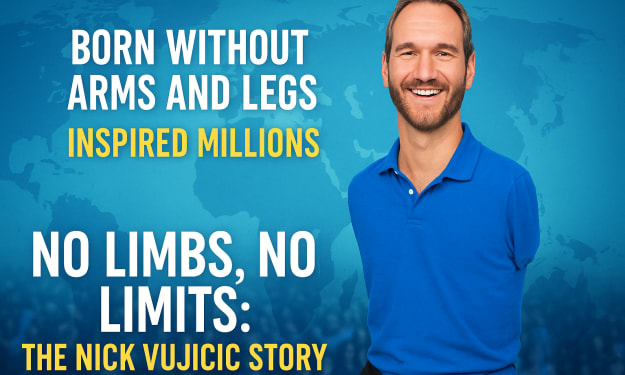
Nick Vujicic: Living Beyond Limits
Nick Vujicic was born in Melbourne, Australia, on December 4, 1982, with a rare condition called Tetra-amelia syndrome — a disorder that meant he was born without arms and legs. For many people, this would be considered the greatest misfortune, a life sentence of difficulty, struggle, and disappointment. And that’s exactly what his parents feared when they first learned of his condition.
By Syad Umarabout a year ago in Motivation
" two souls, one heartbeat" . Content Warning.
In a quiet town nestled between whispering forests and the gentle curl of a silver river, there lived two people who, at first glance, seemed like strangers fated never to meet. Aiden was a musician—brooding, quiet, and lost in melodies only he could hear. His days were spent crafting haunting harmonies on his weathered piano in the attic of an old stone cottage, once belonging to his grandmother. He barely ventured out, save for the occasional walk at dusk when the sky burned orange, and the town was bathed in golden hush. Lena, on the other hand, lived in light. A paramedic, always on the move, her hands carried life and hope, her smile a promise that everything would be okay. She lived in the now, grasped every fleeting second, and believed time was too fragile to waste. But deep inside, where no one could see, Lena carried a grief she never spoke of—the loss of her twin brother, Liam, three years ago. He had been a musician, too. Quiet, like Aiden. Lost in sounds that only he could hear. It was a late September evening when they met. A storm had swept through the town, knocking out power and cutting off the main road. Lena, on her way back from a late shift, took the forest trail—the only way home. The rain made the path slippery, and just as she rounded a bend near the river, her car skidded and slammed into a fallen tree. She wasn't hurt, just shaken. Phone dead, she stepped out and looked for shelter. That’s when she saw the faint glow of a lantern through the trees. It flickered from the attic window of an old stone cottage. Aiden wasn’t expecting company. He rarely did. When he opened the door to find a woman soaked to the bone, rainwater dripping from her lashes but eyes burning with life, he just stared. “I crashed,” she said simply. “I saw your light.” He stepped aside wordlessly. Lena spent the night in the warmth of the old cottage, wrapped in a woolen blanket, listening to the sound of rain and an unfamiliar tune from the attic. She followed it, quietly, and found Aiden at the piano. His fingers moved like memory—soft, sure, aching. “Your music,” she said softly, “sounds like someone I used to know.” He turned, startled. “Really?” “My brother. He used to play like that.” She didn’t say more. In the days that followed, their lives began to thread together. The storm had caused a landslide, closing the forest road indefinitely. Lena stayed in town, took a short break from work, and slowly found herself returning to the cottage—not out of necessity anymore, but something unexplainable. Aiden, too, changed. He began leaving his attic to meet her on her walks. He laughed—awkwardly, at first, like someone remembering how. He played music just for her. And when he played, Lena listened with eyes closed, hand on her chest, as though feeling something stir that had long been buried. They learned each other in quiet moments—over old records and tea, through shared silences and the brushing of fingers in passing. Aiden discovered Lena hummed while she cooked, that she tilted her head when she read, and laughed without restraint. Lena learned that Aiden only composed at night, that he never wore socks, and that the piano was the only thing left from his grandmother. One evening, as autumn painted the trees amber and gold, Aiden showed Lena a piece he had been working on. “It’s called ‘One Heartbeat,’” he said, handing her the sheet music. She studied the notes. “It’s beautiful. Sad… but full of hope.” He looked at her then, deeply, as though seeing something that had eluded him for years. “I didn’t know what it was about until I met you.” She looked down, heart thudding. “Aiden, I need to tell you something.” That night, in the attic under a sky full of stars, Lena told him about Liam. About how he had died in a car accident on the same road where she crashed. About the silence that followed his death, how she hadn’t listened to music since. Until Aiden. Aiden listened, eyes glistening. Then, without a word, he sat at the piano and played the piece again—but slower, softer. And Lena cried. Not because of pain, but because in that music, she felt Liam again. “You brought him back to me,” she whispered. “I think you brought me back to life,” Aiden replied. --- Winter came. The river froze. The forest wore white. And inside the stone cottage, love bloomed. It wasn’t loud or fast. It was patient, kind, healing. Aiden kissed her like she was his first note. Lena held him like he was the answer to a question she had long stopped asking. They were two people, different rhythms, but somehow, in each other, they found the same beat. When they lay together, heart to heart, they often said they could feel one heartbeat between them. It was a joke at first, but soon it felt true. One night, as snow fell silently outside, Aiden woke gasping, clutching his chest. Lena rushed to him. “Aiden?” “My heart,” he choked. “Something’s wrong.” She drove him to the hospital in the middle of a blizzard, hands trembling on the wheel. The doctors ran tests. Hours passed. “It’s a congenital condition,” they told her. “Rare. He was likely born with it. It’s a miracle he’s made it this far.” Aiden needed a heart transplant. Time was running out. Lena refused to leave his side. She gave up her job. Sat by his hospital bed with a suitcase full of music sheets and love. And then came the call. A donor had been found. The surgery was scheduled. The night before, Aiden asked for a piano. The hospital staff brought in a keyboard. Wires trailed from his chest, but his fingers found the keys. He played One Heartbeat for her. Slow. Deep. As if engraving it onto time. “If I don’t make it—” “You will.” “Promise me, Lena. If I don’t… keep playing. Keep living. For both of us.” She kissed his forehead. “We are not two. We’re one. I’ll feel you in every beat.” He smiled. “Two souls…” “…One heartbeat.” --- The surgery was long. Complicated. Lena sat in the waiting room clutching the sheet music. Hours passed. Then, the surgeon appeared, eyes tired but warm. “He made it.” She collapsed into tears. --- Months later, the forest trail reopened. Spring returned. Lena and Aiden stood where they first met—beneath the trees, beside the river. He held her hand. His heart, stronger now, beat firmly beneath her palm. They had survived the silence, the sorrow, the storm. And now, every moment forward would be shared. He built her a studio next to his attic. She returned to medicine part-time. But at dusk, they always came together—hands on keys, breath in sync. The music they made wasn’t just beautiful. It was alive. Because it came from two souls. One heartbeat.
By D A R Kabout a year ago in Motivation
The Beggar Who Traveled Through Time
It was a hot, dry afternoon in Lahore. The traffic hummed past on the main road, indifferent to the man who sat under the broken shade of a neem tree. He was a beggar, or at least he looked like one. His clothes were patched and faded, his beard unkempt, and his eyes half-closed. He sat there every day, mumbling verses no one cared to understand. Children laughed and ran past him, some throwing coins, others insults. Shopkeepers ignored him, and passersby pretended not to notice. But no one knew that this man, who called himself Baba Zamaan, was once a scientist, and not just any scientist—he was the mind behind a secret government experiment that had failed twenty years ago. Back in 2005, Baba Zamaan, then known as Professor Zaman Ali, had been working on a project called “ChronoKey”—a device that could unlock fragments of time. Funded in secrecy, tested in silence, it was meant to open a controlled ripple through time. But the experiment had gone horribly wrong. During the final test, the device exploded, and Zaman vanished. He was presumed dead. But he didn’t die. He had jumped. Not forward. Not backward. Sideways—in a sliver of time that ran parallel to ours. There, he had no food, no water, no sound, only darkness and echoes of forgotten moments. He wandered in that realm for what felt like years. Time was meaningless there. Until one day, he found a way back. When he reappeared in the middle of a street in Lahore, no one recognized the aged, disoriented man. He had no memory of who he was. The trauma of timeless isolation had shattered his mind. All he remembered was the device, and a whisper: “Time is a beggar’s game.” Years passed. Zaman, now Baba Zamaan, became a fixture on the roadside. His mind flickered between brilliance and madness. He wrote symbols on the dirt with a stick, muttering equations that even advanced physicists would struggle to understand. One rainy afternoon, a university student named Faraz noticed the old man. Faraz was curious by nature and intrigued by the strange symbols the beggar scribbled. He began visiting him daily, sitting beside him, asking questions. At first, Baba Zamaan ignored him. But slowly, the fog in his mind began to lift. He spoke in riddles, asking Faraz, “If time is a river, do you drink from it, or do you drown?” Faraz laughed, but listened. One day, Baba Zamaan handed him a crumpled notebook. “This,” he said, “is the map of the hours lost.” Inside were sketches of a device, pieces of equations, and a final note: "The ChronoKey still breathes. Under the earth, beneath the light." Driven by curiosity, Faraz took the notebook to his physics professor, Dr. Ishrat. The professor’s face turned pale as he read. “Where did you get this?” When Faraz told him about the beggar, Dr. Ishrat’s hands trembled. “This… This is Professor Zaman Ali’s work. He disappeared two decades ago. We all thought he died.” Excited and shocked, Faraz and Dr. Ishrat returned to the spot the next morning, but Baba Zamaan was gone. Only a symbol remained, etched in the mud: the symbol of the ChronoKey. Weeks passed. Faraz couldn’t sleep. He kept studying the notebook until one night, something clicked. He built a prototype, crude but functional. When activated, it emitted a soft hum and projected a hologram of Baba Zamaan. In the hologram, Baba spoke clearly: “If you’ve found this, then time has chosen you. I am no longer of this world, but of many. Don’t look for me. Look ahead. One day, you too will stand at the edge of time. Choose wisely.” Faraz never saw Baba again. But he knew he hadn’t imagined him. That hologram, the equations, the memory—they were all real. He buried the ChronoKey prototype in a box and hid it in his closet. Years later, Faraz became a renowned physicist. He never told anyone the full story. But whenever he passed that old neem tree, now long gone, he whispered, “Thank you, Baba Zamaan.” And somewhere in the sliver of time, an old beggar smiled, whispering, “The river flows on.”
By Noman Afridiabout a year ago in Motivation