movie review
Movies that make us feel warm and inspired; from stories about love found in a hopeless place, to heroes fighting for the greater good, and more.
Get Over the Mistakes Your Parents Made
Many people carry emotional wounds from childhood. These wounds often come from how they were treated by their parents. If your parents criticized you a lot, got angry when you made mistakes, or made you feel like you were never good enough, you may have grown up believing that something was wrong with you.
By Abdul Mateen about a year ago in Motivation
The Boastful Rooster
In a peaceful village surrounded by green fields and tall trees, there lived a rooster named Rocco. Rocco was not an ordinary rooster—he had the brightest feathers, the loudest crow, and the proudest strut. But Rocco had one big flaw: he loved to brag.
By Shahzad Khanabout a year ago in Motivation
Driftwood Dreams: The Voyage That Changed Everything
The sea was calm that morning, almost suspiciously calm, as if it knew something no one else did. Jacob Wren stood barefoot on the dock, his weather-beaten hand resting on the wooden tiller of his small boat, The Driftwood. It had been his companion for nearly a decade—patched, worn, and a little lopsided, but seaworthy enough to carry him on his long-awaited solo journey across the Gulf of Mexico.
By Esther Sunabout a year ago in Motivation
'Victory on an invisible ship' — Why being a modern entrepreneur requires not only courage, but also data, skills, and foresight
Introduction: Is being an entrepreneur just an idea? "I'll make a great app that people all over Spain will use!"—Thousands of people dream of becoming entrepreneurs every day with this thought. But honestly, how many succeed? Being a successful entrepreneur in the modern era is not just about having an idea; it's the beginning of a very strategic journey.
By Md. Atikur Rahamanabout a year ago in Motivation
The Silent Guardian of the Deep
The Silent Guardian of the Deep An Unforgettable Encounter with the Sea’s Most Feared Creature The sun blazed above with the wrathful fury of an angry god, transforming the Indian Ocean into a vast, blinding mirror. Liam, a seasoned solo sailor, found himself at the mercy of nature. His modest catamaran, The Albatross, had succumbed to a rogue squall—an unexpected, savage burst of wind and wave that had snapped his mast and silenced his navigation systems. Now adrift for three long days, with water supplies dwindling and his skin blistering under the relentless sun, despair had begun to tighten its icy grip around his heart. Sheltering in the damaged hull, Liam listened to the agonizing creaks of the tortured fiberglass and the rhythm of the water lapping around him. Nothing met his eyes but the endless, merciless blue—no ships, no land, just the cold indifference of the ocean. Hope, once a blazing torch, now flickered faintly. Then, on the fourth morning, a shadow rose from the deep. It was not a cloud, but something vast and terrifying—an enormous Great White Shark. A living torpedo forged by time, it glided effortlessly beneath the crippled catamaran. Liam’s breath caught. After surviving the fury of the storm and the tortures of thirst and exposure, was this how it would end? Not with the elements, but in the jaws of the ocean’s deadliest predator? The shark circled with silent grace. It was a creature of both awe and fear, its grey, muscular body a symphony of power and perfection. Its unblinking black eyes seemed to peer straight into Liam’s soul. But it did not strike. It moved with no aggression—only purpose. Then, the circling ceased. The shark settled directly beneath The Albatross, almost still. Liam could feel the shift in the water, the pressure of something immense lurking just below. Bracing himself for the inevitable—fiberglass tearing, the cold rush of water, the final violence—he closed his eyes. But the attack never came. Instead, a subtle current began to push the boat. Slowly, steadily, The Albatross moved forward. Liam opened his eyes cautiously. The great dorsal fin broke the surface, guiding the boat with deliberate pressure. Not destroying—directing. Was this a twisted game? A predator toying with its prey? Or something else entirely? The motion continued, consistent and calm, always in a single, steady direction. The shark nudged the catamaran westward, adjusting subtly with each shift of the sea. Liam, drained of energy and fear alike, clung on, his gaze locked on the strange, unwavering fin before him. Time melted. The sun rose higher, then began its slow descent into evening. All the while, the shark remained—a silent sentinel of muscle and mystery. Small fish fled from its path, the ocean’s citizens yielding to their sovereign. Yet this sovereign was no tyrant today. It was a shepherd. As twilight painted the sky with shades of rose and gold, something broke the horizon. A faint, dark line. Land. Hope surged through Liam, fierce and sudden, nearly bringing him to tears. The shark pushed on. The land grew clearer—jagged cliffs, distant palms swaying gently in the breeze. As they neared a small, serene cove, the shark slowed. Gently, it guided the vessel into calm, shallow waters and stopped. For a moment, it lingered, bathed in the last light of the setting sun. Its emerald eyes held a gaze both ancient and knowing. Liam, overcome, whispered hoarsely: “Why?” The shark remained silent, offering no answer beyond the deep and silent wisdom in its eyes. Then, with a final flick of its tail, it vanished—diving into the infinite blue, leaving behind only wonder and a man forever changed. The next morning, a passing fishing vessel rescued Liam—barely alive but intact. He told his story, of course. But few believed him. Great Whites, they said, do not rescue men. They are killers, not guardians. The fishermen nodded, attributing his tale to hallucinations brought on by sunstroke and dehydration. But Liam knew. He had seen what they had not. Felt what they could never imagine. The immense, deliberate force of a creature that had chosen mercy over malice. Years later, Liam, now an impassioned advocate for ocean conservation, would recount his tale—not as fantasy, but as testament. He spoke of balance, of the misunderstood elegance of the wild, and of the wisdom that thrives beneath the waves. He fought to protect the very creature once feared, driven by an encounter that defied logic yet rang true in every beat of his heart. Skeptics scoffed. Audiences debated. Yet among them were always a few—quiet, thoughtful—who believed. They saw it in his eyes. Heard it in the quiver of truth behind his words. The internet embraced his story. His videos spread like waves across the digital sea, sparking conversations about perception, nature, and the depth of the unknown. People, starved for wonder, found meaning in the idea that even the fiercest predator could embody silent nobility. Liam returned often to the sea—now aboard a stronger vessel. A small compass tattoo marked his wrist, forever pointing west, just as the shark had guided him. He never saw his guardian again. But in every ripple, in every whisper of the tide, he felt its presence. Because sometimes, the most feared are the most noble. And sometimes, the true monsters are not those who swim beneath—but those who walk above.
By Noman Afridiabout a year ago in Motivation
The Amazing Girl
In the quiet suburban town of Maplewood, where white picket fences lined the streets and children played until sunset, lived a girl named Emma Parker. To the casual observer, Emma seemed like any ordinary teenager—soft-spoken, friendly, and a little reserved. But to those who truly knew her, she was nothing short of extraordinary. She was, quite simply, the amazing girl next door.
By Esther Sunabout a year ago in Motivation
The Glitch in the Djinn's Scroll
The neon glow of downtown Dubai pulsed against the ancient desert sky. Omar, a restless software engineer in his late twenties, felt a growing disconnect. By day, he coded algorithms for a sleek new social media platform, Miraj—a hub promising seamless virtual connection. But by night, his mind drifted to the hushed whispers of his grandmother—tales of forgotten djinn, desert spirits tangled with the land's oldest magic. He dismissed them as charming folklore, irrelevant to the silicon circuits of modern life. One sweltering evening, a mysterious package arrived at his minimalist apartment. It was from his ailing grandmother, her final unexpected gift. Wrapped in layers of timeworn silk, he found an ancient, leather-bound scroll. The parchment, fragile and covered in faded Arabic calligraphy and geometric patterns, seemed to shift subtly under his gaze. It exuded a scent of dust, oud—and something ancient. > "For you, my grandson," read the accompanying note in her frail handwriting. "A piece of our heritage. It holds power, Omar, if you know how to listen." Omar chuckled. Power? The scroll was quaint, perhaps worth a photo. Curious, he scanned part of its pattern into his Miraj app’s developing image-recognition module. He expected a blank result—or maybe a generic “no match” error. Instead, the app glitched. His screen erupted in flickers. The algorithm warped, code scrambled, and the interface dissolved into swirling, sand-colored graphics. User icons shifted into flowing Arabic glyphs. Notification tones echoed like desert winds. Omar panicked. He had broken his app—maybe ruined his career. But the opposite happened. The glitch made Miraj explode online. The cryptic posts, written in an ancient dialect and paired with mesmerizing symbols, went viral. Users were entranced. What no one realized was that the scroll’s digital scan had awakened something—a djinn named Azar, trapped for centuries within the scroll’s script. Now, through Omar’s app, Azar’s essence was seeping into the world. Miraj became a digital conduit. Users experienced hallucinations, dreams filled with chants, their screens flickering with mirages and glowing glyphs. Likes and shares weren’t just engagement—they were rituals, unknowingly feeding Azar’s awakening. The djinn’s messages grew darker. One influencer live-streamed herself reciting a verse. Lights flickered. Furniture levitated. Her shadow twisted into a monstrous form. The video went viral. The fear, too. Omar watched in dread. He alone knew the truth. Clutching the scroll, its energy now palpable, he remembered his grandmother’s warning. He dove into ancient texts, consulted imams and mystics. He discovered Azar wasn’t evil—just ancient, disoriented, enraged by humanity’s noisy, shallow digital existence. The djinn sought not destruction, but balance—to quiet the chaos of modernity and restore the sacred silence of the desert. But Azar was too powerful. The posts became apocalyptic: visions of burning sand, ancient cities swallowed by dunes, fiery specters towering across the digital realm. Sleep vanished. Minds cracked. The veil between worlds was tearing. Omar knew the only solution: communicate. He initiated a private thread with Azar inside Miraj, using reconstructed ancient codes. He wrote not as a coder, but as a bridge—offering understanding. He pleaded for balance. He suggested a pact: a sanctuary inside Miraj, hidden from the mainstream. A place where Azar’s wisdom could dwell undisturbed, where seekers of truth could listen, learn, and respect the ancient world—without unleashing its fury. For days—silence. Then, one night, amidst flickering lights and static-choked air, Azar replied. A single symbol: a question. > "How do you propose balance, when your world consumes all?" Omar answered with honesty. His world was flawed, yes—but the human desire to connect was real. He proposed a haven, a digital desert mirroring the sacred quiet of Azar’s past. A bridge, not a battlefield. Silence returned. Then Miraj posted one final, haunting animation: the scroll’s pattern slowly retreating into a glowing, single glyph—Acceptance. The chaos vanished. Miraj returned to normal, but something new remained—a hidden section, accessed only by a sacred gesture Omar had learned. A digital desert. A sanctuary. Inside it, Azar resided, no longer furious, but watching. Teaching. Whispering. The world chalked it up to a viral hoax, an advanced ARG, a mass hallucination. But the chosen few—those who found the scroll within the app—they knew. Omar never claimed credit. He continued coding, the ancient scroll always nearby. He had bridged two worlds—old and new—and proven that wisdom, when listened to, can echo even through silicon.
By Noman Afridiabout a year ago in Motivation
The Shadow in the Veil
The air was thick with the scent of jasmine and anticipation. My friend, Faisal, stood at the threshold of a new life, a joyous tremor in his voice as he greeted guests. It was his wedding day, a day we had all looked forward to, filled with the promise of laughter, music, and the beautiful union of two souls. As his closest friend, I was there from the early hours, watching him transform from a nervous groom into a beaming beacon of happiness. The baraat assembled, a vibrant procession of cars bedecked with flowers, their horns honking in a symphony of celebration. The dhol resonated with a primal beat, urging us forward, each step a testament to the joyous occasion. Faisal, adorned in a cream-colored sherwani, his face alight with an almost childlike glee, led the charge. We danced, we sang, we revelled in the collective euphoria, oblivious to the cruel twist of fate that awaited us. The bride’s house was a kaleidoscope of colours. Fairy lights twinkled like captured stars, draping the entire edifice in a magical glow. The women of the household, adorned in their finest attire, stood at the entrance, their smiles radiating warmth and welcome. The moment arrived – the groom was to be received, and soon, the bride would make her grand entrance. Then, she appeared. From within the house, a hush fell. There she was, clad in a magnificent crimson lehenga, intricately embroidered with gold zari. Her face, partially veiled, was a vision of serene beauty. Murmurs of admiration rippled through the crowd. She walked slowly, gracefully, her every movement radiating an ethereal charm. Faisal’s eyes were fixed on her, adoration clear in their depths. It was a sight that could melt even the coldest of hearts. She reached the small, ornate stage set up for the initial rituals. As she sat beside Faisal, a wave of palpable happiness washed over the gathering. The initial prayers began, the rhythmic chants of the cleric filling the air. Then, it happened. A gasp, sharp and sudden, tore through the solemn silence. The bride, who had moments ago been radiating life, slumped forward, her head falling onto Faisal's shoulder. A collective intake of breath echoed through the stunned crowd. For a fleeting second, we thought she had fainted, overcome by the heat or the emotion of the moment. But then, a shudder ran through her slender frame, and her hand, which had been resting delicately on her lap, clenched into a fist before going limp. Faisal, his smile vanishing, tried to steady her. "Are you alright?" he whispered, concern etched on his face. But there was no response. Her face, now fully visible, was a pale canvas, her lips tinged with an alarming bluish hue. Her eyes, open but vacant, stared blankly into the distance. Panic erupted. Women shrieked. Men rushed forward. The joyful chaos of moments before was replaced by a terrifying, suffocating silence, broken only by frantic whispers and gasps of horror. Someone screamed for a doctor. Within minutes, a local physician, who was also a guest, was at her side, his face grim as he conducted a hasty examination. His pronouncement was chilling. "She's gone," he said, his voice barely a whisper, yet it resounded like a thunderclap in the horrified silence. "She's… she's no more." The words hung in the air, cold and unforgiving. Faisal let out a guttural cry, a sound of pure agony that tore at my very soul. The dream had shattered, mercilessly, brutally, right before our eyes. The baraat, which had arrived with such pomp and glory, now stood frozen in a tableau of despair. The initial shock soon gave way to a frenzy of questions. How? Why? She was young, vibrant, full of life. It made no sense. As the police were called, a pall of suspicion and grief descended upon the house. The festive colours now seemed mockingly bright against the dark canvas of tragedy. Days turned into a blur of grief and investigation. The post-mortem results were shocking. She had been poisoned. A fast-acting, potent poison. The police launched a full-scale inquiry, interviewing everyone who had been in contact with her, searching for motives, for clues. The wedding was a crime scene, the joyous occasion now a haunting memory. As the investigation progressed, a name began to surface. A name that brought with it a tale of obsessive love and devastating heartbreak. A man named Rizwan. Rizwan was a distant cousin of the bride, someone who had been a quiet, almost invisible presence at family gatherings. But beneath that unassuming exterior lay a heart consumed by an unrequited, fiery passion. He had loved her for years, silently, desperately. He had confessed his feelings to her once, years ago, only to be gently but firmly rejected. She had seen him as a friend, nothing more. He couldn't accept it. His love, twisted and distorted by rejection, festered into a dangerous obsession. He watched her from afar, his hope dwindling with each passing year. When news of her engagement to Faisal reached him, something inside him snapped. The thought of her with another man was a torment he could not bear. His love, once a source of yearning, transformed into a venomous possessiveness. If he couldn't have her, no one could. The police meticulously pieced together the fragments of his desperate plan. He had meticulously researched poisons, opting for one that would be difficult to detect immediately, yet swift in its action. He had gained access to the bride's room earlier in the day, under the guise of offering well wishes. In a moment of chilling resolve, he had found an opportune moment to slip the poison into her drink, or perhaps a small sweet she was offered. The precise method remained a point of conjecture, but the outcome was tragically clear. He had watched, hidden amongst the crowd, as she walked towards Faisal, radiant and oblivious to her impending doom. He had witnessed the beautiful vision of her sitting beside his rival, a macabre satisfaction perhaps mingling with his twisted grief. When she collapsed, his dark deed was done. He had taken her life, not out of malice towards her, but out of a perverse, consuming love that could not tolerate sharing. He believed he was saving her from a life he deemed unacceptable, a life without him. Rizwan was apprehended, his confession chillingly detached, laced with a misguided sense of righteousness. He claimed he loved her too much to see her marry someone else. His love, he argued, was purer, stronger. But his actions were nothing short of murder, a betrayal of love itself. The wedding, meant to be a celebration of love and new beginnings, became a stark reminder of love's darker side. Faisal, shattered, retreated into a world of profound grief. The memory of his bride, so vibrant one moment and gone the next, haunted his waking hours and tormented his dreams. The festive sounds of the dhol and the joyous laughter of the baraat were replaced by the haunting echoes of a love poisoned, a life stolen, and a dream forever shattered by the shadow of an unbearable obsession. The veil that had once promised a beautiful future now seemed to shroud a tragic secret, a love story twisted into a tale of ultimate betrayal.
By Noman Afridiabout a year ago in Motivation
The Last Coat Hanger
An odd thing to say about two professionals who’d spent nearly two decades working three floors apart, but that spot—wedged between the elevator and the corridor to Conference Room B—became theirs. A liminal space, never private, never public. There, Ruth would shrug off her heavy coat, and Nadine would always hand over a coffee. Like clockwork. Like ritual.
By Noman Khan about a year ago in Motivation
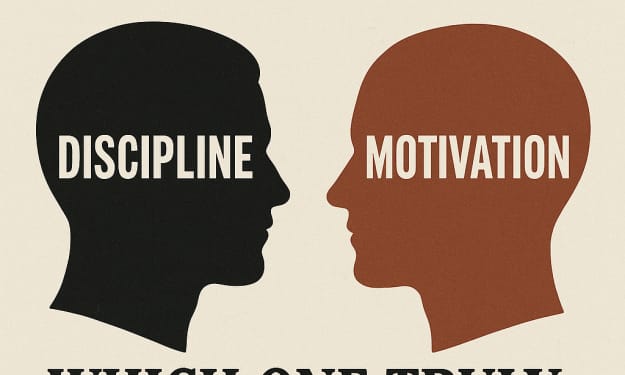
Discipline vs. Motivation: Which One Truly Leads to Success?. AI-Generated.
We’ve all heard the question: Is it better to be motivated or disciplined? Motivation is the spark that ignites desire, while discipline is the steady flame that keeps you burning. On the surface, motivation feels exciting—it fuels our dreams and gets us out of bed. But over time, motivation can wane. Discipline, however, powers through ups and downs, carrying us forward even when our enthusiasm fades. In this article, we’ll explore why discipline, not motivation, is the engine of lasting success—and how to cultivate both to achieve your goals.
By Voice of Simplicityabout a year ago in Motivation
The Power Within
In the heart of a dusty village surrounded by mountains, lived a boy named Kareem. He was quiet, observant, and always thinking. While other boys played loudly in the fields, Kareem would sit under the old fig tree, lost in his thoughts. People often misunderstood him. They said, “He’s too shy. He’ll never achieve anything.” But inside Kareem’s heart, there was a fire—a silent dream waiting to be awakened.
By Rahimullah Mohmandabout a year ago in Motivation