interview
Interviews to keep you inspired from motivational speakers that will help you conquer fears and achieve goals, now!
No Body Cares — Shut Up and Lift
The gym doesn't care about your excuses. The weights don't respond to your complaints. Your goals don’t get closer by talking—they move with effort. And that’s exactly the brutally honest message behind one of the most viral motivational quotes out there: “No body cares, shut up and lift.”
By Sultan Khan2 years ago in Motivation
Crossing Paths. AI-Generated.
**Chapter 1: The Divide** In the heart of the city, the gleaming towers of steel and glass seemed to touch the sky. Behind their immaculate walls, behind the luxury cars and designer suits, lived people who had never known what it meant to struggle, to wonder where the next meal would come from, or whether the bills would be paid. On the top floor of one such tower, in a penthouse overlooking the skyline, Marcus Hathaway sat in his leather chair, gazing out the window. He was the epitome of success—a self-made millionaire, known for his sharp business acumen and ruthless decisions.
By Abdurrahman Abdurrahman2 years ago in Motivation
Facebook Vaudeville: Loosely Based on a True Story
Act I: The Digital Stage is Set Once upon a time—not too long ago, in the curious era between "poke" wars and the birth of the metaverse—a social media empire named Facebook ruled over the digital lands. It was once a place of reunion, where long-lost classmates reconnected and moms proudly posted blurry photos of spaghetti dinners.
By Sultan Khan2 years ago in Motivation
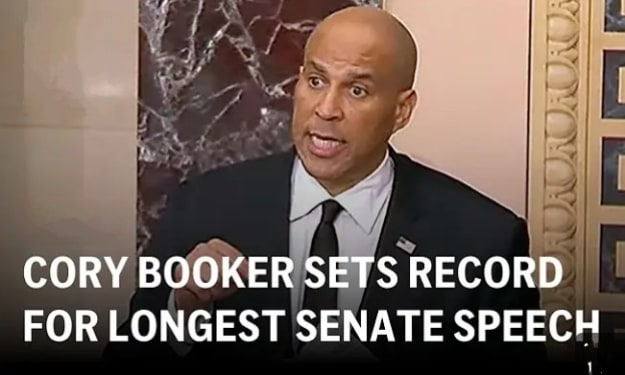
"25 Hours of Defiance: Cory Booker's Epic Showdown Against Trump in the Senate"
Start writing...On March 31, 2025, Senator Cory Booker of New Jersey made history by delivering a 25-hour, 5-minute speech on the Senate floor in protest against the policies of President Donald Trump's administration. This marathon address broke the previous record for the longest Senate speech, which had been held by Senator Strom Thurmond, who spoke for 24 hours and 18 minutes in 1957 to oppose the Civil Rights Act. Booker's speech was not just a feat of endurance; it was a bold statement about the state of the nation and his unwavering commitment to stand against policies he believed to be harmful to the American people. Background and Motivation Booker began his historic address at 7 p.m. on March 31, 2025, declaring that he would speak “as long as he was physically able.” He made it clear that his motivation for this unprecedented action was the deep concern he felt over the direction the country was heading under President Trump's leadership. The Senator framed his speech as a response to what he saw as a national crisis. Booker argued that under Trump's administration, the country was experiencing severe economic instability, threats to civil liberties, and devastating cuts to social programs that would disproportionately harm vulnerable communities. In his opening remarks, Booker pointed to several key issues that he felt needed urgent attention. He specifically criticized the administration’s economic policies, particularly its tax cuts for the wealthy, which Booker believed were exacerbating the national deficit and widening the already significant gap between the rich and the poor. He contended that these policies would only deepen the economic inequalities that had already plagued the country for decades. Key Themes and Issues Addressed The core themes of Booker’s speech were grounded in social justice, economic fairness, and the protection of democratic values. One of the first issues he tackled was the growing economic inequality in America. Booker vehemently opposed the tax cuts that President Trump had championed, arguing that they were a clear favor to the wealthy and large corporations at the expense of the middle class and the poor. He made the case that the country's budget deficit had ballooned because of these policies, and that the economic burden would ultimately fall on the shoulders of everyday Americans who were already struggling to make ends meet. In addition to economic inequality, Booker expressed grave concern over the proposed cuts to vital social programs such as Social Security and Medicaid. He warned that these cuts would have devastating consequences for millions of Americans, particularly the elderly, the disabled, and low-income families who rely on these programs for their basic survival. Booker argued that these cuts were not only harmful but also morally reprehensible, as they threatened the well-being of the most vulnerable members of society. Another key focus of Booker’s speech was the erosion of civil liberties. He strongly criticized the Trump administration’s actions, which he felt undermined the foundational principles of democracy. Booker specifically pointed to what he described as a growing authoritarianism, where checks on presidential power were being undermined and the rule of law was being ignored. He warned that if these trends continued, the very essence of American democracy would be at risk. Personal Narratives and Emotional Appeals In order to humanize the issues he was addressing, Booker shared several deeply emotional and personal stories from his constituents. He read letters from individuals who would be directly affected by the policies he was protesting, bringing a human face to the abstract political arguments. By recounting personal experiences, Booker aimed to illustrate the real-life consequences of the legislative decisions being made in Washington. His speeches were not just about numbers and statistics; they were about the people whose lives would be forever changed by these policies. Physical and Emotional Toll The physical toll of the marathon speech was evident. Booker had prepared for the endurance challenge by fasting and abstaining from water in order to minimize interruptions. This extreme self-discipline, however, led to dehydration and muscle cramps, which only underscored the immense physical and emotional demands of his endeavor. Despite the pain and discomfort, Booker pressed on, drawing strength from the memory of civil rights leaders like John Lewis, who had faced far greater personal hardships in their fight for justice. His resolve was a testament to his belief in the cause and his commitment to making his voice heard. Support and Reactions Throughout his speech, Booker received support from several of his colleagues in the Senate. Senate Minority Leader Chuck Schumer praised Booker for his dedication and courage, acknowledging the significance of the record-breaking speech. Schumer also expressed admiration for Booker’s ability to maintain his focus and passion throughout the grueling 25-hour ordeal. Public reaction was overwhelmingly positive, with many Americans expressing their support for Booker’s stand on social media. The speech went viral, accumulating over one million views, and sparked a nationwide conversation about the issues he had raised. Conclusion and Call to Action As Booker concluded his historic speech, he emphasized the moral imperative to oppose policies that threatened to undermine the democratic values upon which the nation was built. He called on his colleagues in the Senate, as well as the American people, to remain vigilant and proactive in the fight for justice. Booker stressed that the future of the country depended on the collective will of its citizens to stand up for what was right and to resist efforts to dismantle the protections and rights that had been fought for over centuries. Senator Cory Booker’s 25-hour speech stands as a powerful reminder of the impact that one individual’s conviction can have in the face of political adversity. It was a call to action, not just for lawmakers, but for the American people to recognize the importance of safeguarding democracy and advocating for the marginalized. Through his unprecedented act of defiance, Booker not only set a new Senate record but also reignited a critical national conversation about the future of the country and the values that must guide its leadership.
By Asadullah2 years ago in Motivation
The Unknown Wanderer
It was a sleepy town tucked between green hills and a slow-moving river. The people there knew each other well. Every face was familiar. Every story, shared. That’s why when the stranger walked in one quiet morning, no one knew what to make of him.
By Nihal Khan2 years ago in Motivation
Mirror in the Morning
For as long as I can remember, I tried to be someone everyone else liked. In school, I laughed at jokes I didn’t find funny. I wore clothes that didn’t feel like me. I agreed with people just so they would not get upset. I said "yes" when I wanted to say "no." And after all that, I would go home feeling empty and small—like I had left pieces of myself behind.
By Nihal Khan2 years ago in Motivation
The Rainy Stall
In a small town, on a crowded street full of noise and people, there was a tiny tea stall. It didn’t look like much—just a wooden table, a big kettle, a few cups, and an old umbrella for shade. But what made the stall special was the woman who ran it.
By Nihal Khan2 years ago in Motivation
They said you couldn't, " so I did it".
They Said I Couldn't, So I Did" I was born in a village where dreams are stitched into the hem of a girl's dupatta—only to be hidden, never worn out loud. My name is Radha. I was the third daughter in a family that prayed for a son. From the moment I could walk, I was told my place—inside the kitchen, behind the curtain, beneath the expectations of others. They said I couldn't go to school after 8th grade. They said girls don’t need education—just good cooking skills and a better smile. They said, “What will you do by studying? You’ll get married anyway.” But I had this strange hunger in me—not for food, but for more. I remember once asking my uncle, who had just returned from the city, “What does a college look like?”He laughed. Everyone laughed. My mother told me to not speak such nonsense in front of elders. That night, I cried under my blanket, hugging the only book I owned — a tattered English grammar guide someone had thrown away. They said I couldn't speak English. So, I started watching old English movies without understanding a word, rewinding scenes, writing down sentences I didn’t even know how to pronounce. Every time I made a mistake, someone would smirk and say, “This is not your world.” But I whispered back to myself, “One day, it will be.” At 16, I begged my father to let me appear for the 10th board exams. He said no. So I stitched blouses in the afternoon and secretly saved every rupee. I lied once—told my parents I was going to help a neighbor. Instead, I walked five kilometers barefoot to reach the exam center. I passed. They said I couldn't dream of a career. So I dreamed even harder. I started giving tuition to village kids. Five rupees per student. Ten students. Fifty rupees a day. I bought books, a second-hand phone, and internet data. Late at night, while the village slept and the lantern flickered, I watched YouTube videos about scholarships, interviews, and confidence-building. I practiced speaking in front of a broken mirror with missing corners. Then came the biggest test. I applied for a scholarship to study journalism in a city college. The day the acceptance letter came, I touched the paper a hundred times, afraid it might disappear like a dream. But acceptance didn’t come from home. My father said, “If you step out of this house, don’t come back.” So I didn’t. With a small bag and a head full of fear, I boarded a bus to a future I couldn’t fully see. The city was cruel at first. I was mocked for my accent, my clothes, my silence. I often ate only once a day to save money. But I never missed a class. And I never missed writing—because it was my oxygen. Today, I’m 23. I’m not just a journalist. I’m the voice for every girl they said “couldn’t.” I’ve interviewed ministers, covered protests, written stories that brought change. Last year, my village invited me as the Chief Guest at a school event. The same school where I wasn’t allowed to speak. I stood on stage, looked into the eyes of every little girl there, and said: "They said I couldn’t. So I did. And you can too." Because sometimes, the fire they try to extinguish is the one that lights the world. If I did it then why wouldn't you people. To gain something you have to lose something, this is what I have learnt from my life, so move ahead. I too left my house, family and everything, all I had was some savings and hope, I did not know what was going to happen to me, but I did not get scared and after a few salons I got the fruits of my hard work
By Riya mandal2 years ago in Motivation
From ashes to ambitions
In the dim light of early morning, when the world is still tangled in the remnants of sleep, a single soul stands at the edge of a crumbled empire—an empire that once gleamed with prosperity, only to be reduced to smoldering ruins. The air is heavy with the scent of charred wood and lost potential, and the ground beneath her feet is scorched with the fiery memories of what once was. But the woman who stands amidst the ruins does not mourn. She does not weep. She only feels the stirring of something deep within her—a quiet yet fierce flame, rising from the ashes of her past. She knows this feeling. It's the taste of rebirth, the kind that comes only after the fiercest of battles, the hardest of falls.
By Muhammad Owais Ayaz2 years ago in Motivation
Be Yourself; Everyone Else Is Already Taken
In a world that constantly pushes people to fit into predefined molds, the idea of being oneself might seem both liberating and challenging. "Be yourself; everyone else is already taken" is a simple yet profound statement attributed to Oscar Wilde. It highlights the uniqueness of every individual and the importance of embracing one's true identity instead of attempting to be a copy of someone else. Despite societal expectations, peer pressure, and the allure of trends, authenticity remains one of the most valuable traits a person can possess.
By Nora Ariana2 years ago in Motivation
Darren Clohesy’s Approach to Optimizing Business Efficiency and Success
In today’s competitive and fast-moving business environment, operational efficiency is not just a goal—it’s a necessity. Businesses that streamline processes, reduce waste, and maximize output gain a significant advantage. At the forefront of this efficiency-driven movement is Darren Clohesy, a highly respected business strategist known for transforming operations and driving sustainable success.
By Isabella Lyle2 years ago in Motivation