interview
Interviews to keep you inspired from motivational speakers that will help you conquer fears and achieve goals, now!
Myths vs. Reality: What the World Gets Wrong About Afghanistan
When most people hear the word Afghanistan, certain images come to mind — war, destruction, poverty, fear. For decades, the country has been portrayed through a narrow lens by international media, often reduced to conflict zones and tragedy. But Afghanistan is more than a headline, more than a battlefield, and more than the pain it has endured.
By Abdulmusawerabout a year ago in Motivation
Afghanistan: A Hidden Gem That Deserves to Be Seen Up Close
If you follow the media, Afghanistan might seem like a land of dust, danger, and despair. But if you ever dare to look beyond the headlines, you’ll discover a country filled with breathtaking beauty, rich culture, and some of the kindest people you’ll ever meet.
By Abdulmusawerabout a year ago in Motivation
The School Beneath the Mulberry Tree
In the rural highlands of eastern Afghanistan, nestled among the dry fields and mud-brick homes, lies a village so small that it doesn’t even appear on most maps. There are no paved roads. Electricity flickers on and off like a candle in the wind. The closest school is hours away, over rough hills and riverbeds that flood during spring.
By Abdulmusawerabout a year ago in Motivation
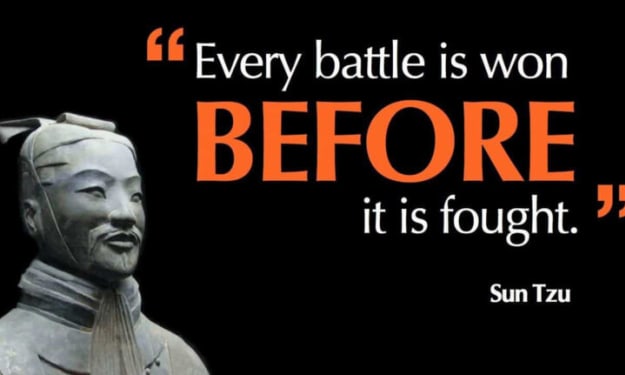
Summery The Art of War" by Sun Tzu
Summary of "The Art of War" by Sun Tzu (650 words) The Art of War is an ancient Chinese military treatise written by Sun Tzu, a legendary general, strategist, and philosopher. Composed over 2,500 years ago, the book remains one of the most influential works on strategy, leadership, and warfare. Though originally meant for military commanders, its lessons are widely applied in business, politics, sports, and daily life. 1. Foundations of Strategy Sun Tzu emphasizes that all warfare is based on deception. Victory depends on outsmarting the enemy, not necessarily overpowering them. He teaches that the best general wins without fighting — by breaking the enemy’s resistance through strategy, manipulation, and diplomacy. According to Sun Tzu, war should be the last option, pursued only when all peaceful means fail. 2. Planning and Preparation Preparation is vital. Sun Tzu outlines five key factors for success: The Way (moral alignment of people and ruler), Heaven (weather and timing), Earth (terrain and distance), The Commander (leadership qualities), and Method and Discipline (organization and logistics). A well-prepared leader considers all these before entering battle. He advises leaders to assess themselves and the enemy carefully. Knowing both will ensure victory; knowing only one can lead to defeat. Accurate calculations and a clear understanding of strengths and weaknesses are essential. 3. Waging War Wisely Sun Tzu warns that prolonged warfare drains resources and morale. Quick, decisive victories are best. He highlights the importance of managing supplies, avoiding unnecessary conflict, and using captured resources instead of depleting one’s own. 4. Positioning and Advantage The book teaches the importance of positioning in warfare. Victory comes not from brute force but from taking advantageous positions. This involves understanding the terrain, controlling key locations, and exploiting the enemy’s weaknesses while defending one's own. He explains the concept of shih — the energy or momentum of a situation — and how skilled leaders use it to gain dominance with minimal effort. 5. Flexibility and Adaptability A recurring theme is adaptability. There is no fixed method for victory. The general must be flexible like water — able to change direction and shape based on the battlefield. Just as water flows to the lowest point, a wise general avoids enemy strengths and attacks where they are weak. Sun Tzu criticizes rigid strategies and praises innovation. Being unpredictable confuses the enemy and creates opportunities. 6. Deception and Psychological Warfare Deception is central to Sun Tzu’s strategy. Misleading the enemy — about one’s strength, intentions, and location — creates confusion and opens paths to victory. “Appear weak when you are strong, and strong when you are weak,” he says. He also explores the power of fear, morale, and manipulation in warfare. A confident, united army defeats a divided, confused one. 7. Leadership and Command Sun Tzu describes the ideal leader as wise, courageous, disciplined, humane, and strict. A leader must inspire loyalty and obedience, make hard decisions, and act decisively. Overreaction, recklessness, or fear can lead to ruin. He emphasizes the importance of rewarding good conduct, punishing disobedience, and maintaining order in the ranks. Discipline ensures the army operates as one force. 8. Spies and Intelligence The final chapter focuses on espionage. Information is the lifeblood of warfare. Knowing the enemy’s plans, movements, and mindset allows a general to strike effectively. Sun Tzu outlines five types of spies and urges leaders to value intelligence above all else. Conclusion The Art of War is more than a military manual — it’s a timeless guide to strategic thinking. Its core principle is that war should be won with intelligence, not brute force. By mastering deception, preparation, adaptability, and leadership, one can secure victory while minimizing conflict and loss. Even today, Sun Tzu's ideas influence modern warfare, business strategy, leadership, and negotiations. His wisdom teaches that the greatest victories are those achieved with the least struggle.
By Khan Shahabout a year ago in Motivation
❤I Am the Voice of a Child: This War Is Not Ours, and This Is Not Islam❤
I could be any child. I could be your son, your nephew, your neighbor. I had a backpack filled with dreams and crayons. I wanted to become a teacher. I loved mangoes in the summer and stories before bedtime.
By Abdulmusawerabout a year ago in Motivation
Longing Landline
The rotary phone rested like a fossil on the corner of Clara’s walnut side table, its beige plastic faded to the color of bone. The coiled cord lay limp, a spiral of forgotten conversations. Dust clung to its edges, but she couldn’t bring herself to wipe it away. It had become a kind of altar—silent, sacred. Clara sat beside it, nursing a cup of tea gone cold. Her fingers hovered over the dial, tracing invisible lines from one number to the next. She could still feel the weight of it beneath her thumb, the slow, deliberate spin, the click-click-click as the dial reset. That sound had once marked the rhythm of her Sunday evenings. It hadn’t rung in years. Not since him. She’d thought about throwing it out more times than she could count. Landlines were obsolete, relics from another lifetime, like cassette tapes and Sunday newspapers. But whenever she reached for the cord, ready to yank it from the wall and be done with it, a knot formed in her chest—tight, insistent. Like cutting the cord would be more than physical. Like she’d be severing something invisible, yet vital. Something still holding on. Ten Years Earlier "You’ll call?" Her voice had barely risen above the whisper of rain on the fire escape. Daniel turned from where he was zipping his suitcase, his mouth curving into that crooked half-smile that always made her breath catch. He stepped closer, cupped her cheek with fingers that smelled faintly of ink and coffee. "Every Sunday. Like clockwork." And he had. For a while. Seven o’clock, every Sunday evening. The phone would ring, sharp and sudden, and Clara’s heart would leap before she even reached for it. She’d settle into her favorite armchair, the receiver pressed tight to her ear, the spiral cord stretching as she crossed one leg over the other and let his voice wrap around her like a blanket. They talked about everything and nothing: his leaky faucet, her new recipe failures, the neighbor’s annoying wind chimes, the way his new city always smelled faintly of cinnamon. There were long pauses filled with unsaid things, and yet the silence between them never felt empty. It felt like breathing. Until one Sunday, the silence stayed. No ring. No voice. Just the slow tick of the clock and the hum of the refrigerator. She waited. Called once, then again. Left a message. Nothing. Weeks passed. Then months. The silence hardened. Grew sharp. She stopped calling. Present Day Clara stared at the phone. It looked both smaller and heavier than she remembered. She curled her fingers under the base, hesitated, then let them fall away. Her tea had long since gone cold, forgotten on the table. She told herself it was foolish. People moved on. Maybe he had a wife now. Children. Maybe he had forgotten all about the woman he used to call every Sunday evening. About the landline with the soft crackle in the background. About her. But the air tonight buzzed faintly, like the electric hum before a storm. Familiar. Charged. She reached for the receiver. Her fingers found the numbers without thinking, dialing from memory—their rhythm etched into muscle and marrow. As the dial spun back, she held her breath. One ring. Two. Three— "Hello?" Her heart jolted. The voice was older, grainier around the edges, but undeniably his. Daniel. She froze. The words she had rehearsed—casual, distant, strong—vanished. A beat of silence. Then: "Clara?" How did he know? After all this time, all these silent years—how did he still know her voice without hearing it? She swallowed. Her throat felt dry. "You didn’t call." A breath. Soft. Not guilty. Not defensive. Just… worn. "I couldn’t." "You didn’t want to?" "No. I wanted to too much." Her eyes stung. She pressed her palm against her knee, grounding herself in the present. She didn’t want to go back—not to the ache of being forgotten. Not to the questions that had circled her for years like wolves. And yet… "I still have that mixtape you made me," he said, his voice a quiet thread. She blinked, startled. "Seriously?" "Track one still skips halfway through, remember?" A laugh slipped out of her, unsteady. "That’s the dumbest thing to keep." "I keep a lot of dumb things. You were never one of them." The air shifted—lighter, somehow. They didn’t talk about the silence. Not directly. No apology, no rehashing of the past. Just small things, like petals dropped along a path. Daniel had switched to tea, finally admitting coffee made him jittery. Clara had learned to bake sourdough during the lockdown years and now kept starter in the fridge like a pet. There was a stray cat who’d adopted her porch as its throne. He told her about a short story he’d written that he’d never shown anyone. She told him how the house creaked differently at night now, as if remembering new things. When they finally said goodbye, there were no promises. No plans. Just the quiet understanding of something mended, something no longer unraveling. Clara placed the receiver down slowly, as though breaking a spell. The phone sat still. Silent once more. But it no longer felt like a tomb. It felt like a bridge. She didn’t need answers. She didn’t need declarations. Some things—some connections—didn’t need to be spoken to be real. Some stayed humming beneath the silence .
By GoldenToneabout a year ago in Motivation
The Secret Behind Successful Relationships. Content Warning.
We often believe that relationships succeed because of blood ties, shared childhoods, or years of staying in touch. But experience proves otherwise. Sometimes, even the closest people drift apart, and total strangers can become our greatest support.
By Saaya Gsmabout a year ago in Motivation
Success Isn’t a Straight Line
Success Isn’t a Straight Line When people hear the word "success," they often picture a straight road — one that moves cleanly from point A to point B. Study hard, get a degree, land a good job, and live happily ever after. I used to believe that too. Until life taught me that real success doesn’t work like that. It’s not a straight line. It’s a winding, messy, often painful journey — and in my case, it began with failure.
By Ali Asad Ullahabout a year ago in Motivation
Daily Habits That Changed My Life
Daily Habits That Changed My Life We all dream of success, happiness, and a better life. But what if I told you that the key isn’t some overnight transformation — it’s hidden in the simple things you do every single day? That’s what I discovered. My life didn’t change because of a big opportunity or a stroke of luck. It changed because I changed my habits. Slowly. Consistently. Quietly.
By Ali Asad Ullahabout a year ago in Motivation
I Failed 100 Times Before I Got It Right
I Failed 100 Times Before I Got It Right Failure is something most people are afraid of. It feels bad, it makes us doubt ourselves, and sometimes, it makes us want to give up. But what if I told you that failing 100 times was the best thing that ever happened to me? This is the story of how I failed again and again—and how those failures helped me finally get it right.
By Ali Asad Ullahabout a year ago in Motivation