Holiday
Employees Actively Seek Out Remote and Hybrid Work.
In recent years, the traditional workplace has undergone a seismic shift. The once-standard 9-to-5 office routine is being challenged by a growing demand for remote and hybrid work models. Employees across industries are now actively seeking out roles that offer flexibility, autonomy, and a better work-life balance. This trend, accelerated by the COVID-19 pandemic, has reshaped the way people think about work — and it's here to stay.
By Abu Taherabout a year ago in Motivation
God’s Test
The night was quiet, yet something felt disturbingly alive in the silence. Arman lay awake, staring at the cracked ceiling of his small room. Life had been dragging him through dark waters—unemployment, loss, betrayal. His heart had grown numb, faith worn thin. That night, as the clock struck 3:03 AM, the air around him shifted. The room became colder, then warmer, as if time itself was adjusting. Then came the voice. Neither male nor female, young nor old. It wasn’t heard—it was felt. "Arman, you have been chosen." He sat upright, breath caught in his chest. “Who’s there?” "A test has been placed upon you. Your choices will tip the scale of humanity’s future. Succeed, and light shall return. Fail, and darkness will rise." He tried to speak, to deny, to ask why him—but the voice had vanished. Sleep took him instantly after, but his dreams were vivid. He stood in a world that wasn’t Earth, yet felt like it. Vast lands split into two realms—one glowing with golden fields, the other ashen with suffering. A narrow bridge connected them, and at the center stood a scale with no weights. In the morning, Arman assumed it was a dream. But from that day, the world began to behave… strangely. At first, it was subtle. People around him would react deeply to his words—as if they carried power. A simple compliment would leave a stranger teary-eyed. A harsh word would spark arguments among people he didn’t even know. By the third day, he realized something frightening: every emotional ripple he created would multiply. His anger would create more anger in others. His kindness would echo. He tested it. Once, while standing in line at a bakery, he smiled gently and let a tired old woman go ahead. The cashier, moved by the gesture, offered her bread for free. The woman, in tears, whispered a prayer for Arman. Later that day, he passed a street where two men were helping an injured dog—one of them was the same man from the bakery line. But on another occasion, when he lashed out at a beggar who grabbed his shirt, he saw that same beggar later, bloody and beaten by an angry mob. The realization crushed him. He wasn’t being tested in one moment—it was every moment. Every decision, word, gesture. The test was not about passing or failing a task. It was about navigating a world where one soul could influence many. He isolated himself, fearing his own shadow. But the voice returned. “To hide is to fail. You must walk the bridge.” That night, in a waking dream, Arman was again in the split world. The scale at the center had begun to tilt—toward darkness. His chest tightened. “You are not perfect. That was never the demand,” the voice said. “But you must choose every day. Love or hate. Mercy or rage. Your heart decides not just for you—but for all.” He wept. “But I’m no one.” “No one becomes everyone when they choose with truth.” The next morning, he rose with purpose. He walked the city streets and listened. Where people fought, he brought calm. Where sorrow grew, he offered silent companionship. He smiled at broken men and fed hungry children. Not because he was told—but because he wanted to. And the world began to shift. Not immediately. But slowly. A teacher forgave a student. A police officer helped a man instead of arresting him. A violent gang disbanded after its leader found a letter from his sister—one that Arman had helped deliver days ago. The light began to spread. Months passed. Arman aged, not in body, but in soul. He no longer heard the voice. He no longer needed to. One final dream came. He stood again at the bridge. This time, the scale was balanced. The golden side glowed warmer. The dark side had begun to crumble. A figure stood beside him—not God, not an angel, but a mirror of himself. Peaceful, older, complete. "The test was never to save the world," the figure said. "It was to see if one man’s heart could still carry the light." Arman smiled. “And?” "You chose. And in choosing love, you reminded others how to choose it too." The next morning, Arman passed away in his sleep—peacefully, with a small smile. But the world he left behind remembered him not as a hero, nor a prophet, but as a man whose kindness seemed to ripple forever. No one knew of the test, but everyone felt the results. And somewhere, in a realm unseen, the scale tipped—finally—toward light.
By IRSHAD MUHAMMADabout a year ago in Motivation
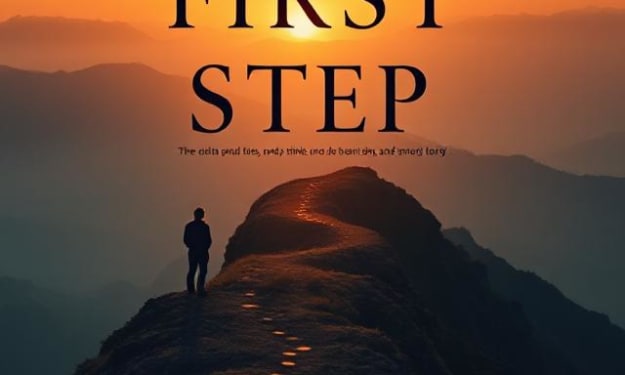
The Power of a Single Step: Overcoming Fear and Embracing Change
The Power of a Single Step: Overcoming Fear and Embracing Change For as long as she could remember, Alina had lived within the quiet walls of familiarity. Her routine was simple—wake up, go to work at the local library, return home to her small apartment, and repeat. She enjoyed the silence of the books and the predictability of her days. But deep inside her, a quiet restlessness brewed—one that she buried beneath the comfort of routine and the fear of the unknown. It wasn’t that Alina lacked ambition. She once dreamed of becoming a travel writer, wandering through cities and capturing stories in cobblestone streets and bustling markets. But every time the thought crept in, so did the fear: What if I fail? What if I can’t make it? What if I leave and everything falls apart? So she stayed. Year after year. Until one evening, after the library had closed and rain tapped softly against the windows, Alina found an old journal while sorting the lost and found bin. The name inside read Maya Collins. The journal was worn and stained with time, but its pages were full of life—sketches of landscapes, stories of strangers, and reflections on fears conquered through small acts of bravery. One passage caught her breath: “It only takes one step to start a new life. Not a leap, not a sprint. Just one honest, trembling step.” That night, the words refused to leave her mind. She read them again the next morning and the next. And something in her began to shift. One week later, Alina called in a few days off from work—something she had never done in six years. With trembling hands, she booked a train ticket to a nearby coastal town. It wasn’t far, but to her, it felt like stepping off the edge of everything she had ever known. The morning of the trip, Alina stood at the station, suitcase in hand, heart pounding in her chest. A voice in her head whispered reasons to go back—what if it rained? What if she got lost? What if she hated it? But then she remembered Maya’s journal. Just one step. She boarded the train. The town of Elmsbay welcomed her with salty air and distant gull cries. She wandered its narrow streets, watched children play near the docks, and sat in a café scribbling observations in a notebook she had brought along, almost unconsciously. She didn’t try to be a writer. She simply watched and wrote. And for the first time in years, she felt alive. That weekend, Alina met Eleanor, the café owner, who struck up a conversation about her writing. They spoke for hours—about dreams, regrets, and the strange courage that comes in quiet moments. Eleanor had once been a dancer but gave it up for fear of failure. Now, in her fifties, she was relearning ballet in a local community class. “You’re never too old to begin,” she said. “And you’re never too broken to change.” The words hit home. When Alina returned to the city, something had shifted. The library felt different—smaller, quieter than she remembered. She resumed work but couldn’t ignore the itch in her chest. She began writing daily, enrolling in an online travel writing course, and started a small blog about places she visited—even if they were just local parks or neighborhoods she’d never explored before. Over the next few months, her steps grew bolder. She traveled farther—first within the country, then across borders. Her blog gained readers. People resonated with her stories, especially her honesty about fear and the hesitance of starting. She didn’t pretend to be fearless. She simply kept stepping forward. One year from the day she found the journal, Alina stood on a stage at a writer’s conference, sharing her story. She spoke about comfort zones, about how they can feel like homes but can quietly suffocate dreams. She spoke about the journal, about Maya’s words, and about her first trembling step onto that train. “And that,” she said, “was the moment everything changed. Not all at once. Not like magic. But slowly, and beautifully.” After her talk, a young woman approached her, tears in her eyes. “I’ve been afraid to leave my job and pursue photography,” she confessed. “But your story… it gave me hope.” Alina smiled. She reached into her bag and handed the woman a small card with Maya’s quote printed on it. “It only takes one step,” she said. “Not a leap. Just a step.”
By IRSHAD MUHAMMADabout a year ago in Motivation
Little Joys of Childhood
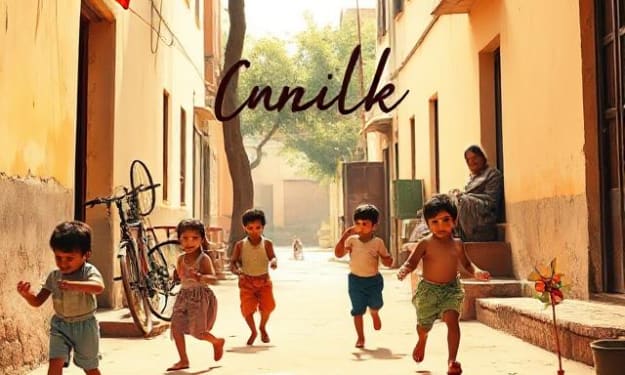
There was a time when happiness came wrapped in simplicity. It didn’t need a smartphone, a credit card, or a weekend getaway. It only needed a few friends, a patch of open ground, and the sound of the ice cream cart’s bell in the distance. That was childhood — a time of wonder, curiosity, and the little joys that stitched our days into warm memories. I grew up in a small town, where life was slow, yet full of color. Our street was not wide, but it echoed with laughter every evening. We didn’t have parks nearby, so the street became our cricket pitch, our race track, and sometimes even our imaginary kingdom. Every day after school, we’d throw off our bags and rush out, still in uniform, with dust-covered shoes and uncombed hair. Our mothers shouted from behind, “Pehle kuch kha lo!” (Eat something first!) but we were already halfway out the door. We couldn’t waste a single minute of playtime. Those moments, those races under the sunset, and those little arguments over whose turn it was to bat—those were the treasures of our day. One of my fondest memories was playing with marbles—kanche. Each of us had our own prized collection, kept in rusted biscuit tins or cotton pouches stitched by our mothers. We played for hours, crouching low, measuring distances with twigs, and showing off our best shots. Winning someone else’s best marble was a moment of pride, but the real joy was in the shared laughter, the teasing, and the thrill of aiming just right. Summers had their own magic. The fan spun lazily in the afternoon heat while we lay on the cool floor, sipping mango juice and reading comics like Chacha Chaudhary or Tinkle. But evenings were different. They were made for adventures. As the sun dipped, we gathered for langri, pakdam pakdai, and chhupan chhupai. The neighborhood kids would all show up, barefoot and buzzing with energy. We’d hide behind trees, walls, or sometimes even inside someone’s open gate. The thrill of being caught or not being found was unmatched. Rainy days were even better. The first rain of the season brought a smell that no perfume could ever match—the scent of wet earth. We’d run outside, arms stretched wide, letting the rain soak us completely. We built paper boats and watched them float away in the water-filled streets, cheering like we had launched real ships. Sometimes, a bigger wave would swallow our little boat, and we'd chase the current, laughing as our feet splashed in muddy puddles. Then there were the festivals—when joy became a community celebration. On Eid, our friends brought sheer khurma, and we returned the love on Diwali with sweets and crackers. Holi was pure madness. We didn’t need expensive colors—some gulal, a few buckets of water, and sneaky balloons thrown from rooftops were enough to make it unforgettable. Our clothes were ruined, our faces unrecognizable, but our smiles were always the brightest. One cannot forget the bond we shared with our grandparents. My nani used to tell us bedtime stories of kings, magical birds, and clever rabbits. We’d sit around her on the charpai, eyes wide open, hanging on to every word she said. Sometimes she added her own twist to the stories, and we never knew which part was real and which was made up. But we believed it all. That was the magic of childhood—the ability to believe. There was also a special joy in collecting things—colorful wrappers, shiny stones, feathers, and even matchbox covers. They weren’t expensive, but they were priceless to us. We’d trade them like precious gems and show them off with pride. I remember creating a ‘museum’ in an old shoebox and charging my cousins one rupee for a “tour.” Life back then wasn’t without its troubles. We got scolded for bad grades, scraped our knees often, and sometimes cried over lost toys. But we bounced back quickly. A piece of imli (tamarind) or a candy from the roadside shop was enough to lift our spirits. We didn’t need much, because we had everything—we had childhood. Now, as I sit in front of a glowing screen, with notifications popping up and bills waiting to be paid, I often find myself drifting back to those days. I think of the smell of my old schoolbag, the feel of wet mud between my toes, the sound of my best friend’s laugh, and the warmth of my mother’s lap after a long day of play. Those days are gone, but the little joys remain—etched in memory like a beautiful painting. They remind me that true happiness isn’t found in big achievements or possessions, but in the small, everyday moments we often overlook. So whenever life feels overwhelming, I close my eyes, take a deep breath, and revisit those lanes of my past. The lanes where I chased kites, rode bicycles with no brakes, and laughed till my stomach hurt. And for a moment, I am a child again.
By IRSHAD MUHAMMADabout a year ago in Motivation
From Zero to Billionaire: The Incredible True Story of MrBeast’s Rise to YouTube Royalty
Introduction In the vast world of YouTube, few personalities stand out like Mr beast, whose real name is Jimmy Donaldson. Today, Mr beast is considered one of the wealthiest and most influential YouTubers globally. However, his rise to fame and fortune wasn’t an easy one. Jimmy’s story is a testament to the power of hard work, creativity, and dedication. From his humble beginnings as a teenage content creator to becoming a billionaire through his viral videos and charitable acts, MrBeast's journey is nothing short of extraordinary. In this success story, we’ll explore how MrBeast went from being an average YouTuber to a global sensation.
By Arab Shahabout a year ago in Motivation
The Unyielding Path
When the World Says Give Up, Let Your Spirit Say Try Again The wind howled across the narrow mountain pass as Arman adjusted the frayed straps of his rucksack. The path ahead was steep, jagged, and blanketed in a mix of loose stones and stubborn ice. Most people would have turned back hours ago. But Arman wasn’t most people—not anymore.
By Qaisar Janabout a year ago in Motivation
can morality possible without religion?
For centuries, one of the primary sources of moral teachings to individuals and societies has been religion. From the Ten Commandments of Christianity to the Quran, the Bhagavad Gita, and Buddhist ethics, religious traditions have shaped human beliefs regarding right and evil. But in a modern, increasingly secular world, a burning question arises: Is morality possible without religion?
By mehadiabout a year ago in Motivation
A Dropshipping Company How does dropshipping work?. AI-Generated.
1. Dropshipping is a business model where you don’t need to stock or handle any products. Instead, when a customer places an order through your online store, that order is immediately forwarded to your supplier, who then ships the product to the customer. The product never needs to be touched. Why is it such a successful online company? Low start-up costs and no need to buy things right away Easy to launch – All you need is a website and a supplier
By Habib Mahmudabout a year ago in Motivation
The Last Ember
In a world where warmth had become myth and sunlight a forgotten language, silence reigned like a tyrant. The sky was a permanent bruise, heavy with leaden clouds that had not parted in generations. The great cities of men—once citadels of light and laughter—lay buried beneath glaciers and ash, their towers broken, their libraries devoured by time and snow. Nature had reclaimed her dominion with vengeance, and mankind had become a whisper on the wind.
By Qaisar Janabout a year ago in Motivation
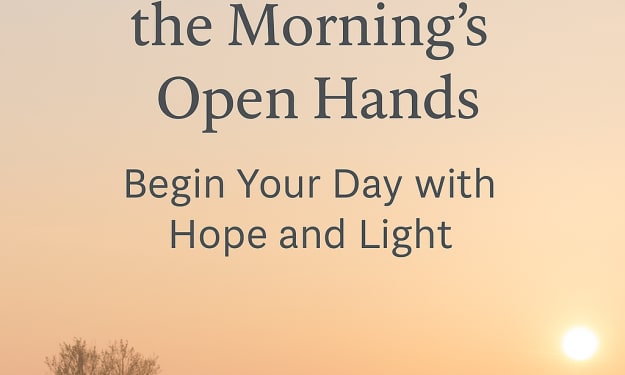
A Song for the Morning’s Open Hands: Begin Your Day with Hope and Light. AI-Generated.
🌞 Introduction: A New Morning, A New Song Every morning, the world offers us something gentle and quiet—an open hand. 🌄 It doesn’t come with noise or pressure. It comes with light, soft air, and the chance to begin again. It’s like a song, just for you. A quiet melody that says: "You are here. You are alive. This is your moment."
By IMONabout a year ago in Motivation
Purpose of Creation: The Greatness of Worship and the True Identity of Human Existence
"And I created the jinn and mankind only for My worship." — (Al-Quran, Surah Az-Dhariyat: 56) --- Purpose of Creation: The Greatness of Worship and the True Identity of Human Existence
By Abdul Barikabout a year ago in Motivation