goals
Understanding your goals to help you achieve them.
Times You Should be A Little Selfish in Life
When growing up, we were told never to be selfish but always put others first but as an adult, you will realize that this mindset will put you in more harm than good. While living a selfless life is admirable, sometimes being a little selfish is essential to your survival and well-being. Psychology has proven that constantly putting others first can lead to burnout, damaged mental health, and resentment. Below are 7 periods when you should be a little selfish to maintain a balanced and fulfilled life.
By Emma Ade2 years ago in Motivation
The Power of Choices: Transform Your Life with Every Decision
Every day, we make countless choices, and these choices can have a huge impact on our lives. From what we wear in the morning to how we spend our time, the decisions we make reflect our values and priorities, ultimately defining our paths. In this article, we will explore three critical sets of concepts: Bad Choice vs. Good Choice, Bad Habit vs. Good Habit, and Disaster vs. Achievement. Understanding these relationships not only highlights the significance of our daily decisions but also empowers us to cultivate a more mindful approach to life. Join me as we uncover the impact of our choices and how they can lead to transformative outcomes.
By Sadia Naznin2 years ago in Motivation
The Art of Sustaining Excellence
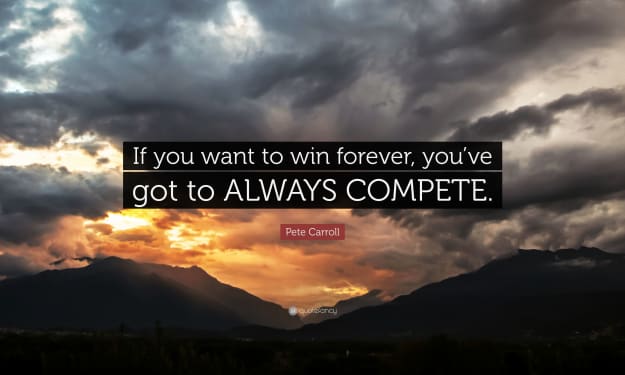
The Art of Sustained Excellence By George Carralejo One of the most often recited quotes from Championship Teams is, “it’s easier to get to the top, than it is to remain on top.” It serves as a warning to successful teams that what got you to the pinnacle, won’t keep you there. Once you’ve reached the apex of your profession, a myriad of new issues inevitably arise: your opponents are intensely focused on beating you, your team must overcome the disease of me, and internal complacency begins to set in. These are just a few of the issues that champions face in their quest to remain the best. So how do the best remain successful year after year? Long term winners have both incredible discipline and a willingness to constantly self-evaluate; by making these traits a hallmark of their culture, the team can remain successful year after year. As Super Bowl winning coach, Pete Carroll stated, the goal is to “Win Forever.”
By George Carralejo2 years ago in Motivation
Derek Hough
Derek Hough is a name that has become synonymous with dance. Over the years, he has established himself as one of the best dancers and choreographers in the entertainment world. From his time on "Dancing with the Stars" to his work as a judge, actor, and musician, Hough has worn many hats and worn them well. His charming personality, incredible talent, and dedication to his craft have made him a household name.
By Farhan Sayed2 years ago in Motivation
How To Parent A Teenager With Borderline Personality Disorder
Parenting a teenager is already a challenge, but when your teen is diagnosed with Borderline Personality Disorder (BPD), the emotional and psychological complexities become even more daunting. As parents, it is crucial to understand what BPD entails, how it affects your child's emotional and behavioral responses, and, most importantly, how to provide the right support.
By Teenage Parenting2 years ago in Motivation
Turning Your Skills and Experience into Income
You have a talent for art and music, but how do you avoid being the so-called starving artist and make money doing what you love? Well, unfortunately you might not be able to avoid the starving artist pitfalls entirely, but if you stick at it and follow these tips, you might be pleasantly surprised with the outcomes.
By Marzan Hossain 2 years ago in Motivation
Five Tips for a Successful Private Lessons Business
Teaching private lessons in music or art can be a great way to make extra cash. You might have a lot of people asking you to show them how to do something that they know you’re good at. However, you might be hesitant to start because oftentimes teaching someone else how to do what you do can be a difficult task.
By Marzan Hossain 2 years ago in Motivation
Why Crises Are Necessary in Life: A Journey Through Pain and Growth
Why Crises Are Necessary in Life: A Journey Through Pain and Growth Life is often seen as a series of peaks and valleys, moments of joy punctuated by inevitable hardships. Among these hardships, crises stand as the most formidable. Crises come unexpectedly, shattering our comfort zones, upending the predictable rhythm of our existence, and forcing us to confront the fragility of life. At first glance, they seem like unwelcome intrusions, but when viewed through the lens of growth and transformation, crises become indispensable milestones in the journey of life. Crises, though painful, have a unique way of awakening the soul. They strip away the illusion of control and remind us that life is inherently unpredictable. Whether it is the loss of a loved one, the collapse of a career, or a personal health scare, crises push us into a corner where we are forced to re-examine our priorities, values, and beliefs. It is in these moments of vulnerability that we begin to see the true essence of life. The Crucible of Change Change is a constant in life, but meaningful change often comes through the crucible of crisis. A crisis acts as a catalyst that disrupts the status quo and shakes us out of complacency. When everything is going well, we rarely pause to question whether we are truly living in alignment with our purpose or fulfilling our potential. We get comfortable in our routines, and in that comfort, we lose sight of the bigger picture. Consider the example of a caterpillar transforming into a butterfly. Before the caterpillar can spread its wings, it must first go through the painful process of metamorphosis. Inside the cocoon, the caterpillar is essentially dissolved into a goo-like substance before re-forming as a butterfly. In this metaphor, the cocoon represents a crisis — a period of darkness and uncertainty. But without that period of dissolution and struggle, the beauty of the butterfly could never emerge. In our own lives, crises often play the role of the cocoon. They break us down, only to rebuild us stronger, more resilient, and more aware of our true potential. The struggle is essential, for it is through adversity that we discover our inner strength, much like the butterfly must struggle to break free from the cocoon in order to strengthen its wings. Crises Build Resilience Resilience is not something we are born with; it is something we cultivate over time, often through the trials we face. Every crisis we encounter tests our capacity to endure, adapt, and overcome. Each time we survive a crisis, we become more resilient, better equipped to handle the next challenge life throws our way. Take, for example, Viktor Frankl, an Austrian psychiatrist who survived the Holocaust. During his time in Nazi concentration camps, Frankl endured unimaginable suffering. He lost his entire family, faced extreme hunger, and lived in constant fear of death. Yet, through this harrowing experience, Frankl developed his philosophy of "logotherapy," which emphasizes finding meaning in life, even in the face of suffering. His crisis not only shaped his personal outlook on life but also inspired countless others to find purpose in their own struggles. Frankl's story is a testament to the power of resilience born from crisis. His ability to rise above the horrors of the Holocaust and create something meaningful from his suffering exemplifies how crises can forge an unshakable strength within us. It is through facing the darkness that we learn to appreciate the light. Crises Foster Compassion and Empathy One of the most beautiful outcomes of a crisis is the way it can deepen our capacity for compassion and empathy. When we go through difficult times, we become more attuned to the struggles of others. We develop a heightened sensitivity to pain, not just our own but also the pain of those around us. Imagine a person who has experienced the loss of a loved one. The grief is overwhelming, and the emotional void seems impossible to fill. But in the midst of that grief, something profound happens. The individual begins to notice others who are also suffering. They recognize the shared human experience of loss, and in that recognition, they find connection. This newfound empathy allows them to offer support to others in similar situations, creating a ripple effect of kindness and understanding. Consider the story of Malala Yousafzai, who, after being shot by the Taliban for advocating girls' education, could have chosen to retreat into anger and bitterness. Instead, she transformed her personal crisis into a global movement for education and empowerment. Her empathy for girls around the world who were denied the right to education fueled her activism, proving that a crisis, when met with compassion, can lead to profound positive change. Crises Lead to Self-Discovery Crises also serve as mirrors, reflecting back to us the aspects of ourselves that we might have ignored or suppressed. In times of crisis, we are forced to confront our fears, our insecurities, and our limitations. But just as importantly, we are given the opportunity to discover our strengths, our courage, and our capacity for growth. For example, someone facing a health crisis might initially feel overwhelmed by fear and uncertainty. But as they navigate their diagnosis and treatment, they might discover an inner resilience they never knew they had. They may learn to appreciate the small joys in life, to cherish each moment with loved ones, and to live with a newfound sense of purpose. Through the crisis, they come to know themselves more fully and deeply. Similarly, a financial crisis may force someone to reassess their values and priorities. Losing a job or facing bankruptcy can be devastating, but it can also lead to a reevaluation of what truly matters in life. Many people who have experienced financial ruin later describe it as a blessing in disguise, as it pushed them to pursue passions they had previously ignored or to build a life more in alignment with their true values. The Gift of Perspective Crises offer the invaluable gift of perspective. When life is easy and comfortable, we often take things for granted. We assume that the good times will last forever, and we lose sight of how fragile and precious life truly is. But when a crisis strikes, it forces us to pause and reassess what really matters. Suddenly, the trivial concerns that once consumed our thoughts—career success, material possessions, social status—seem insignificant in the face of life’s larger challenges. A health crisis, for example, can make us realize that all the wealth in the world means nothing without our health. The loss of a loved one can remind us that time is the most precious resource we have, and that relationships are what give life its deepest meaning. Conclusion: The Paradox of Crisis In the end, crises are paradoxical in nature. They bring pain, but they also bring growth. They create chaos, but out of that chaos emerges clarity. They break us down, but in the breaking, they build us up. Though it is natural to fear crises and to wish for a life free of hardship, the truth is that crises are necessary. They are the fire that forges our character, the storms that clear away the old to make way for the new, the darkness that makes the light all the more beautiful when it finally arrives. So, the next time life throws a crisis your way, remember that while the pain may feel overwhelming in the moment, it is not without purpose. The crisis is here to teach you something, to help you grow, and to lead you to a deeper understanding of yourself and the world around you. And when you emerge from the other side, you will not be the same person who entered— you will be stronger, wiser, and more compassionate, with a heart that has been stretched by pain and a soul that has been deepened by struggle.
By Dipak Pawar2 years ago in Motivation
The Importance of Work: A Journey of Purpose and Fulfilment
The Importance of Work: A Journey of Purpose and Fulfilment Work is often seen as a means of survival, but it is so much more than just a way to earn a living. It defines who we are, gives us purpose, and fills our lives with meaning. Through work, we not only contribute to society but also shape ourselves, grow, and leave behind a legacy. To understand the true importance of work, we must first acknowledge its emotional and psychological impact on us. When we work, we create. Whether it’s a farmer tilling the soil, a teacher shaping young minds, or a doctor saving lives, each of these roles brings something meaningful to the world. Work, in its essence, is the expression of our inner potential. Work as Identity and Fulfilment Imagine a sculptor who carves a block of stone day by day, tirelessly chiselling away to reveal the beautiful statue within. For the sculptor, work is more than just physical labour; it is a form of expression, a reflection of his soul, and the final creation stands as proof of his dedication. Just like that sculptor, each one of us shapes our life through our work. Our careers and jobs give us a sense of identity and belonging. Take the example of a teacher who dedicates years to educating children. Every lesson she teaches, every child she inspires, and every life she touches becomes a part of her legacy. Even though her job may seem mundane to some, for her, it’s a mission. Her work is her way of contributing to the world, and it brings her immense satisfaction. The students she nurtures go on to achieve great things, and in doing so, they carry forward a piece of her work into the future. Work as Growth Work is not always easy. Often, it requires sacrifice, dedication, and resilience. Yet, it is in these struggles that we grow as individuals. Every challenge faced at work teaches us something new, pushes us beyond our comfort zones, and makes us stronger. Consider the story of a young man who started as a daily wage labourer, working in the hot sun for long hours to earn a meagre wage. Despite the hardship, he continued to work hard, save, and learn from his experiences. Over the years, his perseverance paid off, and he opened his own small business. Through hard work and determination, he rose from poverty to success. His journey exemplifies how work shapes not only our destiny but also our character. Work as Contribution to Society Work connects us to the larger fabric of society. It is through our individual roles that society functions smoothly. Every job, no matter how small or seemingly insignificant, plays a crucial role in keeping the world moving forward. The work of a janitor is just as essential as that of a CEO. Without the contributions of every individual, society would fall apart. Think of healthcare workers during the COVID-19 pandemic. These frontline workers put their lives on the line every day to care for the sick and prevent the spread of the virus. Their work was not just a job; it was a selfless contribution to humanity. The importance of their work became evident as they became the backbone of the global fight against the pandemic, reminding us how vital each profession is to society. Work as Purpose Finally, work provides us with a sense of purpose. When we wake up each day with something to accomplish, we feel alive. A retired man who no longer has work to engage in often feels lost and without purpose. This illustrates that work is not just about financial gain; it’s about feeling useful and contributing to something bigger than ourselves. Take the example of Sonu Bhalchandra Brahmakshatriya, who continues to run the renowned Gajraj Gopal Ayurvedic shop in Erandol, inspired by his father's dedication. For him, this work is not just about business—it is a continuation of a century-long tradition of serving the community. It gives him a sense of pride and connection to his roots, and the shop itself becomes a symbol of trust and service to the people. In conclusion, work is not merely a task we perform to get through life—it is life itself. Through work, we define our identity, grow as individuals, contribute to the greater good, and find purpose. It is an integral part of the human experience, and its value cannot be overstated. Whether we are teachers, labourers, doctors, or business owners, each of us, through our work, leaves a lasting mark on the world.
By Dipak Pawar2 years ago in Motivation
What Will Happen to Me?
What Will Happen to Me? In the quiet moments of life, a question often arises in the depths of our hearts: What will happen to me? It’s a question that embodies the uncertainty we face in our journey, a question that haunts us as we navigate the unpredictable waters of existence. From our ambitions and dreams to the inevitable reality of time, this question lingers. But perhaps, it is within this uncertainty that we discover the beauty of life, the resilience of the human spirit, and the power of hope. Life, as we know it, is a tapestry woven with threads of joy, sorrow, success, and failure. We embark on this journey with wide eyes and open hearts, but along the way, we encounter challenges, some expected, others unforeseen. When life throws its curveballs, the thought of what will happen to me becomes more pronounced. But it is these moments of vulnerability that make us human, and they remind us that we are part of something much larger. Take, for instance, the story of a man who lost everything in a financial crisis. His business crumbled, his family was left in despair, and his future seemed bleak. As he sat alone in his empty office, staring at the ruins of his hard work, the question echoed in his mind, "What will happen to me now?" But instead of surrendering to the darkness, he found strength in his pain. He took small steps, sought help from loved ones, and started again. Over time, he built a new life, one that was stronger, richer, and filled with gratitude for the lessons learned through hardship. His story teaches us that even in our darkest hour, when the future feels uncertain, there is always a way forward. What happens to us is not always about what life brings, but how we respond to it. Another touching example comes from a young woman battling a life-threatening illness. Her days were filled with doctors' visits, treatments, and the quiet fear of what will happen to me. She could have given in to despair, but instead, she chose to embrace the present moment with courage and grace. She focused on the love of her family, the warmth of friendships, and the beauty in everyday life. Her illness did not define her; her spirit did. Even when her physical strength waned, her emotional resilience grew. In her, we see a powerful reminder that while we may not control the outcome, we can control how we live in the face of uncertainty. Life is full of such examples—people who have faced unimaginable circumstances but found meaning and purpose despite it all. So, what will happen to you? The answer lies not in predicting the future but in understanding that uncertainty is part of the journey. Life will unfold in ways we cannot foresee, and while we may not always have control over what happens, we do have the power to shape our responses. Perhaps the most beautiful thing about this question is that it invites us to reflect on what truly matters. In a world that is constantly changing, where nothing is permanent, we are reminded that the present moment is all we have. It’s in this moment that we find love, connection, and the quiet joys of life. When we stop worrying about the distant unknown and focus on the now, we discover that life is not about the destination, but the journey itself. If we look at the larger picture, life is a mystery for every living being. From a bird soaring in the sky to a seed buried in the earth, there’s no certainty about tomorrow. And yet, the bird continues to fly, and the seed continues to grow. They trust in the process of life, without knowing what the future holds. Similarly, we too must learn to trust—trust that life will take us where we are meant to go, that we will find strength in adversity, and that we will be guided by our inner compass of love, kindness, and resilience. As we grow older, the question of what will happen to me may evolve. It might shift from concerns about success and career to thoughts about legacy, relationships, and the mark we leave behind. We might wonder if we’ve made a difference in the lives of others or if we’ve lived a life of purpose. In these moments of reflection, we realize that what happens to us is not just about our personal journey, but about the impact we have on the world around us. Each act of kindness, each connection we make, ripples outward, touching the lives of others in ways we may never fully understand. In the end, what will happen to us is not just a matter of fate or circumstance, but a reflection of the choices we make each day. Will we choose fear, or will we choose courage? Will we cling to control, or will we embrace the unknown with trust? Will we allow life’s challenges to break us, or will we let them shape us into stronger, more compassionate beings? The answer to what will happen to me is not written in the stars or found in fortune tellers' predictions. It is written in the way we live each moment, in the love we give, and in the resilience we show. It is written in our ability to find meaning in both joy and sorrow, to rise when we fall, and to keep moving forward even when the path is unclear. So, if you find yourself asking, what will happen to me, know that the answer is already within you. You are stronger than you think, more capable than you realize, and more loved than you can imagine. Trust in the process of life, for while the road may be uncertain, it is also full of beauty, wonder, and endless possibilities. And in the end, it is not about what happens to you, but about how you choose to walk the path laid before you.
By Dipak Pawar2 years ago in Motivation