goals
Understanding your goals to help you achieve them.
They said you couldn't, " so I did it".
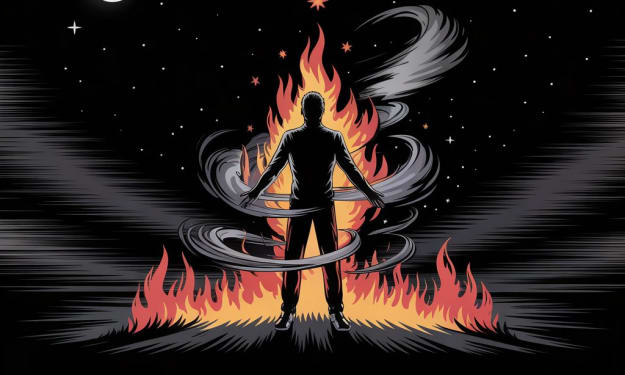
They Said I Couldn't, So I Did" I was born in a village where dreams are stitched into the hem of a girl's dupatta—only to be hidden, never worn out loud. My name is Radha. I was the third daughter in a family that prayed for a son. From the moment I could walk, I was told my place—inside the kitchen, behind the curtain, beneath the expectations of others. They said I couldn't go to school after 8th grade. They said girls don’t need education—just good cooking skills and a better smile. They said, “What will you do by studying? You’ll get married anyway.” But I had this strange hunger in me—not for food, but for more. I remember once asking my uncle, who had just returned from the city, “What does a college look like?”He laughed. Everyone laughed. My mother told me to not speak such nonsense in front of elders. That night, I cried under my blanket, hugging the only book I owned — a tattered English grammar guide someone had thrown away. They said I couldn't speak English. So, I started watching old English movies without understanding a word, rewinding scenes, writing down sentences I didn’t even know how to pronounce. Every time I made a mistake, someone would smirk and say, “This is not your world.” But I whispered back to myself, “One day, it will be.” At 16, I begged my father to let me appear for the 10th board exams. He said no. So I stitched blouses in the afternoon and secretly saved every rupee. I lied once—told my parents I was going to help a neighbor. Instead, I walked five kilometers barefoot to reach the exam center. I passed. They said I couldn't dream of a career. So I dreamed even harder. I started giving tuition to village kids. Five rupees per student. Ten students. Fifty rupees a day. I bought books, a second-hand phone, and internet data. Late at night, while the village slept and the lantern flickered, I watched YouTube videos about scholarships, interviews, and confidence-building. I practiced speaking in front of a broken mirror with missing corners. Then came the biggest test. I applied for a scholarship to study journalism in a city college. The day the acceptance letter came, I touched the paper a hundred times, afraid it might disappear like a dream. But acceptance didn’t come from home. My father said, “If you step out of this house, don’t come back.” So I didn’t. With a small bag and a head full of fear, I boarded a bus to a future I couldn’t fully see. The city was cruel at first. I was mocked for my accent, my clothes, my silence. I often ate only once a day to save money. But I never missed a class. And I never missed writing—because it was my oxygen. Today, I’m 23. I’m not just a journalist. I’m the voice for every girl they said “couldn’t.” I’ve interviewed ministers, covered protests, written stories that brought change. Last year, my village invited me as the Chief Guest at a school event. The same school where I wasn’t allowed to speak. I stood on stage, looked into the eyes of every little girl there, and said: "They said I couldn’t. So I did. And you can too." Because sometimes, the fire they try to extinguish is the one that lights the world. If I did it then why wouldn't you people. To gain something you have to lose something, this is what I have learnt from my life, so move ahead. I too left my house, family and everything, all I had was some savings and hope, I did not know what was going to happen to me, but I did not get scared and after a few salons I got the fruits of my hard work
By Riya mandalabout a year ago in Motivation
How Our Mind Creates the Enemies We Fear Most
A Chilling Psychological Experiment In the United States, inside ADX Florence—the most secure prison in the country—a disturbing psychological experiment was conducted on a death row inmate. Scientists were granted permission to study the power of the human mind. Instead of executing the prisoner by hanging, they showed him a highly venomous snake and told him, "In 40 days, this snake will bite you, and you will die from its venom." For the next 40 days, the prisoner was kept in complete isolation, with nothing but his fear consuming him. As time passed, the psychological toll became evident—his heart rate became erratic, he lost his appetite, and he suffered from severe insomnia. He woke up night after night drenched in sweat, trembling at the thought of the snake’s fangs sinking into his skin. His body began reacting as if he had already been poisoned—his hands shook, his breathing weakened, and his immune system started shutting down—despite being physically unharmed. When the 40 days ended, the scientists blindfolded him. Instead of using a real snake, they pricked his skin with a needle, mimicking a snakebite. The moment the prisoner felt the "bite," his body went into shock. His breathing became shallow, his muscles stiffened, and his heartbeat slowed. Within minutes, he was dead. The autopsy revealed something shocking—his body displayed the exact same effects as a fatal snakebite, yet no venom was present. His own brain had produced the poison that killed him. This is not fiction. It is a terrifying demonstration of how fear alone can be lethal. Our greatest enemy isn’t always external—sometimes, it’s our own mind. The Brain: A Double-Edged Sword The human brain is a biological marvel, a complex network of billions of neurons orchestrating everything from our breath to our deepest emotions. It allows us to love, create, and navigate the world. Yet, like any powerful tool, its effects depend on how it’s used—or, more accurately, how it uses us. The prisoner’s death was not caused by a physical snake but by the idea of one—a fear so deeply ingrained that it manifested physically. This phenomenon, known as the nocebo effect, is the dark counterpart to the placebo effect. It proves that negative expectations can produce real, harmful outcomes. How Fear Shapes Reality Think about your own life. How often has fear held you back? Fear of failure, judgment, or the unknown? These fears aren’t tangible threats like a predator in the wild—they are mental constructs, projections of the brain based on past experiences or imagined futures. Yet, they trigger real physiological responses: a racing heart, shallow breathing, muscle tension, and mental fog. Chronic fear floods the body with stress hormones, weakening the immune system, disrupting digestion, and contributing to long-term health issues. The brain, trying to protect you, ends up sabotaging your well-being. The Brain’s Deceptive Narratives Our thoughts and beliefs shape our reality, yet they are often based on distortions. The brain filters information through past conditioning, creating patterns and narratives that may not reflect truth. Consider your inner voice—the constant stream of thoughts commenting, judging, and worrying. Is this voice truly you, or is it an automatic program running outdated scripts? Phrases like "I can’t do this," "I always fail," or "I’m not good enough" aren’t facts—they are reinforced beliefs that solidify into identity. The brain constructs a story about who you are and then filters reality to confirm it. This is the essence of self-imposed limitation. The Illusion of Reality The brain doesn’t just influence emotions—it constructs our entire perception of reality. What we see, hear, and feel is not an objective truth but an interpretation. Our senses capture only a fraction of the world, and the brain fills in the gaps, creating a coherent (but often flawed) picture. Ancient wisdom traditions have long recognized this. Hinduism speaks of Maya, the illusion that veils true reality. Buddhism describes Samsara, the cycle of suffering fueled by attachment to mental constructs. These teachings suggest that ordinary consciousness is like a dream—and awakening means seeing through the mind’s illusions. Breaking Free from Mental Prisons The solution isn’t to fight the brain but to become aware of its mechanisms. Mindfulness and meditation help us observe thoughts without identifying with them. Instead of being swept away by fear or negativity, we learn to step back and recognize these patterns as passing phenomena. Neuroplasticity shows that we can rewire our brains through conscious practice. By cultivating awareness, we weaken fear-based pathways and strengthen those linked to clarity and peace. The Path to Liberation The prisoner died because he believed his mind’s story without question. But we don’t have to. The key lies in recognizing that: Thoughts are not facts. They are mental events, not absolute truths. Fear is a survival mechanism, not a prophecy. It can be acknowledged without being obeyed. Awareness is freedom. By observing the mind instead of being controlled by it, we reclaim our power.Start writing...
By BeyondTheVeilabout a year ago in Motivation
10 Things I Wish I Started Doing Earlier
--- We all have those "ugh, I wish I knew this sooner" moments. Whether it's about habits, mindset, or just how we spend our time - looking back always makes you realize what could've made life easier, better, or just more you.
By Alberte Brøndumabout a year ago in Motivation
Better Every Day. AI-Generated.
We live in a world that celebrates overnight success stories and dramatic transformations. Social media feeds are filled with "before and after" photos promising instant results, while bestselling books tout secrets to rapid achievement. Yet beneath this cultural obsession with quick fixes lies an uncomfortable truth supported by decades of scientific research: meaningful, lasting change rarely happens through grand gestures or sudden epiphanies. It emerges gradually, almost imperceptibly, through the daily repetition of small, intentional actions. As we stand at the start of second quarter in 2025, this understanding becomes not just useful but essential for anyone seeking to navigate an increasingly complex world.
By Khalid Nooriabout a year ago in Motivation
From ashes to ambitions
In the dim light of early morning, when the world is still tangled in the remnants of sleep, a single soul stands at the edge of a crumbled empire—an empire that once gleamed with prosperity, only to be reduced to smoldering ruins. The air is heavy with the scent of charred wood and lost potential, and the ground beneath her feet is scorched with the fiery memories of what once was. But the woman who stands amidst the ruins does not mourn. She does not weep. She only feels the stirring of something deep within her—a quiet yet fierce flame, rising from the ashes of her past. She knows this feeling. It's the taste of rebirth, the kind that comes only after the fiercest of battles, the hardest of falls.
By Muhammad Owais Ayazabout a year ago in Motivation
Resilience in the Storm
"The Stone and the Seed" In a quiet village nestled between mountains and time, there lived a man named Aven, who was known not for strength or wisdom, but for his silence. He was a stonemason—one who sculpted mountains into monuments, yet within himself bore the weight of an unseen boulder. To the world, he carved beauty; to himself, he was unfinished marble, flawed and fragmented.
By Muhammad Zohaib Khanabout a year ago in Motivation
Conflict Resolution Strategies for the Workplace
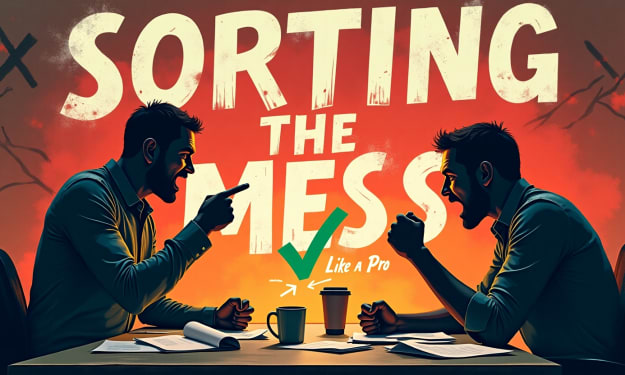
Sorting Out the Mess Like a Pro Workplace fights suck, right? One minute you're all good; the next thing you know, someone's mad about a missed email or who gets the corner desk. Happens all the time when people share space and deadlines. But here's the deal - it doesn't have to ruin your day or your team. I've got some real-talk ways to fix it, no fancy jargon, just stuff that works. Let's figure this out together.
By Padm Rabout a year ago in Motivation
Fear vs. Dream Motivation: Which Is More Effective?
Introduction: The Two Faces of Motivation We all want to achieve something in life—whether it’s getting fit, building a business, writing a book, or just being a better version of ourselves. But why do we actually take action? Is it the fear of failing, or the excitement of success?
By zulixevabout a year ago in Motivation
Golden Grit: The Story of Shannon Miller
In the world of gymnastics, few names hold as much weight as Shannon Miller. By the mid-1990s, she was already one of the most decorated American gymnasts, having won multiple Olympic and World Championship medals. But the dream of Olympic team gold had always eluded the U.S. women. That dream began to take shape leading into the 1996 Atlanta Summer Olympics, when an extraordinary group of young women came together to rewrite history.
By Fiaz aliabout a year ago in Motivation
Charlotte Proved Everyone Wrong & Built a Legacy
Charlotte grew up in a small town where everyone knew everything about everyone. Her family was the kind people whispered about in church pews and behind checkout counters. Her father, David, had been laid off from the local mill when she was ten and never quite recovered from the blow.
By MIGrowthabout a year ago in Motivation
Aladdin and the Magic Lamp
Once upon a time, in a faraway kingdom, there lived a poor young man named Aladdin. He was the son of a tailor and lived in a small, modest house. Despite his humble beginnings, Aladdin had dreams of wealth and adventure. He often found himself gazing at the rich and powerful people of the city, wishing for a life of luxury and comfort.
By Jawad khan about a year ago in Motivation
CrowdStrike remote jobs opportunities in 2025
CrowdStrike occupies the central role that drives the rapid development of the cybersecurity industry. CrowdStrike operates its cloud-native security platform alongside advanced threat detection features which make it a modern workplace leadership organization. The firm maintains remote work as its core practice while providing an extensive selection of worldwide career choices to professionals in 2025. CrowdStrike functions as one of the leading organizations in cybersecurity and technology by embracing flexible work environments along with innovative approaches and a people-inclusive strategy which makes it attractive for remote professionals.
By Philip Marandiabout a year ago in Motivation