
Better Every Day
Small Steps, Big Transformations in 2025!
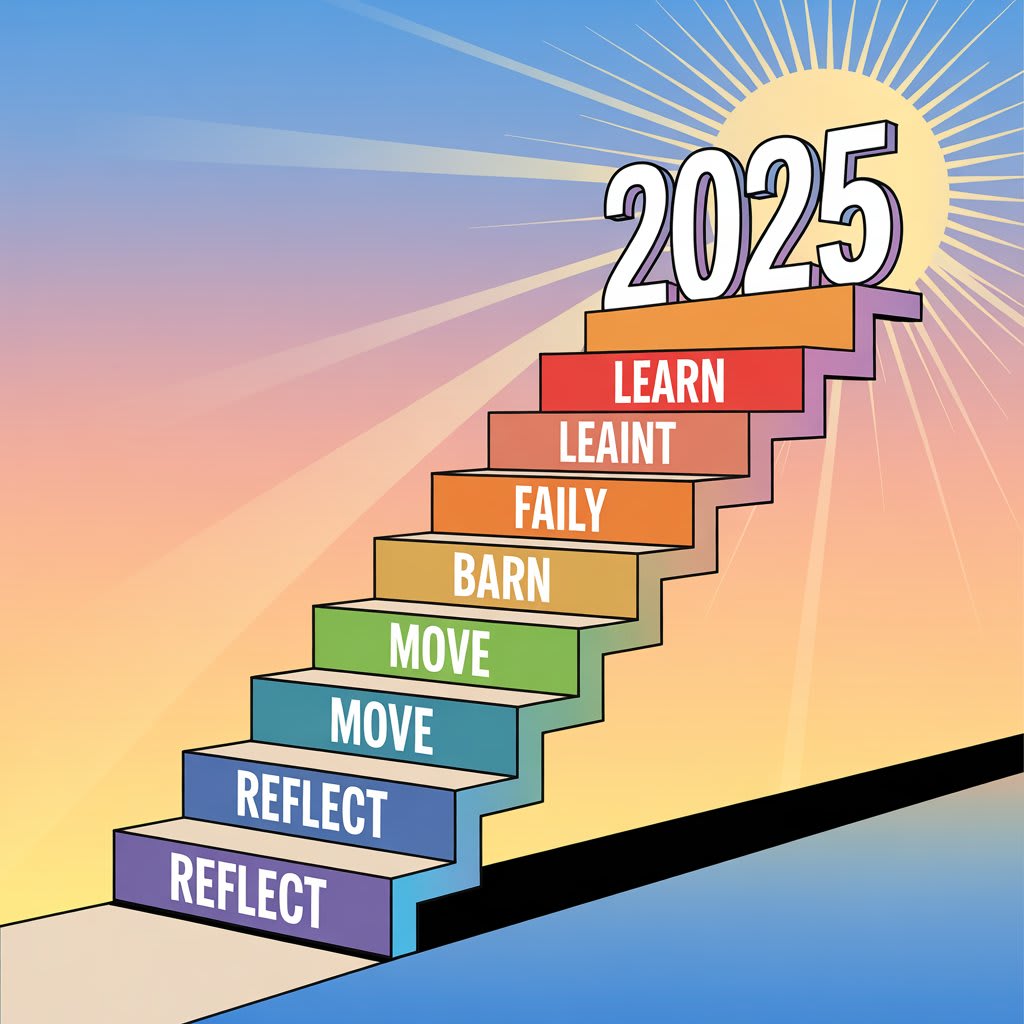
We live in a world that celebrates overnight success stories and dramatic transformations. Social media feeds are filled with "before and after" photos promising instant results, while bestselling books tout secrets to rapid achievement. Yet beneath this cultural obsession with quick fixes lies an uncomfortable truth supported by decades of scientific research: meaningful, lasting change rarely happens through grand gestures or sudden epiphanies. It emerges gradually, almost imperceptibly, through the daily repetition of small, intentional actions. As we stand at the start of second quarter in 2025, this understanding becomes not just useful but essential for anyone seeking to navigate an increasingly complex world.
The science behind incremental growth reveals why small steps outperform ambitious overhauls. Recent studies from King's College London followed thousands of participants attempting lifestyle changes and found that those focusing on modest daily improvements were three times more likely to maintain their progress compared to those attempting radical transformations. This phenomenon has roots in our neurobiology. Each time we complete a small positive action, our brain releases dopamine, creating a sense of reward that makes us more likely to repeat the behavior. Over time, these repeated actions physically rewire neural pathways, making the behavior increasingly automatic. What begins as a conscious effort evolves into an unconscious habit, requiring less willpower to maintain. This neurological process explains why the ancient Greek philosopher Aristotle observed that excellence is not an act but a habit.
Modern researchers have quantified what Aristotle intuited. Harvard psychologist Dr. Teresa Amabile spent years studying workplace motivation before discovering that small daily wins were the most reliable predictor of long-term success. Her research team analyzed tens of thousands of work diaries and found that people's best days were nearly always preceded by small accomplishments the day before. These minor victories created a positive feedback loop where each success made the next one more likely. The implications extend far beyond professional settings. Whether learning a language, improving health, or building relationships, the same principle applies: consistent micro-progress compounds into macro-results.
The challenge lies in overcoming our natural bias toward dramatic solutions. Human brains are wired to notice sudden changes while overlooking gradual processes. We remember the earthquake but not the slow erosion that shaped the canyon. This cognitive tendency leads us to undervalue small daily actions while overestimating the impact of occasional intense efforts. Stanford psychologist Dr. BJ Fogg's research demonstrates this clearly. His studies show that when people attempt ambitious habit changes requiring significant time and effort, they typically fail within weeks. But when those same people start with tiny behaviors—actions taking less than five minutes—they not only sustain the habits but often naturally expand them over time.
Sleep science provides another compelling example of how small adjustments create disproportionate benefits. Neuroscientist Dr. Matthew Walker's research reveals that minor improvements in sleep hygiene can dramatically enhance cognitive function, emotional regulation, and physical health. Something as simple as maintaining a consistent bedtime or reducing screen time before sleep can improve memory retention by nearly forty percent. These findings are particularly relevant as we enter 2025, when demands on our attention and productivity continue to intensify. In a culture that often equates busyness with importance, choosing to prioritize sufficient sleep becomes a radical act of self-preservation.
Our social environments play an equally crucial role in personal growth, though we often underestimate their influence. MIT researcher Dr. Alex Pentland's work demonstrates that our behaviors are significantly shaped by those around us, often without our conscious awareness. His studies tracking human interactions through digital devices reveal that people unconsciously mimic the habits of their frequent contacts. This social contagion effect explains why joining a community of like-minded individuals dramatically increases the likelihood of maintaining positive changes. When we surround ourselves with people who embody the traits we wish to develop, we don't just gain accountability—we unconsciously begin to adopt their mindsets and behaviors.
The accelerating pace of technological change makes continuous learning no longer optional but essential. The World Economic Forum's recent reports indicate that nearly half of today's workforce skills will become obsolete within a few years. In this environment, the ability to learn effectively becomes the ultimate meta-skill. Cognitive science has identified several principles that make learning more efficient, from spaced repetition to desirable difficulty. These methods don't require more time so much as more strategic application. For instance, distributing practice sessions over time with gradually increasing intervals between reviews can dramatically improve long-term retention compared to cramming. Similarly, maintaining the right level of challenge—neither too easy nor frustratingly difficult—optimizes skill acquisition.
What emerges from this scientific landscape is a clear blueprint for personal transformation in 2025 and beyond. Lasting change doesn't require herculean efforts or perfect conditions. It asks only for consistent application of small, research-backed practices. The novelist Anthony Trollope wrote his prolific output by waking early each morning to write for just two hours before his day job, producing exactly 250 words every fifteen minutes. While his contemporaries waited for inspiration, he relied on simple systems. Centuries later, modern science confirms the wisdom of his approach.
As we face the uncertainties and opportunities of the remaining 9 months in 2025, this understanding liberates us from the tyranny of all-or-nothing thinking. We needn't wait for Monday, for New Year's, for the perfect circumstances to begin improving our lives. Each day offers countless opportunities to take small steps forward—to read a few pages, to have a meaningful conversation, to practice a skill, to rest properly. These individual actions may seem insignificant in isolation, but their cumulative effect is profound. Like compound interest in finance, the returns on small daily investments grow exponentially over time.
The Japanese concept of kaizen, or continuous improvement, captures this philosophy perfectly. Originally applied to manufacturing processes, its principles translate powerfully to personal growth. By focusing on tiny, incremental changes rather than dramatic transformations, we bypass resistance and build momentum. What begins as a conscious effort gradually becomes part of our identity. The person who writes daily becomes a writer. The individual who practices gratitude becomes grateful. The one who exercises regularly becomes fit.
In 2025, as artificial intelligence reshapes industries and global challenges grow more complex, our ability to adapt and grow will define our success more than any fixed skill set. The good news is that the tools for transformation are available to everyone. They don't require special talent or resources, just consistent application of research-backed principles. The French writer Antoine de Saint-Exupéry observed that perfection is achieved not when there is nothing more to add, but when there is nothing left to take away. Similarly, personal growth at its most effective isn't about adding more to our lives but about focusing on the essential few actions that yield disproportionate results.
As 2025 is passing, we stand at a crossroads between aspiration and action. The science is clear: small steps taken daily lead further than great leaps attempted sporadically. The compound effect doesn't discriminate—it works equally for anyone who applies it consistently. In 2025, may we have the wisdom to value gradual progress over instant gratification, and the discipline to show up daily for the lives we wish to create. The future belongs not to those who make the most noise but to those who make the most consistent effort. Day by day, step by step, we grow and become better.
About the Creator
Enjoyed the story? Support the Creator.
Subscribe for free to receive all their stories in your feed.
Comments
There are no comments for this story
Be the first to respond and start the conversation.