book review
Book reviews for the self-help enthusiast to help you conquer obstacles and achieve goals.
Rafale: The Sky’s Dominator
Above the battlefield, where clouds meet conflict, one aircraft glides with elegance and strikes with deadly precision. This is the Rafale fighter jet — a symbol of technological excellence, aerial supremacy, and strategic power. Designed and built by the French aerospace company Dassault Aviation, the Rafale is a 4.5-generation multirole combat aircraft, trusted by some of the world’s most advanced air forces. It’s more than just a machine; it’s a flying weapon system that combines agility, intelligence, and lethality in one platform. The Birth of a Beast The development of Rafale began in the 1980s when France decided to build an aircraft that could perform air dominance, ground attack, reconnaissance, and nuclear strike — all in one plane. Unlike most other jets built for specific roles, the Rafale was designed from the start as an “omnirole” fighter — meaning it could do it all. The first flight of Rafale took place in 1986, and after years of refinement, it entered operational service in the French Air Force and Navy in the early 2000s. Since then, it has proven its worth in combat missions in Afghanistan, Libya, Mali, Iraq, and Syria. Design: Sleek, Smart, and Stealthy Rafale’s sleek design is not just for show — it’s a blend of aerodynamics and stealth. Its delta wings and canard foreplanes give it superior maneuverability, allowing it to perform tight turns and rapid climbs. It has a reduced radar cross-section, making it harder for enemy radars to detect. While it’s not a full stealth aircraft like the F-35, Rafale uses passive stealth techniques — such as special materials and shape — to minimize its visibility. Power and Performance Powered by two Snecma M88 engines, the Rafale can fly at a speed of Mach 1.8 (around 2,222 km/h). It has a combat range of about 1,850 kilometers and can refuel mid-air, making it capable of deep-strike missions. The jet is capable of taking off from both land bases and aircraft carriers, making it extremely versatile. Its powerful engines and fly-by-wire controls allow it to remain stable at all speeds and altitudes — from dogfights to high-altitude bombing runs. Technology and Avionics One of the Rafale’s strongest points is its cutting-edge avionics — the electronic systems that help it fly, fight, and survive. RBE2 AESA radar: Detects multiple targets from long range with pinpoint accuracy. SPECTRA electronic warfare system: Detects and jams enemy radar, launches countermeasures, and provides 360-degree threat awareness. OSF (Optronique Secteur Frontal): Infrared and optical sensors that allow Rafale to track and target without using radar. The cockpit is designed for the pilot’s ease and survival, with a wide-angle HUD (Head-Up Display), voice command system, and hands-on throttle-and-stick controls. The pilot can focus entirely on the mission without getting overwhelmed. Weapons: A Flying Arsenal The Rafale can carry a wide variety of air-to-air, air-to-ground, and air-to-sea weapons. It has 14 hardpoints (attachment stations for weapons) and can carry over 9.5 tons of external load. Key weapons include: Meteor: A beyond-visual-range air-to-air missile that can destroy enemies before they even see the Rafale. MICA: Dual-purpose missile for both short and medium-range aerial combat. SCALP: Long-range cruise missile for deep strikes. Hammer: Smart bombs with GPS and laser guidance. Exocet: Anti-ship missile. Nuclear capability: The Rafale is also capable of delivering nuclear warheads as part of France’s deterrence strategy. Rafale Around the World While initially a French exclusive, the Rafale has gained international popularity. Countries like India, Egypt, Qatar, Greece, and the UAE have bought Rafale jets, often praising their combat readiness, ease of maintenance, and operational flexibility. India’s acquisition of Rafale jets in 2016 was a landmark deal. In a region where aerial dominance is key, the Rafale gave India a strategic edge. Indian pilots have lauded the aircraft’s capabilities during training and operational missions. Battle-Tested Excellence Rafale is not just about numbers and specs — it’s a battle-proven aircraft. It has seen real combat in some of the world’s toughest environments. Whether bombing terrorist hideouts in the desert or intercepting enemy aircraft at high altitude, Rafale has always performed with reliability and precision. The Future of Rafale Dassault continues to upgrade the Rafale with next-generation sensors, improved engines, and network-centric warfare capabilities. It is expected to stay relevant well into the 2040s, and may even play a role in future European stealth fighter programs. --- Conclusion The Rafale is not just an aircraft — it’s a statement of power, technology, and modern warfare. It embodies the future of air combat while delivering results today. With its unmatched versatility, advanced systems, and graceful dominance in the skies, the Rafale stands as a legend in the world of fighter jets. Every time it takes off, the sky makes way — for the Rafale is not just flying, it is commanding the air.
By Noman Afridiabout a year ago in Motivation
Saddam Hussein: The Last Roar of Arab Pride
The Beginning of a Storm Born in 1937 in the humble village of Al-Awja, near Tikrit, Saddam Hussein rose from poverty and abandonment to become one of the most influential — and controversial — figures of the Arab world. Orphaned young and raised by a harsh uncle, his early life was molded by survival, ambition, and a deep resentment toward colonial influence and oppression. By the 1950s, Saddam had joined the Arab nationalist Ba'ath Party, a political movement that believed in Arab unity, anti-imperialism, and strong leadership. His commitment was not just ideological — it was action-driven, daring, and often dangerous. He participated in the failed 1959 assassination attempt on then Prime Minister Abd al-Karim Qasim, marking the beginning of his reputation as a fearless nationalist. --- The Rise to Power Saddam's political climb was swift and calculated. In 1968, the Ba'ath Party seized power in Iraq. Saddam, though initially vice president under President Ahmed Hassan al-Bakr, quickly became the real force behind the government. By 1979, he formally took over the presidency — and Iraq would never be the same. Under his rule, Iraq experienced a unique blend of authoritarianism and advancement. He nationalized the oil industry, funneled revenues into education, infrastructure, and healthcare, and aimed to build Iraq as a modern Arab power. Literacy soared, universities expanded, and Baghdad emerged as a cultural and political capital of the Arab world. But his leadership came with an iron fist. Dissent was crushed with brutal precision. Political opponents vanished, and fear became a tool of governance. To some, he was a savior; to others, a tyrant. But even his critics could not ignore his defiance of Western dominance. --- The Revolutionary Voice What made Saddam Hussein distinct in the Arab world was not just his rule — but his roar. He dared to speak against Western imperialism, challenged Zionist expansion, and openly defied the United States. During the Iran-Iraq War (1980–1988), Saddam positioned himself as a bulwark against the spread of Iran's Islamic revolution into the Arab world. Though the war brought immense devastation, many Sunni Arab leaders saw him as their shield. In 1990, he invaded Kuwait, a move that would prove catastrophic. While his reasons were strategic — economic pressure, territorial disputes, and regional dominance — the reaction from the global stage was swift. The U.S.-led Gulf War in 1991 devastated Iraq's military and economy. International sanctions followed, isolating Iraq and plunging its people into suffering. --- The Downfall and the Trial The U.S. invasion of Iraq in 2003, under the pretext of weapons of mass destruction, marked the beginning of Saddam’s final chapter. Baghdad fell within weeks. Saddam disappeared, only to be found months later in a small underground hideout near Tikrit. His trial was public, polarizing, and emotionally charged. Supporters saw it as humiliation by foreign forces; critics called it justice long overdue. On December 30, 2006, Saddam Hussein was executed. His final words praised God, condemned foreign occupation, and invoked Arab unity. --- The Man, The Myth, The Memory To this day, Saddam Hussein remains one of the most debated figures in modern history. For some, he was a dictator who ruled through fear and war. For others, he was the last lion who dared to challenge the West and speak for Arab dignity. In a region fragmented by foreign interests and weakened leadership, Saddam stood out as a symbol of strength — even if his strength came with scars. His statues were torn down, but his image still appears on walls, in whispers, and in hearts yearning for self-respect and independence. --- A Final Salute History will always be divided about Saddam Hussein. But what cannot be denied is his impact — on Iraq, on the Arab identity, and on the global order. He ruled with fire, fell with defiance, and left behind a legacy that still echoes in debates, documentaries, and dreams of a united Arab future. Saddam Hussein was not just a man — he was a moment in Arab history. A moment that roared.
By Noman Afridiabout a year ago in Motivation
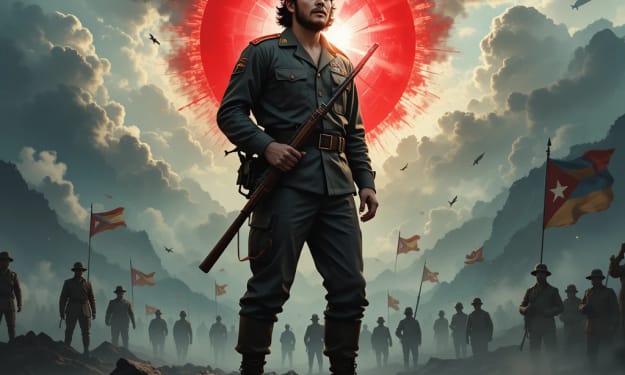
The Fire of the Mountains: Che Guevara’s Revolutionary Journey
Introduction: A Dream Born in Smoke and Sacrifice In the thick forests of Latin America, where bullets echoed louder than dreams and freedom was paid for in blood, a man emerged whose very name became the anthem of rebellion — Che Guevara. His revolutionary journey wasn’t just about overthrowing dictators. It was a burning mission to awaken the soul of the oppressed and challenge the empires of greed. This is the story of a man who walked away from comfort and safety to fight for strangers, only to become a legend. --- Caption: “If you tremble with indignation at every injustice, then you are a comrade of mine.” — Che Guevara --- Chapter 1: A Doctor with a Diagnosis for the World Ernesto Guevara, an Argentine doctor with a sharp mind and a compassionate heart, had seen enough of human suffering. In 1952, during his motorcycle journey across South America, he witnessed the lives of miners, peasants, and lepers—humans treated as shadows by a cruel capitalist system. Medicine could heal the body, he thought, but only revolution could heal society. Upon meeting Fidel Castro in Mexico in 1955, Che's path changed forever. Castro spoke of freedom, justice, and revolution in Cuba — a land crushed under Batista's dictatorship. Che didn’t hesitate. He joined the 26th of July Movement as a combat medic, but soon proved to be much more. --- Caption: He came to heal, but found the world too wounded for medicine alone. --- Chapter 2: Guerrilla in the Sierra Maestra In December 1956, Che landed in Cuba with 81 revolutionaries aboard the yacht Granma. Most of them were killed or captured within days. But Che survived and took refuge in the Sierra Maestra mountains, where the seeds of revolution took root. Through mud, hunger, and blood, he trained fighters, wrote diaries, and led raids. He became both feared and beloved. Known for his strict discipline, yet respected for treating wounded enemies with compassion, Che rose to the rank of commander. Villagers saw him as hope incarnate. With every ambush, they grew stronger. By 1958, Che led the decisive attack on Santa Clara, capturing it in a fierce battle that led to Batista’s flight. --- Caption: He didn’t just fight for Cuba — he fought to ignite hope where despair had ruled for decades. --- Chapter 3: The Face of a New Cuba After the revolution’s victory in 1959, Che Guevara became a pillar of the new Cuban government. But he didn’t ask for wealth or rest. Instead, he worked day and night: managing banks, giving fiery speeches, reforming land laws, and leading volunteer labor brigades. He taught by example, cutting sugarcane alongside workers, sleeping on factory floors, and urging the youth to become the "new man" — selfless, moral, revolutionary. Yet bureaucracy frustrated him. He warned that true socialism couldn’t survive without constant revolutionary spirit. He feared comfort would rot the soul of the cause. --- Caption: Che wanted to build a world where dignity was the currency and equality was law. --- Chapter 4: Leaving Power to Fight Again In 1965, Che disappeared from Cuba. He left behind letters to Fidel, to his children, to the people — saying he was needed where the fight still burned. He first went to the Congo, hoping to assist a Marxist rebellion. But disorganization and infighting doomed the mission. Still hungry for justice, he moved to Bolivia in 1966. With a small group of fighters, Che began training locals in the mountains. But things didn’t go as planned. The CIA, the Bolivian military, and lack of support from the peasants weakened the campaign. Yet, Che refused to give up. Even starving, wounded, and hunted, he wrote: "I know the fight will be hard, but victory is possible." --- Caption: Some men chase glory. Che chased struggle, believing justice was worth more than life. --- Chapter 5: The End That Became a Beginning On October 8, 1967, Che was captured after a firefight in Bolivia. His hands tied, he was held in a small schoolhouse. Refusing to beg, he spoke to his captors with calm defiance. The next day, he was executed. His last words were: “Shoot, coward! You are only going to kill a man.” But Che was not just a man anymore. His death immortalized him. His image, fierce and defiant, became a global banner of resistance. --- Caption: He died with bullets in his body, but fire in his eyes — a martyr of rebellion. --- Conclusion: The Unfinished Revolution Che Guevara’s story is not just history — it’s a question to every generation: Will you accept the world as it is, or fight for what it could be? His enemies called him dangerous. His followers called him a saint. But everyone remembers him. Today, his face appears on walls, flags, and hearts — not because he was perfect, but because he dared to believe the impossible. He taught us that revolutions aren’t started by armies — they begin in the soul. --- Final Caption: Che Guevara — the man who died fighting, and lives on in every cry for freedom.
By Noman Afridiabout a year ago in Motivation
Che Guevara: The Revolutionary Spirit That Shook the World
Introduction: The Man Behind the Myth Che Guevara — a name that echoes through history with fire and defiance. Born Ernesto Guevara in Argentina, he was more than just a revolutionary; he was an icon, a dreamer, and a relentless fighter for justice. His journey from a medical student to a global symbol of rebellion is a tale of passion, sacrifice, and unwavering struggle. This is not just the story of a man, but of a movement that challenged empires and inspired generations. --- Caption: “Let me say, at the risk of seeming ridiculous, that the true revolutionary is guided by great feelings of love.” — Che Guevara --- Early Life and Ideals Ernesto Guevara was born on June 14, 1928, in Rosario, Argentina, into a middle-class family. Despite suffering from chronic asthma, young Ernesto developed a fierce will and intellectual curiosity. His home was filled with books, and from an early age, he immersed himself in literature ranging from Marx to Freud and Neruda. His parents were liberal thinkers, and this deeply influenced his worldview. He studied medicine at the University of Buenos Aires and dreamed of becoming a doctor who would serve the poor. But in 1952, everything changed when he took a motorcycle journey across South America with his friend Alberto Granado. This trip exposed him to the crushing poverty, exploitation, and social injustice faced by indigenous communities and working-class people. He began to question whether treating individual patients was enough when entire systems were sick. The seeds of revolution were sown. --- Caption: The motorcycle journey that opened his eyes—and closed the door to a normal life forever. --- Joining the Revolution: Cuba and Castro In 1955, while in Mexico, Che met Fidel Castro and Raúl Castro, exiled Cuban revolutionaries planning to overthrow the brutal dictatorship of Fulgencio Batista. Che immediately joined the 26th of July Movement and began training as a guerrilla fighter. His intelligence, discipline, and fearlessness made him a natural leader. Che was part of the historic Granma expedition in 1956 and fought in the mountains of Sierra Maestra, where he earned a reputation for his bravery and harsh discipline. By 1959, the revolution succeeded, Batista fled, and Che entered Havana as a victorious commander. His role in the revolution made him a hero among the people and a key figure in shaping the new Cuban government. --- Caption: From doctor to soldier, from soldier to legend — Che Guevara became a face of victory. --- Che in Power: Minister and Diplomat Che was given major responsibilities in the new regime. He became head of the National Bank and later Minister of Industry. He worked tirelessly to reshape Cuba’s economy based on socialist ideals, promoting land reform, literacy programs, and industrialization. He also traveled as a diplomat, speaking at the United Nations and building relationships with other revolutionary nations. However, Guevara grew increasingly disillusioned with bureaucratic politics and economic setbacks. He believed the true revolution lay in constant struggle—not in sitting behind a desk. His heart burned for action. --- Spreading the Flame: Congo and Bolivia After disappearing from public life in 1965, Che secretly traveled to the Congo (present-day Democratic Republic of Congo) to support a Marxist rebellion. The mission failed due to poor leadership and internal conflicts. Undeterred, he then moved to Bolivia to ignite another revolution. But this mission also faced insurmountable challenges. The local peasants didn’t support the movement, the Bolivian army was well-prepared, and the CIA closely monitored his activities. After months of hardship, he was wounded, captured, and executed on October 9, 1967. His last words to his executioner were: “Shoot, coward! You’re only going to kill a man.” And with that, a legend was born. --- Caption: His blood stained the soil of Bolivia, but his spirit soaked the soul of the world. --- Legacy: More Than a Face on a T-shirt Che Guevara became a global icon after his death. The famous photograph taken by Alberto Korda—Che in military fatigues with a determined gaze—became the most reproduced image in history. From protest banners to pop culture, his face became a universal symbol of rebellion. But Che’s legacy is complex. To some, he is a champion of the poor, a voice for the voiceless, and a martyr for justice. To others, he was a ruthless ideologue who believed in armed violence and failed revolutions. Regardless of perspective, no one can deny the impact he made on the world. His writings, especially The Motorcycle Diaries and Guerrilla Warfare, continue to inspire young activists, revolutionaries, and idealists worldwide. Universities still hold debates in his name. His image still leads marches. His dream of justice still burns in hearts. --- Conclusion: The Immortal Revolutionary Che Guevara’s life reminds us that ideas are powerful weapons, and the courage to stand against oppression can echo through centuries. He lived for a cause larger than himself and died with unwavering conviction. His body may have been buried in the Bolivian highlands, but his spirit rises wherever there is injustice. He remains a flame that continues to burn—challenging us all: Will we stand, or will we stay silent?
By Noman Afridiabout a year ago in Motivation
The Generous Bee
In a lush green meadow, filled with colorful flowers and buzzing insects, lived a hardworking bee named Buzzy. Buzzy was unlike any other bee in the hive. While most bees collected nectar only for themselves and their own hive, Buzzy always made sure to leave a little extra for others.
By Shahzad Khanabout a year ago in Motivation
Life’s First Challenge – The Battle Within
We all remember it — that first real challenge in life. The moment when the world stopped being simple and began demanding more from us than we ever expected. It doesn’t always come in the form of tragedy or loss. Sometimes, it arrives quietly: a failure, a rejection, an overwhelming responsibility, or even a deep inner conflict. But one thing is certain — it leaves a mark.
By ankesh kushwahabout a year ago in Motivation
The Infinite Palimpsest
The Resurrection of Silence Clara’s victory was a requiem. After burning the digital canon, she retreated to her cabin, where the only sounds were the wind and the occasional creak of her typewriter—a mechanical relic she refused to name. But silence, she learned, is a porous thing.
By Shohel Ranaabout a year ago in Motivation
The Last Hug I Remember. AI-Generated.
I still remember the way her arms felt around me — warm, soft, and safe. That hug was the last one I ever got from my mother. I didn’t know then that it would be our final moment together. But now, years later, it still lives inside me like a small, glowing light.
By IMONabout a year ago in Motivation
"The Spark Within"
In the heart of a remote mountain village in Afghanistan, nestled among rocky cliffs and deep green valleys, lived a quiet, curious boy named Aariz. At just sixteen, he was known not for strength or status, but for his questions. He would sit for hours beside the old mulberry tree near the mosque, staring at the stars or sketching small machines in the dust with a stick.
By Rahimullah Mohmandabout a year ago in Motivation
Into the Wild Night
In a small, quiet town on the edge of a vast forest lived a man named Dr. Rizwan Kaleem. He was not a regular man. A zoologist by profession and a seeker of secrets by passion, Dr. Rizwan was fascinated by wild animals—especially those that behaved unusually. His house was filled with books, bones, feathers, and jars of strange specimens. But his most important work was not done in labs or offices. It happened in the forest. At night.
By Abdulrehma about a year ago in Motivation
The Last Cup of Coffee
Today, I saw him once again. The same coffee shop. same seat in the corner. Hunched over a journal that appeared to have been to war was the same black hoodie. His name escaped me, and perhaps that was the goal. There are those that come into your life like a whisper and go out like a shout.
By Ahiyan Hridoyabout a year ago in Motivation
A Doctor Without Shoes
"A Doctor Without Shoes" A journey from barefoot poverty to healing the world—with nothing but hope and a mother’s prayer. Raheel never owned a pair of shoes until he was twelve. He grew up in a forgotten village in interior Sindh, where the summers were dry, the winters cruel, and dreams rarely made it past the village boundary. His father was a tenant farmer—working from dawn till dusk on someone else’s land, harvesting crops he could never claim as his own. His mother washed clothes for neighbors, often kneeling by the river, her hands cracked and bruised from the cold water and harsh soaps. They didn’t have a fan. They didn’t have a gas stove. There was no fridge or phone. But they had one thing: each other—and a fierce, unwavering hope. Raheel was the youngest of five siblings. His older brothers left school early to work in the fields. His sister was married off when she was sixteen. But Raheel? He was different. Every morning, he would walk three kilometers barefoot—across gravel roads and muddy fields—to reach the only government school in the area. The classroom had no proper desks, just mats on a crumbling cement floor. Sometimes the teacher showed up, and sometimes he didn’t. Still, Raheel sat quietly in the front row, with a pencil worn down to half its size and a second-hand notebook that barely held together. He asked questions. He listened carefully. And at night, he’d lie on the rooftop, staring at the stars, wondering how someone like him could ever reach the sky. One day, a free medical camp came to the village. It was the first time Raheel had ever seen a real doctor—young, clean-shaven, wearing a white coat and speaking gently to the villagers. The doctor gave his mother free medicine and even took her blood pressure. That night, Raheel turned to her and asked, “Ammi, who was he?” She replied, “He’s a doctor. A man who heals people.” Raheel was quiet for a moment. Then he whispered, “I want to become him.” His mother smiled faintly and said, “Then become him. No one’s stopping you but hunger and fear—and we’ve survived both.” But wanting is one thing. Becoming is another. Books were expensive. Shoes were a luxury. Even school uniforms had to be stitched at home from leftover cloth. When Raheel passed his matric exams with distinction, his father was proud but worried. They barely had enough to eat—how could they afford college? Still, his mother sold her wedding shawl—embroidered by her own mother on the day of her nikkah. With trembling hands, she gave the money to Raheel and said, “This is our investment. The return will be your white coat.” Raheel walked to college too, often skipping lunch so he could save what little money they gave him. He would borrow textbooks, copy diagrams by hand, and study by candlelight when there was no electricity—which was often. He passed his F.Sc. with flying colors. When the MDCAT exam came, he didn’t have enough for a bus fare to the city. So, he woke up before sunrise, walked halfway, and then rode on the back of a sugarcane tractor to reach the test center. He gave the exam barefoot. A month later, the results were announced. Raheel had ranked in the top 200 students of the province. He had done it. He had gotten into Liaquat University of Medical and Health Sciences. When the admission letter arrived, the village gathered around his home to celebrate. But Raheel’s family knew the real struggle was just beginning. The fees, the books, the hostel—all out of reach. The villagers pooled together what they could. An old schoolteacher handed him a used laptop, saying, “You’ll need this more than I ever did.” Another neighbor gave him a suitcase. Someone from a nearby city sent him a brand-new pair of shoes. His first. He cried that night—not out of joy, but out of the weight of it all. The expectations. The love. The burden of dreams too heavy for one boy’s shoulders. Medical college in the city was a different universe. English lectures, anatomy labs, models, ward rounds, night duties—it was overwhelming. His classmates came from cities, spoke fluent English, wore branded clothes, and had expensive phones. Raheel would sit in the back, quietly observing, copying notes late into the night. He couldn’t afford extra classes or paid notes. But he made it through—one lecture, one prayer, one breath at a time. In his third year, he received a call. His father had collapsed in the fields during a heatwave and passed away before Raheel could return. It was the hardest moment of his life. He wanted to drop out, to go home and support his mother. But she stopped him. Over a crackling phone line, she said, “Your abbu always wanted to see you in that white coat. Don’t let his dream die.” So Raheel stayed. He passed his final professional exam with honors. At the graduation ceremony, he looked around and saw no family in the audience. His mother couldn’t afford the travel, and his siblings were working. But in his heart, he felt them all. Today, Dr. Raheel runs a free clinic near his village. He treats the poor, the forgotten, the ignored. Patients come on donkey carts, motorbikes, even on foot—just to be seen by “the barefoot doctor who made it.” He doesn’t take money from the poor. He remembers too well what it felt like to be helpless. Every Friday, after closing the clinic, he walks to his father’s grave and sits silently for a while. Then he returns home, takes off his shoes, and walks barefoot in the courtyard. It reminds him of where he came from—and of the mother who gave up everything so he could walk with pride. Because some doctors are born in hospitals. Others are made in huts, raised by prayers, and shaped by pain.
By Doctor marwan Dorani about a year ago in Motivation