advice
Advice that will put you on the path to success; tips, tricks and nuggets of wisdom from trusted experts and motivational mentors.
The Tom Brady Mindset, 7 Uncommon Habits for Long-Term Dominance
Tom Brady has been one of the most dominant forces in the NFL for over two decades. But what's the secret behind his incredible longevity and success? In this article, we'll explore the mindset and habits that have helped Tom Brady stay at the top of his game for so long, and how you can apply them to your own life.
By Liam Osuosabout a year ago in Motivation
The Invisible Rope
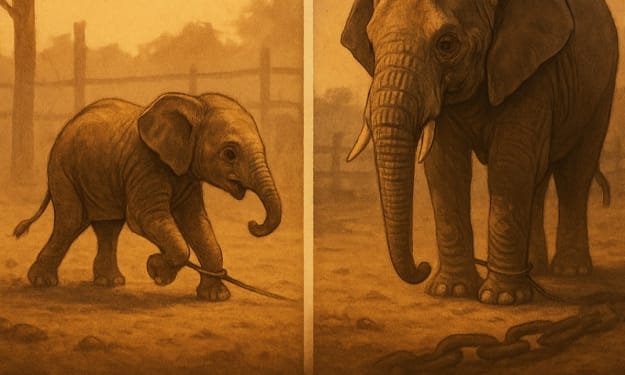
In a quiet, dusty village tucked between golden fields and whispering trees, a weary traveler stopped to rest for the evening. Near the edge of the village, he noticed something both majestic and confusing—a group of elephants standing calmly under the shade of a few tall trees. Their sheer size and power were enough to leave anyone awestruck. Muscles rippled beneath their thick, wrinkled skin, and their trunks swayed gently in the warm breeze. But what truly caught the traveler’s eye wasn’t their grandeur—it was how they were restrained. Each elephant had a thin, fragile rope tied loosely around one leg, the other end staked to a simple wooden peg in the ground. No heavy chains. No fences. No cages. Just that rope. It looked so weak that a single tug could break it. The traveler couldn’t understand. These creatures could crush boulders or pull trees from the earth—so why didn’t they escape? He stood there watching for quite some time. None of the elephants even tried to break free. They just stood there, calm and obedient, as if they truly believed they couldn’t go anywhere. Finally, curiosity got the better of him. He approached an elderly trainer who sat nearby, sipping tea and watching the elephants with the relaxed patience of someone who had done this his whole life. “Excuse me,” the traveler asked, “but how do you manage to keep these enormous animals tied down with nothing but that thin rope? Surely they could break free in a second if they wanted to.” The trainer smiled knowingly, as if he had been asked this question hundreds of times. “When these elephants are very young—just calves—we use this same kind of rope to tie them. At that age, it’s strong enough to hold them. They struggle. They pull. They try everything to escape. But the rope holds, and after many failed attempts, they finally give up. They start to believe they can’t break free.” He paused for a moment, then continued with a trace of sadness in his voice. “As they grow older and stronger, that belief stays with them. Even when they’re more than powerful enough to break the rope easily, they never try again. In their minds, they’re still that weak, helpless baby elephant. They don’t realize that the only thing holding them back now—is their belief.” The traveler stood in silence, letting the words sink in. It wasn’t the rope that restrained the elephants. It was their memory of failure. It was their acceptance of defeat. It was a belief—built from the past—that they were not strong enough, when in truth, they were. As the sun dipped low on the horizon, casting long shadows across the camp, the traveler realized how deeply this simple scene reflected something much greater. How many people, like these elephants, are bound not by physical barriers—but by old, invisible ropes of fear, failure, and doubt? How many give up after failing once or twice, carrying that sense of defeat through the rest of their lives? --- 🧠 Moral of the Story: Just like these elephants, many of us go through life carrying false beliefs—beliefs shaped by early failures, doubts, or criticism. We try something once, fail, and convince ourselves we’re not capable. Then we stop trying. We give up before we even begin. Over time, those beliefs become our reality. We grow stronger, wiser, and more capable—but we don’t notice it. We let the same old fears, the same “ropes,” hold us back. This story reminds us of a powerful truth: The limitations we accept are often not real—they’re mental barriers built from past experiences. The rope is no longer strong. But our belief in it is.We forget to test our limits. We forget to question the beliefs that were once true—but are now outdated.
By Shah Fahadabout a year ago in Motivation
The Unexpected Gift of a Stranger
It was one of those cold, biting winter evenings when the city seemed to move faster than usual, yet everything felt slower because of the chill in the air. The streets were crowded, people bundled up in thick coats and scarves, each hurrying to escape the cold. I was among them, rushing through the streets with a tight schedule on my mind and a heart heavy with worry.
By Muhammad Salmanabout a year ago in Motivation
The Courage of Bilal (RA)
In the early days of Islam, when the message of one God challenged the powerful idols and traditions of Mecca, many brave souls stood firm in their faith despite facing unimaginable hardships. Among these was Bilal ibn Rabah, a man whose courage and steadfastness made him a shining symbol of freedom, faith, and resilience.
By Muhammad Salmanabout a year ago in Motivation
"The One Habit That Changed My Life in Just 30 Days". Content Warning.
Introduction Most people believe life-changing transformations require massive effort, money, or time. We assume we need to overhaul everything—our job, diet, or environment—to see real results. I thought the same… until one simple habit, done daily for just 10 minutes, changed everything for me. This wasn’t a trendy hack or an expensive program. It wasn’t even physical exercise, though I value that too. It was something much simpler—and yet far more powerful than I imagined. That habit was morning journaling. Why I Started Like many people, I was stuck in a cycle of mental chaos. I’d wake up feeling anxious, immediately scroll through social media, compare myself to others, and rush into the day without clarity. My mind felt noisy. My productivity suffered. And deep down, I felt disconnected—from my goals, from peace, and from myself. One night, while reading about habits of high performers, I stumbled across a quote: > “If you want to know what someone truly believes, read their journal.” That stuck with me. So I decided to try something different. For the next 30 days, I committed to writing one page in a notebook every morning—before checking my phone, before reading emails, and before talking to anyone. I didn’t expect miracles. I just wanted to declutter my brain. The Rules I Followed I didn’t overcomplicate it. I made a few simple rules to keep it easy: 1. Write immediately after waking up. 2. No editing, no judging. 3. Write whatever came to mind. 4. Minimum: 1 page or 10 minutes. Some days I wrote about dreams. Other days, fears, frustrations, plans, or even what I had to eat. It didn’t matter. The point was to be honest and consistent. What Changed After 7 Days The first week was weird. At first, my brain resisted. “This is pointless,” I thought. But I kept going. By Day 4, I noticed something unexpected—I started looking forward to it. It became a quiet, peaceful moment just for me. After 7 days, small but noticeable changes began: I felt less reactive during the day. I started thinking more clearly. I was more aware of my emotions. I didn’t feel the usual morning anxiety. It was as if I had opened a conversation with myself for the first time. What Changed After 15 Days By the second week, I began to unlock deeper insights. Patterns started to appear in my writing—recurring thoughts, emotional triggers, hidden fears, and even forgotten dreams. I started noticing how often I sabotaged my progress with overthinking or procrastination. I also started planning my day more intentionally. Instead of letting the day control me, I was beginning to take control of the day. My confidence increased, and I became more productive—not because I was working harder, but because I was more focused and emotionally grounded. What Changed After 30 Days At the end of 30 days, I could confidently say: I was not the same person. Here’s what had transformed: 1. Mental Clarity My mind was no longer a mess of thoughts and worries. I could think clearly, prioritize, and handle problems with calmness. 2. Emotional Balance I became more emotionally intelligent. I could catch myself reacting out of fear or anger and redirect my thoughts. 3. Improved Focus With fewer mental distractions, I became laser-focused in my work and creative pursuits. 4. Self-Awareness I understood my goals, my struggles, and what truly mattered to me. I no longer needed external validation as much. 5. Morning Peace Instead of chaos, I now started my day with calm and intention. It shaped my energy for the entire day. This wasn’t just a “feel-good” practice. It became a tool of self-mastery. Why This Habit Works You might be wondering: Why journaling? Why not meditation or goal-setting? The truth is, journaling does all of that combined. When you journal: You slow down and become present (like meditation) You observe your thoughts without judgment (like therapy) You write down your goals and organize your day (like a planner) You express emotions that might otherwise stay buried In a noisy world, journaling gives you a private space to connect with your truest self. Tips to Start Your Own 30-Day Journaling Challenge If you want to try this habit, here’s how to make it easy and effective: ✅ Keep it Simple Don’t worry about grammar, spelling, or structure. Just write. ✅ Use a Physical Notebook Typing is okay, but writing by hand helps connect more deeply with your thoughts. ✅ Make It a Ritual Do it at the same time each day, preferably in the morning before distractions begin. ✅ Be Honest No one will read it. Be raw, real, and unfiltered. ✅ Don’t Skip Days Even 5 minutes counts. Consistency is what creates change. Final Thoughts: Small Habit, Big Shift We often search for big answers in life—new jobs, relationships, or places. But sometimes, the biggest shift comes from a small, consistent act of honesty with yourself. That’s what journaling gave me: Clarity. Calm. Confidence. So if you're feeling lost, overwhelmed, or disconnected, try this: Write one page every morning for 30 days. No expectations. No pressure. It just might change your life—like it changed mine. “Your mind is a garden. Your journal is the soil. What you plant will grow.” Start planting today.
By Muhammad ibrahim about a year ago in Motivation
The Day They Stopped Worrying About the Scale and Started Lifting Instead
As a strength coach, I’ve met hundreds of people at all stages of their fitness journey. But there’s a particular type of client that sticks with me every time: the beginner who’s tired of obsessing over the scale.
By Community Strength Austin - Personal Trainingabout a year ago in Motivation
When the Arrogant Kneel
Written by: Rahat Tahir always held his head high. In his village, "Chak Number 86," everyone called him "Nawabzada"—the prince. Why? Because his grandfather had acquired large tracts of land during the British rule. Tahir had no respect for farmers or laborers. He would often say: “Donkey’s offspring never turn into horses. A servant will always remain a servant!” Even when Bashir, his old schoolmate, heard this insult, he would silently lower his gaze. Bashir, who once studied with Tahir, now earned his living by driving a donkey cart in the village. His father had once worked as a laborer on Tahir’s family land. Tahir never even considered Bashir worth speaking to. When Fortune Turns Life moved on. But after 2020, Tahir’s luck began to crumble. His crops were hit by disease. His lands went under debt. And one day, his city business collapsed without warning. Tahir took out loans, but rising inflation, interest, and cruel circumstances sank him completely. One day, when auction notices were pasted on the walls of his mansion, the man who once ruled the entire village felt lower than a beggar. That evening, when even the last bag of flour at home ran out, his wife sobbed and said: “Do something, or the children will have to sleep hungry tonight.” Fighting with himself, Tahir decided to ask someone in the village for help the next day. -lEvery Door Closed The next morning, Tahir went door to door: Chaudhry Akram, Malik Siraj, Sain Fazal Din people he once considered beneath him. But all turned him away: “We know you, Tahir Sahib... but we’re struggling ourselves now.” The same sentence echoed in different tones at every house. Only one last hope remained Bashir, the donkey cart driver. The Donkey Once Despised Tahir was hesitant. The same Bashir he used to ignore on the road... now stood before him, his head lowered, voice trembling: “Bashir... brother... I need help.” Bashir, who was sitting on his cart, chewing dry betel leaves, was startled. He got down with respect, greeted Tahir, and said: “Say it, Tahir bhai?” Tears welled in Tahir’s eyes. He bent down in shame. “Bashir, I need to feed my kids. Times are terrible. If you can let me drive your cart for a few hours... I’ll earn a little to buy food.” Bashir silently looked at him for a few moments, then handed him the reins and whip of the cart. “Here this is yours now. Drive it for as long as you want. And listen, I’m also sending flour, lentils, and milk to your house today—for the kids.” The Weight of Honor Tahir drove that donkey cart—with the same hands that once held pens and property papers. The same roads where he wouldn’t even walk without a motorcycle, he now rode with a donkey, calling out for passengers. But every evening, when he looked at his children’s faces, the same donkey felt like a gate to paradise. The one he once called a “donkey’s child” had now become the support that kept him alive. The Day That Changed Hearts Weeks later, Bashir’s son was getting married. The village was shocked when Bashir announced: “My elder brother Tahir Sahib will lead the Nikah and be the chief guest!” Some people laughed, others objected. But on the wedding day, Tahir arrived—in plain clothes, with humility in his eyes. He led the prayer, gave blessings, and then kissed Bashir’s hands: “Bashir, you are not just a brother you are the protector of my dignity. You are the man I once compared to a donkey… and today I admitwith time, it is the same ‘donkey’ that stands like a father.” Return of the Hearts After that day, Tahir changed his life completely. He sold the donkey cart, moved to the city, started a small food stall, and slowly stood on his own feet again. But there was one major difference now he was the first to greet everyone. He respected every laborer, every farmer, every cart driver. Because he had learned: “Respect does not lie in status. It lies in character.” The Lesson Today, when Tahir helps others in need, he often says: “Taking off the crown of arrogance doesn’t make you small it makes you greater. Sometimes the people we consider the least turn out to be the ones who help us the most.” “So if life ever forces you to call a donkey your father don’t be ashamed. Because true men are those who stand by you when no one else does, no matter what their status is.”
By Rahat nazabout a year ago in Motivation
A story of the only true wealth
Written by: Rahat In the final hours of the night, when the world was asleep behind the tall, silent walls of a luxurious Lahore bungalow, one room remained lit. Inside, a man sat not with his expensive watch, laptop, or busy schedule—but in front of an old wooden chest. From that chest, he had taken out a scarf a soft, sky-blue scarf with delicate embroidery around the edges. Now, it was wet with his tears. That scarf belonged to his mother. --- Chapter One: The Music of a Sewing Machine “Ammi... can the same scarf last so many years?” “My son, this isn’t just cloth it’s a prayer. A mother’s prayer never wears out.” Arsalan’s childhood echoed with the rhythm of his mother’s sewing machine. That click-clack wasn’t just stitching clothes it was stitching his dreams, his future. In the dusty lanes of poverty, his mother’s scarf would often become a broom, yet her forehead was never dusty. Her hands were calloused, but her face forever calm. To send Arsalan to school, she stitched for hours curtains, bridal dresses, clothes for others. Yet she never stitched a new outfit for herself. She never complained. Her son’s future was the only thing that mattered. --- Chapter Two: Life’s First Lie One day at school, the teacher asked: “Arsalan, why aren’t you wearing your new uniform?” Ashamed, Arsalan replied, “Miss... my mother was ill, couldn’t manage to get one.” The truth? His mother had spent the night turning old clothes into a new uniform—she even cut up her own dupatta for it. But Arsalan didn’t want to expose her sacrifice. Somehow, it felt like a secret treasure—too sacred to share. That day, he told his first lie and buried the first piece of his mother’s greatness in his heart. --- Chapter Three: The Call of the City, A Mother’s Silent Cry Time passed. Arsalan won a scholarship to a prestigious city university. His mother stayed back in their small village. Mobile signals were unreliable. Calls came rarely, but when they did, she’d always say: “My son, stay happy. I’m always busy... with prayers.” One night, his mother fell severely ill. A neighbor called. “Son, your mother isn’t well.” Arsalan was busy with a university project. He paused, then said, “I’ll come tomorrow.” But tomorrow was too late. --- Chapter Four: Final Meeting, or Final Regret? When Arsalan reached home, her breathing was shallow. Her face was frail, but her eyes still sparkled with love. He held her hand and sobbed: “Ammi... forgive me. I came late...” She gently touched his head and whispered: “You’ve succeeded, my son... My work here is done. Now I can rest.” And with that final breath, her eyes closed forever. --- Chapter Five: The Wealth That Remained Behind Five years later—Arsalan had everything. A booming business, media fame, and fortune beyond imagination. But something was missing—his mother. Inside his mansion, one room had no air-conditioning. Just an old bed, her sewing machine, and that wooden chest. Every night, Arsalan would sit silently in that room. This room was his mother’s legacy—the symbol of the wealth no one could ever earn, or buy. --- Chapter Six: The Journalist’s Question One day, a young journalist came for an interview. With emotion in her voice, she asked: “Mr. Arsalan, what’s the secret behind your success?” Arsalan paused, then softly said: “There was a wealth that shaped me my mother. No one ever earned anything like her. No one could ever buy her.” He stood up and led the journalist into that plain, sacred room. He opened the chest, pulled out the scarf, and said: “This scarf was on my shoulders when I had nothing. And it still is, even when I have everything. The only difference? Back then, she was alive. Now… only her prayers remain.” Chapter Seven: The Ruthless Lesson of Time As the story ended, the journalist’s eyes filled with tears. “If you could spend one more day with your mother,” she asked, “what would you do?” Arsalan smiled gently: “I would become a child again, and sleep in her lap. I would say ‘Ammi, please… don’t ever leave again. Even with all the wealth in the world, I never found the peace I had in your arms.’” A mother is not just a relation—she’s a living prayer. She’s not merely a person she’s paradise, not beneath the feet, but deep inside the heart. A mother’s affection is not found in gold, currency, or fame. She comes once. And those who fail to value her… remain empty, even while holding the whole world in their hands. “A treasure like a mother never earned, never bought.
By Rahat nazabout a year ago in Motivation