advice
Advice that will put you on the path to success; tips, tricks and nuggets of wisdom from trusted experts and motivational mentors.
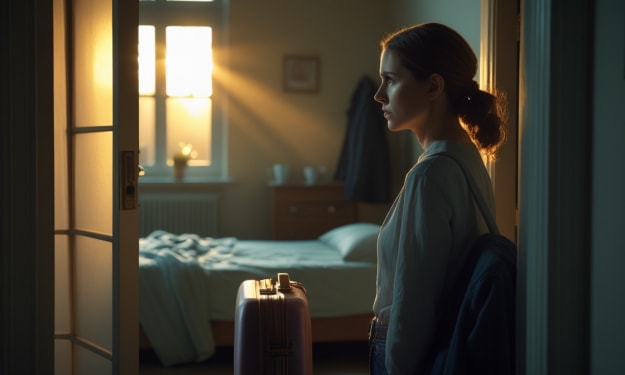
The Night I Finally Chose Myself Over Love
I remember the exact moment I realized I was disappearing.It was 2 a.m. on a Tuesday, and I was sitting on the bathroom floor with my phone in my hand, reading through our text messages for the hundredth time that week. I was trying to decode his words, searching for hidden meanings, wondering what I'd done wrong this time. My hands were shaking. My chest felt tight. And somewhere in the back of my mind, a small voice whispered: This isn't love. This is survival.But I stayed anyway.For three more months, I stayed.
By Ameer Moavia10 months ago in Motivation
The Woman Who Left First
Sophie broke up with Michael on their six-month anniversary.He'd planned a dinner. Bought flowers. Was clearly about to say something significant—maybe "I love you," maybe something about their future. She could see it in his eyes, the way he kept nervously touching the small box in his jacket pocket.And Sophie felt pure panic.Not because she didn't care about Michael. But because she cared too much. Because six months was exactly when people left. When they got close enough to see the real her and decided she wasn't worth staying for. When the fantasy dissolved and reality—messy, needy, imperfect Sophie—became too much.So she left first."I don't think this is working," she said before he could open the box. "I think we want different things."Michael looked shattered. "What? Where is this coming from? I thought we were—""We're not. I'm sorry. I have to go."She walked out of the restaurant, leaving Michael sitting alone with unopened flowers and whatever was in that box. She made it to her car before the tears came.This was the fourth relationship Sophie had ended exactly this way. Right when things got serious. Right before the other person could leave her. Right at the moment when staying would require trusting that someone might actually choose her permanently.Sophie's friends called her a "commitment-phobe" or "emotionally unavailable." Her therapist used words like "avoidant attachment" and "self-sabotage."But Sophie knew what she really was: terrified. Absolutely, bone-deep terrified of being abandoned. So terrified that she'd rather destroy good relationships herself than wait for the inevitable moment when the other person realized she wasn't enough and left.She was thirty-one years old, and she'd been running from abandonment her entire life. The problem was, in running from it, she'd made it happen over and over again.She'd become the abandoner to avoid being the abandoned. And it was destroying her.The Architecture of Abandonment FearHere's what Sophie's friends didn't understand: her fear of abandonment wasn't irrational anxiety. It was a deeply wired survival mechanism that had been forged in childhood and reinforced every year since.Dr. John Bowlby, who developed attachment theory, discovered that fear of abandonment originates in early childhood experiences where caregivers are inconsistent, unavailable, or actually abandon the child. The developing brain learns: People leave. Connection is dangerous. I'm not safe.Sophie was four when her father left. No explanation that made sense to a four-year-old. Just there one day, gone the next. Her mother, overwhelmed with grief and suddenly single parenting, became emotionally unavailable. Present physically, but absent in every way that mattered.Young Sophie learned: People you love disappear. Even when they stay physically, they can leave emotionally. I am not important enough to make them stay.By age seven, Sophie had developed a strategy: don't get attached. Don't need anyone. Don't let people get close enough to hurt you when they inevitably leave.But humans need connection to survive. So Sophie's strategy became more nuanced: get close, but not too close. Let people in, but keep one foot out the door. Care, but be ready to run the moment leaving looks possible.Neuroscience research by Dr. Ruth Feldman shows that children who experience early abandonment develop hyperactive amygdalas—their threat-detection systems are constantly scanning for signs of impending rejection. Their nervous systems exist in a perpetual state of vigilance, waiting for the other shoe to drop.By the time Sophie was an adult, her abandonment fear wasn't conscious thought—it was autonomic response. When relationships got close, her nervous system interpreted closeness as danger. Her amygdala screamed: This person will leave. Get out now before it hurts more.And Sophie, not understanding this was old programming rather than accurate prediction, would listen. She'd find reasons the relationship wasn't right. She'd create distance. She'd leave.She thought she was protecting herself. But she was actually creating the exact outcome she feared most: being alone.The Pattern She Couldn't SeeSophie's best friend Emma had watched this happen four times now. After Sophie left Michael, Emma finally confronted her."Why do you keep doing this? Michael was good to you. He was patient with your boundaries, he respected your pace, he clearly cared about you. And you just... ran.""It wasn't working," Sophie said defensively."It was working fine. You were happy. I saw you happy. Then the moment he got serious, you panicked and destroyed it.""I didn't destroy anything. We just wanted different things.""No, Sophie. You wanted the same things. You're just too terrified to admit it."Sophie felt tears threaten. "You don't understand. Everyone leaves eventually. My dad left. My mom checked out. Every relationship I've had has ended. It's just... inevitable. I'm just speeding up the inevitable so it hurts less.""Except you're the one leaving, Sophie. You're not being abandoned. You're doing the abandoning."The words hit like a slap. Because Emma was right. Sophie had spent thirty-one years so afraid of being left that she'd become the person who leaves. She'd turned her biggest fear into her defining behavior.Dr. Gabor Maté's work on trauma patterns reveals this phenomenon: people often unconsciously recreate their core wounds in an attempt to gain control over them. If you were abandoned as a child and felt powerless, you might become the abandoner as an adult to reclaim that power.But it doesn't heal the wound. It just reinforces it. Every time Sophie left, she confirmed her belief that relationships end, that people don't stay, that she's alone. She was proving her own abandonment fear correct through her own actions."I don't know how to stop," Sophie admitted quietly. "I don't know how to stay when every cell in my body is screaming at me to run.""Then you need to figure it out," Emma said gently. "Because you're going to wake up at fifty, alone, and realize you spent your whole life running from the one thing you actually wanted."
By Ameer Moavia10 months ago in Motivation
Lessons from My No-Buy Year
Late-stage capitalism has obscured our idea of normal consumption. We are pressured to spend our hard-earned income on material goods that add nothing but indulgence to our lives. Whether it’s Stanley Cups, special edition books, or Bath & Body Works lotion, there is something to allure even the most frugal of us.
By Kera Hollow10 months ago in Motivation
The Moment I Realized I was Done Pleasing Everyone but Myself
For most of my life, I didn’t realize I was living for other people. I thought I was being kind. Thought I was being flexible. Thought I was being “easygoing” and mature. What I was really doing was shrinking myself, quietly, consistently, and convincingly, until I could barely hear my own voice.
By Stacy Valentine10 months ago in Motivation
Counting Tomorrow Instead of Drinks. AI-Generated.
I wouldn’t say I’m trying to quit drinking. That would imply resolve, discipline, and some sort of moral awakening. None of those apply here. What I am trying to do—tentatively, experimentally, and with a healthy dose of skepticism—is stop pretending I don’t know exactly how much I drink.
By luna hart10 months ago in Motivation
Why Georgia Is One of the Fastest-Growing States in the United States. AI-Generated.
Over the past decade, Georgia has emerged as one of the fastest-growing states in the nation, drawing newcomers from every corner of the country and beyond. Families, entrepreneurs, artists, and professionals alike are arriving with a shared sense of anticipation, finding in Georgia a rare balance of opportunity, affordability, and belonging.
By Ibskins10 months ago in Motivation
Why We Love People Who Hurt Us
Maya's phone lit up at 2:47 a.m. with a text from Daniel: "I miss you. I'm sorry. Can we talk?"She should have deleted it. Should have blocked his number months ago. Should have learned after the third time he'd disappeared without explanation, only to return with apologies and promises.Instead, her heart leaped. Relief flooded through her. He came back. He still wants me.By 3:15 a.m., she'd responded. By morning, they'd be back together. Again. And Maya would tell herself this time would be different, even though some part of her—some quiet, exhausted part she kept trying to silence—knew it wouldn't be.Daniel would be loving for a week, maybe two. Attentive, affectionate, everything Maya had been craving. Then slowly, he'd start pulling away. Texts would go unanswered. Plans would be canceled. He'd become cold, distant, critical of small things.Maya would panic. Try harder. Become smaller, more agreeable, desperate to bring back the version of Daniel who'd made her feel so wanted. She'd apologize for things that weren't her fault. Change herself to accommodate his shifting moods. Walk on eggshells trying not to trigger his withdrawal.And eventually, he'd leave again. Ghost her for weeks. Then return with another 2 a.m. text. And the cycle would repeat.Maya's friends couldn't understand it. "Why do you keep going back to him? He treats you terribly. You deserve better."Maya knew they were right. She knew Daniel was hurting her. Knew the relationship was toxic. Knew she should walk away and never look back.But she couldn't. Because as much as Daniel hurt her, she loved him. Desperately, painfully, irrationally loved him.And she had no idea why she couldn't stop.The Neuroscience of Trauma BondingHere's what Maya's friends didn't understand: she wasn't staying because she was weak or stupid. She was staying because Daniel had accidentally—or perhaps intentionally—triggered one of the most powerful bonding mechanisms in the human brain: intermittent reinforcement.Dr. Joe Carver, who has studied trauma bonding extensively, explains that inconsistent treatment—alternating between affection and cruelty, presence and absence, warmth and coldness—creates a neurological addiction stronger than consistent kindness ever could.When Daniel was loving, Maya's brain released dopamine, oxytocin, and serotonin—the neurochemicals of pleasure, bonding, and reward. When he withdrew, those chemicals plummeted, sending her into a state similar to drug withdrawal. Anxiety, desperation, physical discomfort.Then when he returned, the neurochemical flood was even more intense than before because her brain had been deprived. The relief was so powerful it felt like love. And Maya's brain learned: Daniel's return is the best feeling in the world. I need him.This is the same mechanism that makes gambling addictive. Slot machines don't pay out consistently—they're unpredictable. And that unpredictability creates a compulsive need to keep pulling the lever, convinced the next pull will bring the reward.Daniel was Maya's slot machine. Most pulls gave her nothing or took something away. But occasionally, he gave her the jackpot—affection, attention, the feeling of being chosen—and that occasional reward kept her hooked far more effectively than consistent love ever could.Research by Dr. Helen Fisher using fMRI scans shows that the brain regions activated during romantic rejection are the same ones involved in cocaine addiction. Maya wasn't just heartbroken when Daniel left—she was experiencing neurological withdrawal. And like any addict, she'd do almost anything to get her fix.Her love wasn't a choice. It was a hijacked reward system convincing her that the person causing her pain was also her only source of relief.
By Ameer Moavia10 months ago in Motivation
For 2026 — Pay Balance!
Happy New Year, everyone. Her heart racing, Una banged on Lista’s apartment door loud enough to wake Satan. She didn’t show up for work last night and wasn’t answering her phone. When no response came, she used her spare key to let herself in. Shock set in when she entered the apartment and saw Lista sitting on the living room floor in a yoga pose, her back against the wall, crying. She was still wearing her work uniform the day before.
By Annelise Lords 10 months ago in Motivation
Crafting Your 2026 Success: A Roadmap to Consistency and Achievement
As one year ends and another begins, many of us pause to reflect. We look back at what we achieved, what we failed to complete, and what we promised ourselves but never followed through on. The end of a year is not just a change of dates on a calendar — it is a powerful psychological reset. And as 2026 approaches, this moment gives us a rare opportunity: the chance to design our life intentionally instead of living on autopilot.
By Mahveen khan10 months ago in Motivation
Last Stop: Nowhere
Elias hadn't bought a ticket, not really. He'd just shuffled onto the last car of the rattletrap train, a ghost slipping through the turnstiles, a man already halfway to gone. No one stopped him. No one even looked. That suited him fine. The seat cushion smelled of something old and damp, like a forgotten dream. The window was streaked with grime, blurring the already grey world outside.
By HAADI10 months ago in Motivation