
Stolen Dreams, Borrowed Lives
Children whose innocence was stolen by labor

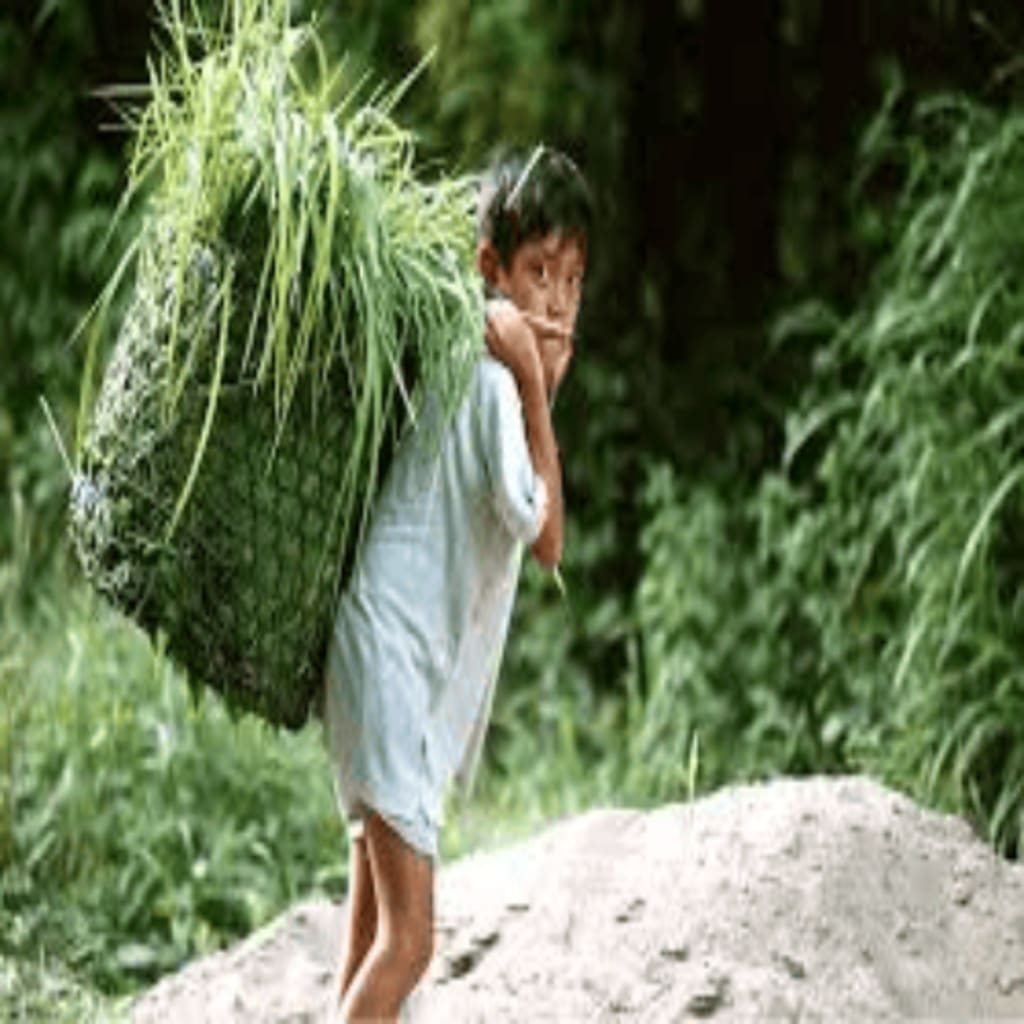
Stolen Dreams, Borrowed Lives Children whose innocence was stolen by labor
“I had wanted to be a pilot,” Sameer breathed, almost drowned by the ceaseless whir of machines. He clung to a rusted metal pipe with his grimy, grease-stained fingers and looked up at a patch of sky visible through the broken ceiling of the workshop. In that moment, his dream took off, above all those twisted, rusty pieces of scrap metal, and beyond the smell of oil that burned so strongly onto his body it felt like a second skin. Sameer was eleven years old, but his hands and eyes were of another person’s age. The lines of his hands and weariness lines in his face bore the years of labour his body had endured. Every morning, long before any birds started moving, he would wake on a ripped mat near his mother and younger sister in their tiny one-room home in a village hidden somewhere in South Asia. There were no shoes upon his feet; his loose cotton garment only partially protected him from the dirt and wind; and now at daybreak he picked his way along the dusty, broken ground, steering clear of glass and shallow pools of waste water, until he came to the iron workshops, where he had been employed since he was seven years old. The shop was a place where light was gobbled up by shadow. The clang of tools and the hiss of welding torches rang out from sunup to sundown. Peace, safety and dreams had no place. Sameer’s work was straightforward and repeated: sharpen blades, buff pipes, sweep metal dust into corners, sift piles of sharp detritus. The danger had never gone away, but Sameer no longer saw it. Burns, cuts and near misses were as much a part of life as the dirt under his fingernails or the stiffness of his back.
All of this for 50 cents a day.
A Home Without Choices Sameer’s father passed away when he was only four. It was in a construction accident — an iron beam that fell, and he never came home that evening. His mother, Nasreen, had wept nightly for weeks, but eventually even mourning had to be put aside in favor of survival. She started washing clothes for richer families in a nearby city, lugging heavy buckets of water and bending for hours over basins, to the extent that her fingers became raw. Sameer recalled that when he was six she had walked with him to the village school. They had waited outside the gate, she in a tattered sari and he with a bag of well-worn pencils they had borrowed. The headmaster had stared at them, sighed, and inquired if they had paid the enrollment fees. Though she shook her head, he told her, “We do not make exceptions.” They did not speak on their walk back home. Late that night, Sameer saw his mother cry quietly into piece of clothe she used as a pillow. He didn’t inquire what would come next, and she didn’t either. The next day, he went to the metal shop, following a neighbor’s son.
The Lost Classroom In another life, Sameer might have been a student sitting at a desk, raising his hand to answer a question about clouds or the countries he’d one day fly to. He may have stayed up late studying, anxious about tests or abuzz with a field trip. But his classroom was a cacophony of hammering, shouting, the smell of hot metal. His teacher was survival and his lessons were scars.
Every now and then, the owner of the workshop would refer to him as “boy” without using his name. “Boy, bring that wrench. Boy, sweep faster. Boy, don’t stand idle!” Little by little, word by word, Sameer forgot when the last time was that someone asked him how he felt or what he wanted to be when he grew older. But he still remembered. He wanted to be a pilot.
Bonded Through Fire and Dust Sameer wasn’t the only person in the world. His best friend was Imran, a skinny boy with round eyes and oil-stained fingernails who worked at an auto shop a few streets away. At lunch they met. Behind the factory at the mouth of an alley, they would sit on upended wooden crates that the factory had thrown out, and share their little meals: cold, hard roti or the previous night’s rice wrapped in newspaper. Occasionally, if they were lucky, Imran would bring a boiled egg that his older sister had managed to sneak to him. Their conversations were ever the same — and never the same.
“How would you spend a million rupees?” Imran asked once. “I’d buy a plane and fly to everywhere there was a place children didn’t work,” Sameer responded. “I’d travel to cities where they allow you to play. Where people don’t yell.” Imran smiled faintly. “I’d buy a bed. A soft one. And sleep for a week without the stench of engine oil.” Sometimes they would laugh, and sometimes the laughter would fade into the silence again and they would remain perfectly still, listening to the distant muffled echoes of children playing on the other side of the street — children who went to school and came home with books in their arms, not blisters on their palms.
The Cut On a Tuesday afternoon, sifting through scrap, Sameer’s hand slipped. A jagged piece of rusty steel tore through his hand. Blood dripped onto the floor. “The injury,” says Panis, “when I showed it to the owner, he frowned, threw me a dirty rag, and said, ‘Tie it up. Get back to work.” Sameer obeyed. He always obeyed.
That night, Nasreen unwrapped the blood-soaked cloth and winced. She scrubbed the wound with boiled water, smeared it with a crushed herb paste she had learned about from her grandmother and kissed his forehead. “Someday,” she whispered, “it will be over.” Sameer didn’t respond. Not from lack of trying to … just not knowing how to believe anymore.
The Weight of Silence Childhood didn’t exactly leap out of Sameer in a single moment. It dissolved, bit by bit. When he refused to play with a broken toy because he was too tired. When he found a schoolbook in the garbage and couldn’t make out the words. Where he could feel pride, not “in his dreams,” as he said, but in his capacity to endure. ' Sameer was a silent spectator of life now. The world around him he perceived as a place that had moved on without him. Festive celebrations came and went. It's workshop was passed by other boys of his age riding bicycles. Girls giggled on their way to school. Men and women chatted about politics, movies, phones. But no one mentioned the children behind machines, in kitchens, on the streets or hidden away in smaller factories built from rooms that never shut. A Faint Spark One evening, a man called Arvind walked into the workshop. He was with a local nonprofit, and had been trying to get inside the factory for weeks. He got down on one knee to the level of Sameer and asked him his name.
“Sameer,” the boy said.
“What do you want to be?” Sameer paused. It had been so long since someone had inquired. “A pilot.”
Arvind smiled. “That’s a good dream.” He showed up a week later with notebooks, bandages and two recruits. They began to offer evening studies to the children of the factory district. And initially Sameer was reluctanct but then Imran got in and he had to follow. Sameer once again found himself in a darkened room, clutching a pencil at night. It was difficult for him to write his name, but he smiled when he finally succeeded. He educated himself on how planes worked, drew their shapes from books, and watched documentaries on a tiny TV that ran on a battery. The dream was still far. But it was breathing again.
Hope Among Shadows Sameer’s world didn’t change overnight. He still worked. He still hurt. But there was a spark now, and it was kindled as he learned each word and memorized each fact and was treated, if only for a moment, not as a tool but as a person. Imran started writing stories — stories of fiction that were about kids who ran away from factories and made flying machines. Sameer read them to the class. More boys and girls attended the evening school, and the room that had only reverbrated with survival began thudding with laughter, curiosity and resilience. The Bigger Picture Sameer’s story is not unique. It is one voice among millions, dispersed throughout all the continents, murmuring in countless dialects. From the brick kilns of India to the cacao fields of West Africa; from the sweatshops of Latin America to the mines of Southeast Asia, children are being robbed of their childhood. Every kid has a name, a family, a dream. Every one has more than it should ever be asked to shoulder.
And yet they aren’t invisible. They are not beyond fixing. Their voices have not gone forever, however it has been sometimes buried. All hopes are braced, if dimmed. Restoring What Was Stolen What children like Sameer need isn’t charity. They need justice. They need an education not as a right but as a fact. They need adults who stand up for them, systems that protect them, communities that support them. And, most of all, they need the world to understand the potential inside of them — not as laborers or survivors, but as thinkers and artists and builders and pilots and poets. Sameer still walks to the workshop. Now, though, in the evening, he walks toward light, toward knowledge, toward a dream once considered to have been impossible. He’s not just a boy in a factory anymore. He’s a boy with a name, a history and a future. Because no child should ever have to decide between hunger and hope.
About the Creator
Enjoyed the story? Support the Creator.
Subscribe for free to receive all their stories in your feed.
Comments
There are no comments for this story
Be the first to respond and start the conversation.