Latest Stories
Most recently published stories in Motivation.
The Salt-Kissed Call
Leo worked the line, same as his old man, same as his old man's old man. The smell of hot metal and industrial cleaner was the scent of his life, stuck in his throat like a swallowed lie. Six days a week, the thrum of the machines vibrated up through his worn boots, rattling his teeth, shaking loose something deep inside him. It wasn't just boredom. It was an ache, sharp and persistent, for somewhere else. A specific somewhere, even though he couldn't name it, hadn't a clue where it might be. He just knew it. Knew it like a scar on his own hand.
By HAADI9 months ago in Motivation
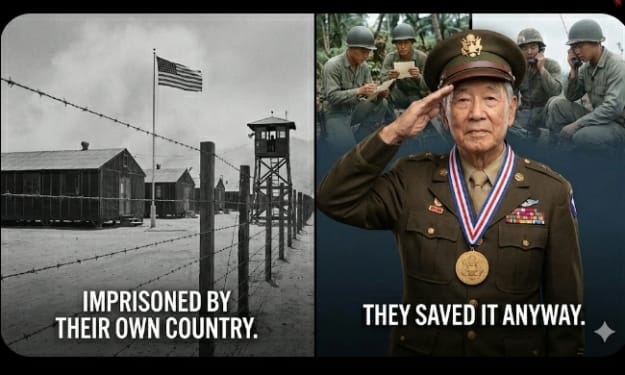
The Patriots Behind Barbed Wire: How the Men America Imprisoned Saved America From Defeat
The untold true story of the Nisei linguists of the Military Intelligence Service (MIS) during WWII. How Japanese Americans recruited from internment camps translated enemy codes, shortened the war, and proved their loyalty to a country that had betrayed them.
By Frank Massey 9 months ago in Motivation
Why We Stay in Relationships That Break Us
The coffee had gone cold in my hands, but I didn't notice. I was too busy staring at my phone, waiting for it to light up with his name. It was our fifth anniversary, and he'd forgotten. Again. But this time, I told myself, would be different. This time, I wouldn't cry. This time, I wouldn't make excuses for him.I cried anyway. And made excuses. Again.That night, as I lay in bed alone—despite sharing it with someone—I asked myself the question I'd been avoiding for years: Why do I stay?The answer was more complicated than I wanted it to be.The Architecture of StayingWe don't wake up one day and decide to accept less than we deserve. It happens gradually, like water wearing away stone. One compromise leads to another. One overlooked hurt becomes a pattern. Before we know it, we're living in a relationship that looks nothing like the one we dreamed of, yet we can't seem to find the door.I stayed because leaving felt impossible. Not because I couldn't physically walk away, but because I'd built my entire identity around being his partner. Who would I be without him? The question terrified me more than the reality of staying in something that was slowly crushing my spirit.My friends would ask, "Why don't you just leave?" As if it were that simple. As if love and pain didn't become so tangled together that you couldn't tell where one ended and the other began.The Sunk Cost of the HeartThere's an economic principle called the sunk cost fallacy—the idea that we continue investing in something because of how much we've already invested, even when it's clear we're losing. We do this with money, with careers, and especially with relationships.I'd given him six years. Six years of my twenties, the years everyone said were supposed to be the best of my life. How could I walk away from that? Wouldn't leaving mean all that time, all that effort, all that love was wasted?I see now what I couldn't see then: staying doesn't honor the time you've invested. It just ensures you'll lose more.Every day I stayed, I was betting against myself. I was choosing the familiar ache over the unknown possibility of something better. And I was teaching my heart that its needs came second.The Illusion of PotentialI didn't fall in love with who he was. I fell in love with who he could be. I saw his potential like a sculptor sees a masterpiece in a block of marble. I just had to chip away at the rough edges, be patient, love him harder, and eventually, he'd become the man I knew he could be.But people aren't projects. And love isn't a renovation.I spent years waiting for him to change, not realizing I was the one being transformed. I was becoming smaller, quieter, more accommodating. I was learning to read his moods like a weather forecast, adjusting my entire existence to avoid the storm.The person I was trying to create didn't exist. And the person I was becoming? I didn't recognize her anymore.Fear Dressed as LoveThe truth I didn't want to face was this: I wasn't staying because of love. I was staying because of fear.Fear that I'd never find anyone else. Fear that I was too damaged, too difficult, too much and not enough all at once. Fear that being alone would be worse than being with someone who made me feel lonely.Society had taught me well. It whispered that a bad relationship was better than no relationship. That I should be grateful someone wanted me at all. That if I just tried harder, loved better, gave more, things would improve.So I stayed. And stayed. And stayed.
By Ameer Moavia9 months ago in Motivation
The Night I Finally Chose Myself Over Love
I remember the exact moment I realized I was disappearing.It was 2 a.m. on a Tuesday, and I was sitting on the bathroom floor with my phone in my hand, reading through our text messages for the hundredth time that week. I was trying to decode his words, searching for hidden meanings, wondering what I'd done wrong this time. My hands were shaking. My chest felt tight. And somewhere in the back of my mind, a small voice whispered: This isn't love. This is survival.But I stayed anyway.For three more months, I stayed.
By Ameer Moavia9 months ago in Motivation
The Woman Who Left First
Sophie broke up with Michael on their six-month anniversary.He'd planned a dinner. Bought flowers. Was clearly about to say something significant—maybe "I love you," maybe something about their future. She could see it in his eyes, the way he kept nervously touching the small box in his jacket pocket.And Sophie felt pure panic.Not because she didn't care about Michael. But because she cared too much. Because six months was exactly when people left. When they got close enough to see the real her and decided she wasn't worth staying for. When the fantasy dissolved and reality—messy, needy, imperfect Sophie—became too much.So she left first."I don't think this is working," she said before he could open the box. "I think we want different things."Michael looked shattered. "What? Where is this coming from? I thought we were—""We're not. I'm sorry. I have to go."She walked out of the restaurant, leaving Michael sitting alone with unopened flowers and whatever was in that box. She made it to her car before the tears came.This was the fourth relationship Sophie had ended exactly this way. Right when things got serious. Right before the other person could leave her. Right at the moment when staying would require trusting that someone might actually choose her permanently.Sophie's friends called her a "commitment-phobe" or "emotionally unavailable." Her therapist used words like "avoidant attachment" and "self-sabotage."But Sophie knew what she really was: terrified. Absolutely, bone-deep terrified of being abandoned. So terrified that she'd rather destroy good relationships herself than wait for the inevitable moment when the other person realized she wasn't enough and left.She was thirty-one years old, and she'd been running from abandonment her entire life. The problem was, in running from it, she'd made it happen over and over again.She'd become the abandoner to avoid being the abandoned. And it was destroying her.The Architecture of Abandonment FearHere's what Sophie's friends didn't understand: her fear of abandonment wasn't irrational anxiety. It was a deeply wired survival mechanism that had been forged in childhood and reinforced every year since.Dr. John Bowlby, who developed attachment theory, discovered that fear of abandonment originates in early childhood experiences where caregivers are inconsistent, unavailable, or actually abandon the child. The developing brain learns: People leave. Connection is dangerous. I'm not safe.Sophie was four when her father left. No explanation that made sense to a four-year-old. Just there one day, gone the next. Her mother, overwhelmed with grief and suddenly single parenting, became emotionally unavailable. Present physically, but absent in every way that mattered.Young Sophie learned: People you love disappear. Even when they stay physically, they can leave emotionally. I am not important enough to make them stay.By age seven, Sophie had developed a strategy: don't get attached. Don't need anyone. Don't let people get close enough to hurt you when they inevitably leave.But humans need connection to survive. So Sophie's strategy became more nuanced: get close, but not too close. Let people in, but keep one foot out the door. Care, but be ready to run the moment leaving looks possible.Neuroscience research by Dr. Ruth Feldman shows that children who experience early abandonment develop hyperactive amygdalas—their threat-detection systems are constantly scanning for signs of impending rejection. Their nervous systems exist in a perpetual state of vigilance, waiting for the other shoe to drop.By the time Sophie was an adult, her abandonment fear wasn't conscious thought—it was autonomic response. When relationships got close, her nervous system interpreted closeness as danger. Her amygdala screamed: This person will leave. Get out now before it hurts more.And Sophie, not understanding this was old programming rather than accurate prediction, would listen. She'd find reasons the relationship wasn't right. She'd create distance. She'd leave.She thought she was protecting herself. But she was actually creating the exact outcome she feared most: being alone.The Pattern She Couldn't SeeSophie's best friend Emma had watched this happen four times now. After Sophie left Michael, Emma finally confronted her."Why do you keep doing this? Michael was good to you. He was patient with your boundaries, he respected your pace, he clearly cared about you. And you just... ran.""It wasn't working," Sophie said defensively."It was working fine. You were happy. I saw you happy. Then the moment he got serious, you panicked and destroyed it.""I didn't destroy anything. We just wanted different things.""No, Sophie. You wanted the same things. You're just too terrified to admit it."Sophie felt tears threaten. "You don't understand. Everyone leaves eventually. My dad left. My mom checked out. Every relationship I've had has ended. It's just... inevitable. I'm just speeding up the inevitable so it hurts less.""Except you're the one leaving, Sophie. You're not being abandoned. You're doing the abandoning."The words hit like a slap. Because Emma was right. Sophie had spent thirty-one years so afraid of being left that she'd become the person who leaves. She'd turned her biggest fear into her defining behavior.Dr. Gabor Maté's work on trauma patterns reveals this phenomenon: people often unconsciously recreate their core wounds in an attempt to gain control over them. If you were abandoned as a child and felt powerless, you might become the abandoner as an adult to reclaim that power.But it doesn't heal the wound. It just reinforces it. Every time Sophie left, she confirmed her belief that relationships end, that people don't stay, that she's alone. She was proving her own abandonment fear correct through her own actions."I don't know how to stop," Sophie admitted quietly. "I don't know how to stay when every cell in my body is screaming at me to run.""Then you need to figure it out," Emma said gently. "Because you're going to wake up at fifty, alone, and realize you spent your whole life running from the one thing you actually wanted."
By Ameer Moavia9 months ago in Motivation
Lessons from My No-Buy Year
Late-stage capitalism has obscured our idea of normal consumption. We are pressured to spend our hard-earned income on material goods that add nothing but indulgence to our lives. Whether it’s Stanley Cups, special edition books, or Bath & Body Works lotion, there is something to allure even the most frugal of us.
By Kera Hollow9 months ago in Motivation
Saying Goodbye to 2025 and Saying Hello to 2026
Goodbye 2025 Year 2025 has come and gone. Let's say, “Goodbye.” Let's say goodbye —not with regrets, not with complaints, but with gratitude. Every quiet mercy, every unexpected kindness, every lesson wrapped in ordinary days shaped us. We honor the year for what it gave and for the great things we received.
By Margaret Minnicks9 months ago in Motivation
Leading With Strength: Top Executive Leadership Qualities That Drive High-Performance Teams
High-performance teams do not appear by chance. They grow under leaders who demonstrate strong, consistent executive leadership qualities. These qualities help teams work together, solve problems, and reach big goals that drive organizational success. They also build a culture where people feel supported and ready to give their best.
By Yeasha Sobhan9 months ago in Motivation
Dear 2025
Dear 2025, You were a good year. Our time together is almost over now. As we start to part ways, I find myself feeling grateful for everything we shared. We had some really good moments together. So much happened that I can’t even keep it all straight in my head right now, but let’s try to reminisce.
By Hayden Searcy9 months ago in Motivation
The Moment I Realized I was Done Pleasing Everyone but Myself
For most of my life, I didn’t realize I was living for other people. I thought I was being kind. Thought I was being flexible. Thought I was being “easygoing” and mature. What I was really doing was shrinking myself, quietly, consistently, and convincingly, until I could barely hear my own voice.
By Stacy Valentine9 months ago in Motivation