
Is Digital Marketing Still Effective for Business Growth in 2026?
Explore the strategies, consumer behavior shifts, AI trends, and trust-building techniques that continue to drive leads, conversions, and sustainable business growth in 2026.

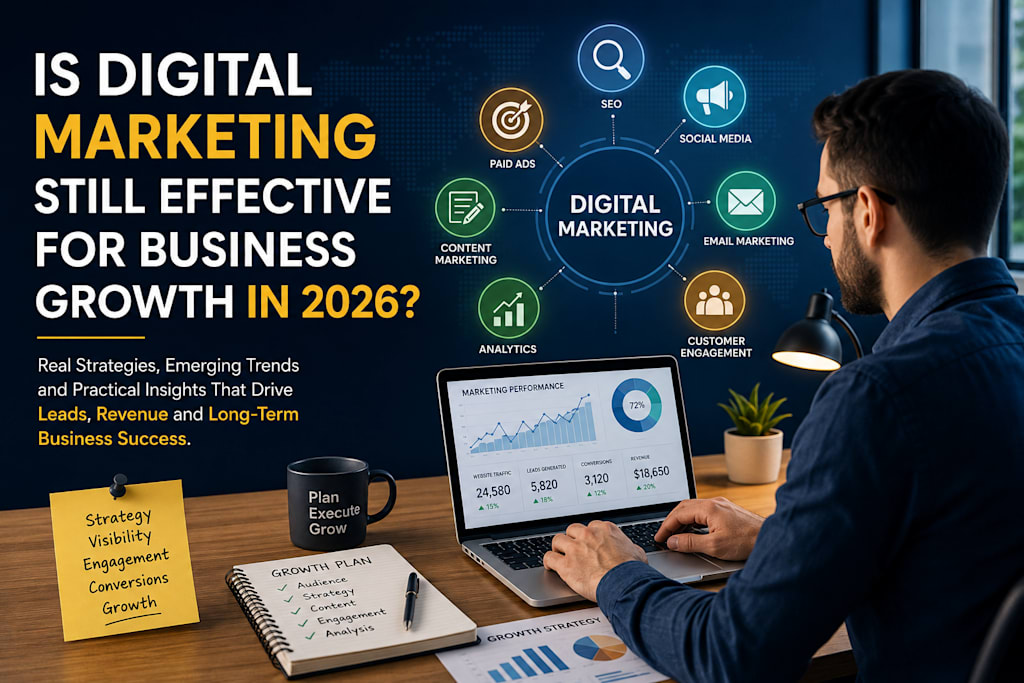
Digital marketing has been declared "dead" more times than most businesses can count. First, it was social media saturation. Then it was privacy updates. After that came AI-generated content, rising advertising costs, declining organic reach, and growing concerns about effective digital marketing strategies for business growth.
Yet businesses that consistently generate leads, build brand authority, and increase revenue in 2026 continue to invest heavily in digital marketing.
The difference is that successful companies are no longer treating digital marketing as a collection of disconnected tactics. They are building integrated customer acquisition systems that combine search visibility, content strategy, customer trust, first-party data, automation, and conversion optimization.
So, is digital marketing still effective in 2026?
Yes, but not in the way many businesses think.
The Biggest Misconception About Digital Marketing
Many organizations still believe digital marketing means:
- Running ads
- Posting on social media
- Publishing occasional blog posts
- Sending promotional emails
These activities alone rarely produce sustainable business growth.
The businesses seeing the strongest results focus on something different:
They build a system that helps potential customers discover, trust, and choose their brand at every stage of the buying journey.
Modern digital marketing is no longer about visibility alone. It is about visibility plus credibility.
Why Some Businesses See Poor Results
A surprising number of companies invest thousands of dollars into marketing but struggle to generate qualified leads.
The problem often isn't marketing itself.
The problem is how marketing is being used.
Common issues include:
Focusing on Traffic Instead of Intent
Many businesses celebrate website traffic growth while ignoring whether visitors actually need their services.
Ten thousand irrelevant visitors create less value than one hundred highly qualified prospects.
Successful digital marketing strategies focus on search intent, customer behavior, and buying signals.
Publishing Content Without Expertise
The internet is filled with generic articles repeating the same information.
Search engines increasingly prioritize content that demonstrates real expertise, practical insights, and unique perspectives.
Businesses that create original content often outperform competitors producing large volumes of low-value content.
Ignoring Conversion Optimization
Generating traffic is only half the challenge.
If visitors cannot quickly understand:
- What you offer
- Why it matters
- Why they should trust you
- What action to take next
Then even strong traffic numbers produce disappointing results.
The Shift Toward Search Intent Marketing
One of the biggest changes in 2026 is the growing importance of intent-based marketing.
Businesses no longer compete simply for rankings.
They compete for relevance.
For example, someone searching:
"best CRM for small businesses"
is much closer to making a purchase decision than someone searching:
"what is CRM"
Understanding these differences helps companies create content that aligns with actual customer needs.
This approach improves:
- Lead generation
- Conversion rates
- Customer acquisition costs
- Revenue growth
AI Has Changed Digital Marketing—But Not How Many Expected
Artificial intelligence has become part of almost every marketing conversation.
Many businesses assumed AI would replace marketers entirely.
Instead, AI has become a productivity tool.
The companies achieving the best results use AI to:
- Analyze customer behavior
- Identify content opportunities
- Automate repetitive tasks
- Improve campaign reporting
- Enhance personalization
However, AI cannot replace genuine expertise, industry knowledge, customer understanding, or business strategy.
In fact, as AI-generated content becomes more common, original human insights become more valuable.
Businesses that combine AI efficiency with real expertise often outperform both extremes.
Why Trust Is Becoming a Ranking Factor
Trust has become one of the most important business assets online.
Consumers are increasingly skeptical of exaggerated claims, misleading advertising, and low-quality content.
Before making a purchase decision, many buyers now:
- Read reviews
- Compare competitors
- Check social proof
- Evaluate expertise
- Research company credibility
This behavior has changed digital marketing significantly.
Modern brands must earn trust before they earn sales.
Companies that consistently provide helpful information often build stronger long-term customer relationships than businesses focused exclusively on promotion.
Content Marketing Is Evolving Beyond SEO
For years, businesses created content mainly to improve rankings.
Today, content serves multiple purposes.
Effective content helps businesses:
- Build authority
- Educate customers
- Answer questions
- Reduce buying hesitation
- Increase brand awareness
- Improve customer retention
The highest-performing content in 2026 often solves specific problems rather than targeting keywords alone.
For example, a business addressing a niche customer challenge may generate more qualified leads than a competitor publishing broad, generic articles.
Specificity frequently wins.
The Growing Importance of First-Party Data
Privacy regulations and browser changes have transformed digital marketing.
Businesses can no longer rely heavily on third-party tracking methods.
This has increased the importance of first-party data.
Examples include:
- Email subscribers
- Customer surveys
- Website interactions
- Purchase history
- CRM data
- Loyalty program information
Organizations using first-party data effectively can create more relevant customer experiences while maintaining privacy compliance.
This trend is expected to become even more important in the coming years.
Local Businesses Are Seeing Unexpected Opportunities
Many small businesses assume digital marketing mainly benefits large brands.
The reality is often the opposite.
Local companies can now compete more effectively because search engines increasingly reward relevance and expertise rather than company size alone.
Businesses that:
- Optimize local search presence
- Collect authentic reviews
- Publish useful content
- Maintain accurate business information
often achieve strong visibility within their target markets.
This creates opportunities that did not exist a decade ago.
What Actually Drives Business Growth Through Digital Marketing?
After analyzing successful campaigns across industries, several patterns consistently emerge.
Businesses achieve stronger results when they focus on:
Customer Problems Before Products
People search for solutions, not services.
Content that addresses customer challenges often performs better than content that focuses only on company offerings.
Consistency Over Virality
Many businesses chase viral content.
Most sustainable growth comes from consistent publishing, optimization, and customer engagement.
Authority Over Volume
One highly useful article can generate more long-term value than dozens of low-quality posts.
Long-Term Asset Building
The most effective digital marketing strategies create assets that continue producing value over time:
- Educational content
- Email audiences
- Search visibility
- Customer communities
- Brand authority
These assets compound rather than disappear when advertising budgets pause.
The Future of Digital Marketing
Digital marketing continues evolving rapidly.
AI, search engine advancements, changing consumer behavior, and new privacy standards will keep reshaping the industry.
However, one principle remains remarkably stable:
Businesses that understand their customers better than their competitors usually win.
Technology changes.
Platforms change.
Algorithms change.
Customer needs remain.
Organizations that focus on solving real problems, building trust, and creating meaningful customer experiences will continue seeing results regardless of which marketing trends dominate headlines.
Conclusion
Digital marketing remains highly effective for business growth in 2026, but success requires a different mindset than it did years ago.
The businesses generating the strongest results are not simply running ads or publishing content for search engines. They are creating customer-focused ecosystems built around trust, expertise, relevance, and long-term value.
Companies that invest in data-driven digital marketing strategies, improve lead generation processes, strengthen brand authority, and focus on customer experience are better positioned for sustainable growth. As competition continues to increase, businesses that adopt effective digital marketing strategies for business growth will have a stronger advantage in attracting qualified customers and building lasting market visibility. The question is no longer whether digital marketing works.
The real question is whether businesses are using it strategically enough to benefit from where it is heading next.
About the Creator
Technology Wisdom
Technology Wisdom is a digital solutions company focused on building scalable software systems and enabling digital transformation for organizations worldwide.
Enjoyed the story? Support the Creator.
Subscribe for free to receive all their stories in your feed.
Comments
There are no comments for this story
Be the first to respond and start the conversation.