

There are moments in life that divide everything into "before" and "after." They rarely announce themselves. There is no fanfare, no flashing lights, no voice from the heavens saying, "This is the day that will change your life forever."
For me, it happened on an ordinary morning in 1973.
I was sixteen, growing up in New York City's low-income housing projects. My world was not one where children dreamed of becoming economists. In fact, I doubt anyone I knew could have explained what an economist did. The career didn't exist in our neighborhood's vocabulary.
My parents were hardworking immigrants who deeply believed in education because they had sacrificed so much to give me the opportunities they never had.
My mother worked as a cleaning lady, and my father worked as a waiter.
Like many parents, my mother had already envisioned my future. Her first choice was simple.
"Become a doctor."
If not a doctor, then perhaps a lawyer.
Those professions represented success, stability, and respect. They were careers she could understand because they were visible to her.
Truthfully, I had no desire to become a doctor. I admired physicians, but I couldn't imagine spending my life practicing medicine. Law seemed slightly more appealing because I loved debating ideas and speaking to groups. Even then, something felt missing. I wasn't passionate about the law itself.
The strange thing was that I wasn’t searching for a career.
I wasn't anxious.
I wasn't worried.
I assumed that someday my purpose would reveal itself.
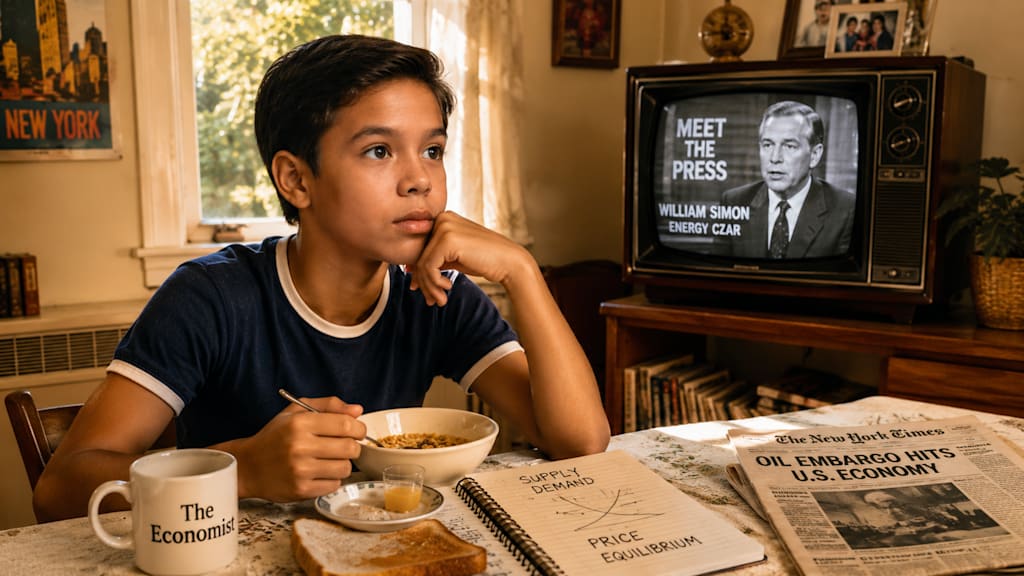
Then one Sunday morning, while eating a late breakfast snack in front of our black-and-white television, I turned on one of my favorite programs: Meet the Press.
The guest that morning was William Simon, then serving as America's Energy Czar during the 1973 oil embargo.
The nation was struggling with gasoline shortages, rising prices, and economic uncertainty. Simon calmly explained how the forces of supply and demand were determining the price of oil.
As he spoke, something extraordinary happened.
He wasn't merely describing an event.
He was explaining how the economy functioned!
The idea that millions of independent decisions by producers and consumers could determine prices fascinated me. Invisible forces, not random chance, were shaping everyday life.
I had never heard anyone describe the economy that way.
The discussion mesmerized me.
The concepts of supply and demand curves were unlike anything I had ever encountered anywhere.
In that instant, I felt something I had never experienced before.
It wasn't curiosity.
It was recognition.
Without hesitation, I turned to my mother.
"I want to become an Economist."
Those words surprised both of us.
After all, five minutes earlier, becoming an Economist had never crossed my mind.
Now I couldn't imagine becoming anything else.
The remarkable part of this story is that I wasn't looking for my future.
My future found me.
That single television interview changed the direction of my life forever.
From that day forward, I never wondered what I wanted to be when I grew up.
I already knew.
The problem, however, was that discovering your dream and learning how to achieve it are two very different things.
I became impatient.
I didn't want to wait until economics appeared later in my high school curriculum.
I approached my high school’s economics teacher and politely asked if he would tutor me so I could begin studying economics immediately.
He looked at me with skepticism.
He told me I probably wasn't serious and that tutoring me would likely waste his time.
I walked away, disappointed but not discouraged.
If no one were willing to teach me, I would teach myself.
I went to the public library and borrowed every economics book I could find.
Only later did I realize why they were so difficult.
Most of them were college textbooks.
Imagine a teenager with no background in economics trying to decipher university-level material.
Every chapter felt like climbing a mountain. I struggled through unfamiliar terminology.
Graphs confused me. Equations made little sense.
Sometimes I read the same page three or four times before understanding a single paragraph.
But I kept going, not because it was easy, but because I loved it.
Every concept I finally understood felt like solving another piece of a giant puzzle.
A year later, when economics finally appeared on my high school schedule, something unexpected happened. Many of my classmates found the material difficult to understand.
For me, however, it felt as if someone had suddenly turned on the lights. Everything clicked.
The countless hours spent struggling alone in the library had prepared me for that moment.
The same teacher who had doubted my commitment watched me grasp the material with surprising ease.
He couldn't believe how quickly I grasped the subject. What he hadn't seen were the months of frustration that preceded the breakthrough.
Learning rarely looks impressive while it's happening. Progress often lies in persistence.
Looking back decades later, I realize that becoming an economist had almost nothing to do with growing up in the housing projects. It had everything to do with staying open to unexpected opportunities.
Life has an amazing way of introducing us to ideas we never knew existed.
Sometimes those ideas arrive through a teacher. Sometimes through a book.
Sometimes through a conversation with a stranger.
And sometimes, as it did for me, through an ordinary television interview on a quiet Sunday morning.
Too many young people put enormous pressure on themselves to decide exactly what they want to do with the rest of their lives.
They worry because they haven't found their passion yet. They compare themselves to friends who seem to have everything together and start believing that they're somehow behind.
I don't believe that's true. Finding your life's work is often similar to finding the right life partner. The harder you force it, the more elusive it can become.
Then, when the right one appears, something inside you knows. That was my experience with economics.
I didn't analyze it.
I didn't debate it.
I didn't create a list of pros and cons.
I fell in love with an idea.
And once I did, there was no turning back.
Today, when I reflect on that morning in front of our old black-and-white television, I realize that my parents unknowingly gave me an extraordinary gift.
Although they couldn't imagine economics as a career, they gave me the freedom to embrace it once I discovered it.
Their world had shown them only a handful of professions. Mine would eventually become much larger.
That is why I encourage every young person to keep an open mind. Don't panic if you don't yet know what you want to become.
Don't assume your dream must look like anyone else's. Don't believe that no one from your neighborhood, family, or background has ever traveled the path you're considering.
Someone must be first. Perhaps that person is you.
Your opportunity may arrive tomorrow. It may arrive next year. It may appear while you're reading a book, listening to a podcast, watching a documentary, or having breakfast on an otherwise ordinary morning.
When it comes knocking, be ready to open the door.
As I look back today, I often smile at the thought that an ordinary Sunday morning in front of a black-and-white television would shape the rest of my life. That single moment eventually led me to earn a Ph.D. in Economics, fulfill my dream of teaching economics at the university level, serve as an economist at the Federal Reserve Bank of New York, advise bond market traders as an economist at Barclays, and ultimately spend 25 years as the Global Chief Economist for Wealth Management at JPMorgan Chase, the largest bank in the United States.
None of those accomplishments crossed my mind that morning in 1973. I simply fell in love with an idea. The lesson is that you don't have to see the entire staircase before taking the first step. You only need to recognize the opportunity when it appears and have the courage to pursue it with everything you have. My journey wasn't defined by where I started in New York City's housing projects or by what those around me thought possible. It was defined by staying open to an unexpected calling and refusing to let go once I found it.
Never underestimate where a single moment of inspiration can lead. It may begin with an ordinary conversation, a book, a teacher, or even a television program, but if it ignites your imagination, it can transform not only your career but your entire life.
About the Creator
Anthony Chan
Chan Economics LLC, Public Speaker
Chief Global Economist & Public Speaker JPM Chase ('94-'19).
Senior Economist Barclays ('91-'94)
Economist, NY Federal Reserve ('89-'91)
Econ. Prof. (Univ. of Dayton, '86-'89)
Ph.D. Economics
Enjoyed the story? Support the Creator.
Subscribe for free to receive all their stories in your feed. You could also become a paid subscriber, letting them know you appreciate their work.
Comments
There are no comments for this story
Be the first to respond and start the conversation.