
A Study Of Certain Potential
A Treatise On Coherent Human Power, The Craft Of Shaping Reality, And The Art Of Directed Becoming

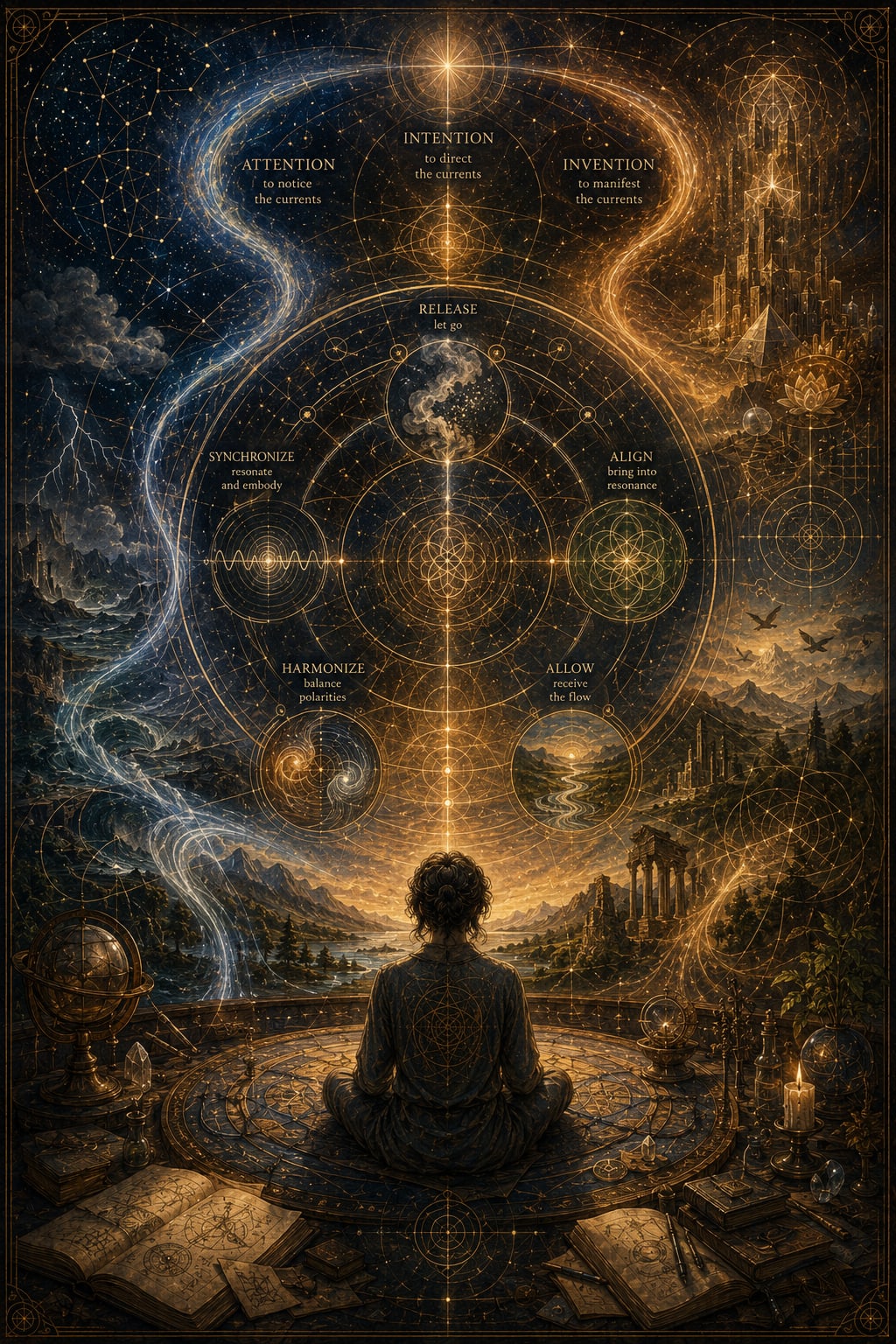
PART 1
The Practice of Human Power: Practical Omnificence
Book I: Alchemy of Attention
"Hominus potentia excedit visum."
(Humanity's power exceeds their vision.)
There is a power already moving through you, one that exceeds the edges of your awareness. It slips beneath the surface of thought, threading through the moments you barely notice, gathering in quiet momentum. To attend is not merely to see - it is to awaken a current, to stir possibility into form. This is the alchemy of attention: a force at once intimate and inexhaustible, shaping what will arrive, long before the world knows it. To learn it is to step into a conversation older than the self, and to discover that the dialogue has been waiting for your voice all along.
What Moves Between Us
Power is never solitary. It circulates, folds, and rebounds through the spaces we inhabit, in ways both visible and unseen. Awareness is the first current: a quiet pulse that stretches between the mind and the world, tracing the edges of what can be shaped. It moves like wind across water - disturbing some surfaces, stirring others into gentle motion, leaving some untouched, and yet leaving all marked.
Ingenuity is the spark. It takes the raw material of attention and reshapes it, bending circumstances with subtle craft. It is neither magic nor labor alone, but the bridge between noticing and shaping: the deft turn of perception into possibility. Ingenuity is the hand that collects what is fleeting and aligns it, patiently, into form.
Will is the vessel. Where attention gathers and ingenuity sketches, will settles in as the point of power, steady and unwavering. It does not force; it allows. It does not command; it consents. Yet through this quiet authority, the currents of the unseen meet the edges of reality, and what was only imagined begins to take weight, to insist upon its presence.
These three - attention, ingenuity, will - are inseparable. They move in cycles, in echoes, in hidden geometries that trace the unseen architecture of the world. To understand what moves between us is to recognize that every thought, every choice, every sustained focus, participates in shaping the world. The alchemy of attention is not a secret kept by the universe - it is a covenant that awaits our awareness, a dialogue in which our voice is already heard. And once noticed, these currents begin to bend subtly toward action, inviting us to see how our focus shapes the unfolding of events.
Book II: Gravity of Intention
"Homo faber fortunae suae."
(Everyone is the architect of their own destiny.)
Once attention has been claimed, every choice begins to carry a subtle weight. Not as a burden, but as the pull that bends probability, nudges outcomes, and traces the path of events before they arrive. Intention is gravity: unseen, inevitable, shaping the arcs of lives and circumstances alike. It is both compass and current, aligning inner will with the tendencies of the world, calling forth responses that mirror the strength of your focus.
To intend is to participate in the architecture of reality. Each thought held, each aim sustained, forms a lattice upon which the future will lean. Some of this lattice is delicate, subtle, invisible to casual sight. Some of it is durable, resilient, woven so tightly that even chance cannot undo it. The power of conscious attention becomes amplified in the presence of deliberate commitment. Where awareness alone observes, intention acts. Where imagination alone dreams, intention manifests.
The lines between what is chosen and what is allowed are not sharp. They are waves, intersections, overlaps where consequence and volition meet. And it is here, in these confluences, that the work of creation is quietly done: not by the will alone, but by the interplay of insight, focus, and the deliberate act of holding one’s aim with clarity.
Gravity of intention is not coercion, nor is it blind striving. It is the natural arc of concentrated energy, moving toward coherence. It is the steady pulse by which the unseen responds, shaping circumstance without requiring dominion. To study it is to learn where attention bends the world, how choices carve channels in possibility, and how, through consistent alignment, the imagined may take form - waiting now for the hands that will bring it fully into being.
Where The Lines Meet
There is a space, narrow and infinite, where seeing and choosing converge. Here, awareness and intention are no longer separate; they intertwine, forming the currents that guide the subtle architecture of reality. Every thought carries a trace of action, every sustained aim a whisper of consequence. It is in this liminal place that possibility becomes pressure, and pressure shapes form.
The lines are never straight. They curve, loop, and intersect in patterns invisible to the casual eye. One’s attention bends them, one’s commitment pulls them taut. Where the lines meet, the world answers - not because it must, but because it is drawn to coherence, responding naturally to the steady insistence of focused will.
This convergence is delicate. Too much force, and the flow breaks; too little, and the current dissipates. The art of intention is the quiet balance: knowing when to hold, when to release, when to trace a line and when to let it stretch unseen. It is both geometry and rhythm, a living map that charts the space between self and circumstance.
In this space, even the smallest choice carries weight. A glance, a word, a sustained thought - each travels outward along the curves of possibility, meeting other currents, bending them, folding them, echoing far beyond what can be measured. To understand where the lines meet is to recognize the delicate power inherent in every deliberate act: the invisible architecture of the world responds to those who move with clarity, integrity, and awareness.
Book III: Reality of Invention
"A posse ad esse."
(From possiblity to actuality.)
The possibilities that attention has noticed, and that intention has begun to shape, do not endure on their own; they wait, unformed, until focus and effort give them substance. Invention is the bridge between what could be and what is - an act of patient persistence, a weaving of vision, will, and sustained attention into tangible presence. To invent is to claim the space between imagination and matter, to inhabit it deliberately, and to let the currents of attention and intention converge in service of creation.
Consistent focus is the crucible of manifestation. Every moment spent tending to an idea, every choice held with clarity, adds substance to the currents set in motion, shaping space, bending paths, coaxing them into form. Assiduity is not labor alone - it is devotion. It is the slow, deliberate crafting of possibility into reality. And it is here, in the quiet patience of sustained engagement, that power becomes practical, and vision finds its form.
To recognize the inner divinity is to acknowledge that the capacity for invention is already present. To clarify volition is to understand what is truly desired and what is fleeting. To harness discretion is to act with awareness of consequence, shaping the world not merely because one can, but because one chooses to align creation with purpose. This is practical omnificence: the disciplined, human art of turning potential into actuality.
Reality is not given. It is invented. Every thought, every intention, every sustained act is a stroke on the canvas of existence. To practice invention is to practice presence, to practice agency, to practice the delicate and exhilarating act of being a conscious participant in the unfolding of the world.
Of Bearing and Becoming
Creation does not arrive all at once. It emerges from cycles and currents, a rhythm of persistent shaping where imagination meets the weight of reality. To bear is to hold attention and intention steady, to cultivate the currents set in motion, to meet the world with hands ready to guide and mold rather than to seize. Each act, no matter how small, moves through layers of consequence, bending circumstance quietly, insistently, toward coherence.
Becoming is the living response to that movement. It is not a final form but a continual adaptation, a dialogue between vision and reality, between will and world. The patterns of attention and intention ripple outward, and the self must move in concert with them, adjusting, refining, and sustaining effort until imagination settles into substance.
In practice, this is where the invisible becomes tangible. Focused work shapes space, time, and perception alike. The currents of possibility bend toward persistence; the world responds to clarity maintained over time. Here, power is neither spectacle nor accident - it is lived and applied, a subtle but unstoppable force, measured in patience, precision, and fidelity to one’s aim.
To inhabit invention is to carry responsibility without burden, to act with discernment, and to recognize that each deliberate choice echoes outward, shaping more than the immediate. Bearing and becoming are inseparable: the act of sustaining attention and commitment shapes both the creation and the creator, revealing the latent capacity to participate consciously in the unfolding of reality.
PART 2
The Art of Coherence: Resonant Being
Within you and around you, currents are already in motion. Thought, energy, intention, and timing flow constantly, shaping the patterns of experience. Coherence is the condition in which these currents move together, naturally amplifying the outcomes you already seek.
To live in coherence is not to force reality, nor to abandon agency. It is to enter a relationship with the forces that shape becoming - mental, emotional, energetic, temporal - and allow them to align in shared direction. In this state, action lands with clarity, intention carries weight, and opportunity arrives in its own rhythm.
The practice of coherence explores essential questions:
How can we release inhibiting cognitive programs?
How can we align beliefs, mindset, and values?
How can we allow providence and kairos?
How can we harmonize energetic polarities?
How can we synchronize with vibrational resonance?
Coherence is not something to acquire; it is something to inhabit. It is a discipline of attention, alignment, and presence - a way of moving through life that maximizes the natural intelligences already at work.
When these questions are engaged, the currents of mind, energy, and intention begin to flow together. Action, thought, and circumstance begin to respond in harmony, and the art of resonant being emerges naturally.
Book I: Release
“How can we release inhibiting cognitive programs?”
Release is not erasure. It is not the elimination of thought, nor the denial of feeling. It is the recognition of what no longer serves, the discernment of patterns that fragment attention, scatter energy, or distort perception.
Cognitive programs are the routines, beliefs, and automatic responses we carry - some inherited, some learned, some adopted without reflection. They were once useful. They once protected, guided, or enabled. Over time, however, they may become friction, subtle interference in the smooth unfolding of experience.
To release is to notice these patterns and allow them to dissolve without force. It begins with attention: observing thoughts, reactions, and impulses as they arise. Where there is observation, friction softens. Where there is clarity, momentum returns.
The process unfolds naturally through three interwoven movements:
Awareness: Observe without judgment. Notice habitual reactions, recurring doubts, and repetitive stories that limit perception. Attention itself is already transformative; by noticing, you weaken unconscious dominance.
Recognition: Identify the function of each program. Understand what it was meant to do, and where it no longer serves. This recognition transforms resistance into insight.
Release: Allow the pattern to step aside. This is rarely sudden. Often, it is a gradual lightening, a loosening of grip, a space opening where thought and energy can flow more freely.
Release is not emptying; it is clearing. It is not denial; it is discernment. The space it creates is the precondition for alignment, the fertile ground in which intention may take root.
To inhabit release is to cultivate a mind unburdened by interference, a field of perception that can respond rather than react, and a foundation for coherence that will carry into the next stages of being.
Book II: Align
“How can we align beliefs, mindset, and values?”
Alignment is the art of bringing what is within into resonance. Where release created space, alignment shapes the field. It ensures that thought, intention, and action pull in the same direction, that inner signals do not contradict one another, and that energy flows without internal friction.
Beliefs, mindset, and values are the compass of experience. They guide perception, decision-making, and action. When they are misaligned - when what is thought, felt, and prioritized diverges - energy splinters, intention falters, and coherence is diminished.
The process of alignment unfolds through three interwoven movements:
Clarification: Identify core beliefs and values. Notice where your mindset supports them and where it conflicts. Ask what assumptions guide your perception and which serve your highest purpose. Clarity is not rigid; it is perceptive and honest.
Reconciliation: Where contradictions exist, bring them into dialogue. Examine conflicting beliefs, outdated expectations, and misaligned priorities. Reconciliation is not about forcing resolution - it is about creating internal consistency, allowing choices, feelings, and priorities to harmonize.
Integration: Once internal alignment is recognized, allow it to permeate thought and action. Let intention, decision, and attention move together, each supporting the other. Integration transforms understanding into lived coherence, creating a stable platform for intentional engagement with reality.
Alignment is not conformity; it is integrity. It is not about perfection; it is about functional resonance. The aligned mind perceives more clearly, acts more decisively, and interacts with reality without internal friction. It is the foundation upon which allowance, harmonization, and synchronization can build.
Book III: Allow
“How can we allow providence and kairos?”
Allowance is the practice of opening to what is already present, of recognizing when movement is timely and when restraint serves better than action. It is not passive waiting, nor resignation to circumstance. It is active receptivity: knowing when to move, when to hold, and when to let the natural unfolding of events guide the process.
Providence and kairos are forces that operate beyond linear intention. They are the currents of opportunity, the alignments of circumstance, and the moments of timing that cannot be manufactured. To allow is to attune to these forces, to perceive their rhythms, and to enter into partnership with them rather than resisting or attempting to control them.
The process of allowance unfolds in three interwoven movements:
Perception: Cultivate awareness of timing, rhythm, and opportunity. Observe patterns in events, interactions, and outcomes. Perception is the skill of distinguishing what can be influenced from what must be received.
Acceptance: Receive what arises without resistance. Acceptance is not passivity; it is a conscious choice to meet reality as it is, rather than as we wish it to be. Resistance consumes energy and fragments coherence; acceptance consolidates it.
Responsive Engagement: Act in harmony with observed timing and opportunity. Engagement is measured and intentional, guided by insight rather than impulse. It allows natural forces to amplify effort, multiplying the impact of aligned action.
To allow is to practice partnership with the flow of reality. It does not diminish agency; it refines it. The one who allows effectively acts with precision, leveraging the momentum of circumstances rather than expending energy against them. In this space, receptivity becomes a form of power, and timing itself becomes a tool of coherent living.
Book IV: Harmonize
“How can we harmonize energetic polarities?”
Harmony is the practice of integrating opposites, of bringing tension into balance, and of creating a coherent field in which energy flows smoothly. It is the skill of navigating dualities - effort and rest, action and receptivity, masculine and feminine, thought and feeling - so that each supports the other rather than colliding.
Energetic polarities are inherent in all systems. Within the self, they manifest as competing drives, conflicting desires, or uneven distribution of focus and attention. Outside, they appear as the push and pull of circumstances, relationships, and environmental forces. Harmonization aligns these polarities, transforming friction into coherence.
The process unfolds in three interwoven movements:
Recognition: Identify the polarities present in thought, energy, and action. Notice where opposing forces create tension, misalignment, or fatigue. Recognition is seeing the landscape without judgment, mapping where energy is scattered or compressed.
Balance: Bring complementary forces into dynamic equilibrium. Balance is not erasure of tension; it is the art of leveraging contrast to maintain stability. Effort is met with rest, control with surrender, strength with receptivity - each reinforcing the other.
Integration: Allow the balanced forces to permeate perception, decision, and action. Integration ensures that inner harmony translates into external coherence, enabling sustained focus, clear intention, and resilient engagement with the currents of reality.
Harmonization is not a state to achieve once, but a continual practice. It is the rhythm that sustains alignment and allowance, the structural integrity that supports intention, and the field in which resonance can emerge naturally. Through harmonization, the currents of energy move without obstruction, creating a stable foundation for the final stage of coherence: synchronization.
Book V: Synchronize
“How can we synchronize with vibrational resonance?”
Synchronization is the practice of attuning oneself to the patterns and frequencies that shape experience. It is the alignment of inner state with outer reality, where thought, feeling, and action resonate with circumstance rather than collide with it.
Vibrational resonance is not mystical; it is a measure of coherence between intention, attention, and the unfolding of events. When synchronization is present, actions land with precision, opportunities emerge in rhythm with preparation, and the flow of experience amplifies the power of conscious focus.
The process unfolds in three interwoven movements:
Perceptive Attunement: Develop sensitivity to patterns in energy, behavior, and circumstance. Notice when momentum aligns and when it resists. Attunement is the ability to discern the natural rhythms of reality, to feel where movement will meet ease and where it will encounter friction.
Responsive Calibration: Adjust thoughts, actions, and intentions to match observed patterns. Calibration is not forcing alignment, but refining posture, timing, and focus so that inner states resonate with outer conditions.
Resonant Action: Move with clarity and coherence, letting the alignment of mind, energy, and circumstance amplify impact. Resonant action flows naturally from attuned perception and deliberate calibration, producing outcomes that feel inevitable and effortless.
Synchronization is the culmination of release, alignment, allowance, and harmonization. It is the lived experience of coherence, where inner and outer systems move together, amplifying each other, and where human power operates at its most practical, intelligent, and effective level.
To synchronize is to inhabit resonance fully: to act with precision, respond with grace, and participate consciously in the unfolding currents of reality. In this state, being and becoming move together seamlessly, and the art of resonant living is realized.
Coherence is not a destination. It is a practice, a way of inhabiting life in which attention, intention, and action move together without obstruction. The five stages - Release, Align, Allow, Harmonize, Synchronize - are not sequential boxes to check; they are interwoven threads of a single, living process.
Release opens space by letting go of what no longer serves.
Align shapes the field, bringing beliefs, mindset, and values into resonance.
Allow cultivates receptivity and attunement to timing, opportunity, and natural flow.
Harmonize integrates polarities, creating balance within and around us.
Synchronize attunes our inner state to the rhythms of reality, producing resonance in action.
Together, these stages form a coherent path, a practice in which human power becomes practical, directed, and sustainable. The work is not about forcing outcomes, correcting flaws, or attaining perfection. It is about inhabiting the currents of life consciously, learning to participate with clarity, and allowing the natural alignment of forces to amplify effort and intention.
To practice coherence is to move with awareness, to notice patterns, to refine alignment, and to act with precision. It is to cultivate a life in which inner capacities and outer conditions meet in harmonious interplay. In this space, creation becomes intelligible, intention carries weight, and being itself resonates with the unfolding of reality.
This is the art of resonant being: the lived practice of human power, fully aligned, fully attuned, fully present.
PART 3
The Way Of Immersion: Living Narrative
Tools, techniques, and practices are not magic in themselves. They are amplifiers, mirrors, and conduits for what already moves within and around us. Nothing works without alignment. Attention, intention, and awareness must be cultivated first; only then can a talisman, a ritual, or a vision board become more than symbolic - they become active participants in shaping experience.
This guide presents methods that engage mind, body, and environment, designed to support coherent manifestation. Each practice is grounded in the principles of:
Attention – noticing currents, patterns, and opportunities with clarity
Intention – directing focus toward a consciously chosen outcome
Alignment – harmonizing beliefs, mindset, and values to sustain coherence
Allowance – cultivating receptivity to timing, providence, and kairos
Harmony – integrating energetic polarities to reduce friction and increase flow
Resonance – attuning to the vibrational patterns of self, tools, and circumstances
By understanding why each method works, and how to implement it practically, you can move beyond rote repetition into intentional, embodied practice. Techniques - from writing exercises and vision boards to talismans, rituals, and reflective exercises - function as amplifiers of your focus, alignment, and resonance.
This is meant to be lived. It offers structured, repeatable approaches, yet encourages adaptation and experimentation. Your aim is not merely to perform a practice, but to cultivate skill in participation - to act with awareness, refine intention, and allow manifestation to unfold naturally and coherently.
Book I: Mindful Intention
Techniques include intentional writing, structured reflection, and affirmations or declarations. Intentional writing involves journaling with purpose, crafting statements of desire, or exploring internal patterns and beliefs. Structured reflection can take the form of guided prompts, self-interrogation, or review of past intentions and outcomes. Affirmations and declarations are phrased in the present tense to embed intentions into attention and belief.
Mindful intention operates at the intersection of awareness, focus, and energy. When you write, reflect, or declare purposefully, you amplify neural and energetic pathways that encode clarity of direction. You transform vague desires into articulated forms that the mind, body, and subtle energy can engage with. You reinforce coherence between inner values, beliefs, and outward focus, reducing internal friction that weakens manifestation. Structured practices create a feedback loop: attention clarifies desire, reflection highlights misalignments, and repetition strengthens the resonance between thought and action.
To implement these techniques practically, create a dedicated time and space for intentional writing. Begin with a question or theme, such as what you wish to bring into form during the month. Write freely without judgment, then highlight or extract statements that feel aligned with your highest intention. For structured reflection, set aside time weekly or monthly to review intentions. Observe what manifested, what shifted, and where attention faltered. Record patterns of success and friction, and adjust future practices based on your observations to reinforce learning and alignment.
For affirmations and declarations, phrase intentions in the present tense, for example: “I cultivate clarity in my actions,” rather than “I will be clear.” Repeat these statements daily, ideally paired with a short ritual such as lighting a candle, using a specific object, or taking a deep breath to embed focus. Combining these affirmations with journaling or visualization helps anchor energy and attention.
Micro-practices include morning intention setting through brief writing or affirmations, evening reflection reviewing alignment with stated intentions, and short declarations throughout the day to subtly bring attention back to focus.
Book II: Visual Architecture
Techniques in this section include vision boards, maps, symbolic sketches, and guided visualization. Vision boards provide a visual representation of intentions and goals, helping to clarify and focus the mind on desired outcomes. Maps and symbolic sketches allow abstract ideas to take form in a tangible way, creating a framework that the mind and energy can engage with. Guided visualization is a method of mentally experiencing desired outcomes, building alignment between imagination, intention, and perception.
Visualization works because the mind and energy respond to coherent, repeated patterns. Seeing your intentions represented externally or experiencing them internally aligns subconscious and conscious perception. This alignment strengthens focus, amplifies resonance with desired outcomes, and shapes attention toward actionable steps. Visualization acts as a rehearsal, preparing both mind and energy to respond to opportunity and circumstance with clarity and coherence.
To implement these techniques practically, begin by selecting images, symbols, or sketches that resonate with your intentions. Arrange them in a way that feels meaningful, whether on a board, in a journal, or digitally. Take time daily to focus on the images or sketches, allowing yourself to feel the intention as if it were already present. Guided visualization can be done seated or lying down. Close your eyes, breathe deeply, and imagine the outcome with all senses engaged, noticing details, emotions, and interactions. Repetition and consistency strengthen the resonance and deepen integration.
Integration into daily practice can be subtle or structured. A vision board can remain in view as a reminder, sketches can be reviewed and added to regularly, and visualization sessions can be scheduled as brief practices throughout the day. The goal is to maintain alignment between attention, intention, and the symbolic representations you create. These practices amplify focus, embed clarity, and support the manifestation process by turning abstract desires into perceptible forms.
Book III: Object and Energy Tools
Techniques in this section include talismans, crystals, personal objects, and ritual implements. Talismans are objects intentionally charged with symbolic meaning or purpose, serving as anchors for attention and intention. Crystals and other personal objects act as resonant conduits, reflecting and amplifying energy. Ritual implements can be simple or elaborate, but their function is to focus attention, signal intention, and create a consistent framework for practice.
These tools work because they operate on both symbolic and energetic levels. Psychometry allows subtle information to be encoded in objects through intention and attention. Resonance between the practitioner and the object strengthens focus, aligns energy, and serves as a reminder or amplifier of purpose. Symbolic anchoring transforms abstract intentions into tangible forms that the mind and body can interact with repeatedly, reinforcing coherence and alignment.
Practical implementation begins with selecting an object that resonates with your intention. This could be a stone, piece of jewelry, or any item that feels significant. Consecration, or intentional preparation of the object, helps embed purpose: this can involve holding it with focus, speaking a declaration, or performing a small ritual to charge it with meaning. Programming the object means regularly returning attention to it, visualizing the intention, and using it as a touchstone to maintain focus and alignment.
Mindful handling is also key. Carry or display the object in a way that reminds you of the intention without creating dependency. Use the object in combination with other practices, such as writing, visualization, or affirmations, to strengthen coherence between mind, energy, and circumstance. Through consistent interaction, the object becomes a bridge between abstract intention and tangible reality, amplifying the process of manifestation and supporting conscious participation in creation.
Book IV: Rituals and Action Protocols
This section focuses on techniques such as simple ceremonies, cyclical practices, and temporal alignment. Rituals provide structured ways to focus attention, reinforce intention, and mark the passage of time in alignment with desired outcomes. Cyclical practices follow natural rhythms - daily, weekly, or seasonal - allowing consistent engagement and repeated reinforcement of intention. Temporal alignment involves recognizing and working with moments of significance or opportunity, known as kairos, to maximize resonance and effectiveness.
Rituals and protocols work because they create frames that guide attention and energy. By repeating actions in a deliberate, consistent way, subtle patterns are reinforced in mind, body, and energy. Structured repetition turns attention into habit, strengthens resonance with intention, and trains awareness to notice opportunities that might otherwise pass unnoticed. Ceremonies, even simple ones, signal to the mind and energy system that a specific focus or intention is present, helping the practitioner enter a state of coherence more easily.
Practical implementation begins with choosing practices that feel meaningful and accessible. A ritual could be as simple as lighting a candle while stating intention, or as involved as creating a short ceremony incorporating objects, movement, or visualization. Cyclical practices should be scheduled regularly, whether daily journaling, weekly reflection, or seasonal renewal activities. Temporal alignment involves observation and selection of moments when energy naturally supports action, such as particular phases of the moon, personal milestones, or moments of synchronicity.
Adaptability is key. Rituals should guide attention and energy, not create rigidity or stress. They can be modified or combined with other practices to suit current circumstances. The goal is to create a flow that reinforces focus, sustains intention, and supports coherent action, turning abstract desire into repeated, embodied patterns that manifest in tangible ways.
Book V: Integration Practices
Integration Practices focus on combining tools, techniques, and awareness into a coherent system that supports manifestation in daily life. This involves bringing together writing, visualization, objects, rituals, and reflective practices so that each element amplifies the others, creating a unified flow of attention, intention, and energy. Integration is not about adding complexity, but about cultivating harmony and coherence across all practices.
Reflective practices support feedback and refinement. By observing outcomes, noticing patterns, and reviewing alignment with intentions, you can adjust techniques and tools to strengthen resonance and effectiveness. This reflection ensures that your efforts are not mechanical, but consciously attuned to both internal clarity and external circumstance.
Daily life becomes the laboratory for these practices. Integration means aligning habits, environment, and interactions with the currents of focus and intention. Small, consistent actions - checking alignment in the morning, revisiting visualization during the day, using objects or talismans as reminders - reinforce coherence without requiring constant effort. Over time, these practices cultivate an intuitive sense of when and how to act, when to pause, and how to maintain resonance with your intentions.
The ultimate purpose of integration is to sustain a lived awareness of attention, intention, and alignment. Practices are combined, rhythms are maintained, and tools are applied in ways that naturally reinforce each other. This creates a system in which manifestation is not an occasional event, but an ongoing, conscious engagement with reality. Through integration, clarity of mind, focus of attention, and coherence of energy converge, allowing intention to flow seamlessly into action and experience.
Optional enhancements can include sequences of practice, exercises to track resonance and outcomes, and strategies to maintain focus, avoid burnout, and sustain alignment over time. These are designed to support ongoing refinement, experimentation, and mastery of coherent manifestation.
The practices, tools, and techniques explored in this guide are not separate from the life you already live - they are extensions of the same currents of attention, intention, and energy that shape every experience. Mastery is not measured in the number of practices performed, but in the coherence you cultivate: clarity of mind, alignment of beliefs, resonance of energy, and skillful application of attention and intention.
Manifestation is not coercion. It is participation. Each practice - whether writing, visualization, ritual, or reflection - serves as a bridge between thought and form, between possibility and actuality. By engaging these tools consciously, you learn to navigate the unseen currents that shape reality, to recognize opportunities, and to act with precision, adaptability, and awareness.
Integration is the final step. It is the living thread that ties together all techniques into a cohesive, resonant system. Through consistent practice, reflection, and refinement, intention becomes embodied, alignment becomes habitual, and action becomes coherent. Manifestation, then, is no longer a series of isolated events but a sustained, conscious engagement with the world.
As you continue to explore and apply these methods, remember that the power to shape your experience is already present. What you have cultivated here is a framework, a laboratory, and a mirror - tools to help you notice, amplify, and direct the currents that always flow through you. The practices are guides, but the life you create is yours, shaped by your focus, your resonance, and your deliberate participation in the unfolding of reality.
About the Creator
Enjoyed the story? Support the Creator.
Subscribe for free to receive all their stories in your feed.
Comments
There are no comments for this story
Be the first to respond and start the conversation.