
6 Little Things Nobody Tells You Before You Travel to Italy
And I mean it

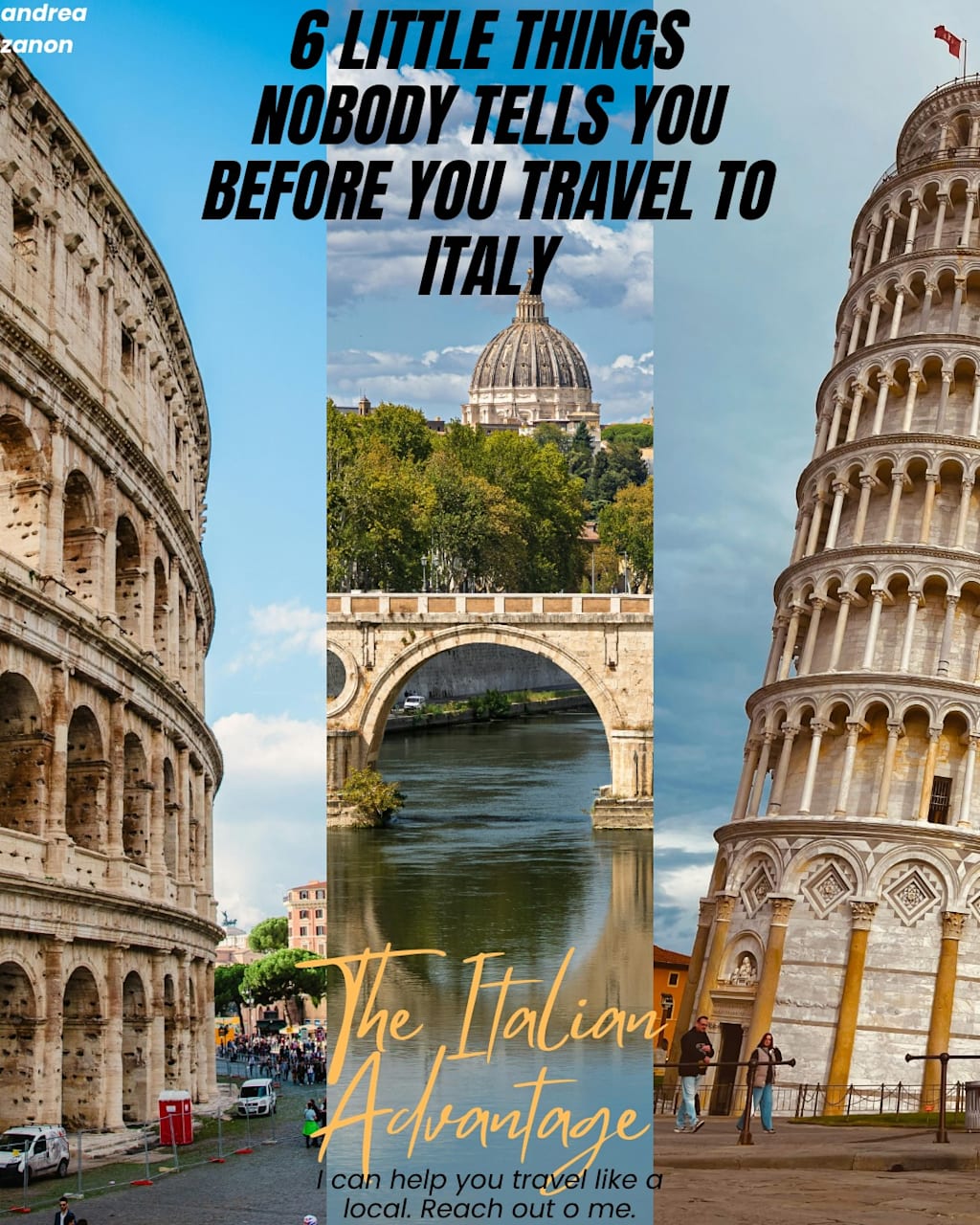
The advice you actually need, from someone who has been inside Italy for twenty years
Let me tell you what nobody in the travel industry wants to say out loud.
Not the cappuccino rule. Not the cheese on seafood pasta debate. Not the spaghetti cutting controversy, though I promise you that one is coming and it will be a longer conversation than you expect.
I want to talk about the things that actually derail trips. The things that happen to intelligent, well-traveled, well-prepared people who simply did not have the right information before they landed. The things I have watched unfold in real time for two decades, from Venice to Naples to Puglia to Lake Garda, working alongside students, entrepreneurs, families relocating, couples getting married, and CEOs doing business in a country that rewards those who understand it and quietly punishes those who do not.
Bologna for my degree. Georgetown for my master. And then back to Italy, where the real education began and never really stopped.
Here is what I know.
One. The Naples cab ride.
You land in Naples. You are excited. You have been planning this trip for months. You get in a taxi and within twenty minutes something goes wrong that you did not see coming and could not have prepared for because nobody told you it was possible.
The driver drops you two hundred yards from your hotel and gestures vaguely in a direction. You are jet lagged, you have luggage, and Naples at street level is not a place where vague gestures are helpful.
Here is what you do instead. Before the car moves, you tell the driver exactly where you are going and you make it clear, calmly and specifically, that you expect to be dropped at the front entrance. You take a photo of their license and registration, which Italian law requires to be displayed inside every taxi. And if you want to make it easy, you offer ten extra euros to be left right at the door. Most drivers will take that deal immediately. The same conversation applies to Venice water taxis when your hotel has canal access. Different vehicle, identical logic.
Two. Flip flops and cobblestones.
This sounds like a minor inconvenience. It is not. The cobblestones in Venice, Florence, and Rome are ancient, uneven, and completely indifferent to your footwear choices. By late morning you will be in pain. By afternoon you will be limping. And somewhere in between you will try to enter a church or sit down at a decent restaurant and be turned away at the door because of what is on your feet.
Pack one pair of real walking shoes. Just one. That is all it takes.
Three. Speaking Italian with a waiter.
If you love the language and want to practice, Italy will reward you enormously for trying. But context matters. If you push to speak Italian without explaining why, some waiters will wonder if you are testing their English, judging their level, or making a point. You are not. But they do not know that yet.
Start with Sto imparando, mi piace tantissimo. I am learning, I love it. Four words that reframe the entire exchange. What could have been awkward becomes warm. What could have been a wall becomes a door.
Four. The cooking class trap.
Cooking classes in Italy are everywhere and they are almost all designed for tourists. They are expensive, they are choreographed, and they end with a certificate that will live in a drawer forever.
What you actually want is harder to find and infinitely more valuable. A local food event. A neighborhood tasting. A sagra in a village square. A dinner that someone is organizing in their home or their courtyard that you found out about because you knew the right person to ask.
These experiences exist everywhere in Italy. They cost almost nothing. And they are the kind of thing people describe for the rest of their lives when someone asks about that trip.
If you are heading to Venice, the Veneto, Naples, or Lake Garda, reach out before you book anything. I know people.
Five. Ask to see the room.
Americans almost never do this. It feels presumptuous, awkward, vaguely rude. It is none of those things. It is practical and it is your right as a paying guest.
When you check in, before you take the key, before you commit to anything, say this: Posso vedere la stanza? Can I see the room? It takes two minutes. It tells you whether the AC works, whether the view matches the photos, whether the bathroom is what you expected. And if it is not, you have the information you need to ask for something different before it is too late.
I do this every time I travel. In Italy, in my home country, everywhere. No explanation needed.
Six. July and August.
If you can move your trip to June or September, do it. The weather is still extraordinary, the crowds are thinner, and the country is operating at something closer to full capacity.
If you cannot avoid July or August, because life is complicated and schedules are what they are, then after you book your hotel, before you do anything else, call me.
Energy shortages have been an increasingly serious issue in Italy since February of this year. What hotels describe as air conditioning and what air conditioning actually means are sometimes two very different things. A unit that runs for forty minutes and then rests for twenty is not AC. It is a gesture in the direction of AC.
Last July one of my clients held a wedding at a stunning Masseria in Puglia. It was 43 degrees. The air conditioning was failing. The cocktail hour was scheduled outside at five in the afternoon. I do not need to tell you how that went.
I will call the hotel before you arrive. I will ask the questions that need to be asked in the language that gets real answers. That is the difference between a trip that works and one that does not.
Meglio chiedere ed essere sicuri. Better to ask and be sure.
And if any of this resonates, if you are planning a trip, a wedding, a relocation, a business meeting, or simply want to finally speak the language of the most beautiful country on earth, you know where to find me.
Sentiamoci.
About the Creator
Andrea Zanon
There is a reason Italian businesses outlast everyone else.
10 years in International Financial Institutions. Now I advise, write, and build.
Founder, Confidente & The Italian Advantage.
andreazanon.tech
Enjoyed the story? Support the Creator.
Subscribe for free to receive all their stories in your feed.
Comments
There are no comments for this story
Be the first to respond and start the conversation.