
What Is Clear Anodized Aluminum?
What clear anodized aluminum is, how the anodizing process works, its advantages, common alloy types, cost factors, and industrial applications.

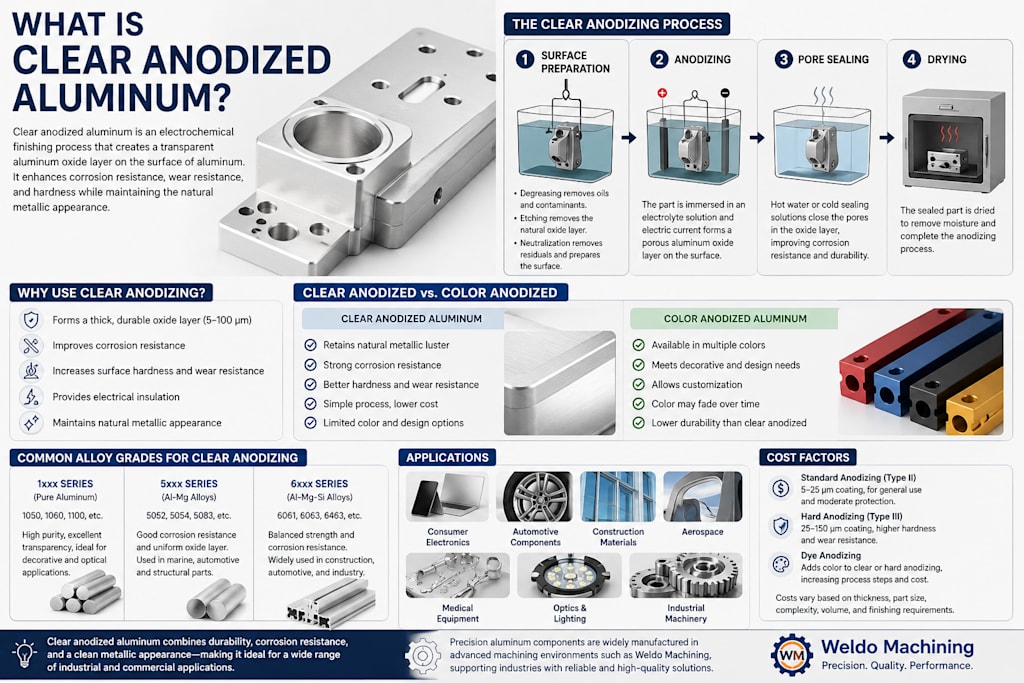
Clear anodized aluminum is aluminum that has undergone an electrochemical finishing process to create a transparent protective oxide layer on its surface. This layer improves corrosion resistance, wear resistance, and surface hardness while maintaining the natural metallic appearance of the aluminum.
Unlike painted or coated finishes, clear anodizing does not significantly change the texture or appearance of the metal. The surface remains metallic with a clean and uniform finish.
How Clear Anodizing Works
Clear anodizing is performed by placing aluminum components into an electrolytic solution and applying an electric current. During this process, the aluminum surface reacts with oxygen to form a durable aluminum oxide layer.
The oxide coating is transparent or slightly translucent and becomes part of the metal surface rather than a separate coating layer.
Main Stages of the Clear Anodizing Process
Surface Preparation
Before anodizing, aluminum parts are cleaned to remove oils, dirt, and machining residues.
• Degreasing removes surface contaminants using alkaline cleaning solutions.
• Alkaline etching removes the natural oxide layer and creates a more uniform surface texture.
• Neutralization removes residues from the etching stage and restores the metal surface.
Anodizing
The aluminum component is immersed in an acid-based electrolyte solution and connected to an electrical circuit.
The electrical current forms a porous oxide film on the aluminum surface. The thickness of this layer can vary depending on the intended application.
Pore Sealing
After anodizing, the pores within the oxide layer are sealed to improve corrosion resistance and durability.
Hot water sealing is commonly used to hydrate and close the pores in the oxide film. Some industrial processes also use room-temperature sealing methods.
Drying
The final stage removes remaining moisture from the surface and stabilizes the coating.
Why Clear Anodizing Is Used
Aluminum naturally forms a thin oxide layer when exposed to air, but this natural layer is extremely thin and offers limited protection.
Anodizing creates a much thicker and harder oxide layer that improves:
• Corrosion resistance
• Surface hardness
• Wear resistance
• Electrical insulation
• Surface durability
The anodized layer can range from approximately 5 to 100 microns depending on the process type and application.
Clear Anodized Aluminum vs. Color Anodized Aluminum
Clear Anodized Aluminum
Advantages
• Retains the natural metallic appearance
• Good corrosion resistance
• Improved hardness and wear resistance
• Simpler finishing process
• Lower processing costs compared to dyed finishes
Limitations
• Limited visual variation
• Less decorative flexibility compared to colored finishes
Color Anodized Aluminum
Advantages
• Available in multiple color options
• Suitable for decorative and design-focused applications
• Allows surface customization
Limitations
• Dyed surfaces may fade over time
• Some colored coatings may have lower durability
• Additional processing steps increase cost and maintenance requirements
Aluminum Alloys Commonly Used for Clear Anodizing
Different aluminum alloy grades respond differently to anodizing depending on their composition.
1xxx Series Aluminum
Examples include 1050, 1060, and 1100 alloys.
These alloys contain very high aluminum content and low impurity levels, producing highly transparent anodized surfaces suitable for decorative and optical applications.
5xxx Series Aluminum-Magnesium Alloys
Examples include 5052, 5054, and 5083.
These alloys offer good corrosion resistance and form relatively uniform anodized coatings. They are commonly used in marine, transportation, and structural applications.
6xxx Series Aluminum-Magnesium-Silicon Alloys
Examples include 6061, 6063, and 6463.
These alloys balance strength, corrosion resistance, and machinability, making them widely used in construction, automotive, and industrial components.
Heat Treatment and Anodizing
Heat treatment is generally completed before anodizing.
High temperatures used during heat treatment can damage the anodized layer, so anodizing is typically performed as the final surface finishing step after machining and thermal processing are complete. Clear anodized aluminum components are commonly manufactured in precision engineering environments such as Weldo Machining for industrial and structural applications.
Cost Factors in Clear Anodizing
The cost of anodizing depends on several factors, including:
• Coating thickness
• Part size and geometry
• Surface preparation requirements
• Production volume
• Process complexity
• Dyeing or sealing methods
Standard Anodizing
Standard anodizing typically produces coatings between 5 and 25 microns thick and is commonly used for decorative and moderate corrosion-resistant applications.
Hard Anodizing
Hard anodizing creates thicker coatings with greater wear resistance and hardness, often used in industrial, automotive, and aerospace components.
Dye Anodizing
Colored anodizing adds an additional dyeing stage to the process, increasing both processing time and cost.
Applications of Clear Anodized Aluminum
Clear anodized aluminum is used across multiple industries because of its combination of durability, corrosion resistance, and clean appearance.
Consumer Electronics
Used in device housings, structural frames, and decorative components.
Automotive Components
Applied to trim pieces, handles, wheel components, and interior parts.
Construction Materials
Used in window frames, railings, curtain wall systems, and outdoor architectural structures.
Aerospace Applications
Used in lightweight structural parts and components requiring corrosion resistance and reduced weight.
Medical Equipment
Used in surgical tools, trays, and equipment housings because anodized surfaces are durable and easier to clean.
Optical and Lighting Equipment
Used in optical mounts, LED housings, and components requiring electrical insulation and heat dissipation.
Industrial Machinery
Used for machine parts, housings, and wear-resistant components in manufacturing environments.
Conclusion
Clear anodized aluminum is a surface treatment method that improves the durability and corrosion resistance of aluminum while preserving its natural metallic appearance. The process is widely used in industries such as construction, transportation, electronics, aerospace, and manufacturing because it enhances surface performance without significantly altering the material’s appearance.
About the Creator
Enjoyed the story? Support the Creator.
Subscribe for free to receive all their stories in your feed.
Comments
There are no comments for this story
Be the first to respond and start the conversation.