
What a Certificated Flight Instructor Gives You That Self-Study Simply Cannot
Certificated Flight Instructor
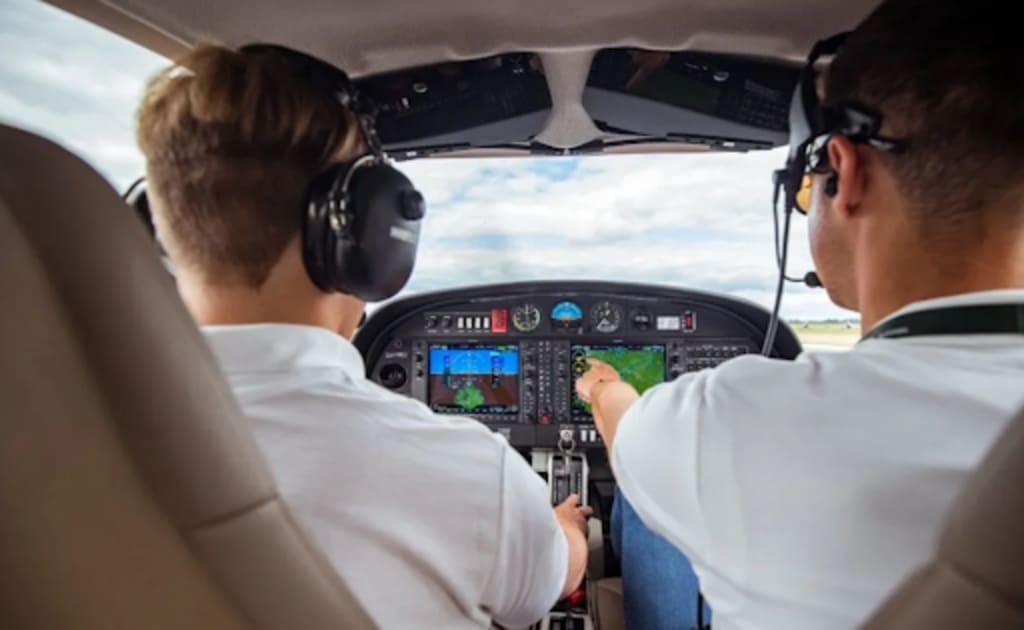
Learning to fly attracts a particular kind of person — someone who has already done the research, watched the videos, downloaded the apps, and arrived at their first lesson knowing more ground theory than some students who are already halfway through training. That preparation is genuinely useful. What it does not produce is a pilot. The distance between understanding how an aircraft behaves and actually controlling one through a crosswind landing or an unexpected airspace incursion is not bridged by information. It is bridged by supervised experience with someone who has already been where the student is heading and knows precisely where things go wrong. That is what a certificated flight instructor actually provides, and it is not something the internet has found a substitute for yet.
Early Errors Become Permanent
The most expensive mistakes in flight training are not the dramatic ones. They are the subtle technique errors that form in the first few hours of handling an aircraft and then solidify through repetition into habits that feel entirely natural to the student experiencing them. A slightly late flare on landing. A tendency to chase the heading indicator with small overcorrections rather than holding a coordinated turn. An approach to clearing turns that looks correct from the outside but misses a blind spot consistently. These errors do not announce themselves. A student flying solo without adequate early correction will repeat them hundreds of times across their training, becoming progressively more confident in a technique that is progressively harder to fix.
Stall Recognition Is Not a Textbook Subject
The theory of aerodynamic stall is genuinely straightforward. Exceed the critical angle of attack, airflow separates from the wing, and lift collapses. Students can explain this accurately before they have ever touched an aircraft. What the textbook cannot teach is recognition by feel — the particular sluggishness that develops in the controls before the break, the specific sound of airflow changing character, the subtle change in the seat pressure that precedes the nose drop. A certificated flight instructor introduces students to these sensations deliberately and repeatedly in a controlled environment at altitude, with recovery managed. The student who encounters an approaching stall for the first time in the circuit without that preparation is not learning stall recognition. They are simply surprised by it.
What Examiners Actually Look For
Checkride preparation is widely misunderstood as an extension of normal training — more practice of the same manoeuvres until the student reaches an acceptable standard. Examiners are not primarily evaluating whether a student can fly a steep turn to a precise heading. They are evaluating whether the applicant makes decisions like a pilot who will continue to develop safely after the licence is issued. This means how a student responds when something does not go to plan during the test matters considerably more than how cleanly they perform when everything is running smoothly. A certificated flight instructor who has taken students through checkrides repeatedly understands this distinction and prepares students for the actual evaluation rather than a performance of it.
Decision Making Has to Be Practised
The accident record in general aviation is not dominated by mechanical failures or extreme weather events. It is dominated by decisions – the choice to depart into conditions that were marginal, to continue when the situation was developing unfavourably, and to accept an aircraft with a discrepancy because the flight felt too important to cancel. These decisions rarely feel obviously wrong at the moment they are made. An experienced instructor exposes students to scenario-based situations throughout training specifically because judgement under ambiguity does not develop through procedures alone. It develops through practising making actual decisions and then discussing them honestly with someone whose job is to develop the student rather than validate them.
Currency Decay Is Invisible to the Pilot Experiencing It
Flying skills degrade without regular practice in ways that are not obvious from the inside. A pilot returning after a prolonged break feels familiar with the aircraft whilst actually operating at a standard that has slipped considerably. This is one of the more dangerous features of skill decay — the subjective experience of competence does not accurately track the objective reality. Recurrency training with a qualified instructor provides an external standard against which actual performance can be honestly measured.
Conclusion
A certificated flight instructor does something that no ground school, simulator, or self-directed study programme can replicate — they observe a student in the actual environment where errors occur and correct them before those errors become the foundation everything else is built upon. The quality of early instruction shapes how a pilot thinks, decides, and handles pressure for the entirety of their flying life. That influence is either working in a pilot's favour or quietly against them, and it starts from the very first hour in the aircraft.
About the Creator
Enjoyed the story? Support the Creator.
Subscribe for free to receive all their stories in your feed.
Comments
There are no comments for this story
Be the first to respond and start the conversation.