
Elravie Re2O and the Evidence Behind an hADM Product
Professional product guide | September 2026

The phrase “skin booster” now covers products with very different starting materials. Some are based on hyaluronic acid, some contain other defined ingredients, and others are described through tissue-derived or regenerative terminology. Placing them together on a shopping page does not make their composition, evidence, or regulatory position interchangeable.
Elravie Re2O is a useful example of why the underlying material matters. Its public identity is associated with human acellular dermal matrix, usually abbreviated hADM. That is a different starting point from a conventional hyaluronic acid formulation. A good product guide should explain the difference clearly without turning a material description into a promise of skin regeneration.
This article is for professional buyers and readers evaluating product information. It explains the terminology, sets out an evidence-review method, and provides practical questions for sourcing and documentation. It does not offer a clinical protocol, establish an approved indication, or determine whether the product is suitable for an individual. Those decisions require the applicable local documents and qualified professional assessment.
Begin with the product rather than the category
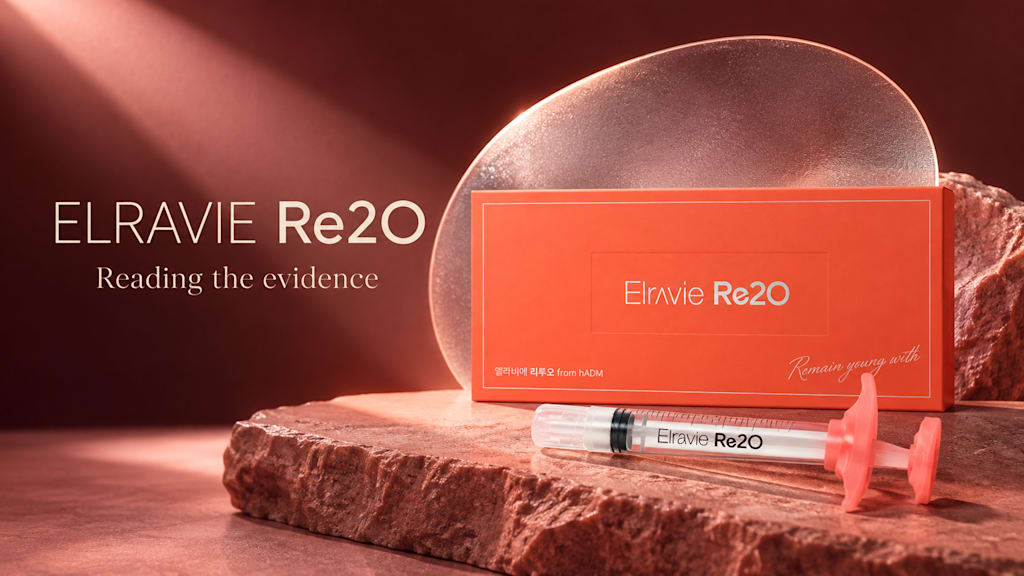
The Elravie Re2O listing shows coral packaging and a matching product presentation. The carton includes an hADM reference. That visual identity helps distinguish the item from other Elravie products, but the complete specification must come from the current label and product documentation rather than the color of the box.
Humedix announced the launch of Elravie Re2O in November 2024, describing a relationship with L&C Bio and an acellular allogeneic dermal material. The announcement is useful primary information about the product's origin and commercial introduction. It remains a company announcement, not an independent clinical trial or a universal statement of market authorization. [1]
Record the exact name and version being offered. Re2O is sometimes visually confused with strings containing a zero, while product families may contain additional items under the same umbrella brand. A purchasing record should preserve the official name, identifier, and supplied presentation so that a later quotation does not quietly refer to a different product.
Translate hADM into plain English
Human acellular dermal matrix refers to a material derived from human dermal tissue that has undergone processing intended to remove cells while retaining an extracellular matrix component. “Allogeneic” indicates material from another human donor. These terms describe origin and processing concepts; they do not, by themselves, establish the composition or performance of every finished product.
The extracellular matrix is the structural environment around cells. In a processed tissue material, its characteristics depend on sourcing and manufacturing. It is therefore misleading to treat hADM as a single identical substance regardless of supplier, processing method, or presentation. Product-specific documents are needed to understand what has actually been supplied.
The word acellular also matters. It should not be translated into a claim that the product contains living stem cells. A tissue-derived matrix, a living cell therapy, and a preparation described as containing extracellular vesicles are different categories. Confusing them may make a product sound more advanced while making the explanation less accurate.
Term
What it describes
What it does not establish
Human derived
Biological origin
Suitability for every recipient
Allogeneic
Donor and recipient are different people
A particular clinical outcome
Acellular
A processing objective concerning cells
Absence of every possible risk
Dermal matrix
Tissue and structural-material category
Equivalence across all products
Skin booster
Broad commercial language
A single regulatory classification
Compare hADM with other product categories fairly
The most useful comparison starts with the material and the evidence question. A hyaluronic acid product can be evaluated through its formulation, physical characteristics, instructions, and clinical evidence. A tissue-derived material also raises questions about donor-related controls, processing, traceability, and the specific pathway under which it is supplied.
Those differences do not establish that one category is better. They explain why the review file may need different documents. A buyer should avoid a universal ranking based on phrases such as “natural matrix,” “next generation,” or “regenerative.” Each phrase needs to be translated into a claim that can be checked.
Product category
Central identity question
Evidence that should match the claim
hADM product
What tissue-derived material and processing are documented
Exact product and proposed use
Hyaluronic acid formulation
Which formulation and presentation are supplied
Product-specific clinical and quality data
Polynucleotide or PDRN product
Which ingredient form and finished product are involved
Evidence for the actual formulation
Extracellular-vesicle preparation
What source and characterization are documented
Defined preparation and relevant human outcomes
This comparison is especially helpful when a clinic already uses a familiar product and is considering adding a new category. The new item should not inherit the old product's evidence file simply because both appear on a skin-quality menu. The assessment should begin again with the material, purpose, and applicable documentation.
Separate biological rationale from demonstrated benefit
A biological rationale explains why a material might be of interest. It can suggest mechanisms worth studying and help researchers formulate questions. Demonstrated clinical benefit requires evidence from an appropriate use in people, with outcomes that matter and methods that allow a meaningful interpretation.
For an hADM product, a statement about extracellular matrix components should not automatically become a promise to restore youthful skin, rebuild collagen, or reverse aging. Those are different claims with different evidentiary demands. Even a plausible mechanism does not establish how much benefit occurs, how consistently it occurs, or how long it lasts.
Ask the source of each claim. Is it a laboratory experiment, a manufacturer explanation, an uncontrolled clinical observation, or a comparative human study? Each may contribute something useful, but the conclusion must stay within the limits of the evidence. A small observational report cannot answer every question about comparative effectiveness or uncommon adverse events.
The FTC's health-products guidance emphasizes that both explicit and implied health claims need appropriate scientific support. For product writers, this means that a sophisticated scientific vocabulary does not reduce the need for evidence. Images and surrounding language can also suggest a stronger conclusion than the literal sentence states. [2]
Build an evidence map instead of collecting impressive citations
Start by writing the exact claim under review. “Contains a specified material” is an identity claim. “Improves a measured skin parameter over a stated period” is a clinical claim. “Works better than another product” is a comparative claim. Each needs a different type of support, and the last requires a valid basis for comparison.
For each study supplied, record the exact tested product, participant characteristics, number enrolled and analyzed, comparison group, outcome measurements, follow-up, and reported limitations. Also note who funded the work and whether the researchers disclosed relevant interests. Funding does not automatically invalidate a study, but it belongs in the reader's assessment.
Do not count references as though quantity alone establishes quality. Ten papers about general dermal matrices may be less relevant to a specific aesthetic claim than one well-designed study of the exact product. Conversely, a product-specific study may still be too limited to support a broad promise. Relevance and study quality need to be considered together.
Keep a column for unanswered questions. This prevents a literature review from becoming a one-way search for favorable statements. If the available evidence does not establish durability, comparative performance, or suitability for a proposed population, leave those points unresolved rather than filling them with marketing language.
Understand what donor and tissue documentation can answer
Human-derived materials introduce a set of sourcing questions that should be addressed through the responsible tissue and product documentation. Ask which organization is responsible for donor-related controls, processing, release, and traceability. The exact documents and legal requirements depend on the product and jurisdiction.
The FDA's tissue-information resources describe the role of donor screening, testing, and good tissue practices in the US framework. These resources explain why tissue controls matter, but they do not establish that Elravie Re2O has a particular US status. General regulatory information must not be presented as product approval. [3]
For the buyer, the aim is to confirm that the relevant controls are documented and reviewable through the appropriate channels. It is not necessary or appropriate to request identifiable personal information about a donor. Traceability should support quality and safety while respecting privacy and the responsible organization's procedures.
A supplier's statement that a facility is accredited also needs context. Ask which organization is accredited, by whom, for what scope, and during which period. Accreditation may be useful evidence about a facility or process. It should not be converted into a blanket claim that every product, indication, or destination market is approved.
Ask what processing claims actually mean
The Humedix launch material refers to a named processing technology associated with the product. A technology name can help identify the manufacturer's approach, but the name itself does not disclose every process parameter or establish a clinical result. Ask which product attributes and release criteria are documented for the supplied version. [1]
Useful questions concern the identity of the processed material, relevant quality controls, the release documentation available to the buyer, and any handling restrictions. Where technical claims are important to the intended use, have an appropriately qualified reviewer assess them. Avoid treating a sales explanation as a substitute for the current instructions.
Be careful with absolute language. “Processed to remove cells” is different from claiming the absence of every potentially relevant biological component. “Human derived” is different from “identical to the recipient's own tissue.” Accurate wording preserves the distinction between a manufacturing objective, a measured specification, and a clinical inference.
Confirm the supplied presentation and handling requirements
The product photograph provides a visual reference, but the purchase should specify the actual contents of the sales unit. Confirm the container, nominal amount as documented, included components, applicable label language, and any preparation-related materials supplied. Do not infer a preparation method from an image of a syringe or from another hADM product.
Request the current instructions before planning storage or staff training. Tissue-derived products can have product-specific requirements, and a general skin-booster storage rule is not a reliable substitute. Record the source and revision of the instructions used to establish the local handling plan.
This guide deliberately does not provide reconstitution quantities, administration routes, or treatment schedules. Those details must come from the applicable product instructions and qualified professional assessment. Copying a protocol from a similarly named product can create a false sense of familiarity while bypassing the most important product-specific information.
Evaluate a supplier through the quality of its answers
A useful discussion with a skin booster supplier should move beyond stock availability to exact product identity, documentation, provenance, and destination-specific questions. Ask which records the seller can provide directly and which require confirmation from the responsible manufacturer or tissue organization. Clear routing is a sign of an organized process.
Check the legal entity on the quotation and invoice, the source of the offered stock as documented, and the conditions under which it will be shipped. If the seller describes itself as authorized, request evidence of the relationship and its scope. Confirm material claims through an appropriate independent channel when the decision depends on them.
Distinguish a helpful intermediary from an authority on every issue. A supplier may competently arrange a shipment while being unable to determine whether a proposed clinical use is appropriate. The buying organization remains responsible for obtaining the relevant professional review rather than assuming the sales conversation resolves all questions.
Design an acceptance record for tissue-derived stock
An acceptance record should connect the exact product and batch to the purchase order, invoice, receipt date, condition on arrival, and storage location. Include the relevant expiry information and the result of any handling review. The person releasing the stock should be identified so the decision can be understood later.
If documents use more than one identifier, record how they relate. A product lot, a processing identifier, and a commercial shipment number may not serve the same purpose. Ask the responsible party to explain the relationship where necessary rather than assuming the numbers should all be identical.
Keep uncertain stock separate from available inventory. For example, a shipment may match the product name but arrive without a document required by the organization's review process. Mark the status as pending and specify the missing item. A visible reason for the hold makes resolution faster and prevents accidental release.
Plan a meaningful discussion with the clinical team
The clinical discussion should begin with the actual patient concern and the proposed role of the product. “Skin quality” can refer to texture, hydration, laxity, pigmentation, or other issues, and those are not interchangeable outcomes. Evidence relevant to one concern may not answer another.
Ask the team to define how any claimed improvement would be assessed and over what period. Consistent photography, validated measures where appropriate, and a clear record of other interventions can improve the quality of observation. Routine clinical observations still have limitations and should not be presented as equivalent to controlled research.
Patient communication should acknowledge the human-derived nature of the material and any relevant uncertainties. Individuals may have personal preferences or concerns about tissue-derived products that deserve a direct answer. A product should not be described solely through a fashionable category name when its actual origin would matter to the person's decision.
Avoid misleading comparisons with collagen and stem cells
The presence of matrix-related material does not establish that a product is a generic collagen injection, a living-cell treatment, or an exosome preparation. These comparisons can be convenient in a short advertisement but inaccurate in a professional explanation. Use the documented product category and clarify unfamiliar terms instead.
Similarly, a claim about supporting an environment for tissue processes should not be rewritten as proof of new tissue formation in every recipient. The exact outcome, measurement method, and clinical evidence must support the statement. If a supplier uses regenerative language, ask what observable endpoint is meant and which study establishes it.
This discipline also helps readers compare alternatives. They can ask whether the proposed benefit concerns appearance, a measured structural change, or a biological mechanism. Those are different levels of explanation. A clear article identifies the level being discussed rather than moving between them without notice.
Use a review meeting to close open questions
Before purchase, bring the commercial specification, tissue-related documentation, clinical evidence summary, and local-status assessment into one review. The participants should be able to see which questions have been answered and which remain open. A long list of attachments is less useful than a concise map connecting each document to a decision.
Assign a named owner and deadline to each unresolved point. If the manufacturer must clarify a presentation detail, record that request. If a qualified professional must assess the intended use, keep the purchase pending until that assessment is complete. This prevents an approaching delivery date from becoming an accidental substitute for evidence.
Document the final conclusion in plain language. State the exact item reviewed, the proposed purpose, the evidence relied upon, and any limits on the decision. The record should be understandable to a new colleague who was not present for the discussions.
A worked evidence review for a proposed skin quality claim
Consider a hypothetical clinic that wants to describe an hADM product as improving skin quality. The initial draft mentions collagen, elasticity, and long-lasting renewal in one sentence. Before publishing, the team separates that sentence into individual claims. The material-origin statement is checked against product documentation. The elasticity statement requires a defined clinical outcome. The duration statement requires relevant follow-up. The renewal phrase needs clarification because it does not identify a measurable result.
The team then reviews the sources supplied with the draft. A company announcement supports the product's commercial introduction and material description. A laboratory discussion offers a biological rationale. Neither source, by itself, establishes the full set of clinical promises in the sentence. The appropriate revision preserves the documented identity and removes or narrows the unsupported outcomes.
Next, the team asks whether there is research on the exact finished product. If a study is available, it is reviewed for the population, procedure, outcome measures, comparison condition, and follow-up. If it concerns another dermal matrix, the file identifies it as background. This prevents a general tissue-material literature from being presented as direct proof for a particular aesthetic product.
The purchasing review runs alongside this editorial review but remains distinct. The supplier may provide complete batch and provenance records while the clinical evidence remains insufficient for a proposed claim. Conversely, an interesting publication does not establish the quality or handling history of the stock offered by a particular seller. Both questions need answers through their own records.
The final public description might explain that the product is associated with a documented hADM material and that professional assessment is required for any proposed use. It can describe the evidence being considered without promising a fixed result. The internal file retains the rejected wording and the reason for revision, helping future writers avoid repeating the same unsupported claim.
This example is not a clinical study or a report of patient outcomes. It is a practical way to connect each sentence to the kind of evidence that sentence requires. The method is particularly useful for emerging product categories, where terminology can move faster than the published evidence.
Questions for the review chair
Before closing the discussion, ask whether everyone is evaluating the same version of the product and the same proposed purpose. Confirm that the tissue-related documents concern the responsible organizations actually involved in supply. Identify any claim that still depends on an assumption, and assign a person to resolve it. Finally, record whether the decision concerns purchase, a specific professional use, or public wording. Those are related decisions, but approval of one should not silently imply approval of all three.
Keeping the meeting conclusion this precise makes later updates easier. If new evidence changes one clinical claim, the team can revise that claim without losing the established identity and provenance records. If the supplied product changes, the team can recognize that a broader review may be needed.
Frequently asked questions
Is Elravie Re2O a hyaluronic acid filler
Its public product identity is associated with human acellular dermal matrix, which is a different material category. Do not classify it as a conventional hyaluronic acid formulation simply because both may appear in skin-booster discussions. Confirm the exact composition and presentation through current official product documents.
Does acellular mean the product contains living stem cells
No. Acellular terminology concerns processing intended to remove cells from a tissue-derived material. It should not be used to suggest a living stem-cell treatment. Product descriptions should identify the documented material accurately and avoid borrowing claims from unrelated biological products.
Does a launch announcement prove clinical effectiveness
No. A company announcement can establish what the company introduced and how it describes the product. Clinical effectiveness requires appropriate evidence for a defined use. Keep the announcement separate from clinical studies in the evidence file, and do not treat commercial enthusiasm as a measured outcome.
Can tissue-bank credentials replace local product review
No. A credential has a defined scope and does not automatically settle the status of every product or proposed use. Review the exact item and destination requirements. Where credentials are cited, verify the organization, scope, and validity rather than relying on a logo or a brief sales statement.
What information should be requested before ordering
Request the exact product identifier, supplied presentation, current instructions, relevant tissue and quality documentation, batch and expiry information, provenance, and handling requirements. Ask the responsible professional to review the proposed purpose and applicable local status. The required file should reflect the actual product rather than a generic skin-booster checklist.
How should uncertain benefit claims be described
State what is known and what remains unestablished. A material rationale can be described as a rationale, while a clinical claim should be tied to the relevant study and its limitations. Avoid promising collagen restoration, a fixed duration, or superior results unless the evidence genuinely supports that exact statement.
Request the evidence before committing to the product
Prepare a focused inquiry that identifies Elravie Re2O, the intended destination, and the documents needed for your review. Ask for the current product presentation and supporting information before negotiating a larger order. Bring unresolved tissue, clinical, and regulatory questions to the appropriate qualified reviewers.
An informed decision should preserve the distinction between an interesting material, a documented product, and a demonstrated clinical benefit. Keeping those three ideas separate does not diminish the product. It gives professionals a more accurate basis for deciding whether the available evidence supports their proposed next step.
References
[1] Humedix. Humedix Launches Skin Booster Elravie Re2O. Corporate announcement, November 18, 2024.
[2] Federal Trade Commission. Health Products Compliance Guidance. December 2022.
[3] US Food and Drug Administration. Tissue & Tissue Products. Official regulatory information. Accessed September 2026.
About the Creator
Enjoyed the story? Support the Creator.
Subscribe for free to receive all their stories in your feed.
Comments
There are no comments for this story
Be the first to respond and start the conversation.