
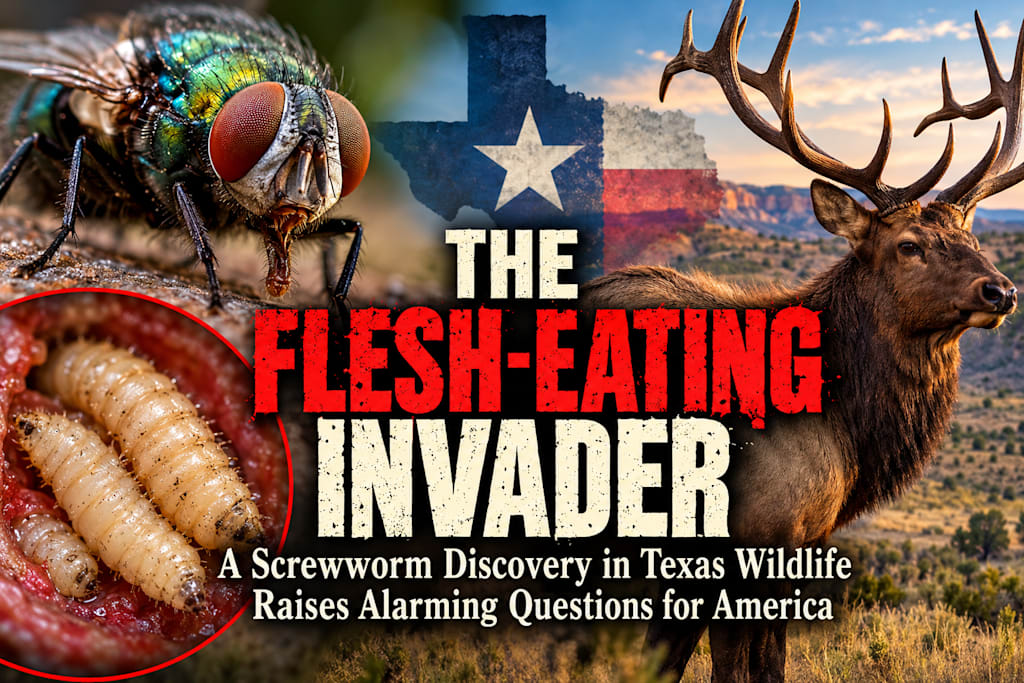
THE FLESH-EATING INVADER
A Screwworm Discovery in Texas Wildlife Raises Alarming Questions for America

☕ MISS LIL'S TEA TABLE TALK: BLOOD, BUGS & THE TEXAS ELK
The Flesh-Eating Screwworm Has Reached American Wildlife. Should We Be Worried?
Well, sugar, set that coffee cup down for just a moment, because Miss Lil has brought something mighty unsettling to the breakfast table today.
We're talking about a fly whose babies don't simply nibble on leftovers or feast on something Mother Nature has already put out of its misery. No, ma'am. These little creatures can burrow into the living flesh of animals, turning an ordinary wound into a potentially deadly infestation.
And now, the United States Department of Agriculture has confirmed a New World screwworm detection in an elk in Texas.
That's right, y'all. An elk.
Now, before anybody starts wrapping themselves in bubble wrap and declaring war on every fly that dares land on the porch railing, let's pour ourselves another cup of Southern pecan coffee and sort through what's happening, what it means, and whether we ought to be keeping a closer eye on our four-legged neighbors.
Because Miss Lil believes in being informed before being alarmed.
And Lord knows, there's a difference.
🪰 FIRST, WHAT IN THE WORLD IS A SCREWWORM?
The New World screwworm, scientifically known as Cochliomyia hominivorax, is a parasitic fly native to the Americas. Its larvae cause a condition known as myiasis, in which fly larvae infest living tissue.
Now, here's where things get downright unpleasant.
An adult female fly lays her eggs in a wound or, in some cases, certain body openings. Those eggs can hatch within a day, and the resulting larvae begin feeding on living tissue.
As they feed, they can burrow deeper into the wound, causing increasing damage. Left untreated, an infestation can lead to severe tissue destruction, secondary infections, suffering, and death.
And here's the detail that makes this pest particularly troublesome: an animal doesn't necessarily need a large, gaping injury to become vulnerable. Even a small wound can provide an entry point.
Before you start looking at every ordinary housefly as a tiny criminal mastermind, remember that not all fly larvae behave this way. Many feed on decaying material. The New World screwworm is different because its larvae actively feed on living tissue.
That's what makes it a serious concern for livestock, wildlife, and, in certain circumstances, people.
🦌 TEXAS HAS A NEW REASON TO WATCH ITS WILDLIFE
According to the USDA announcement published October 21, 2026, a female elk harvested by a hunter on a game ranch in Pecos County, Texas, tested positive for New World screwworm.
This was confirmed as the first detection in U.S. wildlife during the current outbreak.
Now, let's be clear about what that means.
It does not automatically mean screwworm has spread throughout Texas. It does not prove that an established population is thriving in the surrounding wildlife. And it certainly doesn't mean every deer, elk, cow, or outdoor pet is suddenly in danger.
But it does mean officials have found the parasite in a wild animal, and that changes the picture.
Until now, much of the attention surrounding the outbreak has focused on livestock, animal movement, and preventing the parasite from spreading northward. A wildlife detection adds another layer of complexity because wild animals are much harder to monitor than cattle in a managed herd.
Wildlife travels. Animals cross property lines without asking permission. They move through pastures, wooded areas, and ranchland, often without anybody noticing a problem until an animal is injured or examined.
That means officials need to investigate whether this was an isolated case or a sign of a wider problem.
USDA and Texas Parks and Wildlife officials are conducting additional surveillance in the area, and the Texas Animal Health Commission plans to adjust an existing zone to account for the detection.
In other words, the authorities are looking for answers rather than simply crossing their fingers and hoping the problem disappears.
And that, sugar, is exactly what we want to see.
🩺 CAN THIS PARASITE HURT PEOPLE OR PETS?
Now we're getting to the question that might make some folks reconsider their afternoon walk.
Can screwworm infest humans?
Yes.
Can dogs, cats, livestock, and other warm-blooded animals be affected?
Yes, they can.
But does this detection mean Americans should expect a widespread human health emergency?
No. We need to be careful not to jump from one confirmed wildlife detection to conclusions the evidence does not support.
The CDC's October 7, 2026, situation summary described the risk to the U.S. public and animals as very low at that time. However, that assessment came before the October 21 wildlife announcement, so it should not be treated as a new risk assessment following the elk discovery.
The sensible approach is awareness, not panic.
If you're spending time outdoors, keep cuts clean and covered. Check pets and livestock for unusual or worsening wounds. If you discover larvae in a wound, or notice a wound that is deteriorating rapidly, seek appropriate medical or veterinary care.
And please, don't attempt to dig larvae out of a wound yourself or handle an affected wild animal.
Contact a veterinarian or the appropriate wildlife authority and follow their instructions.
Miss Lil is all for a good adventure, but nobody needs to turn a morning walk into an amateur surgical expedition.
🌿 WHAT COULD THIS MEAN FOR THE ENVIRONMENT?
Here's where the conversation becomes bigger than one elk in Texas.
Wildlife populations already face pressures from habitat destruction, drought, disease, vehicle collisions, and other hazards. A parasite capable of causing serious wounds and death could add another burden if it becomes widespread.
But let's separate the known dangers from the possibilities.
Wildlife populations
If screwworm becomes established in local wildlife, affected animals could suffer severe injuries and die from untreated infestations. How significant that impact might become depends on the parasite's distribution, the number of animals affected, and how quickly authorities respond.
Livestock and ranching
Cattle and other livestock are particularly important because screwworm infestations can cause animal suffering, production losses, and expensive veterinary treatment. A wider outbreak could create significant challenges for ranchers and the agricultural economy.
Predators and scavengers
If more animals become sick or die, local food availability could change. However, we should not claim that this has already happened because of the Texas detection. It remains a possible consequence that wildlife researchers would need to investigate.
The broader environment
This isn't an industrial chemical spill or a toxin contaminating waterways. The principal environmental concern is biological: the parasite's ability to injure animals, potentially spread through wildlife, and become established in areas where it was previously eliminated.
One detection is a warning worth taking seriously, but it is not enough to predict widespread ecological damage.
The real question is whether officials can identify and contain the problem before it grows.
🪰 HOW DO YOU FIGHT A FLY THAT EATS LIVING FLESH?
Well, here's a bit of good news to go with that unsettling cup of coffee.
Scientists already have a powerful tool for controlling New World screwworm: the sterile insect technique.
The process involves raising large numbers of flies, sterilizing males with radiation, and releasing them into targeted areas.
When sterile males mate with wild females, the resulting eggs do not produce offspring. Repeated releases can reduce the number of fertile eggs being produced and help suppress the wild population.
This isn't some untested idea dreamed up in a government laboratory last Tuesday. The technique played a major role in eliminating New World screwworm from the continental United States in 1966.
Of course, it requires substantial preparation, enough sterile flies, careful monitoring, and coordination across large areas.
Other important measures include:
Monitoring livestock and wildlife for suspicious wounds.
Testing suspected cases quickly.
Inspecting animals and managing movement when necessary.
Coordinating efforts between federal agencies, state authorities, veterinarians, ranchers, and neighboring countries.
Maintaining the resources needed to respond quickly when new detections occur.
Because screwworm has been spreading north through parts of Central America and Mexico, keeping it out of the United States requires more than a single inspection station or a handful of field officers.
It requires sustained cooperation and prevention.
And prevention, as any homeowner who's ever ignored a little leak can tell you, is usually cheaper than cleaning up a full-blown disaster.
🛑 WHAT CAN ORDINARY PEOPLE DO?
You don't need a laboratory coat, a microscope, or a government-issued fly swatter to help.
If you're a hunter, rancher, farmer, pet owner, or simply someone who spends time outdoors, pay attention to unusual wounds on animals.
Watch for wounds that worsen unexpectedly, visible larvae, foul odors, or animals showing signs of pain and distress.
Don't assume every wound is screwworm, because many other conditions can look concerning. Instead, report suspicious cases and let trained professionals investigate.
Follow official guidance on animal transportation, inspections, and reporting. Avoid moving potentially affected animals without professional advice.
And if you live nowhere near Texas, don't assume that makes the story irrelevant. Animal diseases and parasites can affect food production, trade, veterinary resources, and wildlife management far beyond the location of the original detection.
That doesn't mean an outbreak is inevitable everywhere. It means early detection matters.
💰 WHO PAYS THE PRICE IF THIS GETS OUT OF HAND?
Let's talk dollars and cents for a moment, because somebody eventually has to pay the bill.
A widespread screwworm outbreak could mean higher veterinary expenses, lost livestock, reduced productivity, additional inspections, movement restrictions, and expensive eradication efforts.
Ranchers could face devastating losses if animals become infected in significant numbers. Wildlife agencies could need additional resources for surveillance and treatment. Governments could face mounting costs as they attempt to prevent further spread.
The actual economic impact would depend on how far the parasite spreads and how effective the response proves to be.
That is why funding prevention, maintaining sterile fly production capacity, and acting quickly on new detections matter so much.
Waiting until a parasite has spread across a much larger area could turn a manageable problem into a far more expensive one.
🔎 WHAT SHOULD WE WATCH FOR NEXT?
The Texas detection leaves several important questions unanswered.
Will additional wildlife cases be found in Pecos County or nearby areas?
Will surveillance uncover evidence that the parasite is established in local wildlife, or will this remain an isolated detection?
How quickly can officials determine the extent of the problem?
And will the existing control measures be enough to prevent further spread?
Those are the questions that matter now. The answers will help determine whether this detection represents a contained incident or a more serious development in the current outbreak.
For reliable updates, keep an eye on these official sources:
USDA New World Screwworm Information:
https://www.screwworm.gov/
CDC information about myiasis:
https://www.cdc.gov/myiasis/
Texas Parks and Wildlife:
https://tpwd.texas.gov/
☕ MISS LIL'S FINAL SIP
Well, sugar, I reckon we've had enough unpleasant talk about flies for one morning. I'm ready to get back to discussing something considerably less horrifying, like why grocery prices keep climbing or why the neighbor's rooster believes sunrise is a personal invitation to scream.
But before we close the lid on this particular jar of creepy crawlies, here's the important takeaway.
The confirmed screwworm detection in a Texas elk is a meaningful development because it demonstrates that wildlife has been affected during the current U.S. outbreak. It makes surveillance and containment more complicated, and it deserves a prompt, coordinated response.
It does not, however, prove that the parasite has spread throughout American wildlife or that a widespread human health emergency is approaching.
We need facts, not panic. We need early detection, not finger-pointing. And we need prevention efforts that continue long after the frightening headline disappears from our newsfeeds.
The United States has successfully eliminated this parasite before. That history gives us reason to believe control is possible, although today's outbreak presents its own challenges.
So, my friends, keep your eyes open, report suspicious animal wounds, listen to qualified experts, and don't let fear outrun the evidence.
Now, here's what I want to know while we finish our coffee.
Do you believe we're investing enough in protecting America's livestock and wildlife from emerging animal diseases and parasites, or do we tend to wait until a problem reaches our own backyard before taking it seriously?
Pour yourself another cup, sugar. Miss Lil wants to hear what you think.
And remember, the best defense against a frightening headline is a healthy appetite for facts. ☕🌿
Miss Lil's Tea Table Talk is an educational discussion. For current outbreak status, animal-health guidance, and reporting instructions, consult the relevant federal and state authorities.
About the Creator
Lilithea Adasia
I dig where others look away. 🖤 True crime, paranormal mysteries, uncomfortable truths, and the beautifully broken human experience. I chase the stories others bury and ask the questions others avoid. Come curious. Leave questioning.
Enjoyed the story? Support the Creator.
Subscribe for free to receive all their stories in your feed.
Comments