politics
Political figures, histories, and current events in the whole scope of modern and past politics. Work place politics.
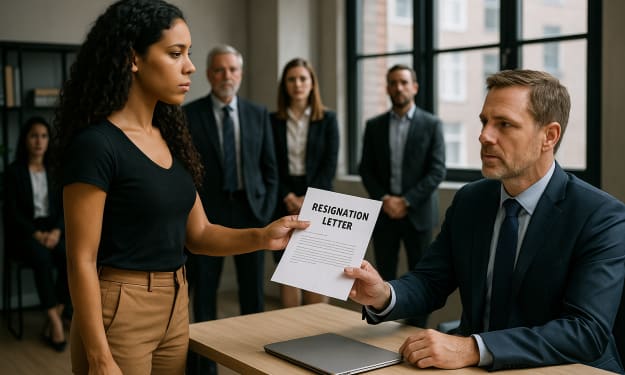
To Whom This May Concern. Honorable Mention in I Resign From… Challenge.
To whom this may concern: Please consider this my formal tender of resignation. For as of this moment, I resign from being resigned to anything we might expect of me. I’m done. Finished. Kaput. Outta here.
By Randy Wayne Jellison-Knockabout a year ago in Journal
The USA Visa Warning Bell Rings Loud On India
Amid Donld Trump's crackdown on illegal immigrants, the US Embassy in India has released a strong advisory warning Indian citizens that they could face a permanent ban on travelling to the US in future. "If you remain in the United States beyond your authorized period of stay, you could be deported and could face a permanent ban on traveling to the United States in the future," the post read.
By Omasanjuwa Ogharandukunabout a year ago in Journal
A Humane Path Forward: Bangladesh’s Quiet Move to Address Illegal Immigration. AI-Generated.
In a global climate increasingly defined by hostility toward undocumented migrants, Bangladesh is charting a markedly different course—one that is grounded not in political posturing, but in quiet diplomacy, legal clarity, and above all, a commitment to human dignity. The Bangladesh-India border spans more than 4,000 kilometers, weaving through rivers, forests, and remote villages. It is one of the most porous and complex borders in the world. Despite numerous bilateral agreements and security arrangements, unauthorized crossings remain common. Over the decades, thousands of individuals—primarily Indian nationals—have entered Bangladesh seeking employment, escaping poverty, or simply trying to build better lives. Many integrated into local communities, some started families, others blended into the informal economy. However, their legal status has remained uncertain, leaving them vulnerable to exploitation, marginalization, and deportation. Unlike the often-violent crackdowns seen elsewhere in the world, Bangladesh has taken a measured and humane approach. Officials estimate that several thousand undocumented Indian nationals currently reside within the country, particularly in border districts such as Dinajpur, Jessore, and Rajshahi. Rather than launching mass raids or stirring public sentiment, the government has initiated a multi-phase verification and repatriation initiative, emphasizing precision, bilateral coordination, and the protection of basic rights. Verification: The First and Most Delicate Step Most undocumented migrants lack formal identification documents. Some never had them. Others lost theirs while crossing, or carry forged papers from third parties. To prevent wrongful deportations, Bangladesh is working closely with Indian counterparts to develop shared biometric and demographic verification protocols. This is painstaking, but essential. For example, in 2024, a pilot identification drive in Chapai Nawabganj helped correctly identify 186 individuals over three months—with 28 cases initially misclassified, later corrected through community testimonies and cross-checking with Indian databases. A Quiet but Coordinated Diplomatic Push Rather than making repatriation a public spectacle, Bangladesh and India are engaged in quiet, ongoing negotiations. These discussions aim to reduce red tape and create standardized procedures for safe return. A proposed model includes the establishment of transit shelters near the border, where migrants awaiting repatriation can access legal counsel, medical care, and consular services. This mirrors a successful model used in Southeast Asia: when Thailand repatriated undocumented Laotian workers in 2022, it did so by establishing joint transit centers with Lao authorities. Bangladesh hopes to replicate such a framework, adapted to regional dynamics and humanitarian standards. Humanity at the Center From the outset, Bangladesh has stressed that deportation must not mean dehumanization. The government has mandated that all returnees—regardless of documentation status—be treated with respect and dignity. Vulnerable groups such as women, unaccompanied minors, and the elderly will receive special protections, including psychosocial support and transitional housing. Civil society organizations and NGOs like BRAC and Ain o Salish Kendra are being mobilized to assist with reintegration and advocacy. Barriers: Fear, Misinformation, and Political Risk Despite the thoughtful framework, implementation faces serious challenges. Many undocumented migrants fear returning to India due to potential social stigma, economic hardship, or even legal consequences. There is also the risk that nationalist rhetoric on either side of the border could politicize the effort. In 2023, a social media rumor falsely claiming mass deportations from Rajshahi caused widespread panic among undocumented workers. It took coordinated messaging from both governments to dispel the misinformation. A Model for the Region? If sustained, Bangladesh’s approach could serve as a blueprint for other nations grappling with undocumented migration. Rather than framing it as a law-and-order crisis, Bangladesh has recast it as a shared human challenge requiring collaboration, compassion, and clarity. As climate change, conflict, and economic inequality continue to displace millions globally, the world needs more examples of immigration policies that are not just firm, but fair. Bangladesh is showing that sovereignty and humanity are not mutually exclusive. This is not about being soft on immigration. It’s about being smart, humane, and future-focused.
By Ahsan' Wayabout a year ago in Journal
Why Lord of the Flies Still Haunts Us in 2025: A Story of Innocence Lost
Imagine a group of boys, barely teens, stranded on a tropical island with no adults, no rules, just freedom. Sounds like paradise, right? In William Golding’s Lord of the Flies, it’s a descent into chaos. Published in 1954, this brutal tale of survival and savagery still grips readers in 2025, forcing us to face the darkness within. I read it last month, and it left me shaken. Here’s why this story of innocence lost remains a gut-punch—and what it reveals about us today.
By Doctor Strangeabout a year ago in Journal
Trump's Advice to Apple: The Reasons Behind the Difficulties at a US iPhone Factory
When U.S. President Donald Trump urged Apple CEO Tim Cook to stop the company's manufacturing expansion in India and concentrate on producing iPhones in the United States in May 2025, it made headlines. Trump's larger America First trade policies, which include enacting high tariffs 145% on Chinese imports and 26% on Indian goods to promote domestic manufacturing are consistent with this directive, which was given during a state visit to Qatar. A key component of Trump's promise to restore American jobs is his idea of a Made in the USA iPhone. Experts and industry analysts counter that this objective is unlikely to be achieved anytime soon due to a number of practical, financial, and logistical difficulties.
By PUSPAYAN SARKARabout a year ago in Journal
Mastering Your Self Assessment Tax Return: A Step-by-Step Breakdown
Completing your taxes can seem like navigating a labyrinth, but with a bit of planning, your Self Assessment Tax Return doesn’t have to be intimidating. Whether you're newly self-employed or managing multiple streams of income, staying compliant with HMRC is both a legal duty and a financial safeguard.
By Self Assessment Tax Returnabout a year ago in Journal
The End of Rule of Law in America?
The state “rule of law” has long been a foundation of the American vote based system, reflecting the rule that all people and education — counting the government itself — are subject to the law. But after a long time, this foundational perfect has come under expanding strain. From particular authorization of laws to politicized legal choices and official exceed, there's developing concern that America is floating absent from its lawful moorings. Whereas “the end” of running the show of law may be as well emotional a conclusion for a few, it's troublesome to deny that its disintegration is genuine — and unsafe.
By Shibli Sadikabout a year ago in Journal