politics
Political figures, histories, and current events in the whole scope of modern and past politics. Work place politics.
Why I Love America: My Story of Belonging, Freedom, and Dreams
From a Small Town to a Great Nation I was born in a quiet village where dreams were often whispered, not spoken aloud. The idea of coming to America was a distant, glittering hope—like stars in the night sky: beautiful, unreachable. But life has its way of surprising you. At 17, I packed everything I had into a single suitcase and stepped onto a plane that would change my life forever. I didn’t know much about America, except what I saw in movies. Skyscrapers, fast food, freedom. But what I discovered was something far deeper: a nation that embraces the broken, the bold, the dreamers, and the determined. Freedom in Every Breath I will never forget the first time I voted. It was just a small local election, but when I held that ballot in my hand, I felt something shift inside me. I was seen. I was heard. I had a voice. In America, I learned what true freedom feels like. The freedom to speak your truth. To live your faith. To love who you love. To rise after you fall. Freedom here is not perfect, but it is powerful. And it is sacred. The Beauty of Many Stories I found myself surrounded by people from everywhere—India, Ghana, Brazil, Poland, Iran, Korea. And yet, somehow, we all found common ground here. We laughed in different accents. We ate different food. We celebrated different holidays. And still, we belonged to something bigger together. America didn’t ask me to forget where I came from. It invited me to bring it with me. That is what makes this country extraordinary. Dreams Don’t Need Permission Here I came with nothing but hope. My first job was washing dishes. I worked night shifts, learned English on my breaks, and studied by flashlight in a tiny room I rented above a deli. It was hard—harder than I ever imagined. But here’s the thing: in America, effort counts. Years later, I own a small business. I hire people who remind me of myself: hungry, hopeful, and willing to try. America didn’t give me a handout—it gave me a chance. And that made all the difference. Loving a Country Means Holding It Accountable I’ve seen America in her moments of glory—and in her moments of pain. I’ve marched in protests and cried over news stories. I’ve seen injustice. But I’ve also seen courage. I’ve seen people stand up, speak out, and refuse to give up. Loving America isn’t about pretending everything is perfect. It’s about believing it can be better—and doing something about it. And that’s what I choose to do, every single day. The Land That Gave Me a New Life America didn’t just change my address—it changed my heart. It taught me resilience, responsibility, and hope. It gave me a family, a purpose, and a home.
By Dr Gabriel about a year ago in Journal
Afghan Refugees in the United States: Challenges, Integration, and the Road Ahead
When the Taliban rapidly seized control of Afghanistan in August 2021, thousands of Afghans who had worked with the U.S. military, NGOs, and foreign agencies found themselves in immediate danger. In response, the United States launched Operation Allies Welcome, a historic effort to evacuate and resettle more than 80,000 Afghan refugees across the country. Now, years later, Afghan evacuees—many of whom came under humanitarian parole or Special Immigrant Visas (SIVs)—are learning to navigate a new life in America. Their journey is one marked by hope, uncertainty, and resilience. A New Beginning, But Not Without Struggles Afghan refugees arrived in the U.S. with very little—most with just the clothes they wore. While many Americans welcomed them warmly, the process of resettlement has not been without challenges. Housing, in particular, has been a significant issue. Cities like Washington D.C., Sacramento, Houston, and Dallas saw a surge in Afghan arrivals, leading to a strain on affordable housing options. Many families found themselves in temporary hotel accommodations for weeks or even months. Language barriers also remain a major hurdle. While some refugees speak English, many do not, which makes finding employment, navigating public services, or simply visiting a doctor a daunting task. Resettlement agencies and volunteer groups have stepped in to offer translation, job training, and community support. Legal Limbo: The Uncertain Status of Humanitarian Parolees A large number of Afghan evacuees were admitted into the U.S. under "humanitarian parole", a temporary status that typically lasts two years. As that time expires, tens of thousands of Afghans now face legal uncertainty. Without a clear pathway to permanent residency, many are living in fear of future deportation. Advocacy groups and lawmakers have been pushing for the Afghan Adjustment Act, a bill that would grant Afghan parolees a chance to apply for permanent legal status. However, as of mid-2025, the bill has faced political delays in Congress. Cultural Adjustment and Identity Adjusting to American culture while holding on to their Afghan identity has been both enriching and complicated for many refugees. Afghan culture values family, community, and tradition, and many newcomers have found solace in tight-knit Afghan-American communities. Mosques, cultural centers, and WhatsApp groups have become lifelines of support and communication. Still, younger Afghan refugees—especially teenagers and children—often find themselves caught between two worlds. In schools, they’re adapting quickly, picking up English and making new friends. At home, they may still speak Dari or Pashto, and help their parents navigate everything from paperwork to bus routes. Contributions to American Society Despite the difficulties, many Afghan refugees have already begun contributing meaningfully to American society. Former interpreters are helping train U.S. troops in language and cultural awareness, while others have opened small businesses or found jobs in manufacturing, logistics, and food services. Doctors, engineers, and teachers—once professionals in Afghanistan—are working to re-license their credentials in the U.S., though the process is often long and expensive. Veterans and former military families have played a unique role, helping their former Afghan colleagues resettle through sponsor circles, donations, and mentorship. The Road Ahead As Afghan refugees continue to rebuild their lives, their long-term success will depend on sustained policy support, legal protections, and community inclusion. With ongoing global crises and a polarized political climate, the U.S. response to Afghan refugees serves as a test of its values and commitments. One thing remains clear: the Afghan people have shown incredible resilience and dignity in the face of displacement. By offering them a chance not just to survive, but to thrive, America can turn this humanitarian mission into a story of shared hope and renewal.
By Dr Gabriel about a year ago in Journal
What Do You Do When You Know Deep Down That You Have No Security?
And deep down… you feel it. The safety net you thought you had? It's gone. The job market is volatile. Governments are shaky. Technology is replacing humans faster than policy can keep up. The middle class is evaporating. And the systems we were told to rely on - education, employment, retirement - are no longer built to protect us.
By Randolphe Tanoguemabout a year ago in Journal
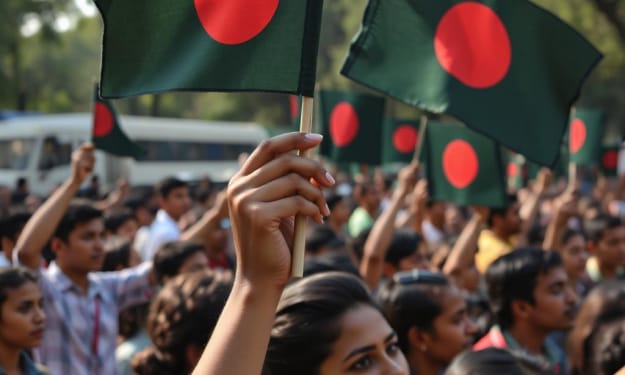
Bangladesh in 2025
Bangladesh’s political landscape in 2025 is undergoing a dramatic and historic transformation. For decades, the country has been dominated by two powerful forces—the secular-nationalist Awami League (AL) and the centre-right Bangladesh Nationalist Party (BNP). These two parties have alternated in power since the fall of military rule in the 1990s, often with fierce rivalry and mutual accusations of corruption and vote rigging. However, a massive student-led uprising in 2024 has disrupted this duopoly, ushering in an interim administration led by Nobel Peace Prize laureate Dr. Muhammad Yunus. This article explores the political history leading up to 2025, the collapse of the Awami League government, the emergence of a new caretaker regime, and the ongoing debates shaping the future of democracy in Bangladesh.
By Foysal Ahmed Meherosabout a year ago in Journal
How South Asia is blowing against the wind of regional cooperation Panorama
As US-inflicted tariff wars mount, the region remains disintegrated with barely 5% of its global trade among members No other region has been hit as hard as Asia by American President Donald Trump's tariff policies targeting countries having a trade surplus with the US. The overall outlook of Asia does not seem bright after the trade war triggered by what Trump termed "reciprocal tariffs". Though paused for 90 days, a baseline 10% remains in force while China faces up to 145% duties prompting it to impose retaliatory steps. The Asian Development Bank (ADB) has lowered its growth forecast for Asia further. The multilateral institution said the tariff issues will shave growth in the region by a third of a percentage point in 2025 and a full percentage point in 2026. What are the immediate steps needed to weather the storm? All multilateral institutions such as the World Bank, IMF and ADB have been calling Asian leaders to prioritise regional cooperation and intra-region trades to navigate economic turbulence and achieve sustainable growth. The Business Standard Google News Keep updated, follow The Business Standard's Google news channel The call fell flat for South Asia, but not for the rest of Asia. Leaders of ASEAN (Association of Southeast Asian Nations), a block of 10 countries of Southeast Asia, are already in action. In the first week of April, the ministers of the bloc at a meeting in Malaysia agreed to establish an ASEAN Geo-economics Task Force to discuss and formulate "a coherent forward-looking regional policy response to emerging economic and geopolitical challenges". The 46th ASEAN Summit, scheduled for May 26, will convene leaders from all ASEAN member states — Indonesia, Malaysia, Philippines, Singapore, Thailand, Brunei Darussalam, Vietnam, Lao PDR, Myanmar, and Cambodia. The next day, they will hold talks with their counterparts from the Gulf Cooperation Council (GCC) to boost regional cooperation. The summit would bring ASEAN closer to six Gulf nations — Bahrain, Oman, Kuwait, Qatar, the United Arab Emirates, and Saudi Arabia. China has also been invited to attend, with Chinese Premier Li Qiang expected to visit Malaysia in conjunction with the summit. "God willing, by the end of next month, Malaysia will mark another historic milestone by hosting the Asean-GCC summit," said Malaysian Prime Minister Datuk Seri Anwar Ibrahim on 12 April. Malaysian Foreign Minister Mohammad Hasan, in mid-March, also announced that in October, ASEAN nations will engage with their 10 dialogue partners, including China, South Korea, Japan, Australia, and the US. Emerging economies in Asia are moving in the direction of enhanced cooperation. But South Asia is blowing against the wind at the time of crisis. The World Bank in its latest update on South Asian economies said while the sub-continent continues to grow faster than any other region, its growth prospects are dimming. Growth outcomes in 2024 were disappointing and the outlook for 2025 has been downgraded for most countries in the region. "After an unexpectedly weak outturn of 6% in 2024, growth in South Asia is expected to soften further to 5.8% in 2025 — 0.4 percentage points below October forecasts — before ticking up to 6.1% in 2026," it said. This outlook, the World Bank said, is subject to heightened risks, including from a highly uncertain global landscape, combined with domestic vulnerabilities including constrained fiscal space. After a decade of shocks, South Asian economies' ability to cushion new shocks is limited, it warns. "Tackling some of its greatest inefficiencies and vulnerabilities could help South Asia navigate this unusually uncertain outlook. These include poor tax collection, unproductive agricultural sectors, households and firms that lack mobility and access to finance to mitigate climate shocks, and a growing labour force with insufficient jobs," said the World Bank. The global lender has been urging South Asia to prioritise regional cooperation to navigate economic turbulence. But South Asian leaders seem to be ignoring the writing on the wall. The region is now under the shadow of an escalation of India and Pakistan tensions after a deadly Kashmir attack which claimed 26 lives. Escalation of the armed conflict will jeopardise intra-regional trade again in times of global economic turbulence. The World Bank has earlier recognised the potential and progress of SAARC (South Asian Association for Regional Cooperation) in areas like regional integration, trade and climate resilience. The reality portrays nothing but a gloomy picture. The last time South Asian leaders joined together in a video conference was more than five years ago after the Covid-19 pandemic broke out worldwide. In response to an offer by India's Prime Minister Narendra Modi, SAARC leaders joined the video conference on 15 March 2020 and pledged to unite and fight together against the deadly virus to keep the people in the region safe. The last SAARC summit was held in Kathmandu, Nepal, in 2014, more than 10 years ago. The 19th summit was scheduled to be held in Pakistan in November 2016, but got cancelled after an attack on an Indian army camp in Kashmir, killing 18 soldiers. According to the charter, SAARC is supposed to hold its summit annually bringing together heads of state to discuss in person how to cooperate more in trade and development. The 39-year old bloc, in fact, has remained as a dysfunctional body for long due to mainly growing enmity between India and Pakistan. The bilateral relation among SAARC countries is also not healthy enough to revive the bloc any time soon, though Bangladesh interim government head Muhammad Yunus has moved for its revival as he believes resuscitating the SAARC spirit can solve many regional problems. After the Kashmir attack, India and Pakistan retaliated by downgrading their relations, suspending bilateral trade and landmark treaties such as Indus Waters and Simla agreements. The relation between Bangladesh and India has reached its lowest ebb after the fall of the India-backed Sheikh Hasina regime. After the political changeover in Bangladesh, Dhaka and Islamabad moved to mend their ties. But the Kashmir attack put a break on the move. Bangladesh's move, however, angered India that scrapped the transshipment facility for Bangladeshi exporters. Even a ruling BJP MP recently demanded that India should stop water flow to Bangladesh by not renewing the Ganges water sharing treaty signed in 1996 for 25 years. India, the major player in the region, does not have good ties with other South Asian countries such as Sri Lanka, Nepal and Maldives either due to what experts allege is its interference in the internal affairs of neighbours. The other regional bloc BIMSTEC was intended to integrate seven South Asian and Southeast Asian nations — Bangladesh, Bhutan, India, Myanmar, Nepal, Sri Lanka, and Thailand. It was established in 1997 following Indian efforts to shift focus away from SAARC to sideline Pakistan. But it could not make much of a splash. The only positive thing is it held its latest summit in early April where top leaders pledged economic integration amid global economic turbulence. Intraregional trade accounts for barely 5% of South Asia's total trade, compared to the ASEAN region where intra-regional trade makes up 25%, according to the World Bank. South Asia is home to a quarter of the world's population. Despite a significant poverty decline in recent years, the region still has 7.6% of its population living in extreme poverty. When the rest of Asia is making moves for regional cooperation to weather the US tariff war, the South Asian region not only remains the world's most disintegrated area, but also faces a dangerous moment after a deadly militant attack in Kashmir ramped up tensions between two nuclear armed neighbours — India and Pakistan — having a bitter history of conflicts.
By Riham Rahman about a year ago in Journal
When a Woman Shook the Roman Empire: The Incredible Rebellion of Boudica
Start writing...پلانٹین (Plantago major) — قدرتی شفا بخش جڑی بوٹی Plantain Plantago major A Natural Healing Herb Plantain, scientifically known as Plantago major, is a natural herb that has been used for centuries in traditional medicine, herbal remedies, and home treatments. This plant commonly grows in gardens, fields, roadsides, and abandoned areas without any special care. Unfortunately, many people consider it just a useless “weed” and remove it from their gardens, unaware of its powerful medicinal properties. The leaves of the plantain are broad, oval-shaped, and have prominent veins. They are deep green in color and grow close to the ground. The plant also produces small brown seeds, which are used in herbal medicine and supplements. When it comes to benefits, plantain offers a long list. It is especially famous for healing wounds. In ancient times, when someone had a cut, insect bite, or skin irritation, fresh plantain leaves were chewed or crushed and then applied directly to the affected area. This not only reduced pain but also helped prevent infection and speed up healing. Even today, natural health practitioners recommend plantain as a natural antiseptic and anti-inflammatory remedy. Plantain leaves can also be boiled to make a tea, which is beneficial for digestion. It helps with stomach acidity, ulcers, and indigestion. The tea is also soothing for respiratory issues such as coughs, colds, and sore throats. Its seeds, also known as psyllium husk, are widely used to relieve constipation and cleanse the digestive tract. For skin problems, plantain is equally effective. If someone suffers from acne, eczema, or allergic skin reactions, applying a poultice or paste of plantain leaves can provide relief. Plantain oil, available in herbal stores, can also be applied directly to the skin to reduce inflammation and irritation. Plantain is rich in vitamins A and C, calcium, and other essential minerals, which help strengthen the body and boost immunity. The fresh leaves can even be added to salads or cooked in soups and vegetable dishes. In some countries, plantain is eaten as a leafy green vegetable. Although it may appear as a common plant, plantain holds the value of a natural treasure. In today’s world, where people often rely on synthetic medicines, herbs like plantain are regaining popularity for being affordable, natural, and safe when used properly. To collect plantain, it is best to harvest from clean areas free of pollution and chemicals. The fresh leaves can be washed and stored, or dried in the sun for later use in teas or powders. The seeds can also be dried and saved for medicinal purposes. Globally, there is a growing demand for plantain oil, tea, supplements, and powders. Natural food stores, herbal shops, and online markets offer various plantain-based products. In Pakistan too, if people learn about its benefits, they can use it for their health and even sell extra harvest for a good income. It is important to consult a qualified healthcare provider or herbalist before using any medicinal herb, especially for pregnant women, individuals with medical conditions, or those taking regular medication. In the end, plantain is a free gift from nature. We just need to recognize its value. If we stop ignoring the plants around us and instead learn about them, we’ll discover that nature has placed many health treasures right at our feet. ---
By GillanI Media about a year ago in Journal
Is the political duopoly in the UK coming to an end?
The leader of Reform UK, a populist right-wing party that opposes immigration and has seen a sharp increase in support in recent months, was rejoicing over his candidate's close win in a by-election in the northwest English constituency of Runcorn and Helsby.
By Francis Damiabout a year ago in Journal
Donald Trump Defends Prospect of Air Force One Replacement Gift from Qatar as a 'Very Transparent Deal'. AI-Generated.
Former President addresses criticism, insists no conflict of interest in foreign involvement In a move drawing both political attention and media scrutiny, former President Donald Trump has defended what he described as a “very transparent deal” involving Qatar’s potential role in gifting or funding a replacement aircraft for Air Force One. Amid rising questions about foreign influence and ethical considerations, Trump dismissed concerns, stating that the proposal was entirely above board and mischaracterized by critics.
By Pritom dev nathabout a year ago in Journal
Navigating Power: The Debate Over U.S. Access to Global Trade Routes
In a move stirring intense debate in international policy circles, the United States has renewed calls for guaranteed military and commercial access through two of the world’s most vital maritime arteries: the Panama Canal and the Suez Canal. Citing both historic contributions and its role as a global security guarantor, the U.S. administration has framed this appeal as not only practical but also principled. Yet this stance has reignited global concerns over sovereignty, fairness, and the future of international cooperation.
By Hafed Al Ghwellabout a year ago in Journal