history
Key historic events throughout the ages in relation to business, work, corporate figures and moguls.
Gender Inequality
I wasn't going to write about this. Because honestly? I'm tired. Not tired of the conversation—tired of having to have it. Tired of explaining something that feels as obvious as rain. But tonight, after another story about another woman who got talked over, passed over, or just plain erased, I can't sleep.
By John Smith6 months ago in Journal
My Building Of A Vocal Story
Introduction When I build a Vocal story it is never just writing. I receive a lot of criticism especially for challenge entries because I do things that stamp my identity over any Vocal story that I publish. This may be an issue because the story is very me rather than some Vocal template piece, or nothing but text.
By Mike Singleton 💜 Mikeydred 6 months ago in Journal
Authorship vs Refinement
Much of the confusion surrounding artificial intelligence and writing comes from a failure to distinguish between two fundamentally different acts: originating ideas and refining their expression. These acts are often treated as interchangeable, as though whoever touches the final form must also be the source of the thought itself. That assumption does not reflect how writing has ever worked, nor does it reflect how human thinking actually unfolds.
By Peter Thwing - Host of the FST Podcast6 months ago in Journal
Institutions Fear Inference More Than Lies
Institutions are often willing to tolerate isolated falsehoods, minor inaccuracies, selective framing, and even outright contradictions. A single lie can be corrected, buried, explained away, or isolated from the larger structure. What institutions consistently resist is not merely factual disagreement. They resist inference. They resist the moment when separate observations are connected into a pattern, and the pattern begins to imply responsibility.
By Peter Thwing - Host of the FST Podcast6 months ago in Journal
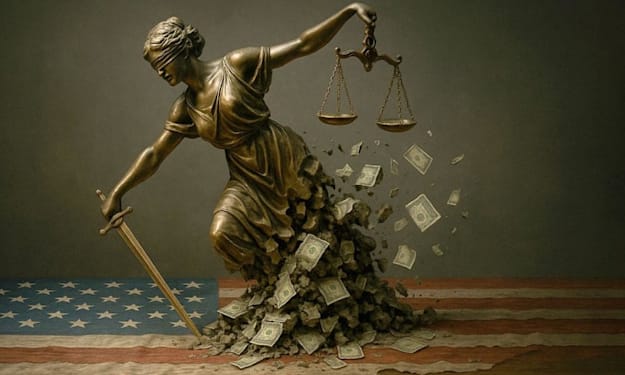
Immunity and Practical Unaccountability
In theory, no one is above the law. This phrase is repeated often enough that it functions as a civic mantra, a reassurance that power is ultimately constrained and that authority remains accountable to the same moral and legal standards imposed on everyone else. On paper, police officers, prosecutors, and government agents are subject to the law just like any citizen. They can be investigated, disciplined, sued, or prosecuted when misconduct occurs.
By Peter Thwing - Host of the FST Podcast6 months ago in Journal
Writing as Journal, Not Just Product
Not everything that matters begins as something meant for an audience. Much of what shapes a person most deeply starts as private wrestling, unfinished realization, unresolved tension, or a question that has not yet settled into a firm position. Treating writing only as a product meant for consumption misunderstands one of its most essential functions. Before writing becomes communication, it is often orientation.
By Peter Thwing - Host of the FST Podcast6 months ago in Journal
Bobby Cox and the Baseball Legacy Built on Loyalty
Some sports figures become famous because of dramatic moments. Others become unforgettable because of the way they quietly shape an entire generation of athletes and fans. Bobby Cox belongs to the second group. His story is not only about baseball victories or championship seasons. It is about trust, patience, emotional discipline, and leadership during pressure-filled moments that millions of fans watched closely. When people search for “bobby cox,” they are often searching for more than statistics. They want to understand how one manager became deeply connected to the identity of a baseball team and its supporters. His calm personality, fierce loyalty to players, and long career created memories that still matter to baseball fans today. Bobby Cox represents a style of leadership that feels increasingly rare in modern sports culture.
By Muqadas khan6 months ago in Journal
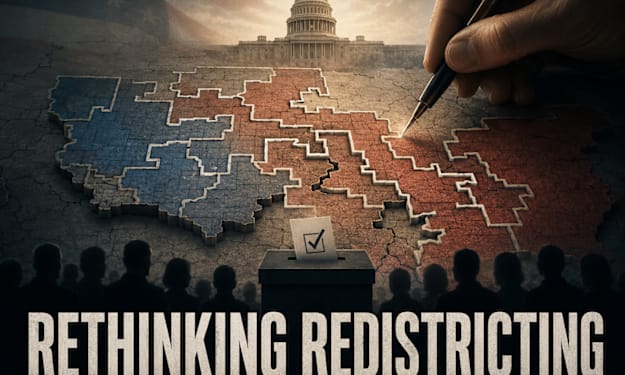
Every Alternative Is an Admission
The Current System Should Not Be Treated as the Neutral Baseline The current redistricting system is often treated as the normal starting point, while every alternative is treated as an experiment that must justify itself. That framing is backwards. The current system is already an experiment in political assignment. It already decides which voters belong together before they vote. It already gives enormous power to whoever controls the boundaries. It already allows voters to be packed, cracked, attached, diluted, concentrated, divided, or rearranged while still maintaining the appearance of legal process. The familiar system should not receive moral credit merely because people are used to it.
By Peter Thwing - Host of the FST Podcast6 months ago in Journal
Why This Conversation Has to Happen Now
This Is Not an Abstract Exercise Brainstorming alternatives to redistricting can sound theoretical until the country enters a moment when the map itself becomes one of the main weapons of national power. At that point, the question stops being academic. It becomes immediate. If congressional control can be altered not mainly by persuading voters, but by changing the containers those voters are placed into, then redistricting is not a procedural side issue. It is one of the most consequential political powers in the country.
By Peter Thwing - Host of the FST Podcast6 months ago in Journal