
It's England's Fault Americans Call It 'Soccer'
Digging into America's Linguistic Red Card

Every time a well-meaning American posts online about “soccer,” middle-aged English men in Yorkshire set upon him like raccoons finding an unlocked dumpster behind a seafood restaurant.“It’s called football because you use your feet!” they scream. “Why do Americans always have to be different?”
There is a widespread belief that the United States invented the word “soccer” out of pure linguistic exceptionalism, and to protect their own sport of American Football.
But history harbors a secret: The word “soccer” is not American at all. It is a thoroughly British invention.
The United States didn’t change the name of the world’s most popular sport. They simply kept using the slang term that the English taught them.
The Wild West of 19th-Century Football
To understand how we got here, we have to travel back to 19th-century England. At the time, “football” wasn’t a single sport. It was a generic term for the chaotic collection of games played on foot by the working class, in contrast to the games played by the aristocracy on horseback.

Every prestigious British boarding school had its own rules. Some schools allowed handling the ball; others banned it. As these students arrived at universities like Oxford and Cambridge, they realized they couldn’t play against each other without a standardized rulebook.
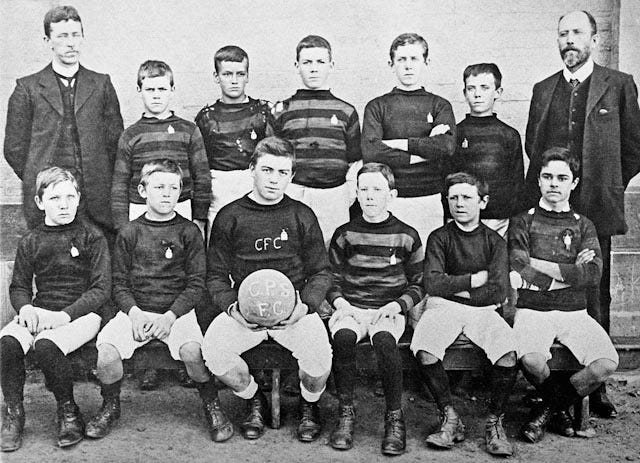
This dilemma gave birth to two distinct sports:
Rugby Football: The version that allowed players to pick up the ball and run with it.
Association Football: The version codified in 1863 by the London-based Football Association, which heavily restricted handling the ball.
Both games were called “football.”
It soon became a communication nightmare.
Enter Oxford Slang
In the 1880s, a peculiar linguistic fad took over the University of Oxford. Elite students began shortening everyday words and slapping the suffix “-er” onto the end.
“Breakfast” became brekker. “Rugby Football” became rugger.
When it came to Association Football, calling it “foot-er” didn’t exactly roll off the tongue. So students grabbed the middle portion of the word Association, shortened it, and added the suffix.
Association, became assocer, which quickly evolved into soccer.
For nearly a century, “soccer” and “football” coexisted peacefully in British discourse. It was an accepted, upper-middle-class nickname for the sport, appearing routinely in newspapers, books, and prime-time television broadcasts.
Headline in a British Newspaper (1940)
Why America Stuck With “Soccer”
As England was busy inventing slang, both versions of British football crossed the Atlantic to the United States.
In the late 1800s, American universities began playing a highly localized, ultra-violent variant of rugby football. This game exploded in popularity, capturing the imagination of the country. Naturally, Americans claimed the generic term “football” for the sport.
When the international version of Association Football arrived on American shores, the country faced a practical dilemma. They couldn’t call it football without causing mass confusion.
So, they borrowed the perfectly legitimate British nickname: soccer.
The sport’s governing body in the U.S. was originally called the United States Soccer Football Association. It wasn’t until 1974 that they dropped the word “Football” entirely to solidify a distinct brand identity separate from the NFL.
As the table shows, the U.S. isn’t an isolated anomaly. Nearly every English-speaking country that developed its own popular domestic “football” code naturally adopted the word “soccer” to keep the sports distinct.
Country: Domestic Sport / Term Used for Association Football
United States: American Football (NFL) / Soccer
Canada: Canadian Football (CFL) / Soccer
Australia: Aussie Rules Football (AFL) / Soccer
Ireland: Gaelic Football (GAA)/ Soccer
The Great British Ghosting
If “soccer” was a standard British word for decades, why does saying it in a London pub today invite immediate scorn?
Because of a mid-century cultural shift. Following World War II, American cultural influence began pouring into Europe through cinema, music, and the military. At the same time, English football fans began pushing back against what they perceived as the “Americanization” of their culture.
By the 1980s, British fans had completely abandoned the word “soccer,” rewriting history to view it as an Americanism.
So the next time anyone criticizes you for using the word “soccer,” you can gently remind them that the United States (and Australia, Ireland, and Canada) didn’t rename the world’s most popular sport. They just preserved a piece of 19th-century Oxford slang that the British used for a hundred years.
About the Creator
Scott Christenson🌴
Born and raised in Milwaukee WI, living in Hong Kong. Hoping to share some of my experiences w short story & non-fiction writing.
Enjoyed the story? Support the Creator.
Subscribe for free to receive all their stories in your feed. You could also become a paid subscriber, letting them know you appreciate their work.
Comments
There are no comments for this story
Be the first to respond and start the conversation.