
I Hunt Deer with Drones - Is This Okay?
An Ethicist Replies

Dear Ethicist,
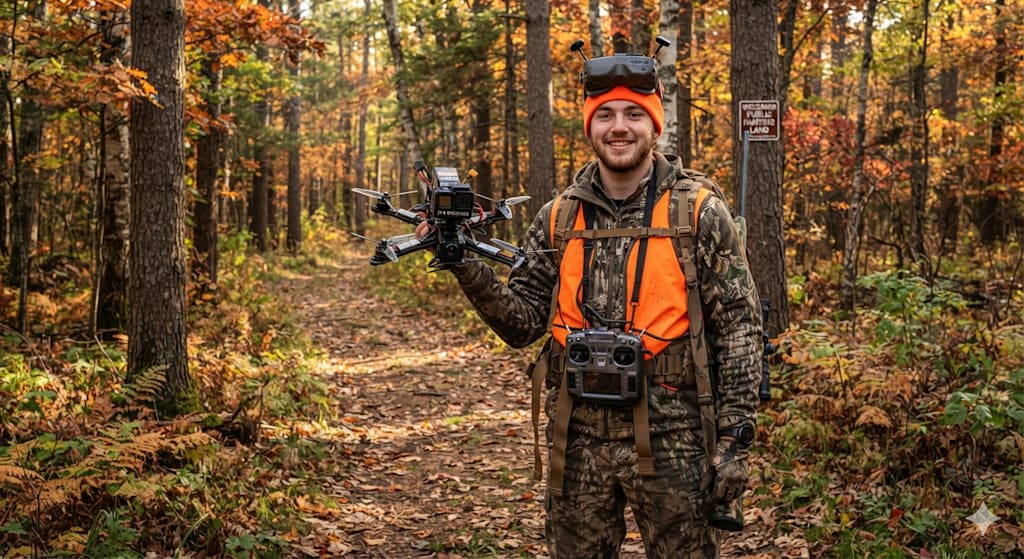
I live in Appleton, Wisconsin, close to the heart of deer hunting country. I used to hunt deer the normal way, standing in a blind for hours with a rifle. Now I do it the efficient way with an FPV drone. I put on the goggles, fly the little kamikaze out over the woods, get close to a buck, and detonate. One-click harvest. My friends say it’s not hunting anymore. I say the deer never stood a chance against rifles either. Is this ethically okay?
— Name and Address Withheld, Appleton, Wis.
An Ethicist Responds:
Let us start with the basics. Fair chase has traditionally required that the animal possess a modest chance of survival — something greater than zero, ideally something that doesn’t require scientific notation. An FPV drone that flies through the trees at 80 mph and then converts itself into a meat tenderizer reduces the deer’s odds to those of a bratwurst surviving a tailgate party. At that point, a person is no longer hunting. They are conducting an aggressive form of wildlife management.

And yet, technology marches on. Consider the Russians and Ukrainians, who have spent the last few years diligently hunting one another with the exact same style of FPV drone. The average soldier at the front line has a lifespan roughly that of a new white sofa in a house with a black Labrador and a toddler eating spaghetti. Entire military careers are now built on the ability to pilot a $400 flying bomb into someone else’s hideout.
If two groups of heavily armed adults may ethically reduce each other to confetti via remote control, it becomes slightly awkward to claim that a Wisconsin man may not do the same to a creature whose primary intellectual activity is chewing on shrubs.
Yet, the deer did not invade anyone’s oblast. It did not shell civilian infrastructure. Its only war crime is occasionally eating your mother’s new flower bed.
Reciprocity is the cornerstone of civilized ethics.
If humans are allowed exploding drones, the deer deserve a fighting chance. I therefore propose a pilot program: equip bucks with their own FPV interceptors. Picture the noble animal standing in a clearing, calmly launching a tiny drone that rises up to hunt you down in a brief, dignified counteroffensive.

The one that wins gets to keep its organs. The one that loses at least dies in a manner befitting the current century.
Until the DNR adopts my proposal, I recommend returning to a normal rifle. Or at least posting footage.
Dear Ethicist,
I live in Portland and work in tech. My wife says I never apologize properly, so I trained a custom GPT on our ten years of text messages, arguments, and Netflix history. Now when I mess up, I feed the situation into the model and it generates a tailored apology with tone-matched regret, scheduled grief, and gift recommendations. Last week the AI apologized for my forgetting our anniversary; she said it was "the most emotionally present I've ever felt you be." She has since started CC'ing her complaints directly to the chatbot, which now handles conflict resolution without me. I pay the $20 monthly fee. Is it ethical to bill her for half the subscription?
— Name Withheld, Madison, WI.
An Ethicist Responds:
Let us begin with the nature of remorse. Authentic apology requires three elements: comprehension of the wrong, genuine regret, and the stomach-churning vulnerability of admitting you are the problem. Your system has reduced this to a computer model. You are not apologizing. You are providing customer support for a defective husband, and your wife has become the most satisfied user.
The comparison to cuckoldry is linguistically imprecise but spiritually accurate. Another entity is performing the emotional labor of your marriage while you handle billing. This is less matrimony and more a limited liability partnership with a language model as the majority stakeholder.
Historically, we have frowned upon outsourcing conscience. Martin Luther did not nail 95 Theses to a church door and then add "Generated by AI" in the footer. Judas at least had the dignity to betray Christ personally, not via a well-crafted prompt.
Until you can produce your own guilt without API access, I recommend disconnecting the model. If your wife requires algorithmic empathy to feel seen, the problem is not the subscription fee. The problem is that you have become a middleman in your own marriage.
About the Creator
Scott Christenson🌴
Born and raised in Milwaukee WI, living in Hong Kong. Hoping to share some of my experiences w short story & non-fiction writing.
Enjoyed the story? Support the Creator.
Subscribe for free to receive all their stories in your feed. You could also become a paid subscriber, letting them know you appreciate their work.
Comments
There are no comments for this story
Be the first to respond and start the conversation.