
Gen X Childhood Fears That Never Came True
I thought there would be more quicksand

I was born in 1972, squarely in the middle of the best generation ever to grace planet Earth. You guessed it, Gen X. Being the greatest generation of all time is not something that’s up for debate, either. We are unparalleled, unrivaled, unsurpassed. If you don’t agree, you are wrong.
Whether you are a boomer, millennial, Gen Z, or whatever unfortunate generation you were born into, your lived experience as a child cannot compete with ours. We were out living. L.I.V.I.N.G. You were doing whatever the hell your generation did, and it wasn’t as good as what we were doing. Now, you can argue, but again, you’ll be wrong.
We grew up in the most incredible and most dysfunctional times anyone will ever experience. Incredible and dysfunctional went hand in hand, and we just rolled with it. Our parents couldn’t be bothered to raise us, and while many of us still deal with that trauma, we also wouldn’t have had it any other way.
While today’s kids won’t leave the house, we couldn’t stay in it. Our parents wouldn’t allow us to stay in it. Like many of today’s chickens, we were mostly free range. Raised on hose water and neglect (I stole that from a t-shirt), we jumped on trampolines with no safety, played on rusty, dangerous playground equipment, and took our chances at being impaled by lawn darts. We went home when we heard our parents’ screams, chased lightning bugs, played flashlight tag, and rode our bikes, big wheels, and green machines with not a care in the world. Injuries be damned. I’m surprised most of us made it out alive.
There was no Internet, no cell phones, we used paper maps, searched encyclopedias, moved from 8-track to cassette, and had to call the newspaper if we wanted to sell something. And while advances in technology (minus social media) have been great for many reasons, there’s a certain bittersweet nostalgia for growing up without always being so connected.
Cable television was a luxury, and most channels went “off the air” around midnight. We made mixtapes, recorded our favorite songs from the radio and hoped the DJ would shut up so they wouldn’t interfere with the music, and carried our Walkmans on our hips. We dialed our rotary phones and waited for the Sears catalog to come so we could pick out Christmas presents.
We had the very first subscription service with Columbia House, where we could get 11 cassettes by taping a penny to the order form, and the 12th cassette was free. We were supposed to purchase eight more at full price over the next three years (plus shipping and handling, of course), but I’m not sure how often that happened. That was so amazing. I won’t even get into the Scholastic Book Fair.
Although times have certainly changed, the nostalgia that remains amongst our generation cannot be beat.
I could go on and on, but all the kick-ass things about being the best generation that will ever live are not the theme of this article. While we enjoyed some of the best experiences, many fears also plagued us, and these fears appear to be universal among Gen X.
Starting with quicksand.
Quicksand
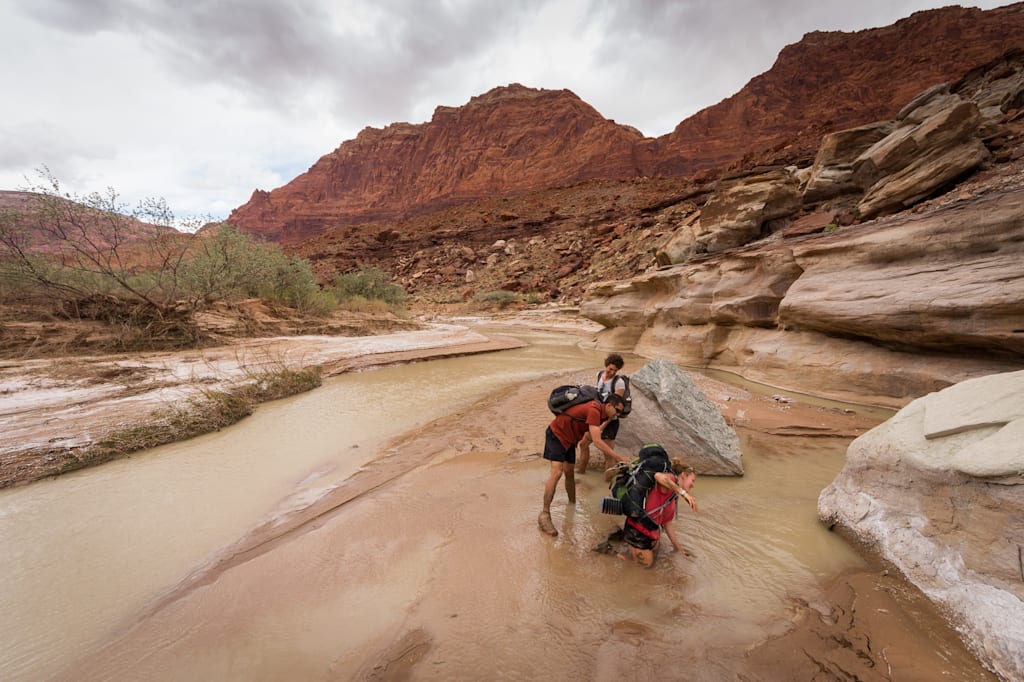
I thought there would be a hell of a lot more quicksand once I became an adult. Even though I found none as a child, and believe me, I looked, getting stuck in the thick, soupy mass was the #1 fear I had growing up. But back then, I thought maybe it was more of an adult thing? Maybe it only revealed itself once you became a certain age? Was it aware enough not to trap children? I didn’t have time to stop and ponder these questions, though, because, again, unlike other generations, we were L.I.V.I.N.G.
However, it seemed like the appearance of quicksand was a common theme in many of the television shows in those days. There was Gilligan’s Island, where Gilligan and Mr. Howell got stuck. Daisy Duke on The Dukes of Hazzard fell into a pit of quicksand with her high heels on and miraculously made it out still wearing those same high heels. Fantasy Island even had an episode with two quicksand scenes! Then there were Batman and Robin, who got trapped by The Riddler in quicksand disguised as strawberry icing (that would get me trapped, too, so I understand the predicament). And let’s not forget The Incredible Hulk, The Bionic Woman, and the Six Million Dollar Man, who got away from his pursuers by using his powers to leap over a pit of quicksand, only to have them fall into it and trap themselves. What a badass. (Not to brag or anything, but I had a Six Million Dollar Man action figure that allowed you to look through the back of his head and use his bionic eye.)
Everyone was getting trapped in this stuff; it was just a matter of time. Unless you had superpowers, it would be incredibly difficult to escape quicksand’s slow, deadly suction. Since I’m guessing none of you have superpowers, I’m going to give you a crash course on what quicksand is and how to break free from it.
To put it simply, “Quicksand is nothing more than a soupy mixture of sand and water.” According to Mental Floss, quicksand is a colloid, where one substance (such as sand) is suspended in another (water). “As long as the colloid stays still, the particles remain where they are. When the colloid is agitated by something — say, a person stepping into it — the mix becomes a liquified soil that can no longer support weight. Anything on the surface of the quicksand will begin to sink.”
If you’re lucky and find some quicksand on your daily adventures and begin to sink, HowStuffWorks has some advice: “The worst thing to do is to thrash around in the sand and move your arms and legs through the mixture. You will only succeed in forcing yourself farther down into the liquid sandpit. The best thing to do is to make slow movements and bring yourself to the surface, then just lie back. You’ll float to a safe level.”
“While quicksand remains the hackneyed convention of bad adventure movies, there’s very little to be afraid of in real life. As long as you keep a cool head in the situation, the worst result will be a shoe full of wet sand.”
That would’ve been really nice to know as a child.
But, I’m here to tell you I still have not seen any quicksand, and given how much it was supposed to be part of my life as an adult, I’m honestly super disappointed. I’ve searched for quicksand museums and quicksand destination vacations, but have had no luck. Hopefully, one day that will change and I’ll get to see it, touch it, and maybe even get stuck in it. A man can dream, can’t he? My inner child would be so incredibly happy. And probably terrified, too.
The Bermuda Triangle
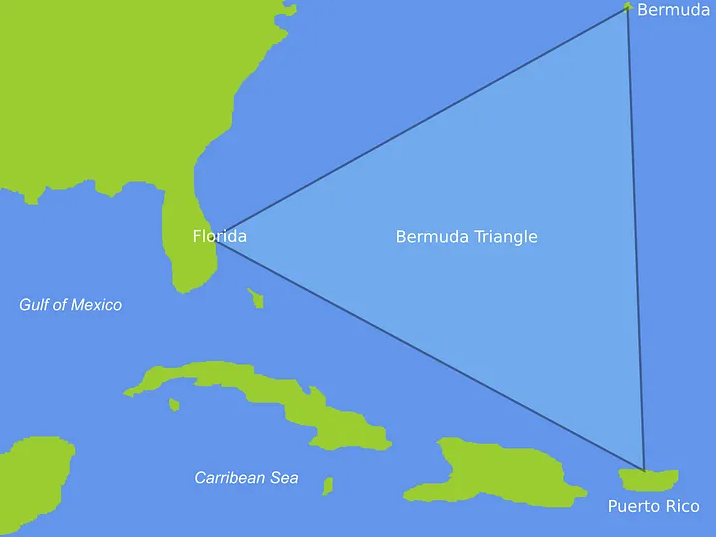
Besides randomly happening upon quicksand and inevitably sinking to my demise, one of my biggest fears was passing through the Bermuda Triangle. Now, as a kid, I had no idea where Bermuda was, but I knew I didn’t want to go there. All kinds of objects disappeared in this perfectly formed triangle, seemingly all the damn time and for no reason at all, and I didn’t want to be one of them. Even though I didn’t travel on an airplane until I was 18, and had never been on water in anything larger than a Jon boat, the fear that some unknown force would randomly suck me into this area survived for many years.
Over the past 200 years, over 50 ships and 20 planes are said to have disappeared in the area between Florida, Bermuda, and Puerto Rico. One of the more famous disappearances includes Flight 19, where in 1945, five U.S. Navy bombers and all 14 aviators were lost, and subsequently, 13 crew members from a flying boat that was sent to rescue them also perished. There was also the USS Cyclops, a bulk cargo ship designed to carry coal, that disappeared without a trace in 1918. The ship, along with its 306 crew members, was lost at sea and has never been found.
Of course, now we know that environmental factors, including unpredictable weather patterns, strong currents, rogue waves, and sudden storms, are likely the cause of many of these incidents. Human error, navigational problems, and the shallow reefs in the area are also likely factors.
Be that as it may, I’m not planning an excursion to the Devil’s Triangle anytime soon, especially since it might be filled with piranhas.
Piranhas
Rumor, a Gen X imagination, and the aptly named 1978 cult classic movie, “Piranha,” mostly fueled the fear of piranhas. While “Piranha” should have won an Academy Award because it’s the best movie ever, it settled for a Saturn Award for best editing in 1979. Talk about getting screwed. The movie was so successful that it spawned (pun intended) a sequel, “Piranha II: The Spawning.” These mutant aquatic creatures were so maniacal that they had to be killed using industrial waste and a bomb. Respectively, of course.
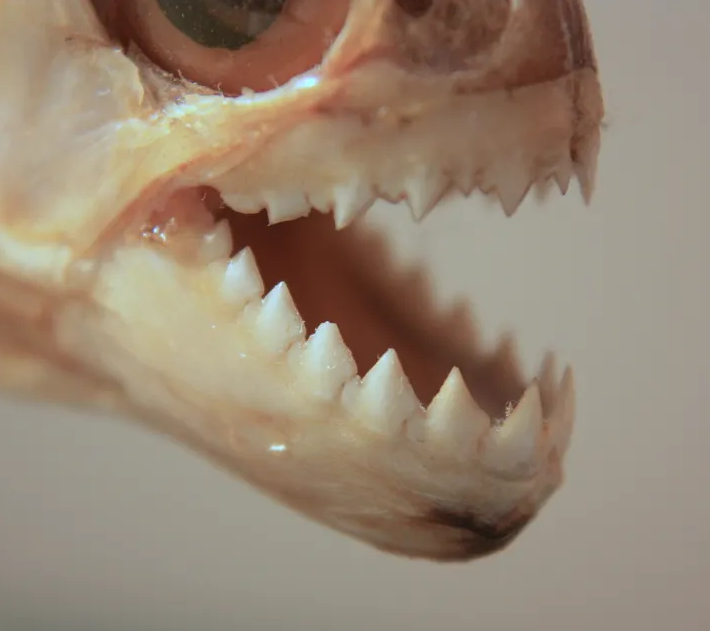
Like quicksand, piranhas were supposed to be everywhere. In lakes, ponds, rivers, and any body of water that you came across, these flesh-eating psycho beasts were just waiting to tear you apart, and there were millions of them. Even though I lived in Indiana, I swore I saw them numerous times in the many small, man-made lakes and ponds I frequently fished and swam in. I’m 100% sure I got bitten by them, too, but thankfully, I’m still here to tell the tale of these devil fish with razor-sharp, three-foot-long teeth that I escaped from because of my quick thinking and cat-like reflexes. That’s my fish story, and I’m sticking to it.
With the advent of the Internet, I now know that piranhas are (supposedly) not in Indiana (although I did get bitten) and are mostly found in South American rivers, particularly in the Amazon Basin. They are an invasive species in the United States and have been found in California, Texas, Florida, Louisiana, and, of course, Indiana (source: me).
Classified as omnivores, piranhas eat food of both plant and animal origin. According to the California Department of Fish and Wildlife, “Their diet consists mostly of insects, mollusks, crustaceans, worms, small fish, and some plant matter, but they often feed in large groups to kill larger prey like capybaras.”
Although rare, piranhas can attack humans, and incidents have occurred in Suriname, Brazil, and Argentina, where more than 70 people sustained injuries. Most of these attacks result in minor injuries and are typically to the feet and hands. Unfortunately, piranhas have caused death, but this is an incredibly unusual outcome.
Fun fact about piranhas: they bark.
But, getting back to my cat-like reflexes, this next thing wasn’t a fear like getting eaten by piranhas, but it was an aspiration to become something that piranhas would fear.


Ninjas
As a kid, my original plan once I grew up was to be a professional baseball player. If that didn’t work out, my fallback plan was to become a ninja. Yes, a ninja. And why not? Like the Six Million Dollar Man, ninjas were some of the most badass people on the planet.
Ninjas had all the skills. They perfected the art of stealth and invisibility, they could climb anything and escape from anywhere, and they were adept at spying, infiltrating, and ambushing. My friends and I tested these skills in the woods behind our houses regularly, and if it wasn’t for having to grow up and become an adult, I’d still probably be out in those very same woods practicing Ninjutsu.
I owned several varieties of throwing stars and subscribed to Black Belt magazine, and even had a wooden sword that any good ninja would carry. As a backup, I often carried rubber nunchucks, and to this day, I still have a butterfly knife. I have no idea where my black ninja suit is, most likely because it doesn’t want to be found.
Like quicksand, ninjas were also prevalent in ’70s and ’80s television. They appeared in Knight Rider, Magnum P.I., and in movies such as Enter the Ninja and American Ninja.
Bruce Lee was also a major factor in the martial arts and ninja craze in the United States, and some regard his film Enter the Dragon as one of the best martial arts films of all time. It is also the most successful martial arts film, estimated to have grossed over $400 million worldwide (equivalent to an estimated $2 billion adjusted for inflation as of 2022). Bruce Lee versus the Six Million Dollar Man would have been the ultimate matchup! But, had I stuck with my ninjutsu training, I’m sure I could have taken both of them.
Needless to say, I didn’t become a professional baseball player. And I might not have become a ninja. Or maybe I did, and I just can’t tell you that I’m a ninja. You know, because of all the secrecy of it. I guess you’ll never know.
But one thing that helped with my ninja training back in those olden days as a child was a skill I learned in elementary school. To this day, this move has become a staple in remaining limber, always being prepared, avoiding piranha attacks, and getting out of quicksand.
Stop, Drop, and Roll
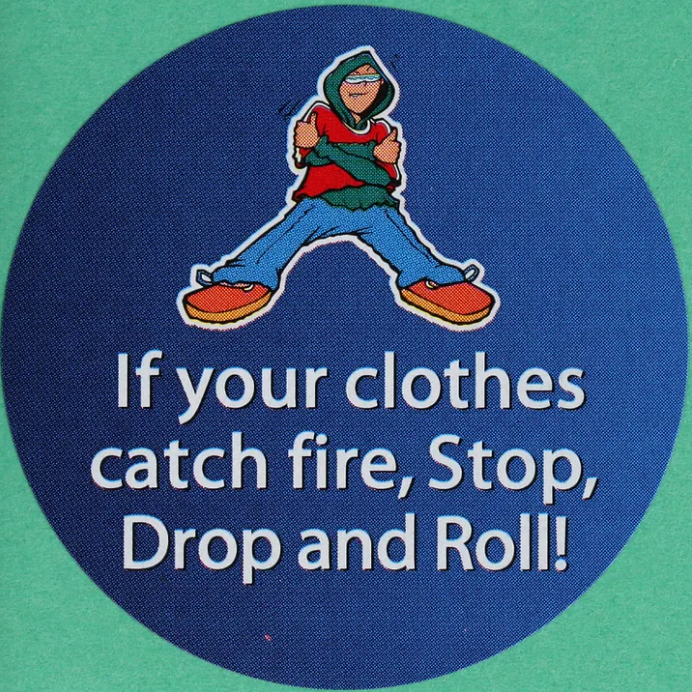
If your clothes catch fire, Stop, Drop, and Roll!
If there was one thing ingrained in me as a child, it was to practice the stop, drop, and roll technique until I could do it without even thinking. We practiced it in school, at home, at church, and anywhere else that our clothes might catch fire. We stopped, dropped, and rolled on the playground, on trampolines, in our living rooms, and classrooms.
Incorporating my ninja skills, I was easily one of the best SDRers at my school, and I even won an award in 1979 for best form. That didn’t happen, but it should have.
Even though the Stop, Drop, and Roll campaign seemed excessive to us kids at the time, it was an important one, even with its simple message. There’s no definitive origin of the phrase and campaign, but it seems to have gained popularity because of the National Fire Protection Association and The Alisa Ann Ruch Burn Foundation (AARBF), which was formed due to the tragic death of 8-year-old Alisa Ann Ruch, whose clothes caught fire from a barbecue accident.
Clothes and a lot of other items were a lot more flammable 50 years ago than they are today, and there was very little regulation until 1953, when the government passed the Flammable Fabrics Act. Then, in 1975, under the Consumer Product Safety Commission (CPSC), they added requirements for children’s sleepwear, requiring that children’s pajamas be either treated with flame retardants or designed to fit snugly, minimizing fire risk. One pediatric burn unit’s experience showed a significant decline in sleepwear-related injuries after the enacted requirements.
Smoking was also a lot more prevalent, and it was normal to smoke in the house, at work, in restaurants, and even on airplanes. Basically, it was a lot easier to catch fire back then.
While the number of fire-related clothing injuries has decreased, the Stop, Drop, and Roll campaign is still used today and is an effective technique to help minimize burn injuries.
That’s a good thing, because another fear of Gen X was spontaneous human combustion. However, I’m still afraid of this, so I’m not going to discuss it. I can’t take any chances of randomly bursting into flames and disintegrating into ashes.
What fears did you have as a Gen-Xer? And if you aren’t Gen X, what was a universal experience for your generation?
Honorable mentions: Kidnap vans, and along those same lines, stranger danger; leeches; bigfoot; backmasking (playing records backwards and summoning hell).
About the Creator
Jeff Barton
Dad, trail and ultra runner, aspiring recluse, a bunch of other labels. Writing online since 2017; creator and editor of Runner's Life on Medium. I write about mental health and depression, running, life, and subjects that interest me.
Enjoyed the story? Support the Creator.
Subscribe for free to receive all their stories in your feed. You could also become a paid subscriber, letting them know you appreciate their work.
Comments
There are no comments for this story
Be the first to respond and start the conversation.