
Five Farces of Locally Sourced Ingredients
Gordon Ramsey vs The Absurdity of Knowing Where Your Food Comes From


Berkeley, California
To escape the midday sun, Mark and Sheila stepped into an exclusive-looking restaurant they noticed on Shattuck Avenue and were quickly seated at a back table.
The waiter approached and set the bread basket down with the gravity of a man delivering a prognosis.
“My name is Henry and the sourdough starter for this bread,” he said, “was begun by Stephen Sanders in 2019, during his divorce. He feeds it only on Tuesdays while listening to Colin Stetson. You will taste the sadness, but also the hope.”
The couple nodded nervously, not often frequenting this sort of restaurant.
“The butter,” Henry continued, “was churned by Gary’s niece, Adriana, before she left for Morocco to find herself. The salt was harvested by Gary’s ex-wife, Linda, from her own tears during a custody mediation, in a parking structure in Oakland.”
Sheila reached for the wine list. Henry gently moved it aside.
“I will be serving the house red, stomped by Keith, who doesn’t believe in wearing shoes. Keith has never met Gary, but they share a distrust of attachment. The oak for the cask was felled by a man named Bernard, who was thinking about his mother. She was not a good woman.”
Two hours passed and they had not yet reached the main course.
Mark tried to stand. “I think we’ll just—”
“The door,” Henry said softly, “is locally sourced oak. The handle was forged by Keith, who, as I mentioned, does not believe in them. You cannot leave until you understand our local narrative.”
“I just want to go home.” Sheila began to weep.
Henry leaned in. “Those tears. Are they salted?”
They were.
He made a note. “Excellent. We’ve been looking for a replacement, someone local.”
🥕 🥦 🥬 🥒 🍅 🍆 🌽 🥔 🧄 🧅 🫑 🌶️ 🫛 🫚 🫘 🥑 🍄 🍄🟫
Moultrie, Georgia
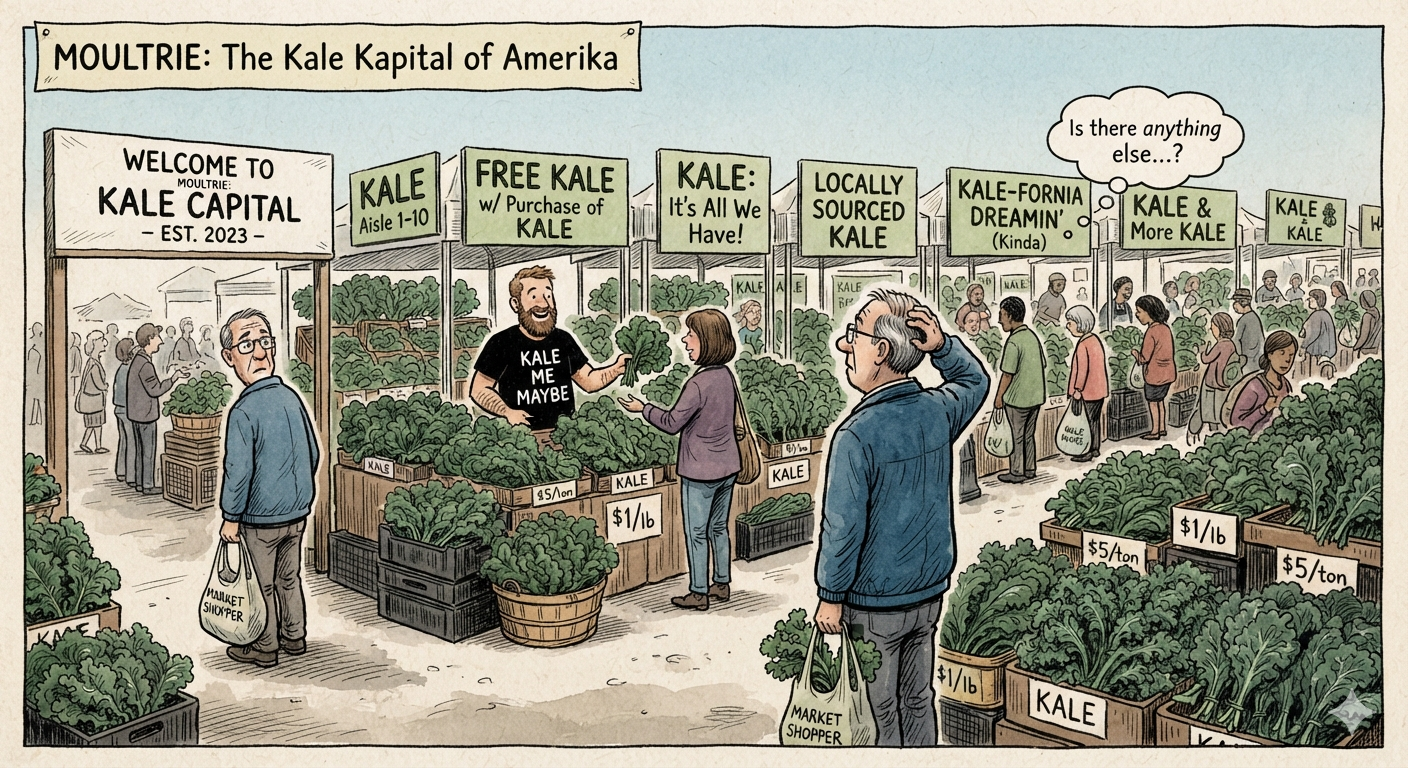
It was the peak of the August heat in Georgia, and the sign in Moultrie, Colquitt County, declared, “Moultrie: The Kale Kapital of Amerika.”
Dave wiped his sweaty brow and studied the hand-painted lettering with a weary sigh. He couldn't decide if the town was trying to be clever with marketing or if the local government simply lacked a dictionary.
Regardless of their spelling prowess, Moultrie was thriving. Packed gravel parking lots, a "No Vacancy" sign at the town’s solitary motel, and a bustling gridlock at the farmers market signaled that tourism was booming. Back in Atlanta, the "poop lettuce" scare had terrified everyone and people were now driving hours into the countryside to get their hands on locally sourced greens.
At the market, Dave lined up at the nearest stall, which was overflowing with vibrant, leafy greens priced at $2.99 a bunch. While he waited in line, a vendor from the opposite booth caught his eye and gestured for him to come over. He was clad in Crocs and a tee that read: “Kale Me Maybe.”
He leaned over his booth. “His kale ain’t local,” he hissed.
“Is that so?” Dave asked.
“Factory farm stuff. Probably shipped in from Taylors.”
Dave glanced back at the bright green bundle of kale in his hand. He had to admit, it looked exactly like the immaculate, spotless greens he used to buy at Whole Foods.
The vendor handed Dave a loose, deep-green leaf. “Taste real food,” he said, his eyes wide open with sincerity.
Dave took a hesitant bite. “It's crisp. Fresh.”
“Ain’t it?” he said, and then added, “My grandma’s ashes are in that soil.”.
Dave choked, a bit of stem catching in his throat. “I’m sorry, what?”
“My grandma’s ashes are in that kale,” the man repeated. He raised a finger, pointing toward a ridge in the distance. “Three generations of Higgins men and women scattered over the soil. That leaf you just bit into? That’s probably her left hip.”
Dave spat out the half-chewed green.
“Suit yourself,” the man muttered.
Before Dave could retreat, a woman jumped out from a neighboring stall. She held a battered watering can.
“Don’t listen to Barry,” she snapped. “He grows his kale on an irrigation system. Mine drinks nothing but pure rainwater collected from my own roof.”
Dave was starting to feel hassled. “Why should I believe you?” he asked.
She pointed up at a listing shack across the alleyway. Its tin roof was so rusted it looked like it was from the previous century..
“My greens are locally sourced,” she declared proudly. “My kale remembers the history of this land.”
Barry scoffed loudly. “It remembers lead paint.”
Dave bought a bundle from each then walked away to the sound of their renewed bickering.
Dave knew the truth. Both bundles would inevitably sink to the bottom of the vegetable drawer of his refrigerator to wilt on top of the store bought bunch. Nobody actually liked kale.
🥕 🥦 🥬 🥒 🍅 🍆 🌽 🥔 🧄 🧅 🫑 🌶️ 🫛 🫚 🫘 🥑 🍄 🍄🟫
Portland Oregon
To escape the heat of Los Angeles, a decade ago Liam and I moved to Portland. We loved it here, and inspired by the local culture, became shroomers. No, not that kind of shroomer, the responsible culinary mushroom gathering variety of shroomer.
Every story you read in the news about wild mushroom harvesting goes the same way, don’t it?
Local amateurs go out into the woods after a few days of rain, only to end up in the emergency room on life support after eating a Blue Rhinoceros that looks like a prized Topaz Hippopotamus to everyone except an expertly trained mycologist.
The emergency in my story wasn’t medical. It was marital.
For six years, Liam and I were Portland’s premier culinary couple. At locavore dinners, while other chefs served mushrooms that looked suspiciously manicured, like they’d been lightly dusted with organic, fair-trade dirt just for aesthetic effect, we served the real deal. Mushrooms that carry the pungent flavor of the Pacific Northwest forest floor.
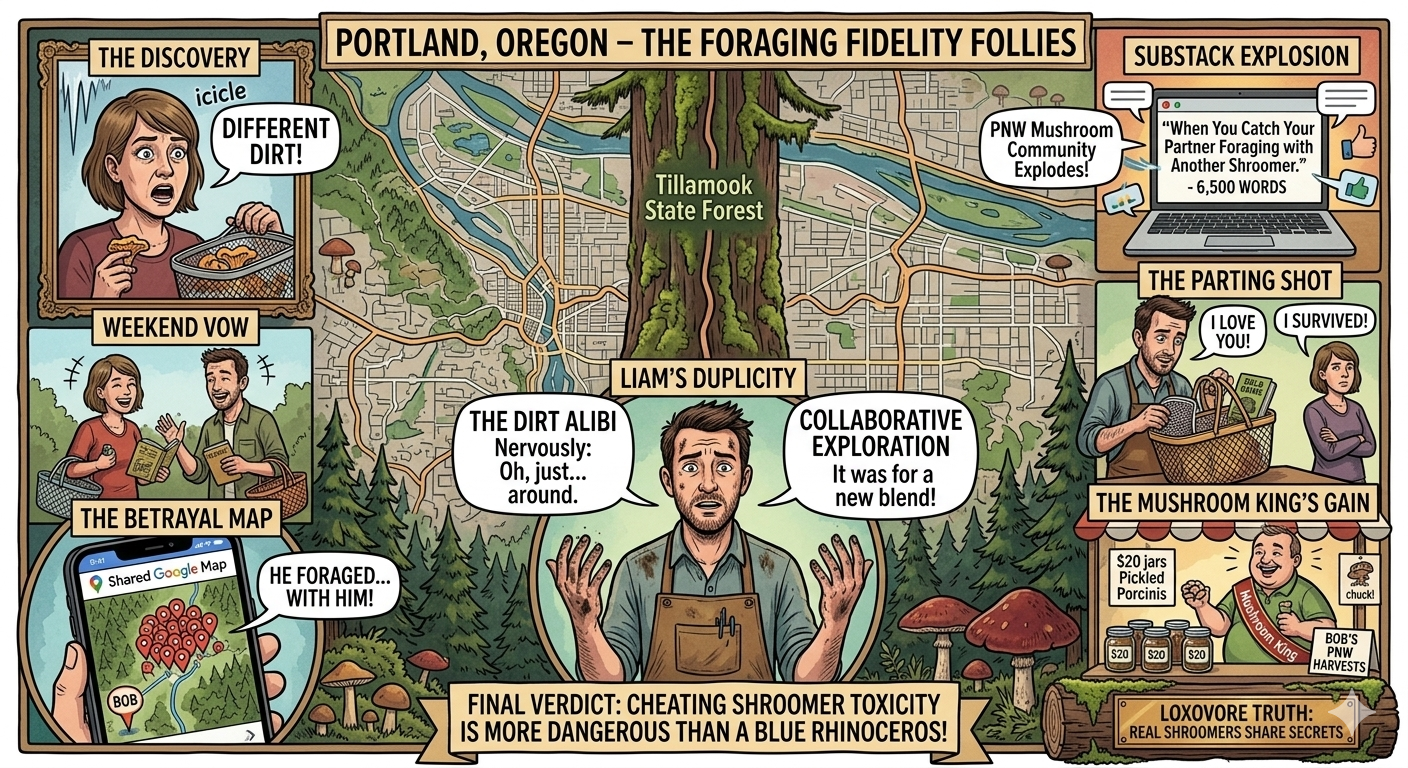
It began on a Tuesday when I noticed dirt under Liam’s fingernails. Not just any dirt, the dark, rich, damp loam unique to the Tillamook State Forest. We had an unspoken, sacred vow. We only foraged for our chanterelle and morel with each other on weekends.
"Where did you get those, Liam?" I asked, my voice ice cold.
"Oh, just... around," he stammered, nervously adjusting his apron.
I didn't buy it. That night, while he slept, I did what any heartbroken, tech-savvy Portlander would do: I checked his Garmin GPS watch. What I found was a digital roadmap of betrayal. He hadn’t just been foraging without me; he had dropped more than ten mushroom location pins into a shared Google Map.
The co-owner of that map? Bob. The self-proclaimed “Mushroom King” who sells $20 jars of pickled Porcinis at the farmers market.
My grief was overwhelming, so I did what any mycophagist does—I poured my soul into a 6,500-word essay on Substack. I titled it: “When You Catch Your Partner Foraging with Another Shroomer.”
The Pacific Northwest Mushroom Community exploded.
Liam tried to defend himself, claiming it was just "collaborative exploration," but the people had spoken.
“I love you,” he said pathetically as he packed his high boots, field guide, mesh basket, and then left.
So let the amateurs have their tragic news stories about mistaking poisonous mushrooms for edible varieties. They only risk liver failure. I survived the most dangerous toxin of the Portland food scene: a cheating shroomer.
🥕 🥦 🥬 🥒 🍅 🍆 🌽 🥔 🧄 🧅 🫑 🌶️ 🫛 🫚 🫘 🥑 🍄 🍄🟫
Geneva, Switzerland
The hotter the summers became in Europe, the more people began the trek to Switzerland in search of cooler weather. The restaurant business was booming.
Chef Julian’s restaurant, Terroir, had a simple rule: nothing on the plate traveled more than one hundred miles. Then a rival opened across the street with a fifty-mile radius, and Julian, competitive by nature, countered with Terroir Local: a twenty-five miles, then ten, then one.
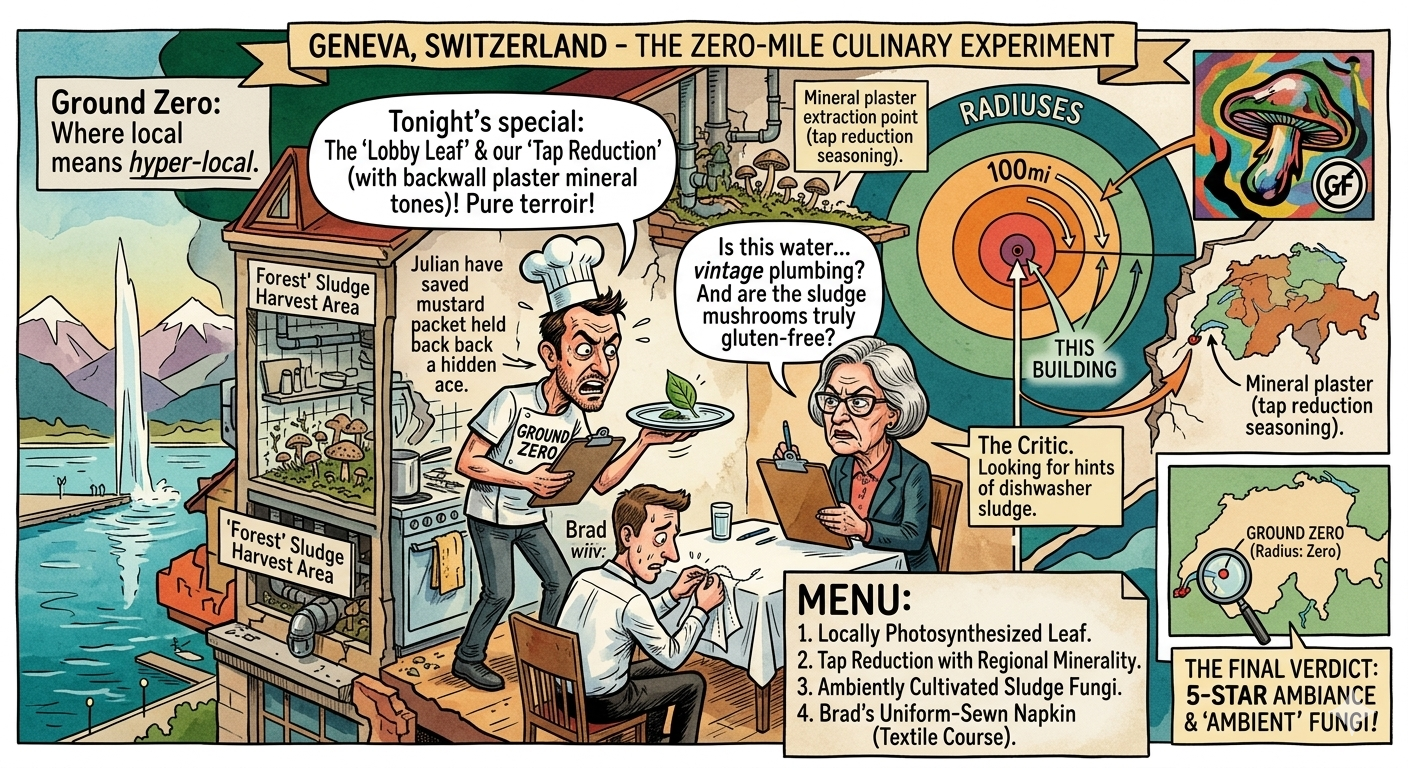
By the time Julian opened Ground Zero, the rules had become absolute. Every ingredient had to come from inside the building.
The menu was challenging.
The amuse-bouche was a single basil leaf from the lobby, described as “locally photosynthesized.” The water was a “tap reduction,” simmered for six hours with a shard of plaster from the back wall for “hints of regional minerality”.
The sous chef had recently quit after discovering the “forest mushrooms” were harvested from the hardened sludge behind the dishwasher.
A crisis arrived on a Thursday, when a restaurant critic—a woman named Camille who had once given Julian a B-minus in culinary school—walked in unannounced.
Julian panicked. Their walk-in cooler was empty except for a packet of mustard he had saved from the fast food restaurant next door. He had thirty seconds.
“Tonight,” he announced, sweeping his arm toward the dining room, “we are doing a Provenance Showcase!” He held aloft a piece of paper.
Camille squinted at her clipboard. “That’s a napkin.”
“This,” he corrected. “Will be sewn by our server, Brad, into a staff uniform.”
Julian’s eyes signalled a server, and he carefully filled her water glass with their best backwall reduction.
Camille noted how careful she was not to get his uniform wet. “Washable?”
“Of course.” Julian sweated, but not too much, hoping his bluff wasn’t called.
Then she looked at the sludge-grown mushrooms and asked, “Are these gluten-free?”
“Yes, and even better, they are ambiently cultivated,” Julian whispered.
She gave him 5 stars.
🥕 🥦 🥬 🥒 🍅 🍆 🌽 🥔 🧄 🧅 🫑 🌶️ 🫛 🫚 🫘 🥑 🍄 🍄🟫
Alresford, England
Lower Alresford, population 187, had one pig. Her name was Duchess.
In the hot long summer of last year, when two farm-to-table restaurants opened on the same cobblestoned street of Lower Alresford, both claimed her.
Chef Martin of The Root Cellar had raised Duchess from a piglet. Chef Margaret of Soil & Stem had, technically, petted her once during the village farming festival. The dispute escalated quickly.
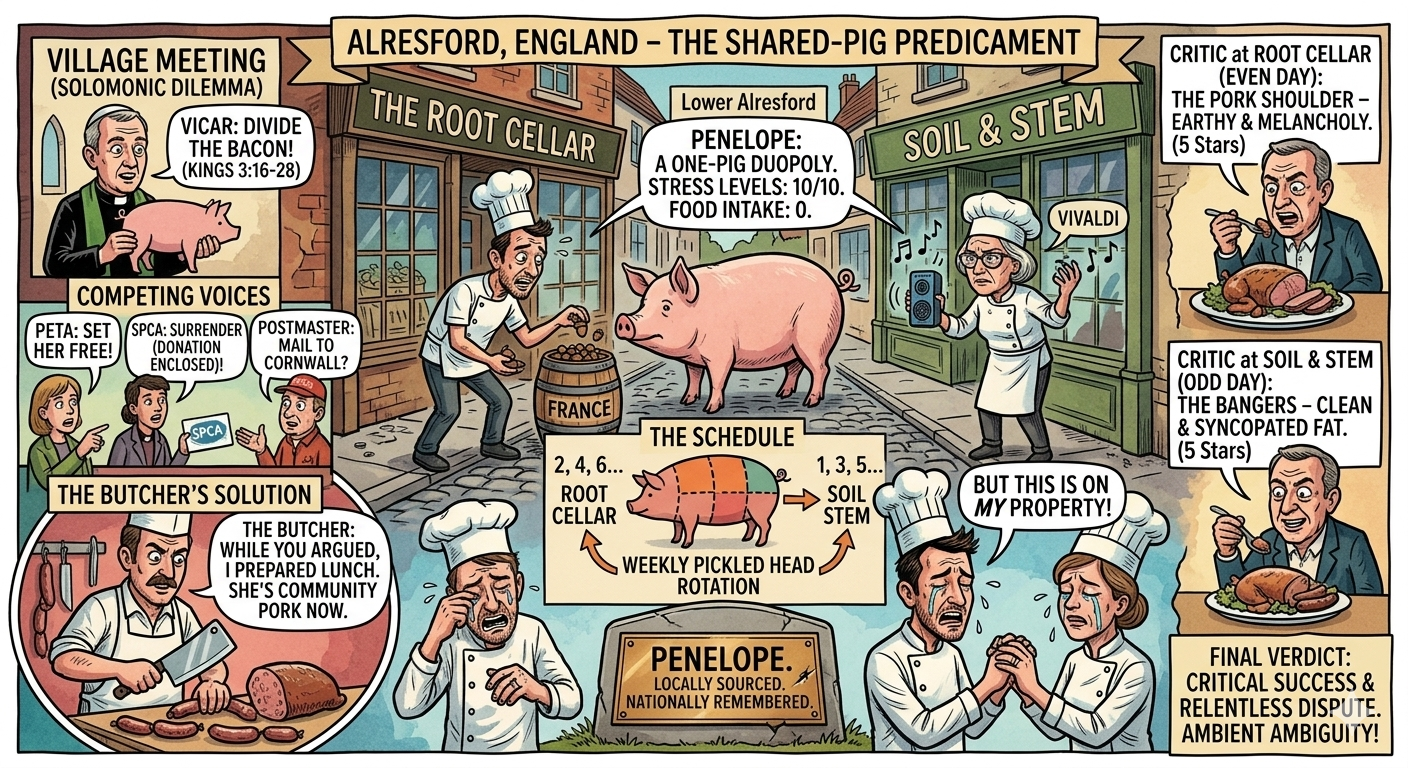
Martin began feeding Duchess acorns he ordered from France, which violated every principle of his own menu but improved the marbling. Margaret played Vivaldi to Duchess through a Bluetooth speaker hidden in the sty, to relax her, believing that would produce tenderer meat.
Duchess, knowing something was off, stopped eating.
The village held an emergency meeting in the pub. The vicar, quoting King Solomon, suggested they divide her into halves of bacon. Margaret and Martin, each believing her their own, refused. The local PETA representative demanded they set her free, whilst the SPCA suggested they surrender Duchess to them, after donating for her care of course. The postmaster suggested they simply mail her to Cornwall. The entire village devolved into debate. Then the butcher offered a compromise they couldn’t refuse: while they were busy building up a hunger, he had already slaughtered Duchess for lunch. She would become a communal ingredient.
To ensure fairness, on even-numbered days, she would be served at The Root Cellar. On odd days, at Soil & Stem. The pickled head would be alternated weekly.
A food critic from London visited both restaurants, unaware it was the same animal. On Saturday, he wrote, “The Root Cellar’s pork shoulder proved profoundly earthy, with a melancholy finish.” The next day, dining at Soil & Stem, he wrote of the gloriousness of the bangers, “Clean and uplifting, with a surprising syncopation in the fat.”
Tourists and gastronomes began to flock from London.
Four years later, they buried her pickled head behind the local church. Both chefs openly wept and briefly held hands. A bronze plaque still reads: Duchess. Locally Sourced. Nationally Remembered.
Both restaurants immediately claimed the grave was on their property.
About the Creator
Scott Christenson🌴
Born and raised in Milwaukee WI, living in Hong Kong. Hoping to share some of my experiences w short story & non-fiction writing.
Enjoyed the story? Support the Creator.
Subscribe for free to receive all their stories in your feed. You could also become a paid subscriber, letting them know you appreciate their work.
Comments
There are no comments for this story
Be the first to respond and start the conversation.