
Fantasy Island: Who on Earth Was Paying for All This?
The greatest fantasy wasn’t becoming a king, a cowboy or a millionaire. It was running the island without going bankrupt.

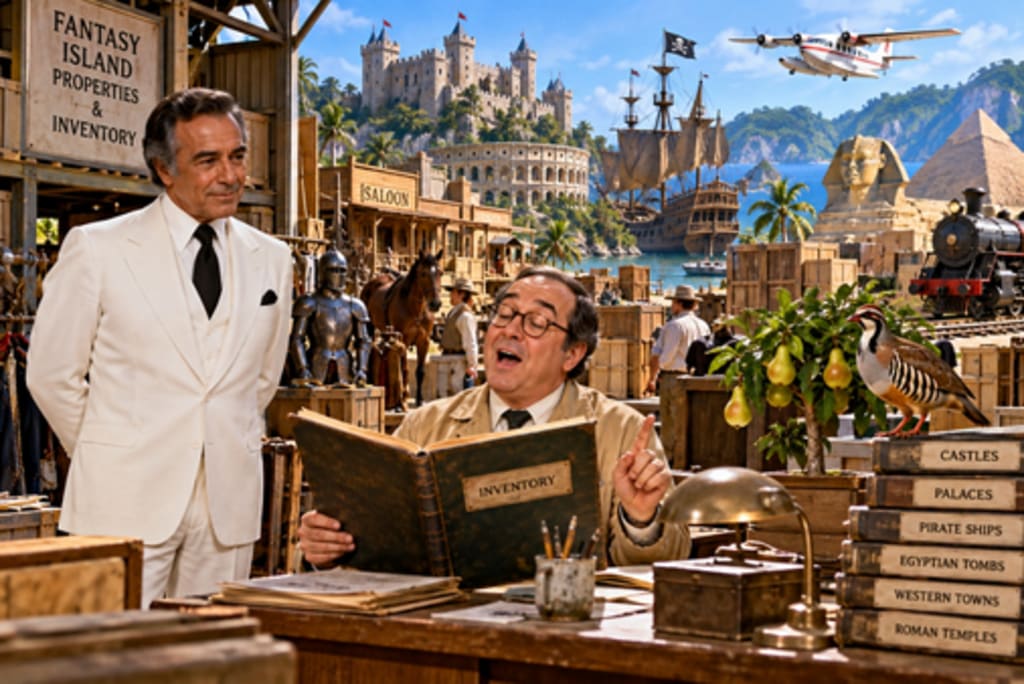
I used to enjoy watching Fantasy Island, the television series in which guests arrived on a mysterious tropical island to experience their most cherished fantasies.
There was the elegant Mr Roarke, immaculately dressed in his white suit, welcoming visitors with the confidence of a man who had everything under control.
And, of course, there was Tattoo, whose excited announcement of the approaching aircraft became one of television’s most recognisable moments.
Each week, several guests arrived with their dreams, their personal problems and presumably their wallets.
One might want to experience life as a cowboy in the American West. Another might wish to become a medieval nobleman. A third might find themselves transported into an ancient civilisation.
By the end of the episode, lessons had been learned, relationships repaired and fantasies fulfilled, although not always in the ways the guests had expected.
Mr Roarke would bid everyone farewell, and the island would prepare for its next collection of visitors.
As a younger viewer, I accepted all this without question.
But as I grew older, I began wondering about something the programme never seemed particularly interested in explaining.
How on earth did the island actually operate?
Who Built Everything?
Consider a guest who wanted to become a sheriff in a nineteenth-century American town.
He would arrive on the island and somehow find himself in a fully functioning Western settlement.
There would be a saloon, a sheriff’s office, a jail, a general store, stables and perhaps a bank waiting to be robbed.
There would be horses, wagons, gunslingers, townspeople and enough dust to make the place look authentic.
But who built it?
Did Mr Roarke employ an army of carpenters, builders, painters and set designers?
And where did they obtain their materials?
Was there an enormous hardware store hidden behind the palm trees?
Did cargo ships arrive every night carrying timber, bricks, cement and roofing materials?
Imagine the conversation between Mr Roarke and his construction supervisor.
“Good morning, Mr Roarke. We’ve finished the Western town.”
“Excellent.”
“Unfortunately, we have a problem.”
“What is it?”
“The next guest wants to become a Roman emperor.”
“I see.”
“He arrives tomorrow.”
“Then I suggest you begin constructing the Colosseum immediately.”
And somehow, I suspect, Mr Roarke would have remained perfectly calm.
What Happened When the Guests Went Home?
Building these elaborate environments was only half the problem.
What happened to them afterwards?
Suppose the cowboy fantasy ended on Friday afternoon.
Did the construction workers arrive on Saturday morning and demolish the entire town?
Was the saloon dismantled, the jail knocked down and the general store packed away?
And what about the medieval castles?
Surely they couldn’t be demolished after every visit.
Perhaps somewhere on the island there was an enormous storage facility containing castles, Egyptian pyramids, Roman temples, pirate ships and Western towns.
I can imagine a warehouse manager consulting his inventory.
I can imagine the island’s warehouse manager checking his inventory. After several exhausting days of counting castles, pirate ships and Roman temples, he begins quietly singing to himself, using the melody of The Twelve Days of Christmas.
On the sixth day of business,
Mr Roarke did say to me:
Six castles standing,
Five golden palaces,
Four pirate ships,
Three ancient tombs,
Two Roman forts,
And a partridge in a pear tree!
Afterwards, his assistant could interrupt:
“Very nice. But why is there a partridge in a pear tree?”
The manager looks at his inventory.
“I haven’t the faintest idea. It was here when I started.”
“Anything missing?”
“Yes. Someone has misplaced the French Revolution.”
And then there was the question of maintenance.
Did the castles require repainting? Were the pirate ships inspected for seaworthiness? Who fed the horses when nobody wanted to be a cowboy?
The more I thought about it, the more the island began to resemble a gigantic theme park operated by a man with an unlimited budget and no apparent concern for practical difficulties.
Surely the Fantasies Would Occasionally Collide
But there was another problem.
Several guests arrived on the same aircraft, each with an entirely different fantasy.
And all these adventures apparently took place simultaneously on one island.
How large was this island?
It couldn’t have been infinite.
Yet one guest might be living in a Western town, another in medieval England and a third in ancient Rome.
Surely, sooner or later, somebody would wander into the wrong fantasy.
Imagine a sheriff pursuing a bank robber across the desert.
He follows the outlaw over a hill, only to discover a medieval castle.
A knight in shining armour stands at the drawbridge.
“Halt! Who goes there?”
“I’m the marshal of Dodge City. I’m looking for Black Bart.”
“Have you permission from His Majesty to enter?”
“Listen, buddy. I don’t know anything about your king. I’m looking for a bank robber.”
At that moment, a Roman centurion emerges from the nearby forest.
“Excuse me, gentlemen. Could either of you direct me to the Colosseum?”
Before anyone can answer, a pirate ship fires its cannons from the nearby harbour.
The sheriff draws his revolver.
The knight raises his sword.
The centurion summons his legion.
And somewhere in the distance, a guest enjoying a peaceful romantic fantasy complains about the noise.
I would have loved to see an episode in which three fantasies accidentally overlapped.
It might have been the most entertaining episode of the entire series.
And Who Were All These People?
Every fantasy required supporting characters.
A medieval castle needed knights, servants, cooks, guards and peasants.
A Western town needed cowboys, shopkeepers, bartenders, outlaws and ordinary townspeople.
An ancient Roman fantasy might require hundreds of soldiers and citizens.
Who were these people?
Were they actors employed by Mr Roarke?
If so, the island must have had an extraordinary payroll.
Did the same actors move from one fantasy to another?
Perhaps the man playing a medieval knight on Monday became a Roman senator on Tuesday and a Western bank robber on Wednesday.
And what happened if an actor became ill?
“Mr Roarke, we have a problem.”
“Yes?”
“The Roman emperor has called in sick.”
“Can we find a replacement?”
“The only available actor is playing the village idiot in the medieval fantasy.”
“Very well. Give him a toga.”
There must also have been some unusual employment contracts.
Imagine applying for a position on Fantasy Island.
Position available: Supporting Character.
Duties may include sword fighting, horse riding, serving medieval banquets, participating in pirate attacks and occasionally being murdered.
Previous experience in ancient Rome desirable but not essential.
Applicants must be willing to work across several centuries.
Now, About the Money
Of all the questions that occurred to me, this was perhaps the most perplexing.
Who paid for everything?
The guests who visited Fantasy Island were not necessarily wealthy.
Some appeared to have saved for years to afford the experience.
Yet the cost of providing their fantasies must have been astronomical.
Suppose a guest paid $10,000 to experience life as a medieval king.
That sounds like a considerable amount of money, particularly in the 1970s.
But what would Mr Roarke have to provide?
A castle.
A throne room.
Servants.
Knights.
Horses.
Elaborate costumes.
Banquets.
Possibly an entire village.
Even allowing for the purchasing power of money at the time, I suspect the guest’s payment would barely cover the catering.
And that was just one fantasy.
What about the other guests arriving on the same aircraft?
Perhaps one wanted to command a pirate ship, while another wanted to become a Roman emperor.
Mr Roarke might have had several million dollars’ worth of expenses for a weekend that brought in only a fraction of that amount.
No wonder he wore a white suit.
He probably couldn’t afford to get it dirty.
The Island’s Accountant
I often wondered whether Mr Roarke employed an accountant.
If he did, I suspect the poor fellow had the most stressful job on the island.
Imagine him arriving at Mr Roarke’s office with the monthly financial statements.
“Mr Roarke, we need to discuss the accounts.”
“Certainly. What seems to be the problem?”
“Our expenditure is considerably higher than our income.”
“How much higher?”
“Approximately four million dollars.”
“I see.”
“And that’s before we include the construction of the Egyptian pyramid.”
“Ah, yes. A particularly successful fantasy.”
“Successful? The guest paid us $5,000!”
“Money is not everything, my friend.”
“Try telling that to the bank.”
There would also be the question of insurance.
What insurance company would cover an island where guests regularly engaged in sword fights, gun battles, pirate attacks and other dangerous adventures?
And imagine the workers’ compensation claims.
“Nature of injury?”
“Bitten by a crocodile.”
“Occupation?”
“Pirate.”
“Location of incident?”
“Ancient Egypt.”
I suspect even the insurance assessor would have given up.
What About the Guests Who Wanted to Be Rich?
There was another financial complication.
Suppose a guest wanted to experience life as a millionaire.
Would Mr Roarke give him a million dollars?
And if so, what happened when the fantasy ended?
Did the guest have to return the money?
Imagine the conversation at checkout.
“Thank you for visiting Fantasy Island, sir. We trust you enjoyed your experience as a wealthy industrialist.”
“Very much.”
“Excellent. Now, before you leave, could you please return the mansion, the Rolls-Royce and the $2 million?”
“But I thought they were mine!”
“Only until checkout, sir.”
“And what about my wife?”
“I’m afraid she belongs to another fantasy.”
Perhaps Mr Roarke had an entire department devoted to recovering property from departing guests.
It would certainly explain why everyone was so carefully escorted back to the aircraft.
The One Explanation That Solves Everything
Of course, there is an obvious objection to all these questions.
Fantasy Island was not intended to be realistic.
Mr Roarke was a mysterious figure who sometimes appeared to possess supernatural powers. The fantasies themselves frequently involved events that could not be explained by ordinary science.
Perhaps the Western towns, castles, pirate ships and ancient civilisations were not constructed at all.
Perhaps Mr Roarke simply made them appear.
That would solve the construction problem.
It would solve the storage problem.
It might even explain how several enormous fantasy environments could coexist on a relatively small island.
But it would introduce another question.
If Mr Roarke could create entire worlds by supernatural means, why did he need to charge his guests anything?
Was the money simply a symbolic payment?
Was it meant to demonstrate how much the guests valued their dreams?
Or was Mr Roarke, despite his extraordinary powers, still required to pay the electricity bill?
I never found out.
Perhaps I Was Asking the Wrong Questions
Looking back, I realise that my questions were probably the last things the programme’s creators wanted viewers to consider.
Fantasy Island was about dreams, desires, regrets and the unexpected consequences of getting what we think we want.
Its purpose was not to demonstrate sound financial management or explain the logistics of constructing a medieval castle.
And yet I cannot help wondering.
When I watched the programme years ago, I was fascinated by the extraordinary fantasies.
Today, I find myself thinking about the carpenters, the accountants, the warehouse managers and the unfortunate workers who presumably had to rebuild ancient Rome before the next aircraft arrived.
Perhaps that is one of the peculiar consequences of growing older.
We begin noticing the practical problems behind the magic.
We stop asking whether a dream can come true and start wondering who is going to pay for it.
But I still have one final question.
If Mr Roarke could arrange almost any fantasy imaginable, why didn’t he simply choose one for himself?
A profitable business.
Now that would have been a fantasy worth watching.
About the Creator
George Dimitriadis
Retired mathematics teacher from Melbourne, Australia. I write humorous classroom stories featuring Jimmy, a student who questions mathematical conventions, as well as personal reflections on life, nostalgia and everyday absurdities.
Enjoyed the story? Support the Creator.
Subscribe for free to receive all their stories in your feed.
Comments
There are no comments for this story
Be the first to respond and start the conversation.