
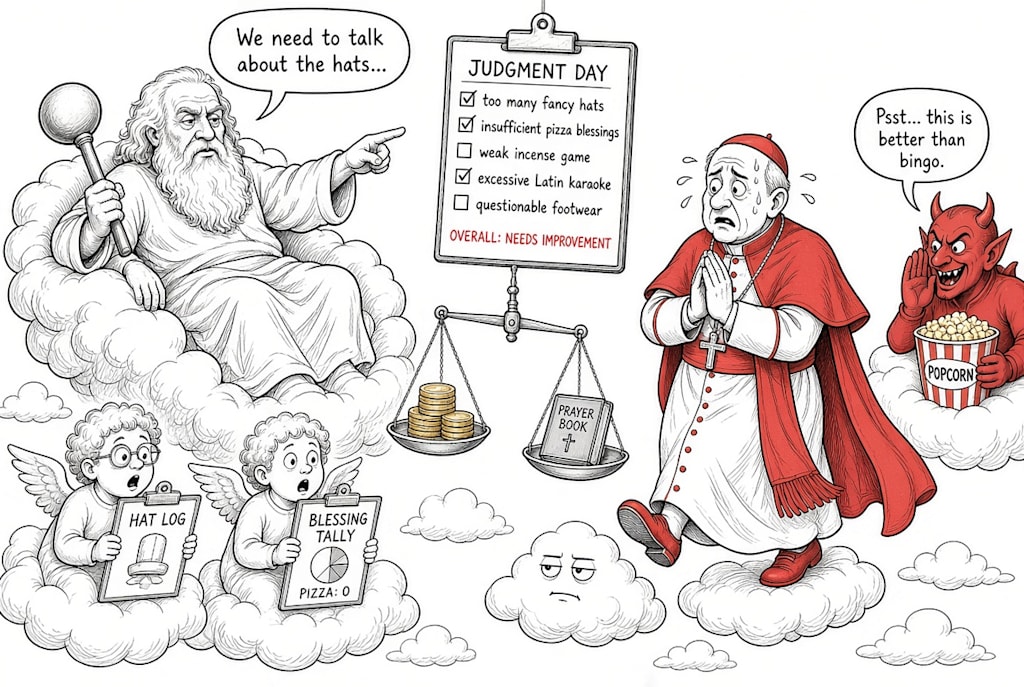
Did God Just Give the Pope a Performance Review?
A logical theological conclusion

When the Vatican announced that Pope Leo XIV — the Chicagoan formerly known as Robert Prevost — was undergoing surgery for lung adenocarcinoma, the media defaulted to its usual clinical vocabulary. They spoke of “nodules,” “lobectomies,” and “video-assisted thoracic techniques” as if the Pope was simply a high-ranking corporate executive suffering an unfortunate mishap.
Every single media outlet failed to emphasize two crucial facts of the case: the Pope was a keen athlete and a lifelong non-smoker.
This is not a man who spent his decades in the Curia huddled over unfiltered Gitanes in a smog-filled basement.
If a man with pristine, non-smoking lungs and the cardiovascular health of a country club tennis player gets hit with a malignant tumor in his right chest while occupying the most divine office on Earth, the conclusion is wildly obvious to anyone:
God has punished the Pope.
To the secular mind, this sounds harsh. But within the hallowed, tapestry-lined corridors of Vatican City, a medical emergency is not just an illness; it is a performance review delivered via the medium of oncology.
If you look at the amount of holy backstabbing required to reach the holy balcony in St. Peter’s Square, you can see why the Almighty might have snapped.
To become Pope requires a level of ruthless maneuvering that makes Machiavelli look like a well-meaning but fundamentally naive Bible Study teacher.
You do not get to the top office by merely being “very good at praying.” You get there by mastering the dark art of the ecclesiastical shiv. It is an environment where a nod from a cardinal during a synod is the difference between being promoted, or being banished to a drafty diocese in North Dakota.
As Leo XIV recovers at the Gemelli Hospital, practicing respiratory physiotherapy and listening to the distant sharpening of knives at the College of Cardinals, he can at least take comfort in tradition.
History shows, when God decides to deliver a corporate reprimand to His Vicars, he does not skimp on theatricality.
Pope Formosus (891–896) and the Courtroom Drama of the Damned
Pope Formosus was an exceptionally adept political operator who managed to alienate the powerful House of Spoleto while securing the papal throne, during an era when the papacy was less a spiritual calling and more a high-stakes game of musical chairs.
God’s punishment arrived roughly nine months after Formosus was already died and buried.
His successor, Pope Stephen VI, had Formosus’s rotting corpse dug up, dressed in papal vestments, and plopped onto a throne to stand trial at the infamous Cadaver Synod. A terrified young deacon was appointed to stand next to the decaying pontiff to speak on his behalf, answering questions like, “Why did you usurp the universal Apostolic See in a spirit of ambition?” Formosus lost the case.
The court stripped him of his sacred robes, chopped off the three fingers of his right hand used for giving blessings, and flung him into the Tiber River.
It remains the gold standard for a retrospective Vatican human resources audit.
Pope John XII (955–964) and the Defenestration of Desire
Pope John XII ascended to the Papal throne at the tender age of eighteen. Rather than focusing on theology, John decided to utilize the vast resources of the Holy See to turn the Lateran Palace into a functioning brothel. Chroniclers noted that he regularly toasted the Devil during dinners and gambled away church funds while invoking pagan gods for luck.
The divine intervention in John’s case was remarkably direct and entirely lacking in subtlety.
While engaging in an extramarital tryst with a married Roman woman named Stefanetta, the Pope was caught red-handed by the lady’s husband. The outraged spouse, unawed by the papal tiara, promptly defenestrated Pope John XII out of the bedroom window.
He died of his injuries days later, proving that while God’s wrath might have mercy, a jealous Roman husband’s does not.
Pope Benedict IX (1032–1048) and the Great Papal Garage Sale
Universally regarded by historians as one of the most disgraceful individuals ever to wear the ring, Pope Benedict IX viewed the papacy not as a cross to bear, but as a highly lucrative asset to be flipped for a profit. He was forced out of Rome multiple times due to his horrific behavior — which reportedly included organizing orgies and ordering the assassinations of his political detractors — only to ride back into town with mercenary armies to retake the throne.
Eventually, Benedict grew bored of the job and wanted to marry his cousin. Realizing he couldn’t easily do that while remaining Pope, he hit upon a brilliant capitalistic solution: he sold the papacy to his godfather, John Gratian (who became Pope Gregory VI), for the rough modern equivalent of a few thousand pounds of silver.
God’s punishment for this ultimate act of simony was a life of complete, agonizing irrelevance. Benedict spent his remaining years wandering from monastery to monastery, stripped of his wealth, universally loathed, and forced to watch the church slowly reform itself into an institution that viewed him as a historical stain.
Pope Alexander VI (1492–1503) and the Poisoned Chalice
No discussion of ecclesiastical backstabbing is complete without Pope Alexander VI, born Rodrigo Borgia. Alexander turned the Vatican into a family business, utilizing his brilliant, terrifying children — Cesare and Lucrezia — to systematically eliminate any cardinal who dared question his authority or possess a bank account large enough to look attractive under asset forfeiture laws.
The Borgia method was simple: invite a wealthy cardinal to a lovely, multi-course dinner, slip a dash of cantarella (a tasteless arsenic derivative) into their wine, inherit their vast estates by law, and repeat.
The divine poetic justice arrived during a hot August night in 1503. Alexander was hosting a dinner for a group of newly wealthy cardinals. Through a catastrophic mix-up by a servant — or perhaps a bit of celestial intervention — the Pope accidentally drank the heavily poisoned wine they had been prepared for their guests. Alexander died in agonizing, agonizing torment.
Pope Clement VII (1523–1534) and the Ultimate Imperial Lock-In
Pope Clement VII, a member of the fabulously wealthy and profoundly manipulative Medici family, was a master of the double-cross.
His life began under tragic circumstances. One month before his birth, his father, Giuliano de Medici, was murdered in the Florence Cathedral by enemies of his family, in what is now known as the “Pazzi conspiracy”. This childhood experience turned him into a master manipulator and diplomat.
He spent his papacy trying to play the Holy Roman Emperor Charles V against the King of France, constantly signing treaties with one while whispering sweet nothings into the ear of the other. He genuinely believed that Medici intellect could outmaneuver the brute force of European empires.
He was wrong. In 1527, Charles V’s unpaid, mutinous imperial army marched on Rome, breached the walls, and initiated the Sack of Rome, a slaughter so brutal that the waters of the fountains ran red. Clement was forced to sprint down the Passetto di Borgo — the secret elevated escape tunnel — while his Swiss Guard were systematically massacred on the steps of St. Peter’s. He spent the next six months trapped inside the Castel Sant’Angelo, surviving on dwindling rations, forced to watch his city burn from the ramparts, and ultimately being compelled to pay an astronomical ransom to the Emperor he thought he could outsmart.
He died of liver failure at the age of 56, having gone blind in one eye and losing most of his sight in the other. Theologians of the time claimed he was poisoned by death cap mushrooms, but his long illness points toward natural causes.
A Modern Conclusion
Today, for Pope Leo XIV, compared to having your corpse put on trial, being chucked out of a window by a jealous husband, or gasping on your own arsenic, having a small, localized tumor cleanly excised by Rome’s finest thoracic surgeons looks like a mild, administrative slap on the wrist.
Yet, as Leo XIV returns to his normal diet and peers out over Rome’s intact, non-smoldering skyline, the beautiful irony of the papacy carries on.
To get the job, you must possess the calculating, icy ambition of a corporate raider. But the second the white smoke rises, you must pretend you are a humble, unassuming servant of God who was dragged kicking and screaming to the Papal throne by the Holy Spirit.
About the Creator
Scott Christenson🌴
Born and raised in Milwaukee WI, living in Hong Kong. Hoping to share some of my experiences w short story & non-fiction writing.
Enjoyed the story? Support the Creator.
Subscribe for free to receive all their stories in your feed. You could also become a paid subscriber, letting them know you appreciate their work.
Comments
There are no comments for this story
Be the first to respond and start the conversation.