
AI Made a Romantic Movie. I Watched a Comedy.
Twenty-one minutes of romance, teleportation, disappearing jewellery, magical costume changes and actors who couldn't remember what they looked like.

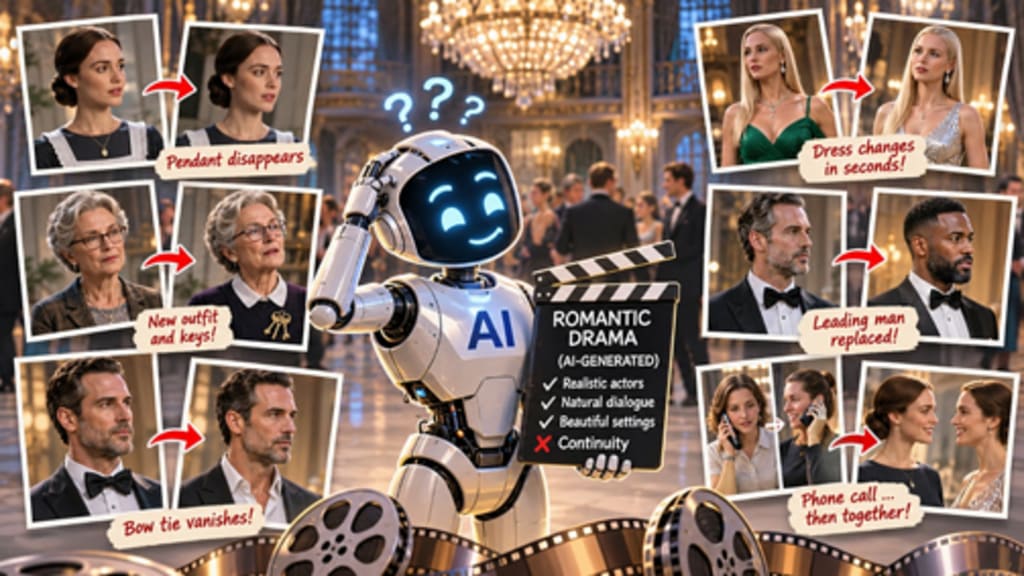
I have always enjoyed watching films, particularly when I notice something that the director, actors or editors have apparently overlooked.
A glass that is full in one shot and almost empty in the next. A cigarette that mysteriously grows longer as someone smokes it. A character who enters a room wearing a jacket and leaves without it, despite never having taken it off.
These little mistakes are part of the fun of watching movies.
But recently, I watched a film on YouTube that elevated continuity errors to an entirely new art form.
It was a romantic drama lasting approximately 21 minutes, apparently produced entirely using artificial intelligence.
And I must admit, the technology initially impressed me.
The characters looked remarkably realistic. Their facial expressions were convincing. Their lip movements appeared perfectly synchronised with their speech. The dialogue sounded natural, with the leading man speaking in an American accent and his female companion in an English accent.
The settings were equally impressive. Luxurious offices, beautifully furnished rooms, elegant costumes and a magnificent ballroom.
Had I watched just one isolated scene, I might easily have mistaken it for a conventional film featuring real actors.
But there was a problem.
A rather serious problem.
Artificial intelligence appeared perfectly capable of remembering what a character looked like for several seconds.
Remembering what that same character looked like ten seconds earlier was apparently asking too much.
What followed was one of the most unintentionally entertaining films I have ever watched.
Beam Me Up, Scotty!
Early in the film, the young fiancée is talking to her friend on her mobile phone.
Nothing unusual there.
But in the very next scene, the two women are apparently together, speaking face to face as though they are in the same room.
There is no indication that either woman has travelled anywhere.
One moment they are communicating by telephone. The next, they are together.
I immediately thought of Star Trek.
Perhaps modern mobile phones have a feature I haven't discovered.
Alongside the familiar icons for the camera, calculator and messages, there might now be one labelled TRANSPORTER.
Press it once and you materialise beside the person you're talking to.
Think of the convenience!
No traffic congestion. No parking problems. No waiting for public transport.
But the mystery deepened.
In the following scene, the women were back on their phones, continuing the same conversation.
Apparently, they had transported themselves home again.
Then the whole performance happened a second time.
Another face-to-face conversation, followed by another return to remote communication.
Except that this time the technology had advanced.
The fiancée was now using her laptop while her friend was using her mobile phone.
Perhaps the laptop was equipped with a more powerful transporter.
I wondered whether the producers had obtained a licence from Starfleet.
The Office Musical Chairs Championship
Later, the action moved to an office.
An older lady was sitting at her desk while a young maid stood beside her, handing her some documents.
A perfectly ordinary scene.
But two seconds later, the maid was standing on the opposite side of the desk, and the older lady appeared to have changed position as well.
All during what seemed to be the same conversation.
I examined the two frames carefully.
There was simply insufficient time for everyone to move into their new positions.
Perhaps they were playing musical chairs.
The music had stopped, and everyone had scrambled to find a new position.
Or perhaps the office had its own transporter.
By this stage, I was beginning to suspect that teleportation was a standard feature of the building.
The Amazing Changing Clothes
The older lady soon demonstrated another remarkable talent.
She could change clothes without leaving her chair.
In one scene, she wore a plain grey outfit.
Moments later, she had acquired a black cardigan and a white collar.
I looked carefully for a wardrobe assistant hiding beneath the desk.
No sign of one.
Perhaps she had been trained by Houdini.
And she wasn't the only person with this extraordinary ability.
The young maid also seemed incapable of deciding what to wear.
Sometimes she wore a white apron. Sometimes the apron disappeared. Her collar changed shape, and the details of her uniform varied from one shot to another.
I began to wonder whether the maid had been hired to clean the house or to demonstrate a new range of quick-change costumes.
The Lady With Two Pairs of Glasses
The older lady had another interesting habit.
She appeared to possess two pairs of spectacles.
One pair hung from a chain around her neck.
Another pair occasionally appeared on her face.
Now, I have no objection to someone owning two pairs of glasses.
But the way they appeared and disappeared during the conversation suggested that her eyesight was deteriorating at an alarming rate.
Perhaps the first pair had stopped working and she needed a second pair to examine the documents.
Or perhaps the glasses, like the people and furniture, were capable of moving independently.
I was beginning to think that the house was haunted.
The Mystery of the Appearing Keys
Then came the keys.
During one conversation, the older lady was sitting at her desk, apparently without any keys attached to her clothing.
In a subsequent shot, a bunch of keys had materialised on her cardigan.
Not one key.
Several.
Where had they come from?
Had someone handed them to her?
Had she retrieved them from a drawer?
Or had they simply appeared out of thin air?
I considered the possibility that the keys were part of a magic act.
Perhaps the older lady was preparing to make the entire filing cabinet disappear.
By this stage, I would not have been surprised.
The Man Who Couldn't Decide Which Way to Part His Hair
A gentleman then entered the story.
He was neatly dressed and had carefully groomed hair.
In one shot, the parting ran from the right side of his head towards the left.
In the next, it ran in the opposite direction.
Not merely a stray hair falling out of place.
The entire hairstyle appeared to have reversed itself.
Perhaps he had caught sight of himself in a mirror and decided that the original arrangement was unflattering.
Perhaps he had a portable hairdresser following him around.
Or perhaps the film had been shot in a parallel universe where left and right were interchangeable.
I considered examining his wristwatch to see whether it had changed wrists as well.
But I was already struggling to keep up.
A Little Difficulty With Dialogue
The gentleman also seemed to have difficulty remembering what he had just said.
In one shot, he finished a sentence with the words:
"...to take you."
In the next shot, he began again:
"Take you wherever you need."
Apparently, the words had become stuck somewhere between the two cameras.
I don't know whether the character was supposed to hesitate or whether the dialogue had been assembled from separate pieces.
But it sounded as though he was repeating himself.
Perhaps he had forgotten that he had already said those words.
I was tempted to suggest that someone provide him with a script.
The Understudy Takes Over
Then something even more remarkable happened.
The gentleman appeared to change his face.
In one shot, he was a distinguished-looking man with greying hair, a clean-shaven appearance and a white-collared shirt beneath his jumper.
In the next, he looked younger, had a different hairstyle, noticeable facial hair and a different shirt.
These were supposed to be consecutive moments in the same scene.
I could think of only one explanation.
The actor had become exhausted.
Perhaps the constant teleportation, changes of hairstyle and repeated dialogue had taken their toll.
He needed a rest.
Fortunately, his understudy was waiting nearby.
"You're on!" the director must have shouted.
And in stepped another gentleman to continue the conversation.
The young maid, naturally, appeared not to notice.
Perhaps this sort of thing happened regularly in the household.
Now You See the Pendant. Now You Don't.
The maid was still performing her own magic tricks.
In one shot, she wore a pendant around her neck.
A rather attractive one, too.
In the next shot, it had vanished.
No broken chain. No explanation. No indication that she had removed it.
It had simply ceased to exist.
I wondered whether the older lady's mysterious keys and the maid's missing pendant had somehow exchanged places.
Perhaps there was a secret compartment somewhere in the house containing all the objects that disappeared between scenes.
I imagined the producers opening it at the end of filming and finding several necklaces, a collection of spectacles, a few aprons and somebody's missing hairpiece.
The Ballroom Fashion Show
Eventually, the action moved to an elegant ballroom.
There were chandeliers, beautifully dressed guests, formal dinner suits and an atmosphere of wealth and sophistication.
The romantic drama was evidently approaching its climax.
A blonde woman appeared in a beautiful green evening gown.
Then, moments later, she was wearing a glittering silver dress.
I was impressed.
Most people need several minutes to change into formal clothing, particularly when complicated fastenings are involved.
This woman could apparently accomplish the task in seconds, without disturbing her hair or makeup.
Houdini would have been envious.
Perhaps the ballroom had a special changing room equipped with one of those transporters.
Step inside wearing green.
Press a button.
Step out wearing silver.
An invention like that could revolutionise the fashion industry.
The Girlfriend Who Became Someone Else
The surprises continued.
The gentleman was standing in the ballroom with his blonde companion.
They appeared to be having a serious conversation.
Then the next shot showed him speaking to another gentleman.
The blonde woman had vanished.
In her place stood a man wearing a dinner suit.
For a moment, I wondered whether I had missed some important development in the romantic plot.
Had the girlfriend suddenly transformed into a man?
Had the gentleman simply found someone else to talk to?
Or had the director decided that the original conversation was becoming boring and substituted an entirely different one?
Whatever the explanation, it happened remarkably quickly.
At this stage, I had abandoned any attempt to follow the romantic storyline.
I was far more interested in discovering who would appear next.
The Bow Tie That Was Causing Anxiety
Later, the gentleman addressed the assembled guests.
He stood before a microphone, wearing a formal dinner suit and bow tie.
Public speaking can be a nerve-racking experience.
Perhaps the gentleman was feeling the pressure.
Because, in the next shot, his bow tie had disappeared.
So had his formal shirt.
He was now wearing an open-necked white shirt beneath his jacket.
I understood immediately.
The bow tie had been restricting his breathing.
He had loosened up to calm his nerves.
Unfortunately, he had done so in the fraction of a second between camera angles.
That was impressive enough.
But there was another mystery.
In one shot, he was speaking into a single microphone.
In another, he was standing behind a lectern with two microphones.
Perhaps the organisers were worried that one microphone would not be sufficient to capture his speech.
Or perhaps the second microphone was intended for his understudy.
The Handkerchief That Changed Its Mind
The gentleman's evening continued to present difficulties.
In one scene, his breast pocket contained a neatly folded white handkerchief.
In another, the handkerchief was arranged differently.
I wondered whether he had given one to his distressed fiancée.
A thoughtful gesture, certainly.
But if so, he seemed to have an inexhaustible supply.
Perhaps the pocket was another of those magical compartments, capable of producing fresh handkerchiefs whenever required.
I began to think that the gentleman was not merely a wealthy businessman.
He was a professional magician working undercover.
Another Quick Change — And Another Understudy
The ballroom scenes were particularly demanding on the performers.
At one point, the blonde woman was standing beside the gentleman in her silver dress.
Moments later, another man was standing beside her.
Her original companion had apparently been replaced.
Perhaps he had gone to retrieve his bow tie.
Or perhaps he had finally decided that enough was enough.
After all, it must be exhausting to spend an entire evening changing clothes, changing faces and occasionally changing into somebody else.
I pictured the director calling for yet another understudy.
"Where's the gentleman in the dinner suit?"
"Which one?"
"The one who was talking to the blonde woman."
"Which blonde woman?"
"The one in the silver dress."
"She was wearing green a moment ago."
"Never mind. Just send somebody in!"
The Final Scene — And One Last Substitution
By the time we reached the final scene, I was expecting almost anything.
The young maid was standing outside the grand building with her boss.
At least, I assumed he was her boss.
Only moments earlier, he had been a distinguished, grey-haired gentleman dressed in formal evening attire.
Now he appeared younger, with a different face and hairstyle, wearing an open-necked blue shirt.
Apparently, the evening had been too much for him.
His understudy had taken over again.
The maid had also changed.
Her uniform had disappeared, replaced by a navy-blue dress.
And, reassuringly, her missing pendant had returned.
Perhaps it had spent the evening in the same mysterious location as the older lady's keys.
I waited for one final surprise.
Perhaps the building would change colour.
Perhaps the two characters would swap places.
Perhaps the maid would turn into the older lady.
But no.
The film ended.
A New Kind of Entertainment
I have watched many films over the years, including some with glaring continuity errors.
But I have never encountered anything quite like this.
In approximately 21 minutes, I witnessed people apparently teleporting between locations, changing clothes in seconds, rearranging themselves around furniture, acquiring and losing jewellery, reversing hairstyles, repeating dialogue and occasionally turning into entirely different people.
And yet, there is something genuinely remarkable about the production.
Artificial intelligence has reached the stage where it can create convincing human faces, natural-sounding voices, realistic lip movements and elaborate settings.
The individual scenes can be extraordinarily persuasive.
The difficulty arises when those scenes have to be connected into a coherent story.
The computer seems perfectly capable of creating a handsome gentleman in a dinner suit.
It is less successful at remembering whether he was wearing a bow tie, which way his hair was parted or, occasionally, which gentleman he was supposed to be.
The same applies to the women.
A beautiful green dress becomes a silver gown. A necklace disappears. An apron comes and goes. Two women conducting a telephone conversation suddenly find themselves in the same room.
It is as though every new scene begins with a fresh set of instructions, with little regard for what happened previously.
Of course, conventional films have always contained continuity errors.
But at least human actors generally manage to retain the same faces throughout a production.
That is one advantage they still possess.
The Perfect After-Dinner Game
I think I have discovered a new form of entertainment.
Gather a few friends or family members, select a short AI-generated film and see who can identify the most inconsistencies.
The scoring system could be simple:
One point for a disappearing object.
Two points for a sudden costume change.
Three points for an unexplained journey across town.
Five points for a character who changes into somebody else during a conversation.
Ten points if the entire cast manages to remain unchanged for five consecutive minutes.
That last one might prove particularly difficult.
And there could be bonus points for providing the most imaginative explanation.
A missing necklace?
Sleight of hand.
A woman suddenly appearing in another room?
Star Trek transporter.
A gentleman changing his face?
Understudy.
A ballroom gown changing colour?
Houdini.
A man reversing his hair parting?
An unexpected change in the direction of the wind.
Artificial intelligence may eventually produce films indistinguishable from those made by human actors.
Indeed, judging by the realism of some individual scenes, that day may not be far away.
But it still has some work to do.
For the moment, it appears to have mastered the art of creating convincing actors without necessarily remembering which actors it created.
And perhaps its most remarkable achievement is that it managed to produce a 21-minute romantic drama that was considerably funnier than many professionally written comedies.
As for the romantic couple, I hope they live happily ever after.
Although, given what I witnessed, I wouldn't be surprised if they wake up the next morning married to entirely different people.
And if anyone asks me whether I enjoyed the film, my answer is simple.
I haven't laughed so much at a romantic drama in years.
About the Creator
George Dimitriadis
Retired mathematics teacher from Melbourne, Australia. I write humorous classroom stories featuring Jimmy, a student who questions mathematical conventions, as well as personal reflections on life, nostalgia and everyday absurdities.
Enjoyed the story? Support the Creator.
Subscribe for free to receive all their stories in your feed.
Comments
There are no comments for this story
Be the first to respond and start the conversation.